|
|
|
| Convolutional long short-term memory network based lithium battery life prediction and dynamic modeling |
Xiaolong WANG1,2( ),Jili TAO2,*(),Xiangxian ZHU3,Jianwei LIANG1,Daidai CHEN3,Zhitao LIU4 ),Jili TAO2,*(),Xiangxian ZHU3,Jianwei LIANG1,Daidai CHEN3,Zhitao LIU4 |
1. School of Electrical Engineering and Automation, Jiangxi University of Science and Technology, Ganzhou, 341099
2. School of Information Science and Engineering, NingboTech University, Ningbo 315100
3. Key Laboratory of Automotive Electronics Intelligentization of Zhejiang Province, Ningbo Joyson Electronic Corp., Ningbo 315048
4. College of Control Science and Engineering, Zhejiang University, Hangzhou 310027 |
|
|
|
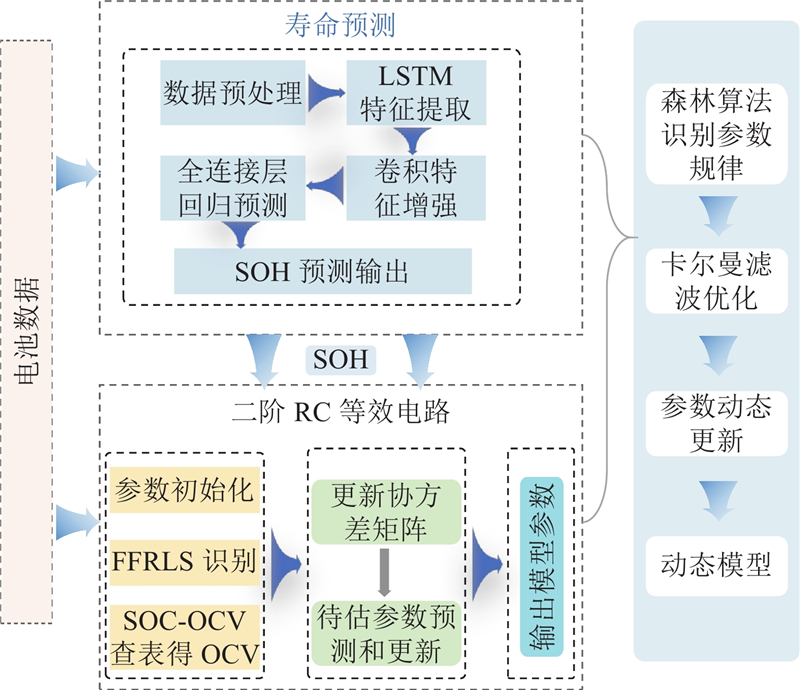
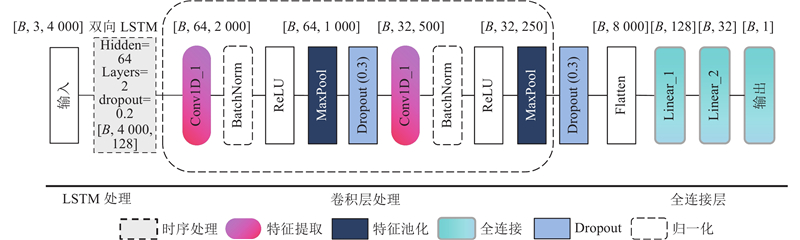
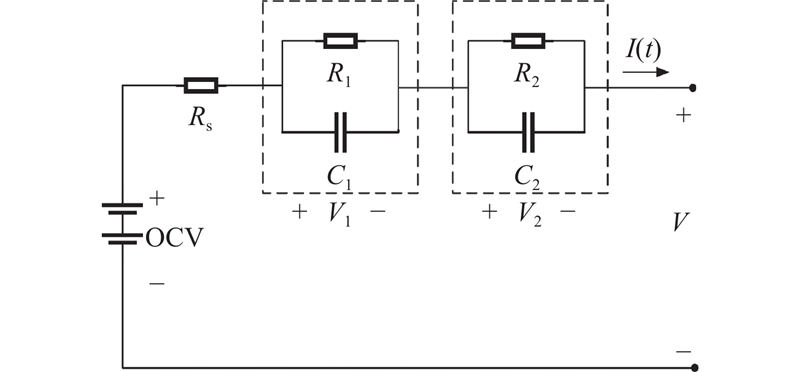
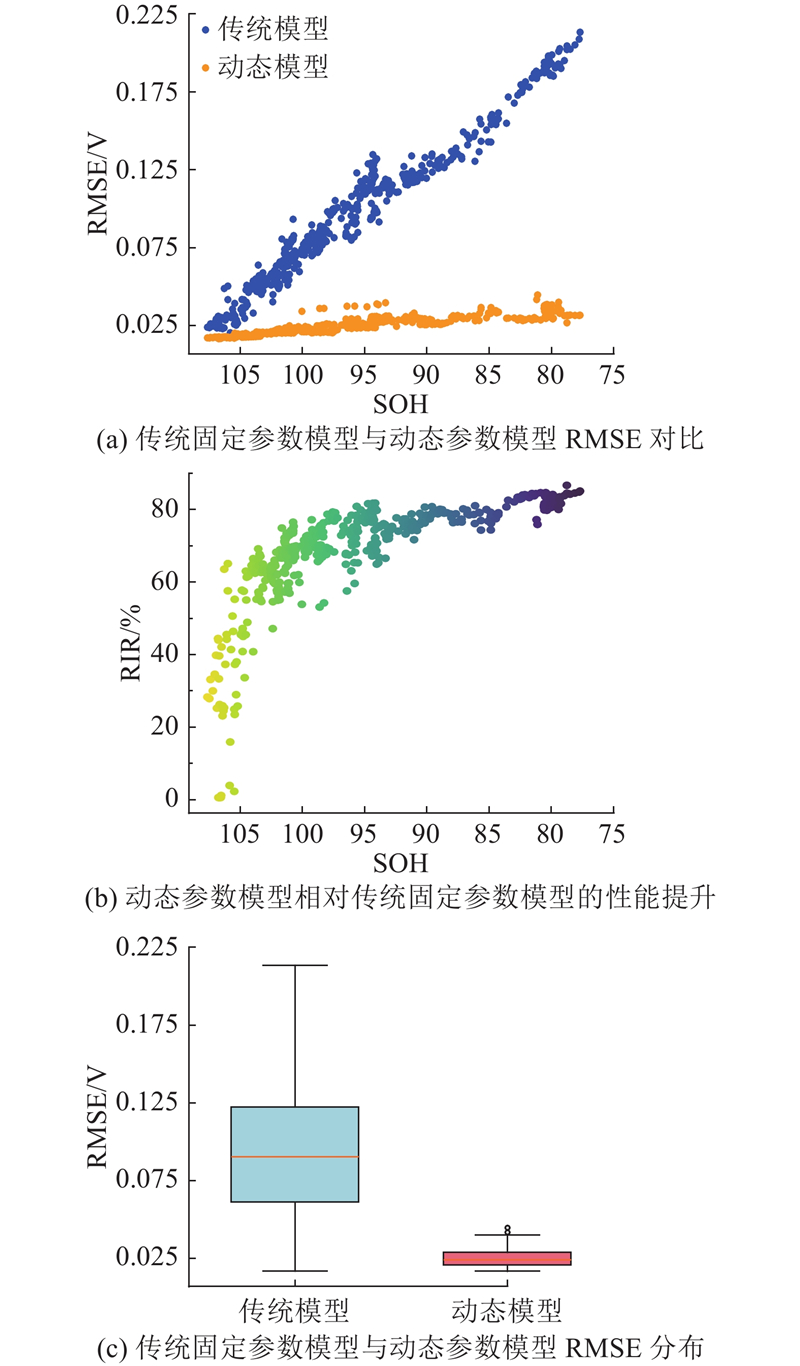
Abstract To address the problem that traditional fixed-parameter models cannot adapt to battery aging processes, data-driven approaches were deeply integrated with physical model mechanisms, and a state-of-health (SOH)-based dynamic modeling method for lithium-ion batteries was proposed. Convolutional long short-term memory networks were employed to extract multi-scale features from battery time-series data, achieving high-precision SOH prediction. A second-order RC equivalent circuit model was constructed, and a forgetting factor recursive least squares method was adopted for online parameter identification. Random forest regression and Kalman filtering were introduced to realize dynamic updating of model parameters according to aging states. Experimental results show that the proposed method achieves higher prediction accuracy and a more stable error distribution than the traditional fixed-parameter model across all battery aging stages. In the late aging stage, the proposed method improves the prediction performance of the dynamic model by approximately 80%, with a median error of 0.025 V, demonstrating significant advantages over the traditional model.
|
|
Received: 10 June 2025
Published: 06 May 2026
|
|
|
| Fund: 国家自然科学基金资助项目(62373321);浙江省自然科学基金资助项目(LMS25F030027);浙江省汽车电子智能化重点实验室开放课题资助(J20240708). |
|
Corresponding Authors:
Jili TAO
E-mail: yk12090202@163.com;taojili@nbt.edu.cn
|
基于卷积长短期记忆网络的锂电池寿命预测及动态建模
针对传统固定参数模型难以适应电池老化过程的问题,将数据驱动与物理模型机理深度融合,提出基于健康状态(SOH)的锂离子电池动态建模方法. 采用卷积长短期记忆网络从电池时序数据中提取多尺度特征,实现SOH高精度预测;构建二阶RC等效电路模型,采用带遗忘因子的递推最小二乘法进行参数在线识别;引入随机森林回归与卡尔曼滤波,实现模型参数随老化状态的动态更新. 实验结果表明,所提方法在电池老化各阶段均具有比传统固定参数模型更高的预测精度和更稳定的误差分布. 在电池老化后期,所提方法使动态模型的性能显著提升约80%,中位误差为0.025 V,相比传统模型具有显著优势.
关键词:
寿命预测,
卷积长短期记忆网络,
动态模型,
递推最小二乘法,
卡尔曼滤波
|
|
| [1] |
DOU W, ZHENG M, ZHANG W, et al Review on the binders for sustainable high-energy-density lithium ion batteries: status, solutions, and prospects[J]. Advanced Functional Materials, 2023, 33 (45): 2305161
doi: 10.1002/adfm.202305161
|
|
|
| [2] |
李秋燕, 王利利, 张艺涵, 等 能源互联网多能流的耦合模型及动态优化方法综述[J]. 电力系统保护与控制, 2020, 48 (19): 179- 186
LI Qiuyan, WANG Lili, ZHANG Yihan, et al A review of coupling models and dynamic optimization methods for energy Internet multi-energy flow[J]. Power System Protection and Control, 2020, 48 (19): 179- 186
|
|
|
| [3] |
LIU Y, ZHU Y, CUI Y Challenges and opportunities towards fast-charging battery materials[J]. Nature Energy, 2019, 4 (7): 540- 550
doi: 10.1038/s41560-019-0405-3
|
|
|
| [4] |
SU L, XU Y, DONG Z State-of-health estimation of lithium-ion batteries: a comprehensive literature review from cell to pack levels[J]. Energy Conversion and Economics, 2024, 5 (4): 224- 242
doi: 10.1049/enc2.12125
|
|
|
| [5] |
LI P, WU X, GROSU R, et al Applying neural network to health estimation and lifetime prediction of lithium-ion batteries[J]. IEEE Transactions on Transportation Electrification, 2025, 11 (1): 4224- 4248
doi: 10.1109/TTE.2024.3457621
|
|
|
| [6] |
ZHANG M, YANG D, DU J, et al A review of SOH prediction of Li-ion batteries based on data-driven algorithms[J]. Energies, 2023, 16 (7): 3167
doi: 10.3390/en16073167
|
|
|
| [7] |
YAO Q, SONG X, XIE W State of health estimation of lithium-ion battery based on CNN–WNN–WLSTM[J]. Complex and Intelligent Systems, 2024, 10 (2): 2919- 2936
doi: 10.1007/s40747-023-01300-3
|
|
|
| [8] |
LI P, ZHANG Z, GROSU R, et al An end-to-end neural network framework for state-of-health estimation and remaining useful life prediction of electric vehicle lithium batteries[J]. Renewable and Sustainable Energy Reviews, 2022, 156: 111843
doi: 10.1016/j.rser.2021.111843
|
|
|
| [9] |
WU X, LI P, DENG Z, et al LDNet-RUL: lightweight deformable neural network for remaining useful life prognostics of lithium-ion batteries[J]. IEEE Transactions on Power Electronics, 2025, 40 (9): 13514- 13528
doi: 10.1109/TPEL.2025.3562188
|
|
|
| [10] |
WANG S, TAKYI-ANINAKWA P, FAN Y C, et al A novel feedback correction-adaptive Kalman filtering method for the whole-life-cycle state of charge and closed-circuit voltage prediction of lithium-ion batteries based on the second-order electrical equivalent circuit model[J]. International Journal of Electrical Power and Energy Systems, 2022, 139: 108020
doi: 10.1109/ACCESS.2021.3111927
|
|
|
| [11] |
TRAN M K, MATHEW M, JANHUNEN S, et al. A comprehensive equivalent circuit model for lithium-ion batteries, incorporating the effects of state of health, state of charge, and temperature on model parameters [J]. Journal of Energy Storage, 2021, 43: 103252
|
|
|
| [12] |
WANG F, ZHAI Z, ZHAO Z, et al Physics-informed neural network for lithium-ion battery degradation stable modeling and prognosis[J]. Nature Communications, 2024, 15: 4332
doi: 10.1038/s41467-024-48779-z
|
|
|
| [13] |
WU Y, BAI D, ZHANG K, et al Advancements in the estimation of the state of charge of lithium-ion battery: a comprehensive review of traditional and deep learning approaches[J]. Journal of Materials Informatics, 2025, 5: 18
doi: 10.20517/jmi.2024.84
|
|
|
| [14] |
WANG Q, GAO T, LI X SOC estimation of lithium-ion battery based on equivalent circuit model with variable parameters[J]. Energies, 2022, 15 (16): 5829
doi: 10.3390/en15165829
|
|
|
| [15] |
XU Y W, WU X L, CHEN M Y, et al Li-ion batteries state-of-charge observation method based on model with variable parameters[J]. Control Theory and Applications, 2019, 36 (3): 443- 452
doi: 10.1109/cac.2017.8243196
|
|
|
| [16] |
ZHANG Y, XIONG R, HE H, et al Long short-term memory recurrent neural network for remaining useful life prediction of lithium-ion batteries[J]. IEEE Transactions on Vehicular Technology, 2018, 67 (7): 5695- 5705
doi: 10.1109/TVT.2018.2805189
|
|
|
| [17] |
ZHAO Z, KOU F R, YANG T X, et al Fractional-order-model-based state-of-charge fusion estimation for multi-chemistry lithium-ion batteries[J]. Journal of Power Sources, 2026, 666: 239186
doi: 10.1016/j.jpowsour.2025.239186
|
|
|
| [18] |
CHEN Y, MENG J, MING S, et al Improved deep extreme learning machine for state of health estimation of lithium-ion battery[J]. International Journal of Energy Research, 2024, 2024 (1): 8892634
doi: 10.1155/2024/8892634
|
|
|
| [19] |
YANG S, ZHOU S, HUA Y, et al A parameter adaptive method for state of charge estimation of lithium-ion batteries with an improved extended Kalman filter[J]. Scientific Reports, 2021, 11: 5805
doi: 10.1038/s41598-021-84729-1
|
|
|
| [20] |
FANG F, MA C, JI Y A method for state of charge and state of health estimation of lithium batteries based on an adaptive weighting unscented Kalman filter[J]. Energies, 2024, 17 (9): 2145
doi: 10.3390/en17092145
|
|
|
| [21] |
LI X, SONG Y, REN H State of charge estimation of lithium-ion batteries based on fractional-order model with mul-ti-innovations dual cubature Kalman filter method[J]. Journal of the Electrochemical Society, 2024, 171 (9): 090510
doi: 10.1149/1945-7111/ad75bb
|
|
|
| [22] |
KNOX J, BLYTH M, HALES A Advancing state estimation for lithium-ion batteries with hysteresis through systematic extended Kalman filter tuning[J]. Scientific Reports, 2024, 14: 12472
doi: 10.1038/s41598-024-61596-0
|
|
|
| [23] |
FAHMY H M, HASANIEN H M, ALSALEH I, et al State of health estimation of lithium-ion battery using dual adaptive unscented Kalman filter and Coulomb counting approach[J]. Journal of Energy Storage, 2024, 88: 111557
doi: 10.1016/j.est.2024.111557
|
|
|
| [24] |
戴彦文, 于艾清 基于健康特征参数的CNN-LSTM&GRU组合锂电池SOH估计[J]. 储能科学与技术, 2022, 11 (5): 1641- 1649
DAI Yanwen, YU Aiqing Combined CNN-LSTM and GRU based health feature parameters for lithium-ion batteries SOH estimation[J]. Energy Storage Science and Technology, 2022, 11 (5): 1641- 1649
|
|
|
| [25] |
刘伟霞, 田勋, 肖家勇, 等 基于混合模型及LSTM的锂电池SOH与剩余寿命预测[J]. 储能科学与技术, 2021, 10 (2): 689- 694
LIU Weixia, TIAN Xun, XIAO Jiayong, et al Estimation of SOH and remaining life of lithium batteries based on a combination model and long short-term memory[J]. Energy Storage Science and Technology, 2021, 10 (2): 689- 694
doi: 10.19799/j.cnki.2095-4239.2020.0382
|
|
|
| [26] |
HO K C, KHANH D N, HSUEH Y F, et al Deep learning approach for equivalent circuit model parameter identification of lithium-ion batteries[J]. Electronics, 2025, 14 (11): 2201
doi: 10.3390/electronics14112201
|
|
|
| [27] |
LI P, AO Z, HOU J, et al Physics-informed mamba neural network with potential knowledge for state-of-charge estimation of lithium-ion batteries[J]. Journal of Energy Storage, 2025, 123: 116546
doi: 10.1016/j.est.2025.116546
|
|
|
| [28] |
刘萍, 李泽文, 蔡雨思, 等 基于等效电路模型和数据驱动模型融合的SOC和SOH联合估计方法[J]. 电工技术学报, 2024, 39 (10): 3232- 3243
LIU Ping, LI Zewen, CAI Yusi, et al Joint estimation method of SOC and SOH based on fusion of equivalent circuit model and data-driven model[J]. Transactions of China Electrotechnical Society, 2024, 39 (10): 3232- 3243
|
|
|
| [29] |
LIU D, LI L, SONG Y, et al Hybrid state of charge estimation for lithium-ion battery under dynamic operating conditions[J]. International Journal of Electrical Power and Energy Systems, 2019, 110: 48- 61
doi: 10.1016/j.ijepes.2019.02.046
|
|
|
| [30] |
TANG X, ZOU C, YAO K, et al Aging trajectory prediction for lithium-ion batteries via model migration and Bayesian Monte Carlo method[J]. Applied Energy, 2019, 254: 113591
doi: 10.1016/j.apenergy.2019.113591
|
|
|
| [31] |
FENG J, WU L, HUANG K, et al Online SOC estimation of a lithium-ion battery based on FFRLS and AEKF[J]. Energy Storage Science and Technology, 2021, 10: 242
|
|
|
| [32] |
范兴明, 封浩, 张鑫 最小二乘算法优化及其在锂离子电池参数辨识中的应用[J]. 电工技术学报, 2024, 39 (5): 1577- 1588
FAN Xingming, FENG Hao, ZHANG Xin Optimization of least squares method and its application in parameter identification of lithium-ion battery model[J]. Transactions of China Electrotechnical Society, 2024, 39 (5): 1577- 1588
doi: 10.19595/j.cnki.1000-6753.tces.222214
|
|
|
| [33] |
LAO Z, XIA B, WANG W, et al A novel method for lithium-ion battery online parameter identification based on variable forgetting factor recursive least squares[J]. Energies, 2018, 11 (6): 1358
doi: 10.3390/en11061358
|
|
|
| [34] |
WANG H, ZHENG Y, YU Y Lithium-ion battery SOC estimation based on adaptive forgetting factor least squares online identification and unscented Kalman filter[J]. Mathematics, 2021, 9 (15): 1733
doi: 10.3390/math9151733
|
|
|
| [35] |
SUN X, JI J, REN B, et al Adaptive forgetting factor recursive least square algorithm for online identification of equivalent circuit model parameters of a lithium-ion battery[J]. Energies, 2019, 12 (12): 2242
doi: 10.3390/en12122242
|
|
|
| [36] |
TAN X, ZHAN D, LYU P, et al Online state-of-health estimation of lithium-ion battery based on dynamic parameter identification at multi timescale and support vector regression[J]. Journal of Power Sources, 2021, 484: 229233
doi: 10.1016/j.jpowsour.2020.229233
|
|
|
|
Viewed |
|
|
|
Full text
|
|
|
|
|
Abstract
|
|
|
|
|
Cited |
|
|
|
|
| |
Shared |
|
|
|
|
| |
Discussed |
|
|
|
|