Please wait a minute...
浙江大学学报(工学版)  2026, Vol. 60 Issue (10): 2227-2235    DOI: 10.3785/j.issn.1008-973X.2026.10.015
计算机技术与控制工程     
基于信息瓶颈的社交推荐优化模型
蔡晓东(),方晟,李婷
桂林电子科技大学 信息与通信学院,广西 桂林 541004
Information bottleneck-based social recommendation optimization model
Xiaodong CAI(),Sheng FANG,Ting LI
School of Information and Communication, Guilin University of Electronic Technology, Guilin 541004, China
 全文: PDF(1283 KB)   HTML
摘要:

现有的社交去噪策略往往依赖于用户-项目交互数据进行偏好引导去噪,基本忽略了交互数据本身可能存在噪声的问题,且现有的负采样策略在硬度控制方面存在局限性,这将降低模型的推荐性能. 针对上述问题,提出基于信息瓶颈的社交推荐优化模型IB-SRO. 构建信息瓶颈引导的双视图协同去噪模块,该模块通过多阶段学习策略异步优化社交网络噪声与用户-项目交互噪声,并结合信息瓶颈协同优化方法对2种噪声进行阶段性优化,以增强不同视图之间的独立性,从而提高去噪效果. 设计新的差异感知负采样策略,通过混合相似度和差异感知函数来改进负采样策略,使其能够根据正样本的预测情况自适应选择合适硬度的负样本,以增强用户偏好的学习从而提高模型性能. 实验结果表明,在Top-N推荐任务中,IB-SRO相较于当前最先进的基线模型,在Epinions、Yelp和Douban-Book这3个数据集上分别实现了6.87%、6.72%和2.73%的平均提升,验证了模型的有效性.

关键词: 社交推荐噪声信息瓶颈双视图协同去噪差异感知负采样    
Abstract:

Existing social denoising strategies often rely on user-item interaction data for preference-guided denoising, basically ignoring the problem that the interaction data itself may be noisy, and there are limitations in the hardness control of existing negative sampling strategies, which will reduce the model’s recommendation performance. To address these issues, an information bottleneck-based social recommendation optimization model, IB-SRO, was proposed. First, an information bottleneck-guided dual-view collaborative denoising module was introduced, in which social network noise and user-item interaction noise were asynchronously optimized through a multi-stage learning strategy. A collaborative optimization method guided by the information bottleneck was applied to sequentially optimize the two types of noise, increasing the independence between different views and enhancing the denoising effect. Moreover, a novel difference-aware negative sampling strategy was designed. By combining similarity and difference-aware functions, the strategy was enabled to adaptively select appropriately hard negative samples based on the predicted scores of positive samples, enhancing the learning of user preferences and thereby improving the model’s performance. Experimental results showed that compared with the state-of-the-art models, IB-SRO achieved average improvements of 6.87%, 6.72%, and 2.73% on the Epinions, Yelp, and Douban-Book datasets respectively in Top-N recommendation tasks, which verified the effectiveness of the model.

Key words: social recommendation    noise    information bottleneck    dual-view collaborative denoising    difference-aware negative sampling
收稿日期: 2025-04-23 出版日期: 2026-07-28
CLC:  TP 391  
基金资助: 广西创新驱动发展专项(AA20302001).
作者简介: 蔡晓东(1971—),男,研究员,博导,从事大数据挖掘研究. orcid.org/0000-0001-8505-1007. E-mail:caixiaodong@guet.edu.cn
服务  
把本文推荐给朋友
加入引用管理器
E-mail Alert
作者相关文章  
蔡晓东
方晟
李婷

引用本文:

蔡晓东,方晟,李婷. 基于信息瓶颈的社交推荐优化模型[J]. 浙江大学学报(工学版), 2026, 60(10): 2227-2235.

Xiaodong CAI,Sheng FANG,Ting LI. Information bottleneck-based social recommendation optimization model. Journal of ZheJiang University (Engineering Science), 2026, 60(10): 2227-2235.

链接本文:

https://www.zjujournals.com/eng/CN/10.3785/j.issn.1008-973X.2026.10.015        https://www.zjujournals.com/eng/CN/Y2026/V60/I10/2227

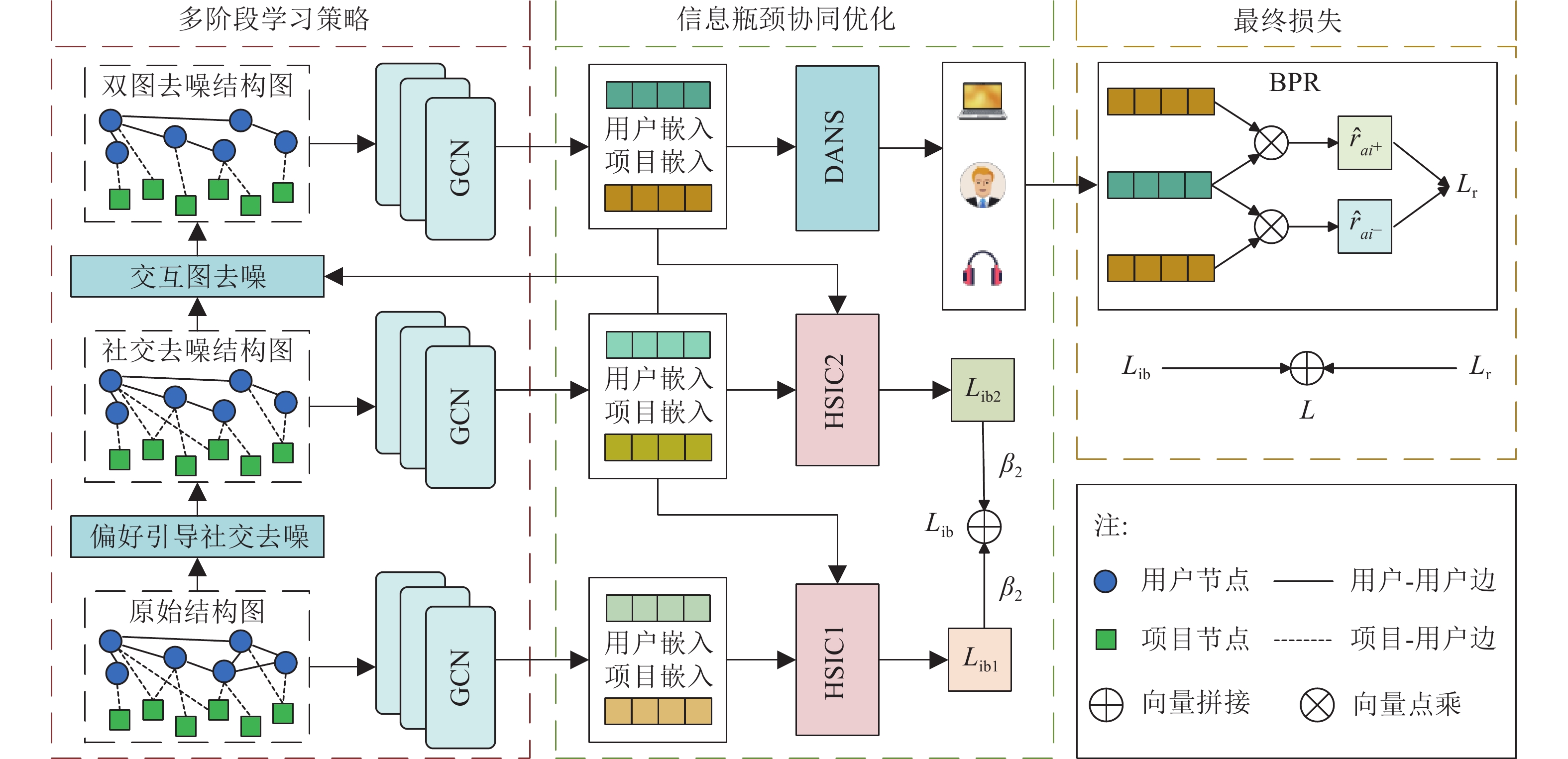
图 1  IB-SRO模型整体框架图
模型EpinionsYelpDouban-Book
ttrain/sttest/sttrain/sttest/sttrain/sttest/s
GDMSR26.975.6838.149.6126.975.68
GBSR15.523.2223.175.9215.523.22
IB-SRO23.743.4335.616.1023.743.43
表 1  不同模型上每一轮运行时间
数据集用户数量项目数量交互数量社交关系
数量
社交关系
稠密度/%
Epinions180882616497643523558130.1087
Yelp19593212664508848641570.2060
Douban-Book8358821203278151872730.1150
表 2  数据集的统计信息
ModelsEpinionsYelpDouban-Book
R@10N@10R@20N@20R@10N@10R@20N@20R@10N@10R@20N@20
GraphRec0.04360.03150.06810.03870.06720.04850.10770.06070.09710.11450.14530.1237
DiffNet++0.04680.03290.07270.04060.07070.05160.11140.06400.10100.11840.14890.1270
SocialLGN0.04160.03070.06340.03710.06810.05070.10590.06200.10340.11820.15270.1274
ESRF0.04620.03290.07270.04060.07180.05260.11230.06450.10420.11990.15340.1301
GDMSR0.04610.03260.07210.04140.07390.05350.11480.06580.10260.10010.15380.1245
$\underline{{\rm{GBSR}}}$0.05290.03850.07930.04640.08050.05920.12430.07240.11890.14510.16940.1523
IB-SRO0.05710.04120.08430.04930.08620.06350.13180.07710.12160.14810.17630.1561
Impro/%7.947.016.316.257.087.266.036.492.272.074.072.50
表 3  各模型实验结果对比
模型EpinionsYelpDouban-Book
R@20N@20R@20N@20R@20N@20
IBSRO-S0.08280.04720.11890.06900.16100.1386
IBSRO-I0.08330.04810.13130.07670.17490.1553
IBSRO-B0.08090.04680.12250.07180.16870.1469
IBSRO-N0.08140.04730.12530.07360.17210.1535
IB-SRO0.08430.04930.13180.07710.17510.1556
表 4  各关键组件的有效性分析
MethodsEpinionsYelpDouban-Book
R@20N@20R@20N@20R@20N@20
MixGCF0.08320.04830.12990.07630.17360.1541
DNS0.08200.04780.12820.07570.17280.1537
AHNS0.08280.04790.13000.07650.17450.1550
DANS0.08430.04930.13180.07710.17510.1556
表 5  DANS先进性分析
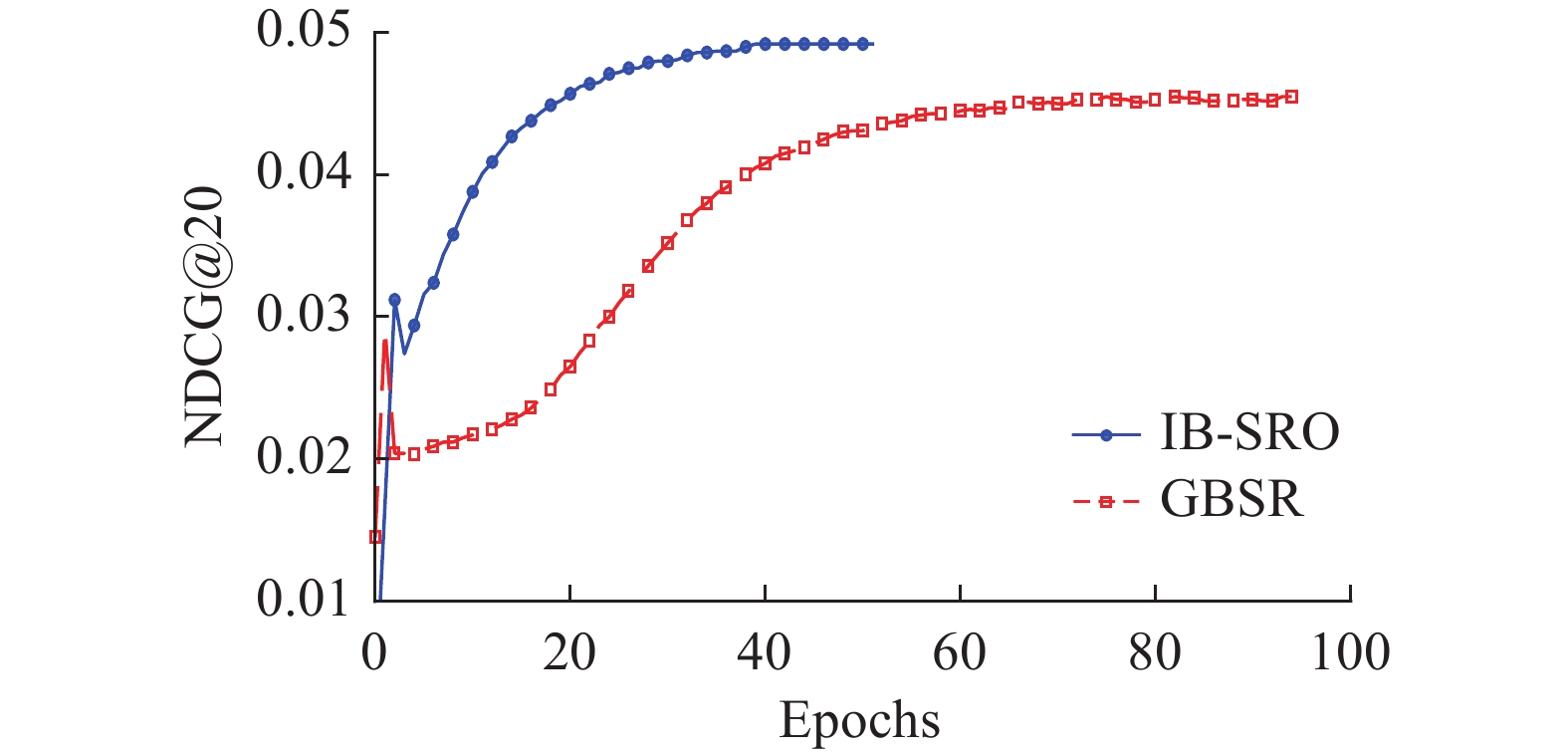
图 2  IB-SRO和GBSR在Epinions上的收敛曲线
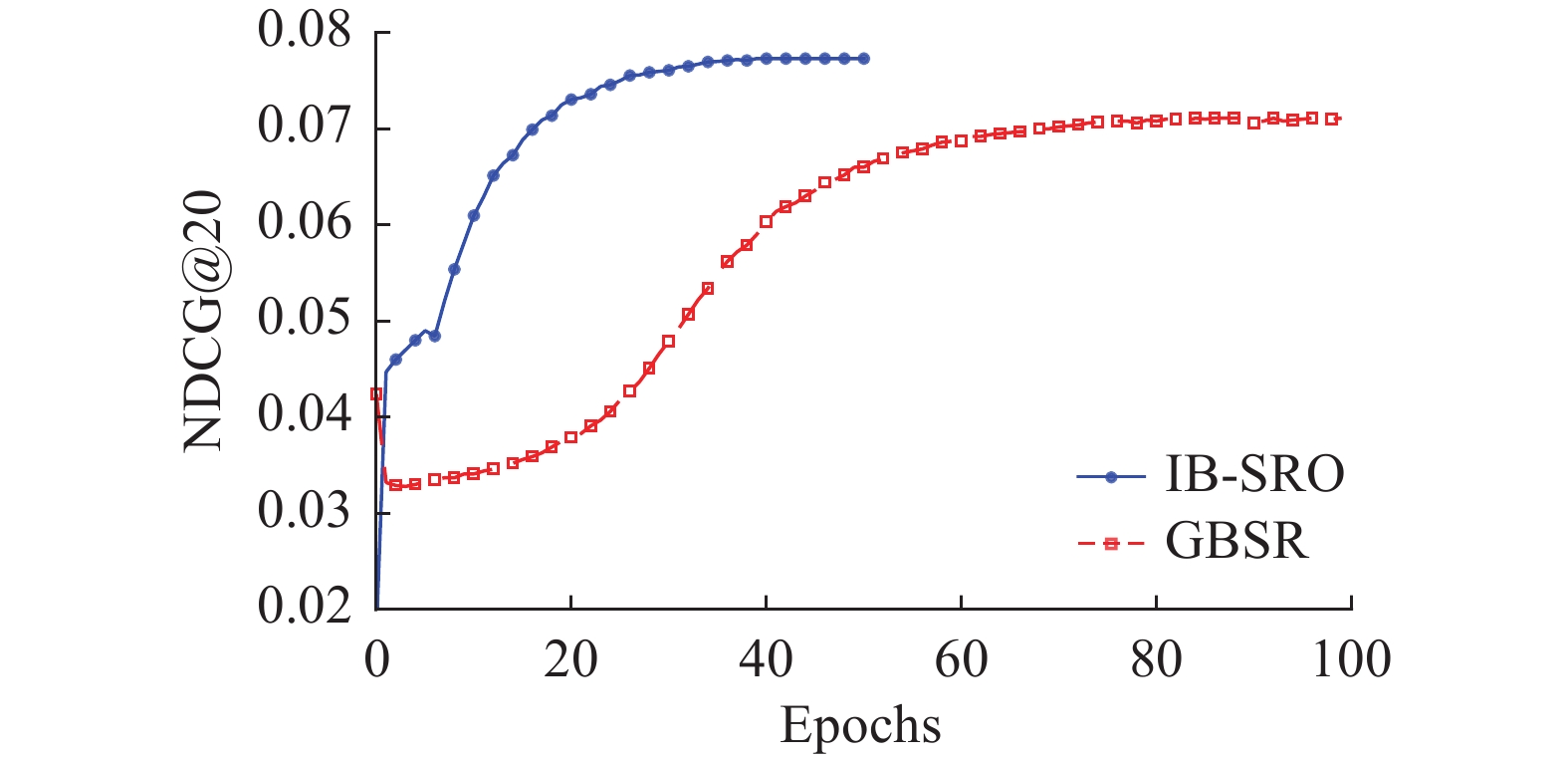
图 3  IB-SRO和GBSR在Yelp上的收敛曲线
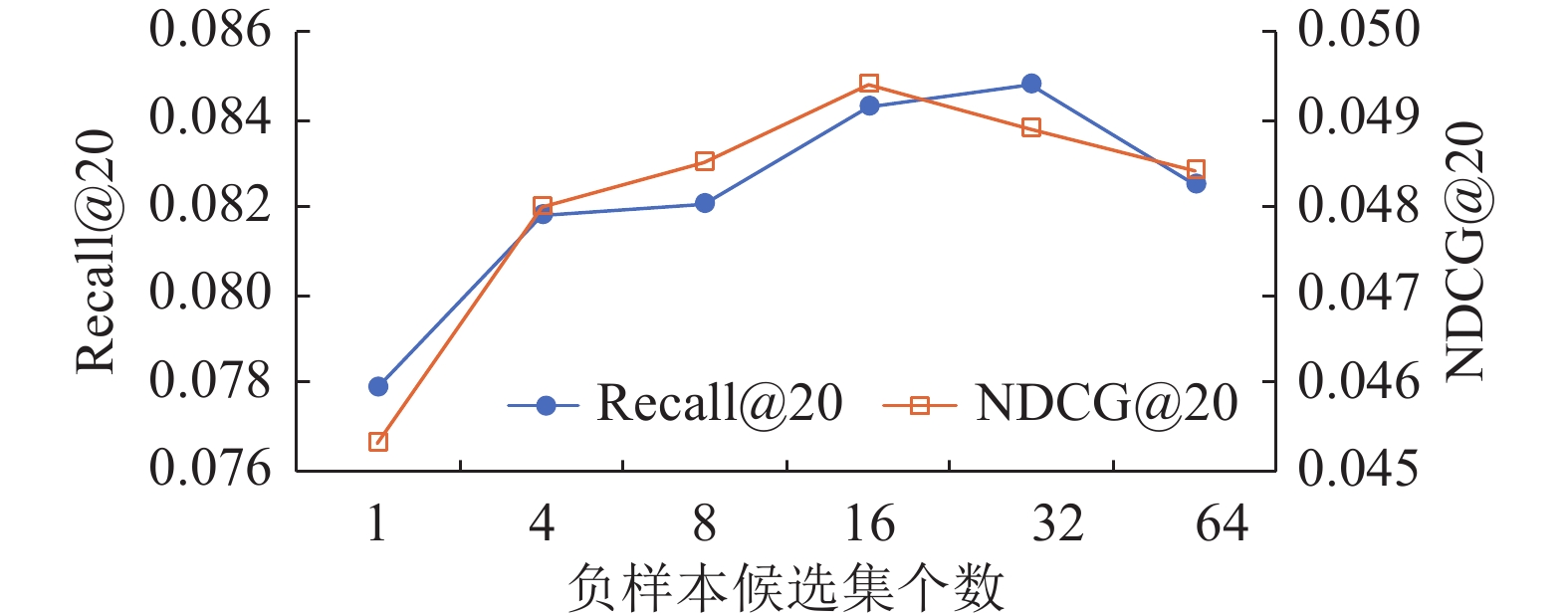
图 4  负样本候选集个数对模型性能影响
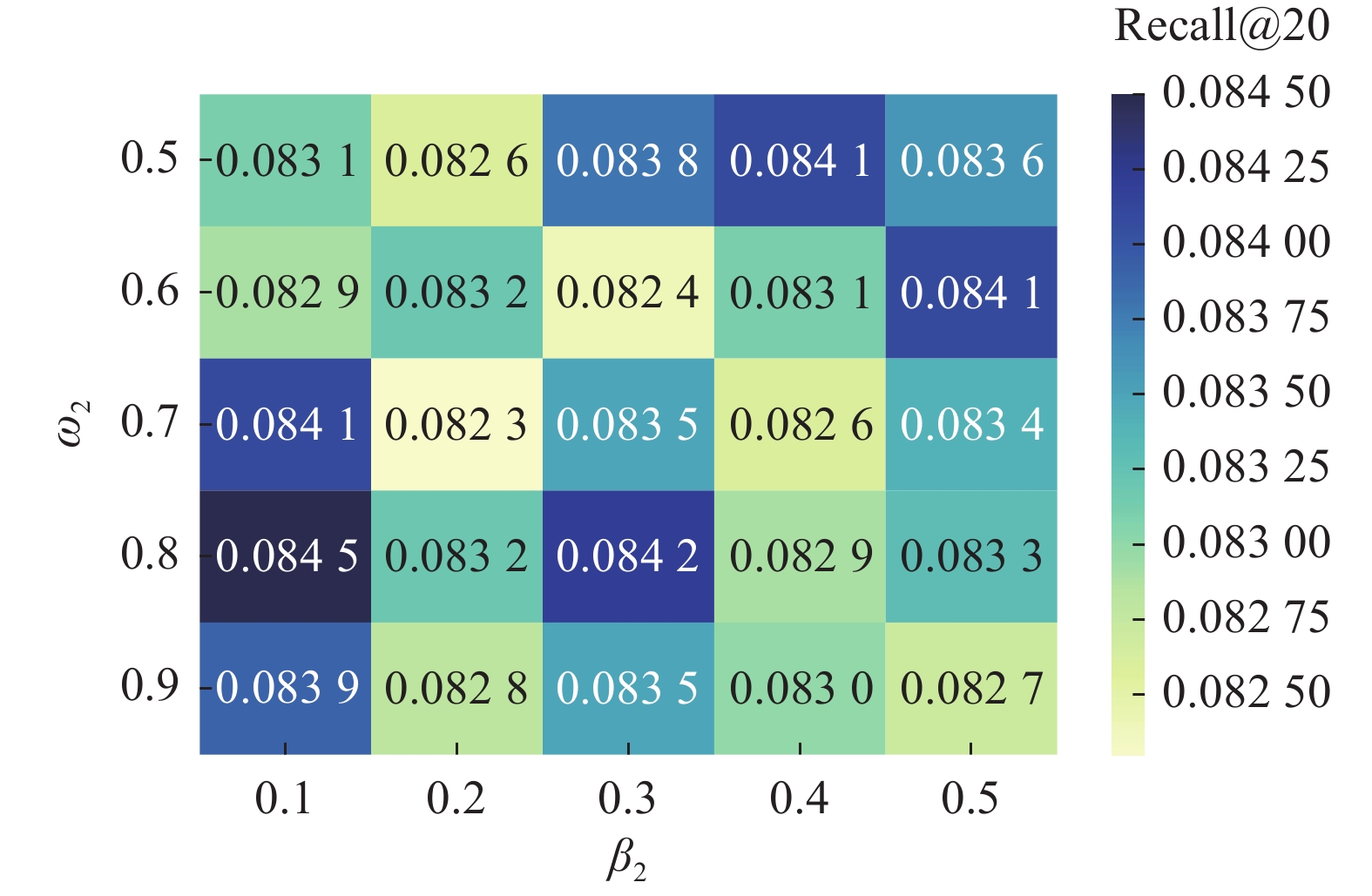
图 5  信息瓶颈参数对模型性能影响
1 JANNACH D, ZANKER M, FELFERNIG A, et al. Recommender systems: an introduction [M]. Cambridge: Cambridge University Press, 2010.
2 BOND R M, FARISS C J, JONES J J, et al A 61-million-person experiment in social influence and political mobilization[J]. Nature, 2012, 489 (7415): 295- 298
doi: 10.1038/nature11421
3 JAMALI M, ESTER M. A matrix factorization technique with trust propagation for recommendation in social networks [C]// 4th ACM Conference on Recommender Systems. Barcelona: ACM, 2010: 135–142.
4 DERR T, MA Y, TANG J. Signed graph convolutional networks [C]// IEEE International Conference on Data Mining. Singapore: IEEE, 2018: 929–934.
5 SHARMA K, LEE Y C, NAMBI S, et al A survey of graph neural networks for social recommender systems[J]. ACM Computing Surveys, 2024, 56 (10): 1- 34
6 FAN W, MA Y, LI Q, et al. Graph neural networks for social recommendation [C]// World Wide Web Conference. San Francisco: ACM, 2019: 417–426.
7 WU L, LI J, SUN P, et al DiffNet: a neural influence and interest diffusion network for social recommendation[J]. IEEE Transactions on Knowledge and Data Engineering, 2022, 34 (10): 4753- 4766
doi: 10.1109/TKDE.2020.3048414
8 LIAO J, ZHOU W, LUO F, et al SocialLGN: light graph convolution network for social recommendation[J]. Information Sciences, 2022, 589: 595- 607
doi: 10.1016/j.ins.2022.01.001
9 CAI M, CHEN L, WANG Y, et al. Popularity-aware alignment and contrast for mitigating popularity bias [C]// 30th ACM SIGKDD Conference on Knowledge Discovery and Data Mining. Barcelona: ACM, 2024: 187–198.
10 LIN S, ZHOU S, CHEN J, et al ReCRec: reasoning the causes of implicit feedback for debiased recommendation[J]. ACM Transactions on Information Systems, 2024, 42 (6): 1- 26
doi: 10.1145/3672275
11 QUAN Y, DING J, GAO C, et al. Robust preference-guided denoising for graph based social recommendation [C]// ACM Web Conference 2023. Austin: ACM, 2023: 1097–1108.
12 PAN Y, HE F, YU H A correlative denoising autoencoder to model social influence for top-N recommender system[J]. Frontiers of Computer Science, 2019, 14 (3): 143301
doi: 10.1007/s11704-019-8123-3
13 YU J, YIN H, LI J, et al Enhancing social recommendation with adversarial graph convolutional networks[J]. IEEE Transactions on Knowledge and Data Engineering, 2022, 34 (8): 3727- 3739
doi: 10.1109/TKDE.2020.3033673
14 HE X, FAN W, WANG R, et al Balancing user preferences by social networks: a condition-guided social recommendation model for mitigating popularity bias[J]. Neural Networks, 2025, 187: 107317
doi: 10.1016/j.neunet.2025.107317
15 YANG Y, WU L, WANG Z, et al. Graph bottlenecked social recommendation [C]// 30th ACM SIGKDD Conference on Knowledge Discovery and Data Mining. Barcelona: ACM, 2024: 3853–3862.
16 RENDLE S, FREUDENTHALER C, GANTNER Z, et al. BPR: Bayesian personalized ranking from implicit feedback [C]// Proceedings of the 25th Conference on Uncertainty in Artificial Intelligence. Menlo Park: AUAI Press, 2009: 452–461.
17 HUANG T, DONG Y, DING M, et al. MixGCF: an improved training method for graph neural network-based recommender systems [C]// Proceedings of the 27th ACM SIGKDD Conference on Knowledge Discovery and Data Mining. Singapore: ACM, 2021: 665–674.
18 SHI W, CHEN J, FENG F, et al. On the theories behind hard negative sampling for recommendation [C]// ACM Web Conference 2023. Austin: ACM, 2023: 812–822.
19 LAI R, CHEN L, ZHAO Y, et al. Disentangled negative sampling for collaborative filtering [C]// 16th ACM International Conference on Web Search and Data Mining. Singapore: ACM, 2023: 96–104.
20 LI Z, XIA L, HUANG C. RecDiff: diffusion model for social recommendation [C]// 33rd ACM International Conference on Information and Knowledge Management. Boise: ACM, 2024: 1346–1355.
21 HE X, DENG K, WANG X, et al. LightGCN: simplifying and powering graph convolution network for recommendation [C]// 43rd International ACM SIGIR Conference on Research and Development in Information Retrieval. [S.l.]: ACM, 2020: 639–648.
22 MA W K, LEWIS J P, KLEIJN W B The HSIC bottleneck: deep learning without back-propagation[J]. Proceedings of the AAAI Conference on Artificial Intelligence, 2020, 34 (4): 5085- 5092
doi: 10.1609/aaai.v34i04.5950
[1] 蔡蕊,郭钦涵,张子豪,董建锋,张荣,刘宝龙,王勋. 大模型辅助的噪声鲁棒无监督骨架表示学习[J]. 浙江大学学报(工学版), 2026, 60(9): 1972-1979.
[2] 刘帅凝,展旭,刘晨,王贵新. 基于迁移学习的离心压气机气动噪声空间辐射特性预测[J]. 浙江大学学报(工学版), 2026, 60(4): 712-722.
[3] 项新建,袁天顺,何亚强,汪成立. 基于时序分解和软阈值时间卷积的交通流预测[J]. 浙江大学学报(工学版), 2025, 59(7): 1353-1361.
[4] 刘登峰,陈世海,郭文静,柴志雷. 基于轻量残差网络的高效半色调算法[J]. 浙江大学学报(工学版), 2025, 59(1): 62-69.
[5] 潘琦,江丙云,陈云. 电动汽车充电桩的气动噪声分析和优化[J]. 浙江大学学报(工学版), 2024, 58(4): 799-807.
[6] 傅海鹏,程志强. 噪声系数最小1.6 dB有高带外抑制的5~6 GHz射频接收前端芯片[J]. 浙江大学学报(工学版), 2024, 58(10): 2192-2198.
[7] 汤雪扬,蔡小培,王伟华,常文浩,王启好. 基于粒子概率神经网络算法的钢轨波磨识别[J]. 浙江大学学报(工学版), 2023, 57(9): 1766-1774.
[8] 陈小波,陈玲,梁书荣,胡煜. 重尾非高斯定位噪声下鲁棒协同目标跟踪[J]. 浙江大学学报(工学版), 2022, 56(5): 967-976.
[9] 李倩,梁宁,童威棋,徐海平,曹琳琳,吴大转. 基于循环平稳分析的推进泵流致噪声特性研究[J]. 浙江大学学报(工学版), 2021, 55(9): 1660-1667.
[10] 张凌,邢允,叶豪杰,吴大转. 水下排气降噪装置设计及其降噪特性[J]. 浙江大学学报(工学版), 2021, 55(7): 1381-1390.
[11] 牛亚文,赵才友,易强,师多佳,郑钧元,陈嵘. 可实现宽频隔声的全向通风铁路声屏障[J]. 浙江大学学报(工学版), 2021, 55(6): 1048-1055.
[12] 詹志文,张凌新,邓见,邵雪明. DTMB 4119螺旋桨噪声特性的数值模拟[J]. 浙江大学学报(工学版), 2021, 55(4): 767-774.
[13] 张玙,刘益才. 小型制冷系统两相流致噪声研究进展[J]. 浙江大学学报(工学版), 2021, 55(4): 775-792.
[14] 王友卫,凤丽洲. 基于合群度-隶属度噪声检测及动态特征选择的改进AdaBoost算法[J]. 浙江大学学报(工学版), 2021, 55(2): 367-376.
[15] 周天翔,郑晓燕,叶世泽,陈恒林. 基于逆变器端口模型的电磁干扰滤波器设计[J]. 浙江大学学报(工学版), 2021, 55(11): 2215-2224.