|
|
|
| Seismic resilience assessment of power supply system based on multi-level adaptive cooperative algorithm |
Xiaohang LIU1( ),Qing QIN1,*(),Kaige WANG2,Jun HUANG2,Changyou WANG2 |
1. School of Civil and Architectural Engineering, Xi’an University of Science and Technology, Xi’an 710055, China
2. School of Civil Engineering, Xi’an University of Architecture and Technology, Xi’an 710055, China |
|
|
|
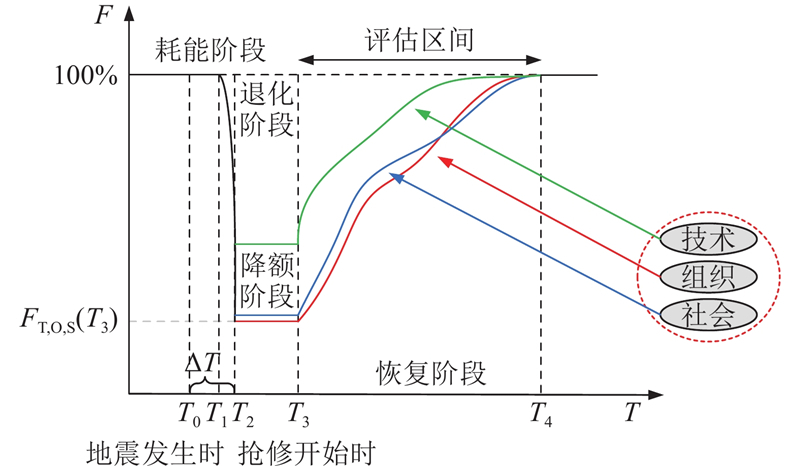
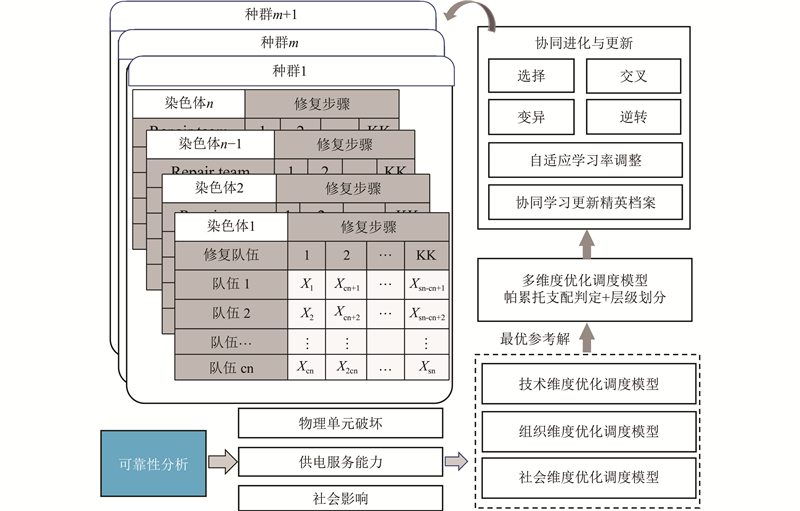
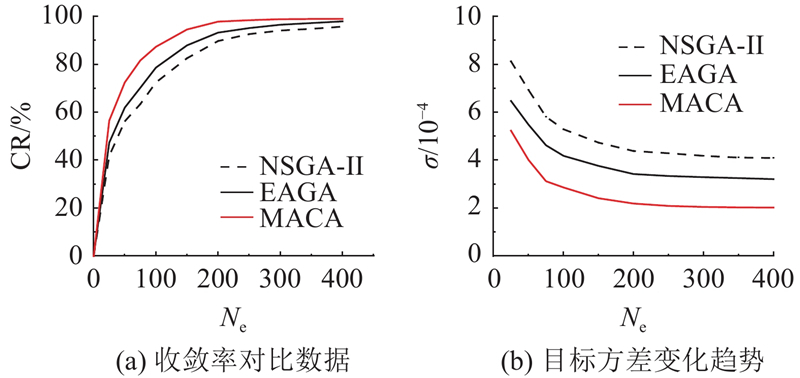
Abstract A multi-objective optimization–based multi-dimensional assessment and decision-making method for seismic resilience was proposed in order to quantitatively assess and enhance the seismic resilience and recovery efficiency of urban power supply system. Performance functions and resilience indicators were constructed from three dimensions—technical, organizational, and social—to quantitatively characterize the post-earthquake functional degradation and recovery process of the system. A multi-level adaptive cooperative algorithm (MACA) was introduced. Graph-theory-based partition heuristic encoding, hierarchical Pareto clustering, and dynamic learning rates were employed to improve convergence stability and global search capability while preserving solution diversity. Information synergy and experience transfer among repair groups were realized through node partitioning and dynamic allocation of repair crews, ultimately yielding a comprehensive optimal restoration plan. Case study results demonstrate that the three-dimensional framework can effectively quantify post-earthquake performance and reveal the differential recovery across dimensions. The MACA-optimized scheme improved organizational and social resilience by 5.2% and 3.7%, respectively compared with random restoration. The algorithm achieved a convergence rate of 98.9%, and the variance of the solution set was reduced by 46.7% compared with NSGA-Ⅱ.
|
|
Received: 23 October 2025
Published: 21 October 2026
|
|
|
| Fund: 陕西省科技厅资助项目(2025JC-YBQN 529);陕西省教育厅专项科研计划资助项目(25JK0550). |
|
Corresponding Authors:
Qing QIN
E-mail: liuxiaohang@xust.edu.cn;qinqing@xust.edu.cn
|
基于多层次自适应协同算法的供电系统抗震韧性评估
为了量化评估并提升城市供电系统的抗震韧性与恢复效率,提出多目标优化的抗震韧性多维度评估与决策方法. 从技术、组织、社会3个维度构建性能函数与韧性指标,量化表征系统震后功能退化与恢复进程. 提出多层次自适应协同算法(MACA),采用图论分区启发式编码、层次化帕累托聚类与动态学习率,在保持解集多样性的同时提升收敛稳定性与全局寻优能力. 算法通过节点分区与修复队伍动态分配,实现修复群体间信息协同与经验迁移,获得综合最优修复方案. 算例结果表明,三维度框架能够有效量化震后性能并揭示各维度恢复差异;MACA优化方案相较随机修复,组织维度与社会维度的恢复力分别提升了5.2%和3.7%. 算法收敛率达到98.9%,解集方差较NSGA-Ⅱ降低了46.7%.
关键词:
多目标优化,
自适应协同优化算法,
供电系统,
抗震韧性,
三维度评估
|
|
| [1] |
翟长海, 胡杰, 谢礼立 城市生命线工程系统抗震韧性统一设计方法[J]. 地震工程与工程振动, 2025, 45 (2): 1- 13
Zhai Changhai, Hu Jie, Xie Lili Unified seismic resilience design approach for urban lifeline engineering systems[J]. Earthquake Engineering and Engineering Dynamics, 2025, 45 (2): 1- 13
doi: 10.13197/j.eeed.2025.0201
|
|
|
| [2] |
Aydin N Y, Celik K, Gecen R, et al Rebuilding Antakya: cultivating urban resilience through cultural identity and education for post-disaster reconstruction in Turkey[J]. International Journal of Disaster Risk Reduction, 2025, 117: 105196
doi: 10.1016/j.ijdrr.2025.105196
|
|
|
| [3] |
谢强, 文嘉意, 庞准 大型变压器-套管体系基底隔震及其经济效用分析[J]. 高电压技术, 2020, 46 (3): 890- 897
Xie Qiang, Wen Jiayi, Pang Zhun Base isolation and its cost-effective analysis on large transformer-bushing system[J]. High Voltage Engineering, 2020, 46 (3): 890- 897
doi: 10.13336/j.1003-6520.hve.20190513007
|
|
|
| [4] |
赵旭东, 陈志龙, 许继恒, 等 地震灾害下城市双层关联生命线网络易损性[J]. 浙江大学学报(工学版), 2020, 54 (4): 767- 777
Zhao Xudong, Chen Zhilong, Xu Jiheng, et al Seismic vulnerability of urban double-layer interdependent lifeline network[J]. Journal of Zhejiang University (Engineering Science), 2020, 54 (4): 767- 777
doi: 10.3785/j.issn.1008-973X.2020.04.016
|
|
|
| [5] |
Bruneau M, Chang S E, Eguchi R T, et al A framework to quantitatively assess and enhance the seismic resilience of communities[J]. Earthquake Spectra, 2003, 19 (4): 733- 752
doi: 10.1193/1.1623497
|
|
|
| [6] |
Sun L, Stojadinovic B, Sansavini G Resilience evaluation framework for integrated civil infrastructure–community systems under seismic hazard[J]. Journal of Infrastructure Systems, 2019, 25 (2): 04019016
doi: 10.1061/(ASCE)IS.1943-555X.0000492
|
|
|
| [7] |
De Iuliis M, Kammouh O, Cimellaro G P, et al Quantifying restoration time of power and telecommunication lifelines after earthquakes using Bayesian belief network model[J]. Reliability Engineering and System Safety, 2021, 208: 107320
doi: 10.1016/j.ress.2020.107320
|
|
|
| [8] |
张世锟. 考虑交通影响的电力系统震后韧性评估研究 [D]. 大连: 大连理工大学, 2024: 34-48.
Zhang Shikun. Research on post earthquake resilience assessment of power systems considering traffic influence [D]. Dalian: Dalian University of Technology, 2024: 34-48.
|
|
|
| [9] |
Amani-jouneghani F, Fotuhi-firuzabad M, Moeini-aghtaie M, et al Seismic resilience assessment of electric power distribution networks[J]. IEEE Transactions on Power Delivery, 2025, 40 (1): 387- 397
doi: 10.1109/TPWRD.2024.3502211
|
|
|
| [10] |
Taherkhani A H, Heravi G, AminshokravI A Developing a framework to enhance the seismic resilience of the electricity distribution system feeding the healthcare system[J]. International Journal of Disaster Risk Reduction, 2022, 71: 102801
doi: 10.1016/j.ijdrr.2022.102801
|
|
|
| [11] |
Shi W, Liang H, Bittner M Stochastic planning for power distribution system resilience enhancement against earthquakes considering mobile energy resources[J]. IEEE Transactions on Sustainable Energy, 2024, 15 (1): 414- 428
doi: 10.1109/TSTE.2023.3296063
|
|
|
| [12] |
Yang Z, Dehghanian P, Nazemi M Seismic-resilient electric power distribution systems: harnessing the mobility of power sources[J]. IEEE Transactions on Industry Applications, 2020, 56 (3): 2304- 2313
doi: 10.1109/TIA.2020.2972854
|
|
|
| [13] |
Wan H, Liu W, Zhang S, et al Pre-disaster allocation and post-disaster dispatch strategies of power emergency resources for resilience enhancement of distribution networks[J]. Electric Power Systems Research, 2025, 238: 111038
doi: 10.1016/j.epsr.2024.111038
|
|
|
| [14] |
张芳, 宋冬冬 城市电力系统设施抗震韧性研究进展[J]. 世界地震工程, 2025, 41 (2): 173- 188
Zhang Fang, Song Dongdong Research progress in seismic resilience of urban power system facilities[J]. World Earthquake Engineering, 2025, 41 (2): 173- 188
doi: 10.19994/j.cnki.WEE.2025.0035
|
|
|
| [15] |
缪惠全, 高思远, 刘如山, 等 生命线工程的可靠性研究进展分析(Ⅱ): 国内电力系统的抗震可靠性[J]. 北京工业大学学报, 2024, 50 (3): 362- 384
Miao Huiquan, Gao Siyuan, Liu Rushan, et al Research progress on reliability of lifeline engineering (Ⅱ): domestic research on seismic reliability of electricity system[J]. Journal of Beijing University of Technology, 2024, 50 (3): 362- 384
doi: 10.11936/bjutxb2023020025
|
|
|
| [16] |
Zhai C, Zhao Y, Wen W, et al A novel urban seismic resilience assessment method considering the weighting of post-earthquake loss and recovery time[J]. International Journal of Disaster Risk Reduction, 2023, 84: 103453
doi: 10.1016/j.ijdrr.2022.103453
|
|
|
| [17] |
Romero N, Nozick L K, Dobson I, et al Seismic retrofit for electric power systems[J]. Earthquake Spectra, 2015, 31 (2): 1157- 1176
doi: 10.1193/052112EQS193M
|
|
|
| [18] |
Oboudi M H, Mohammadi M Two-stage seismic resilience enhancement of electrical distribution systems[J]. Reliability Engineering and System Safety, 2024, 241: 109635
doi: 10.1016/j.ress.2023.109635
|
|
|
| [19] |
Deng C, Xue Z, Wang K, et al. A resilience-based post-earthquake restoration method for multi-state power distribution networks [C]//Proceedings of the Panda Forum on Power and Energy. Chengdu: IEEE, 2023: 2221–2225.
|
|
|
| [20] |
龙立, 郑山锁, 周炎, 等 基于拟蒙特卡罗方法的供水管网抗震可靠性分析并行化研究[J]. 浙江大学学报(工学版), 2020, 54 (2): 241- 247
Long Li, Zheng Shansuo, Zhou Yan, et al Parallel study of seismic reliability analysis of water supply pipe network based on quasi-Monte Carlo method[J]. Journal of Zhejiang University (Engineering Science), 2020, 54 (2): 241- 247
doi: 10.3785/j.issn.1008-973X.2020.02.004
|
|
|
| [21] |
Liu X, Zheng S, Wu X, et al Research on a seismic connectivity reliability model of power systems based on the quasi-Monte Carlo method[J]. Reliability Engineering and System Safety, 2021, 215: 107888
doi: 10.1016/j.ress.2021.107888
|
|
|
| [22] |
刘如山, 张美晶, 邬玉斌, 等 汶川地震四川电网震害及功能失效研究[J]. 应用基础与工程科学学报, 2010, 18 (S1): 200- 211
Liu Rushan, Zhang Meijing, Wu Yubin, et al Damage and failure study of Sichuan electric power grid in Wenchuan earthquake[J]. Journal of Basic Science and Engineering, 2010, 18 (S1): 200- 211
|
|
|
| [23] |
张盈斐, 胡小兵, 周航, 等 基于改进的NSGA-Ⅱ算法的三维扇区自动划设[J]. 浙江大学学报(工学版), 2025, 59 (2): 413- 422
Zhang Yingfei, Hu Xiaobing, Zhou Hang, et al Three-dimensional sector automatic design based on improved NSGA-Ⅱ algorithm[J]. Journal of Zhejiang University (Engineering Science), 2025, 59 (2): 413- 422
|
|
|
|
Viewed |
|
|
|
Full text
|
|
|
|
|
Abstract
|
|
|
|
|
Cited |
|
|
|
|
| |
Shared |
|
|
|
|
| |
Discussed |
|
|
|
|