|
|
|
| Lightweight traffic police gesture recognition method for autonomous driving |
Changyuan LIU1( ),Haijian ZHAO1,Haibin WU1,Jiawei LIU2 ),Haijian ZHAO1,Haibin WU1,Jiawei LIU2 |
1. College of Measurement and Control Technology and Communication Engineering, Harbin University of Science and Technology, Harbin 150080, China
2. Heilongjiang Province Highway Construction Center, Harbin 150001, China |
|
|
|
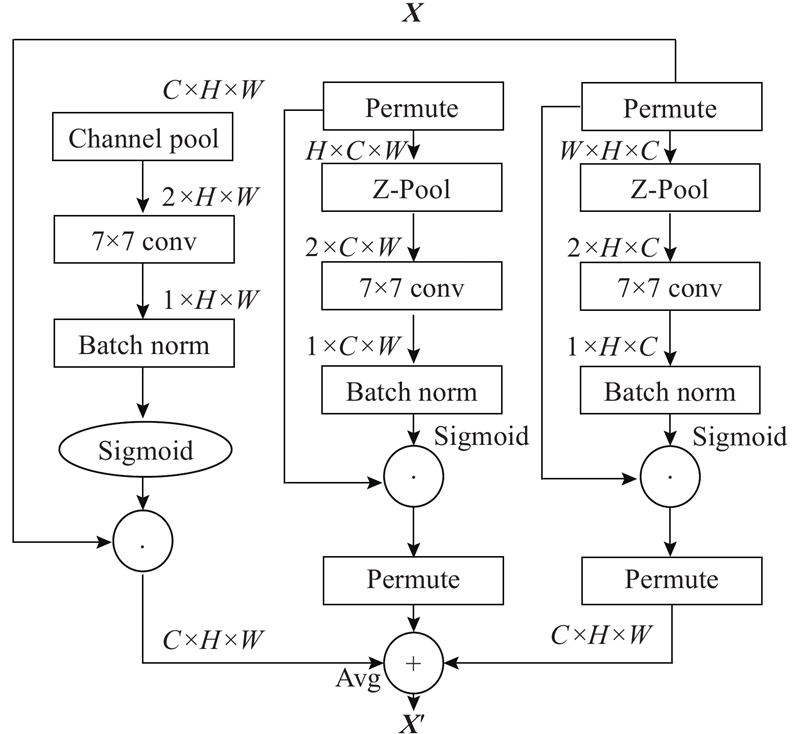
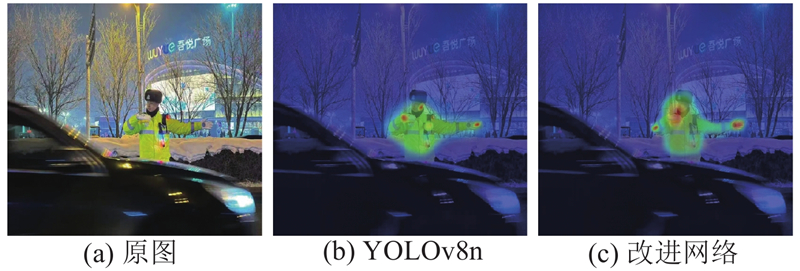
Abstract A lightweight traffic police gesture recognition method for autonomous driving was proposed to address the challenge of maintaining high recognition accuracy while achieving lightweight deployment, particularly given the subtle variations in gestures and complex application scenarios. An efficient adaptive weight downsampling module was designed on the basis of the YOLOv8n algorithm. This module replaced the standard convolutions in the backbone network to capture spatial differences, reducing both parameter count and computational complexity. Additionally, a C2f-G module was introduced to better leverage local and contextual features, improving the recognition accuracy in complex backgrounds. A triplet attention mechanism was incorporated into the neck network to comprehensively capture fine-grained feature details. Experimental validation on the Chinese traffic police gesture dataset showed that compared to the baseline model, the proposed method reduced the parameter count by 44.0%, increased the mean average precision by 3 percentage points, and achieved a detection speed of 294 frames/s. The proposed method effectively addresses the challenge of dynamic traffic police gesture recognition in complex environments, achieves fast and high-precision recognition, realizes a lightweight architecture, and significantly reduces the deployment complexity.
|
|
Received: 11 July 2025
Published: 16 July 2026
|
|
|
| Fund: 黑龙江省交通运输厅科技资助项目(HJK2024B002). |
面向自动驾驶的轻量化交警手势识别方法
现阶段的交警手势识别方法难以在保持高识别准确率的同时实现轻量化部署,且交警手势具有变化细微、使用场景复杂的特点,为此提出面向自动驾驶的轻量化交警手势识别方法. 基于YOLOv8n算法,设计高效自适应权重下采样模块,取代主干网络部分标准卷积,捕捉位置差异,减少参数量与计算量. 设计C2f-G模块,充分利用局部和上下文特征,提高复杂背景下的识别准确率. 在颈部网络引入三重注意力机制,全面捕捉细粒度特征信息. 在中国交警手势数据集上进行验证,与基线模型相比,所提方法的参数量减少44.0%,平均精度均值提升3个百分点,检测速度达294帧/s. 所提方法有效解决了复杂环境下交警手势动态识别的问题,在快速、高精度识别的同时,实现模型轻量化,显著减小了部署难度.
关键词:
自动驾驶,
交警手势识别,
YOLOv8n,
自适应权重,
目标检测
|
|
| [1] |
全国汽车标准化技术委员会. 汽车驾驶自动化分级: GB/T 40429-2021[S]. 北京: 中国标准出版社, 2021: 7–9.
|
|
|
| [2] |
YUAN T, WANG B Accelerometer-based Chinese traffic police gesture recognition system[J]. Chinese Journal of Electronics, 2010, 19 (2): 270- 274
|
|
|
| [3] |
YOU Z, LIU J, HOU W, et al. A wearable system designed for Chinese traffic police based on gesture recognition [M]// Transdisciplinary Engineering: A Paradigm Shift. IOS Press, 2017: 385–393.
|
|
|
| [4] |
GUO F, CAI Z, TANG J. Chinese traffic police gesture recognition in complex scene [C]// 2011 IEEE 10th International Conference on Trust, Security and Privacy in Computing and Communications. Changsha: IEEE, 2011: 1505–1511.
|
|
|
| [5] |
SATHYA R, GEETHA M K Vision based traffic police hand signal recognition in surveillance video-a survey[J]. International Journal of Computer Applications, 2013, 81 (9): 1- 10
doi: 10.5120/14037-2192
|
|
|
| [6] |
MIAO Y, SHI E, LEI M, et al. Vehicle control system based on dynamic traffic gesture recognition [C]// 2022 5th International Conference on Circuits, Systems and Simulation (ICCSS). Piscataway: IEEE, 2022: 196–201.
|
|
|
| [7] |
马天祥 基于目标检测和模板匹配的交警手势识别研究[J]. 现代信息科技, 2022, 6 (20): 60- 64
MA Tianxiang Research on traffic police gesture recognition based on object detection and template matching[J]. Modern Information Technology, 2022, 6 (20): 60- 64
|
|
|
| [8] |
徐志平. 基于深度学习的交通指挥手势识别[D]. 济南: 济南大学, 2023.
XU Zhiping. Recognition of traffic command gestures based on deep learning [D]. Jinan: University of Jinan, 2023.
|
|
|
| [9] |
方吴逸, 陈章进, 唐英杰 基于改进YOLOX-tiny算法的交警手势识别[J]. 电子测量技术, 2024, 47 (8): 100- 109
FANG Wuyi, CHEN Zhangjin, TANG Yingjie Traffic police gesture recognition based on improved YOLOX-tiny algorithm[J]. Electronic Measurement Technology, 2024, 47 (8): 100- 109
|
|
|
| [10] |
WU T, TANG S, ZHANG R, et al CGNet: a light-weight context guided network for semantic segmentation[J]. IEEE Transactions on Image Processing, 2020, 30: 1169- 1179
|
|
|
| [11] |
MISRA D, NALAMADA T, ARASANIPALAI A U, et al. Rotate to attend: convolutional triplet attention module [C]// Proceedings of the IEEE/CVF Winter Conference on Applications of Computer Vision. [S.l.]: IEEE, 2021: 3139–3148.
|
|
|
| [12] |
HE J, ZHANG C, HE X, et al Visual recognition of traffic police gestures with convolutional pose machine and handcrafted features[J]. Neurocomputing, 2020, 390: 248- 259
doi: 10.1016/j.neucom.2019.07.103
|
|
|
| [13] |
ZHAO Y, LV W, XU S, et al. Detrs beat YOLOs on real-time object detection [C]// Proceedings of the IEEE/CVF Conference on Computer Vision and Pattern Recognition. Seattle: IEEE, 2024: 16965–16974.
|
|
|
| [14] |
WANG C, HE W, NIE Y, et al Gold-YOLO: efficient object detector via gather-and-distribute mechanism[J]. Advances in Neural Information Processing Systems, 2023, 36: 51094- 51112
|
|
|
| [15] |
JOCHER G, CHAURASIA A, QIU J. YOLOv5 [EB/OL]. (2021–07–08)[2024–04–09]. https://github.com/ultralytics/yolov5.
|
|
|
| [16] |
YASEEN M. What is YOLOv8: an in-depth exploration of the internal features of the next-generation object detector [EB/OL]. (2024–08–28)[2026–07–02]. https://arxiv.org/abs/2408.15857.
|
|
|
| [17] |
WANG C Y, YEH I H, MARK LIAO H Y. YOLOv9: learning what you want to learn using programmable gradient information [C]// European Conference on Computer Vision. Cham: Springer, 2024: 1–21.
|
|
|
| [18] |
WANG A, CHEN H, LIU L, et al YOLOv10: real-time end-to-end object detection[J]. Advances in Neural Information Processing Systems, 2024, 37: 107984- 108011
|
|
|
| [19] |
KHANAM R, HUSSAIN M. YOLOv11: an overview of the key architectural enhancements [EB/OL]. (2024–10–23)[2026–07–02]. https://doi.org/10.48550/arXiv.2410.17725.
|
|
|
| [20] |
BOCHKOVSKIY A, WANG C Y, LIAO H Y M. YOLOv4: optimal speed and accuracy of object detection [EB/OL]. (2020–04–23)[2024–11–20]. https://arxiv.org/abs/2004.10934.
|
|
|
|
Viewed |
|
|
|
Full text
|
|
|
|
|
Abstract
|
|
|
|
|
Cited |
|
|
|
|
| |
Shared |
|
|
|
|
| |
Discussed |
|
|
|
|