|
|
|
| VAE model combined with multi-domain feature for muscle fatigue analysis |
Bo DONG1( ),Donghao LV1,2,*(),Dahua YU1,Xiaowei DU3 ),Donghao LV1,2,*(),Dahua YU1,Xiaowei DU3 |
1. School of Automation and Electrical Engineering, Inner Mongolia University of Science and Technology, Baotou 014010, China
2. School of Automation, China University of Geosciences, Wuhan 430074, China
3. Department of Physical Education, Inner Monglia University of Science and Technology, Baotou 014010, China |
|
|
|
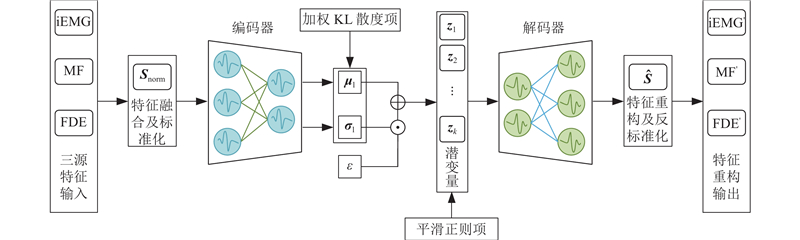
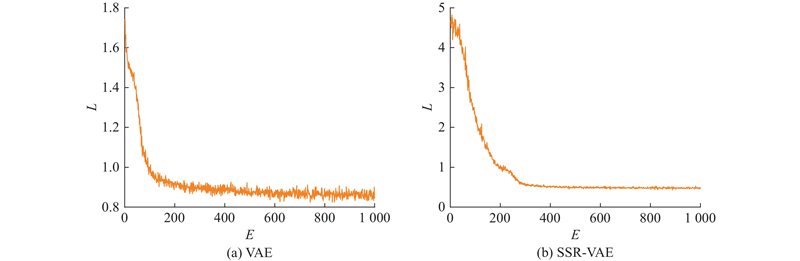
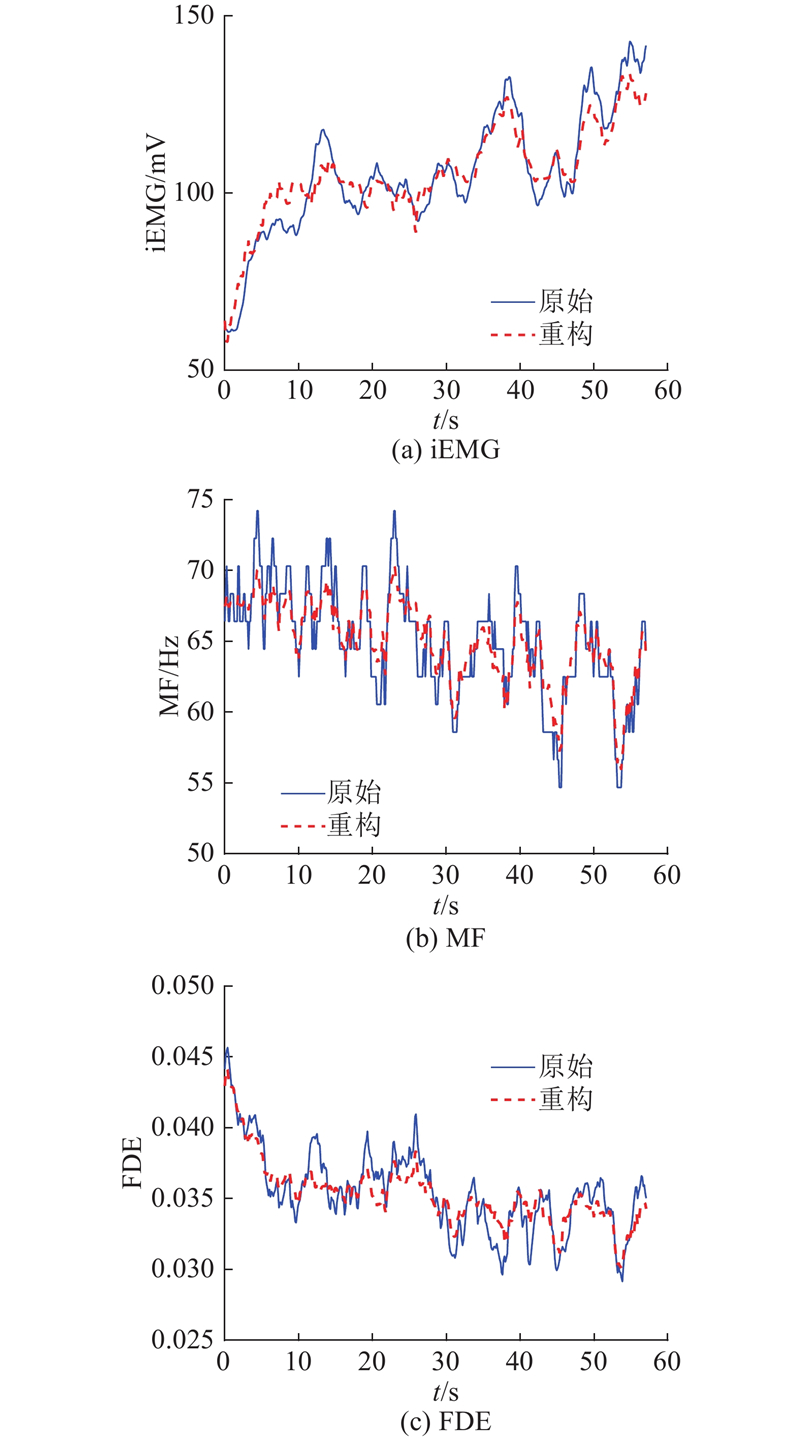
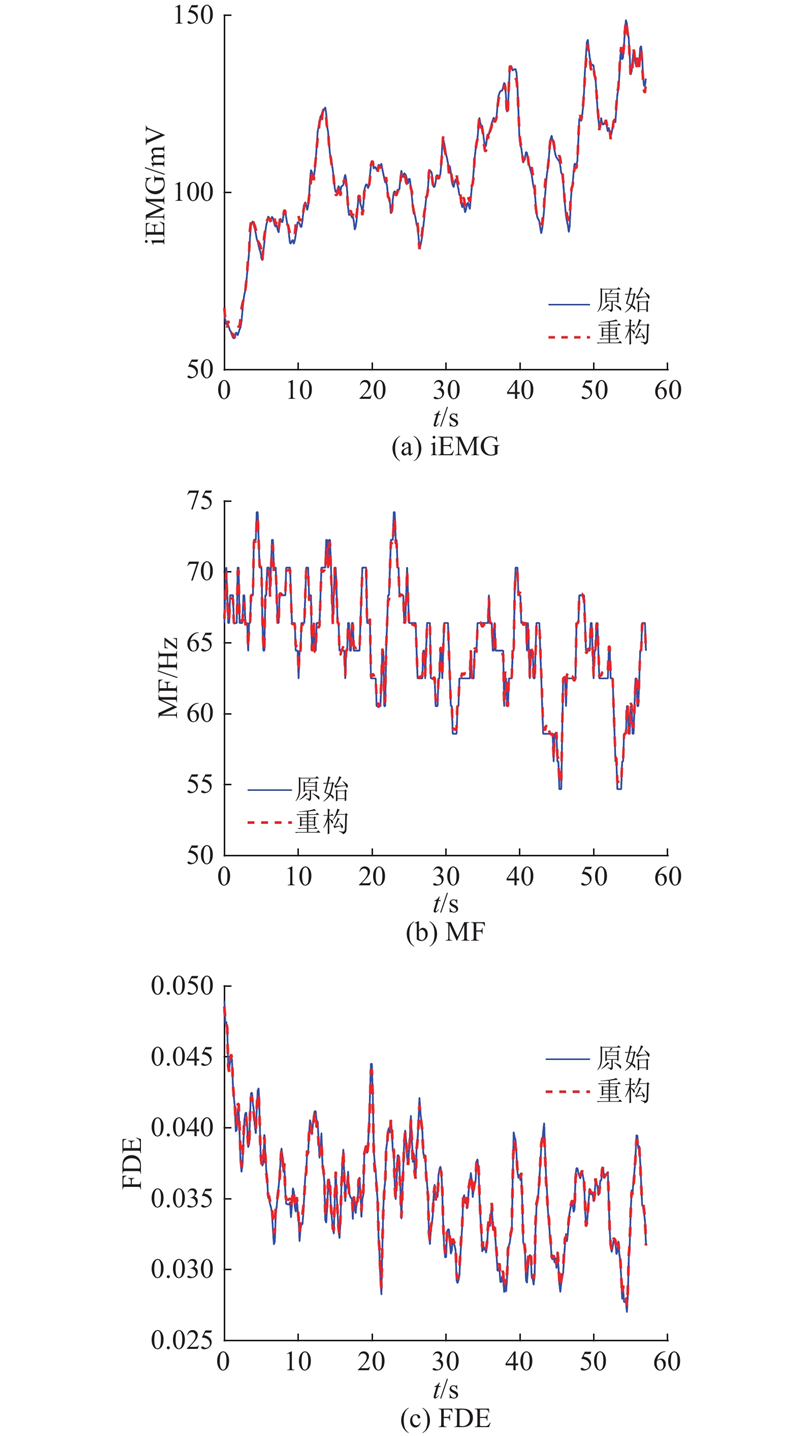
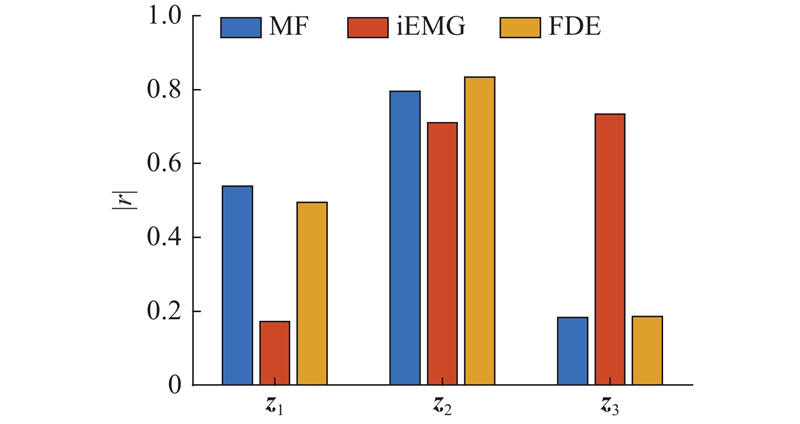
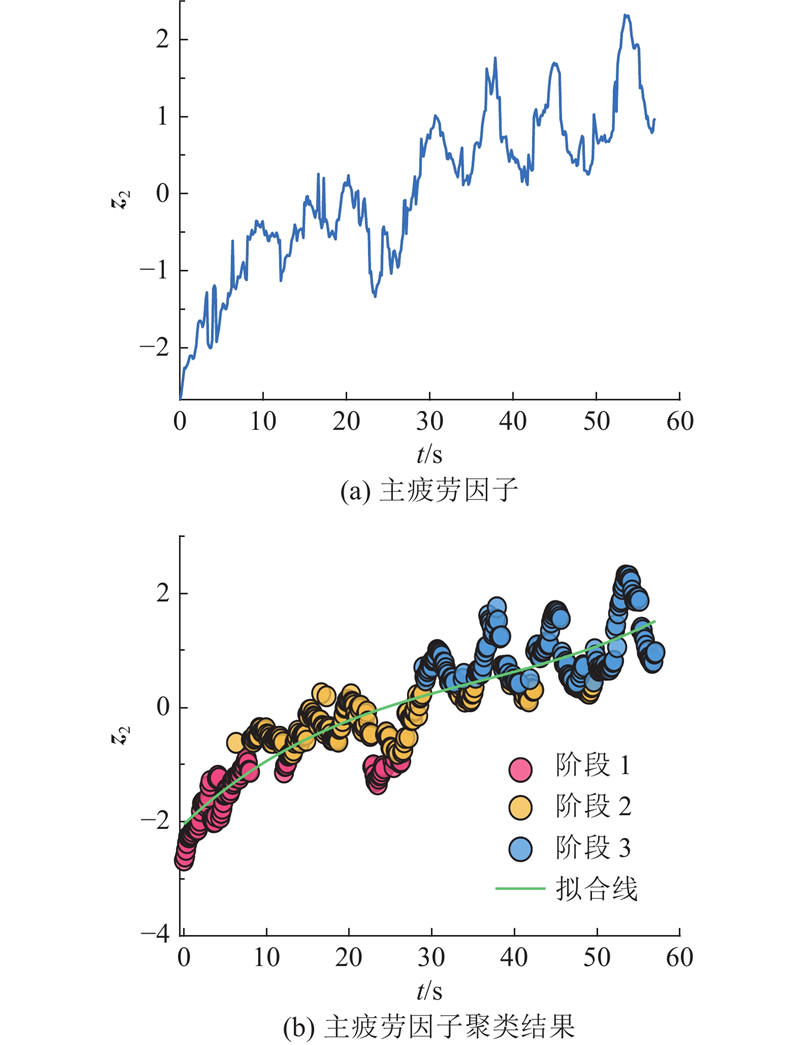
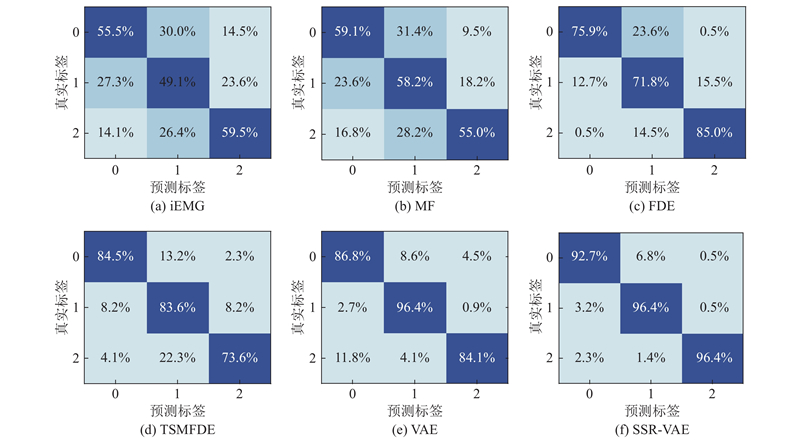
Abstract A structure-smoothing regularized variational autoencoder (SSR-VAE) was proposed based on the variational autoencoder (VAE) in order to address the issue of single-feature reliance, limited capacity to capture complex fatigue evolution process, and unclear delineation of fatigue state in existing muscle fatigue analysis method. Time-domain, frequency-domain and nonlinear entropy feature were incorporated to enhance the model’s ability to capture the dynamic change in surface electromyography (sEMG) signal. The decoupling and temporal continuity of the latent variable space were optimized by introducing weighted KL divergence and trajectory smoothing regularization term into the loss function. A correlation-based selection mechanism was used to extract the main fatigue factor from the latent space, which effectively represented the muscle fatigue state. The experimental results show that SSR-VAE outperforms the VAE model in reconstruction performance, and the extracted main fatigue factor can be used to more clearly distinguish different fatigue stage. SSR-VAE achieved a maximum accuracy of 96.211% in muscle fatigue state classification, significantly outperforming other comparison method.
|
|
Received: 01 July 2025
Published: 06 May 2026
|
|
|
| Fund: 内蒙古自治区自然科学基金资助项目(2024MS06024);内蒙古自治区一流学科科研专项资助项目(YLXKZX-NKD-020);内蒙古自治区直属高校基本科研业务费资助项目(2023QNJS194). |
|
Corresponding Authors:
Donghao LV
E-mail: 2023023236@stu.imust.edu.cn;wsldh2016957@imust.edu.cn
|
融合多域特征的VAE模型在肌肉疲劳分析中的应用
针对现有肌肉疲劳分析方法中存在的特征单一、对复杂疲劳演化过程捕捉能力不足以及疲劳状态界定不清等问题,基于变分自编码器(VAE)提出结构-平滑正则化变分自编码器(SSR-VAE). 结合时域、频域和非线性熵3类特征输入,增强对表面肌电(sEMG)信号动态变化的捕捉能力. 通过在损失函数中引入加权KL散度和轨迹平滑正则化项,优化了潜变量空间的解耦性和时序连续性. 利用相关性筛选机制,从潜变量空间中提取主疲劳因子,有效表征肌肉疲劳状态. 实验结果表明,与VAE模型相比,SSR-VAE在重构性能方面表现更优,利用提取的主疲劳因子,能够更清晰地划分疲劳阶段. SSR-VAE在肌肉疲劳状态分类中的最高准确率达到96.211%,明显优于其他对比方法.
关键词:
肌肉疲劳,
表面肌电信号,
变分自编码器(VAE),
潜变量,
特征融合
|
|
| [1] |
MARCO G, ALBERTO B, TAIAN V Surface EMG and muscle fatigue: multi-channel approaches to the study of myoelectric manifestations of muscle fatigue[J]. Physiological Measurement, 2017, 38 (5): R27
doi: 10.1088/1361-6579/aa60b9
|
|
|
| [2] |
YOUSIF H A, NORASMADI A R, BIN SALLEH A F, et al Assessment of muscles fatigue during 400-meters running strategies based on the surface EMG signals[J]. Journal of Biomimetics, Biomaterials and Biomedical Engineering, 2019, 42: 1- 13
doi: 10.4028/www.scientific.net/jbbbe.42.1
|
|
|
| [3] |
ZHOU Y, LI J, DONG M Prediction of actively exerted torque from ankle joint complex based on muscle synergy[J]. IEEE Transactions on Industrial Electronics, 2024, 71 (2): 1729- 1737
doi: 10.1109/TIE.2023.3257380
|
|
|
| [4] |
CHLIF M, KEOCHKERIAN D, TEMFEMO A, et al Relationship between electromyogram spectrum parameters and the tension-time index during incremental exercise in trained subjects[J]. Journal of Sports Science and Medicine, 2018, 17 (3): 509- 514
|
|
|
| [5] |
王万良, 潘杰, 王铮, 等 基于双分支网络的表面肌电信号识别方法[J]. 浙江大学学报: 工学版, 2024, 58 (11): 2208- 2218
WANG Wanliang, PAN Jie, WANG Zheng, et al Recognition method of surface electromyographic signal based on two-branch network[J]. Journal of Zhejiang University: Engineering Science, 2024, 58 (11): 2208- 2218
doi: 10.3785/j.issn.1008-973X.2024.11.002
|
|
|
| [6] |
GUO H, GONG P, WANG Y, et al Complex network properties analysis of muscle fatigue based on sEMG signals[J]. IEEE Sensors Journal, 2023, 23 (4): 3859- 3869
doi: 10.1109/JSEN.2022.3233047
|
|
|
| [7] |
DUAN T, HUANG B, LI X, et al Real-time indicators and influence factors of muscle fatigue in push-type work[J]. International Journal of Industrial Ergonomics, 2020, 80: 103046
doi: 10.1016/j.ergon.2020.103046
|
|
|
| [8] |
姚贺龙, 吕东澔, 张勇, 等 基于傅里叶分解方法的肌肉疲劳状态分类研究[J]. 电子测量与仪器学报, 2023, 37 (6): 48- 58
YAO Helong, LV Donghao, ZHANG Yong, et al Study of muscle fatigue state classification based on Fourier decomposition method[J]. Journal of Electronic Measurement and Instrumentation, 2023, 37 (6): 48- 58
doi: 10.13382/j.jemi.B2306358
|
|
|
| [9] |
BIRNBAUM S, SHARSHAR T, ROPERS J, et al Neuromuscular fatigue in autoimmune myasthenia gravis: a cross-sectional study[J]. Neurophysiologie Clinique, 2023, 53 (4): 102844
doi: 10.1016/j.neucli.2023.102844
|
|
|
| [10] |
LIU Q, LIU Y, ZHANG C, et al sEMG-based dynamic muscle fatigue classification using SVM with improved whale optimization algorithm[J]. IEEE Internet of Things Journal, 2021, 8 (23): 16835- 16844
doi: 10.1109/JIOT.2021.3056126
|
|
|
| [11] |
WANG S, TANG H, WANG B, et al Analysis of fatigue in the biceps brachii by using rapid refined composite multiscale sample entropy[J]. Biomedical Signal Processing and Control, 2021, 67: 102510
doi: 10.1016/j.bspc.2021.102510
|
|
|
| [12] |
WEI C, WANG H, ZHOU B, et al sEMG signal-based lower limb movements recognition using tunable Q-factor wavelet transform and kraskov entropy[J]. IRBM, 2023, 44 (4): 100773
doi: 10.1016/j.irbm.2023.100773
|
|
|
| [13] |
XI X, DING J, WANG J, et al Analysis of functional corticomuscular coupling based on multiscale transfer spectral entropy[J]. IEEE Journal of Biomedical and Health Informatics, 2022, 26 (10): 5085- 5096
doi: 10.1109/JBHI.2022.3193984
|
|
|
| [14] |
MENGARELLI A, TIGRINI A, FIORETTI S, et al On the use of fuzzy and permutation entropy in hand gesture characterization from EMG signals: parameters selection and comparison[J]. Applied Sciences, 2020, 10 (20): 7144
doi: 10.3390/app10207144
|
|
|
| [15] |
XIE H B, GUO J Y, ZHENG Y P Fuzzy approximate entropy analysis of chaotic and natural complex systems: detecting muscle fatigue using electromyography signals[J]. Annals of Biomedical Engineering, 2010, 38 (4): 1483- 1496
doi: 10.1007/s10439-010-9933-5
|
|
|
| [16] |
侯言旭, 姜礼杰, 胡保华, 等 基于边际谱熵的肌肉疲劳实时评估方法研究[J]. 仪器仪表学报, 2017, 38 (7): 1625- 1633
HOU Yanxu, JIANG Lijie, HU Baohua, et al Real-time assessment of muscle fatigue based on marginal spectrum entropy[J]. Chinese Journal of Scientific Instrument, 2017, 38 (7): 1625- 1633
|
|
|
| [17] |
石欣, 余可祺, 敖钰民, 等 基于下肢sEMG的疲劳模糊增量熵表征方法研究[J]. 仪器仪表学报, 2024, 45 (5): 271- 280
SHI Xin, YU Keqi, AO Yumin, et al Research on entropy of incremental fuzzy entropy representation model for lower limb fatigue based on sEMG[J]. Chinese Journal of Scientific Instrument, 2024, 45 (5): 271- 280
doi: 10.19650/j.cnki.cjsi.J2412468
|
|
|
| [18] |
BERETTA-PICCOLI M, BOCCIA G, PONTI T, et al Relationship between isometric muscle force and fractal dimension of surface electromyogram[J]. BioMed Research International, 2018, 2018: 5373846
doi: 10.1155/2018/5373846
|
|
|
| [19] |
JIANG W, XIA C, ZHANG Y, et al. Research on muscle fatigue trend via nonlinear dynamic feature analysis of mechanomyography signal [C]//Proceedings of the IEEE 4th International Conference on Signal and Image Processing. Wuxi: IEEE, 2019: 669–673.
|
|
|
| [20] |
SU Z, LIU H, QIAN J, et al Hand gesture recognition based on sEMG signal and convolutional neural network[J]. International Journal of Pattern Recognition and Artificial Intelligence, 2021, 35 (11): 2151012
doi: 10.1142/S0218001421510125
|
|
|
| [21] |
WANG G, JIN L, ZHANG J, et al Recurrent neural network enabled continuous motion estimation of lower limb joints from incomplete sEMG signals[J]. IEEE Transactions on Neural Systems and Rehabilitation Engineering, 2024, 32: 3577- 3589
doi: 10.1109/TNSRE.2024.3459924
|
|
|
| [22] |
SHARMA T, SHARMA K P Novel approach of time series prediction using SEMG on hand gestures for prosthetic control[J]. Sādhanā, 2025, 50 (3): 121
doi: 10.1007/s12046-025-02759-1
|
|
|
| [23] |
MU D, LI F, YU L, et al Study on exercise muscle fatigue based on sEMG and ECG data fusion and temporal convolutional network[J]. PLoS One, 2022, 17 (12): e0276921
doi: 10.1371/journal.pone.0276921
|
|
|
| [24] |
HWANG S, KWON N, LEE D, et al A multimodal fatigue detection system using sEMG and IMU signals with a hybrid CNN-LSTM-attention model[J]. Sensors, 2025, 25 (11): 3309
doi: 10.3390/s25113309
|
|
|
| [25] |
WANG J, SUN S, SUN Y A muscle fatigue classification model based on LSTM and improved wavelet packet threshold[J]. Sensors, 2021, 21 (19): 6369
doi: 10.3390/s21196369
|
|
|
| [26] |
LANGEVIN A, CARBONNEAU M A, CHERIET M, et al Energy disaggregation using variational autoencoders[J]. Energy and Buildings, 2022, 254: 111623
doi: 10.1016/j.enbuild.2021.111623
|
|
|
| [27] |
AZAMI H, ESCUDERO J Amplitude- and fluctuation-based dispersion entropy[J]. Entropy, 2018, 20 (3): 210
doi: 10.3390/e20030210
|
|
|
| [28] |
JARRETT D, YOON J, VAN DER SCHAAR M Dynamic prediction in clinical survival analysis using temporal convolutional networks[J]. IEEE Journal of Biomedical and Health Informatics, 2019, 24 (2): 424- 436
|
|
|
| [29] |
AL-SELWI S M, HASSAN M F, ABDULKADIR S J, et al RNN-LSTM: from applications to modeling techniques and beyond: systematic review[J]. Journal of King Saud University: Computer and Information Sciences, 2024, 36 (5): 102068
doi: 10.1016/j.jksuci.2024.102068
|
|
|
| [30] |
曹震, 吕东澔, 张勇, 等 基于sEMG信号几何特征的肌肉疲劳分类[J]. 传感器与微系统, 2024, 43 (7): 145- 148
CAO Zhen, LV Donghao, ZHANG Yong, et al Muscle fatigue classification based on geometric features of sEMG signal[J]. Transducer and Microsystem Technologies, 2024, 43 (7): 145- 148
doi: 10.13873/J.1000-9787(2024)07-0145-04
|
|
|
| [31] |
徐哲熙, 刘婷, 任晟民, 等 基于时移多尺度波动散布熵和改进核极限学习机的水电机组故障诊断[J]. 工程科学与技术, 2024, 56 (3): 41- 51
XU Zhexi, LIU Ting, REN Shengmin, et al Fault diagnosis method of hydropower units based on time-shifted multiscale fluctuation dispersion en-tropy and improved kernel extreme learning machine[J]. Advanced Engineering Sciences, 2024, 56 (3): 41- 51
doi: 10.12454/j.jsuese.202200843
|
|
|
|
Viewed |
|
|
|
Full text
|
|
|
|
|
Abstract
|
|
|
|
|
Cited |
|
|
|
|
| |
Shared |
|
|
|
|
| |
Discussed |
|
|
|
|