|
|
|
| Water-floating garbage trajectory prediction model based on multi-scale graph convolution |
Long MA1( ),Yongqi HOU1(),Baijing WU1,Li GAO1,Jianwei DENG2,Guanghui YAN1 ),Yongqi HOU1(),Baijing WU1,Li GAO1,Jianwei DENG2,Guanghui YAN1 |
1. School of Electronic and Information Engineering, Lanzhou Jiaotong University, Lanzhou 730070, China
2. Gansu Provincial Institute of Water Resources, Lanzhou 730000, China |
|
|
|
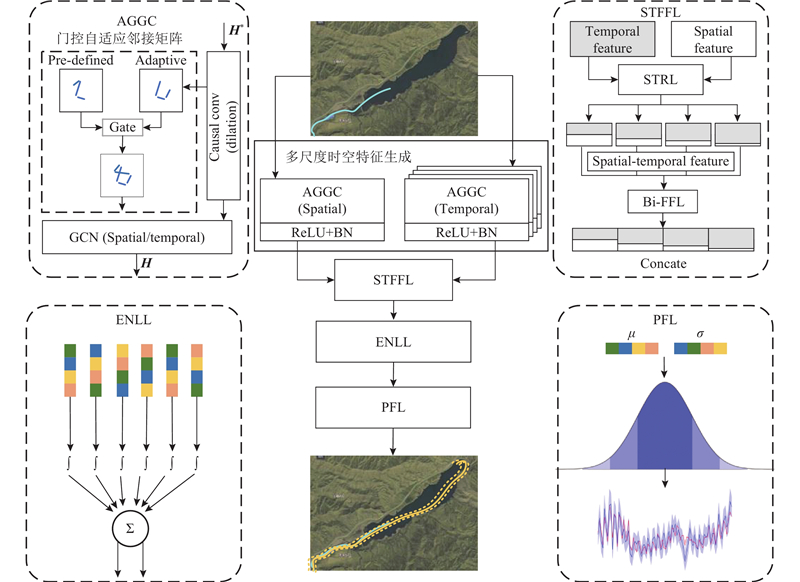
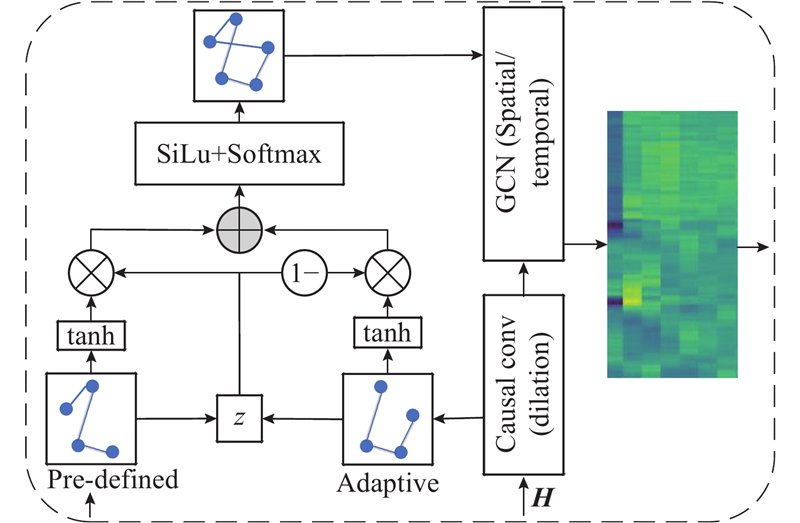
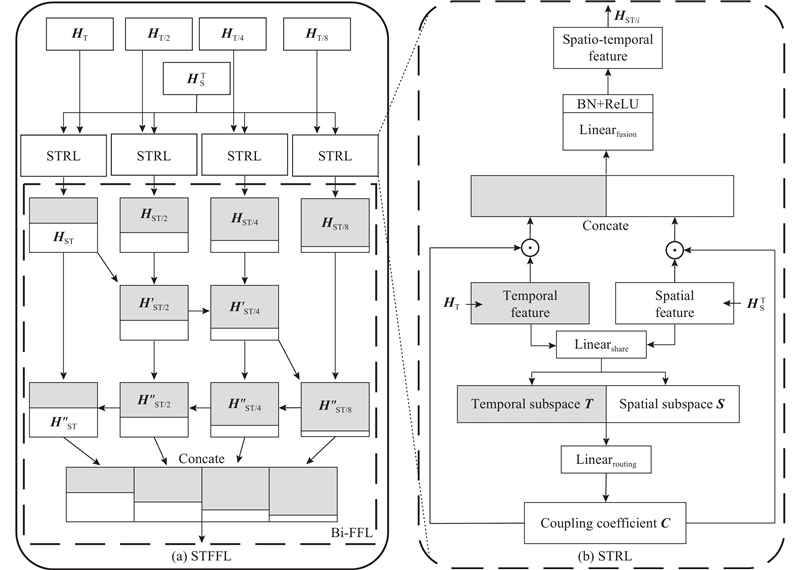
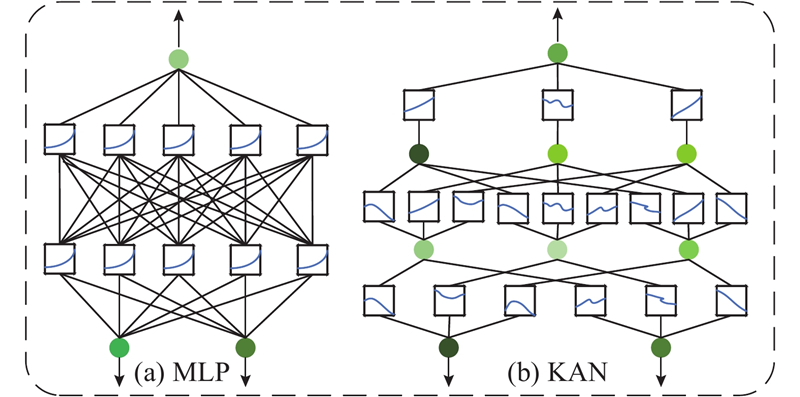
Abstract In response to the insufficient modeling of spatiotemporal heterogeneity under a single scale in water-floating garbage trajectory prediction, which often leads to high uncertainty in results, a multi-scale adaptive graph convolutional model (MAGC-Trajectory) was proposed. First, an adaptive gated graph convolution module was developed. Static adjacency relationships imposed by spatiotemporal priors were cross-domain integrated with data-driven dynamic topological structures. This enhanced the model’s ability to capture temporal dependencies of garbage drift and fluctuations of its trajectories. Next, a multi-scale spatiotemporal interaction module was designed. Spatial features were decoupled along different temporal scales. They were then fused in a weighted manner with temporal features. This strengthened the representation of spatiotemporal heterogeneity in garbage trajectories. Meanwhile, an improved nonlinear learning layer was introduced. A learnable adaptive activation function was employed to reinforce global fusion of multiscale spatiotemporal features. This resulted in high-order drift trajectory features with a unified representation. Lastly, a probabilistic prediction layer was constructed. Mean-variance estimation was utilized to estimate the trajectories’ distribution interval. This quantified predictive uncertainty and thus provided more robust predicted trajectories. Experiments were conducted on the water-floating garbage trajectory dataset. Results showed that, compared with the baseline model, the proposed approach reduced MAE by 0.000 2 and RMSE by 0.000 5. These improvements provide actionable support for decision-making in mitigating water-floating garbage pollution within the study area.
|
|
Received: 22 April 2025
Published: 19 March 2026
|
|
|
| Fund: 国家自然科学基金资助项目(62366028);甘肃省水利科学研究院项目基金(LZJT524289). |
多尺度图卷积下的水漂垃圾轨迹预测模型
针对水漂垃圾轨迹预测中单一尺度下时空异质性建模不足,导致预测结果不确定性高的问题,提出多尺度自适应图卷积模型MAGC-Trajectory. 构建自适应门控图卷积模块,将时空先验约束的静态邻接关系与数据驱动的动态拓扑结构进行跨域融合,提升模型对垃圾漂移的时序关系和轨迹波动的捕捉能力;设计多尺度时空交互模块,对空间特征进行时间尺度解耦,并与时序特征加权融合,增强垃圾轨迹时空异质性的表征能力;提出改进非线性学习层,使用可学习的自适应激活函数强化不同尺度时空特征的全局融合,生成具有统一表征的漂移轨迹高阶特征;设计概率预测层,使用均值-方差估计轨迹分布区间,量化预测结果的不确定性,提供更加鲁棒的预测轨迹. 在水漂垃圾轨迹数据集上的实验表明,相较于基准模型,所提模型的MAE、RMSE分别降低了0.000 2、0.000 5. 所提方法能够从决策上助力研究区域的水漂垃圾污染治理工作.
关键词:
水漂垃圾,
轨迹预测,
图卷积,
自适应邻接矩阵,
时空特征融合,
概率预测
|
|
| [1] |
仇威, 栾华龙, 渠庚, 等 三峡水库应急补水对2022年洪季长江口盐水入侵的影响[J]. 长江科学院院报, 2024, 41 (10): 30- 39
QIU Wei, LUAN Hualong, QU Geng, et al Impact of emergent water supply of the Three Gorges Reservoir on saltwater intrusion in the Changjiang River Estuary in 2022[J]. Journal of Changjiang River Scientific Research Institute, 2024, 41 (10): 30- 39
doi: 10.11988/ckyyb.20240616
|
|
|
| [2] |
张云, 王雨, 周绍辉, 等 星载GNSS-R检测太湖水华可行性分析[J]. 北京航空航天大学学报, 2024, 50 (3): 695- 705
ZHANG Yun, WANG Yu, ZHOU Shaohui, et al Analysis on feasibility of detecting water blooms in Taihu Lake with spaceborne GNSS-R[J]. Journal of Beijing University of Aeronautics and Astronautics, 2024, 50 (3): 695- 705
|
|
|
| [3] |
TAN Y, CHENG Q, LYU F, et al Hydrological reduction and control effect evaluation of sponge city construction based on one-way coupling model of SWMM-FVCOM: a case in university campus[J]. Journal of Environmental Management, 2024, 349: 119599
doi: 10.1016/j.jenvman.2023.119599
|
|
|
| [4] |
CASTÁN-LASCORZ M A, JIMÉNEZ-HERRERA P, TRONCOSO A, et al A new hybrid method for predicting univariate and multivariate time series based on pattern forecasting[J]. Information Sciences, 2022, 586: 611- 627
doi: 10.1016/j.ins.2021.12.001
|
|
|
| [5] |
潘金伟, 王乙乔, 钟博, 等 基于统计特征搜索的多元时间序列预测方法[J]. 电子与信息学报, 2024, 46 (8): 3276- 3284
PAN Jinwei, WANG Yiqiao, ZHONG Bo, et al Statistical feature-based search for multivariate time series forecasting[J]. Journal of Electronics and Information Technology, 2024, 46 (8): 3276- 3284
doi: 10.11999/JEIT231264
|
|
|
| [6] |
VERDONCK T, BAESENS B, ÓSKARSDÓTTIR M, et al Special issue on feature engineering editorial[J]. Machine Learning, 2024, 113 (7): 3917- 3928
doi: 10.1007/s10994-021-06042-2
|
|
|
| [7] |
CATON S, HAAS C Fairness in machine learning: a survey[J]. ACM Computing Surveys, 2024, 56 (7): 1- 38
|
|
|
| [8] |
AL-SELWI S M, HASSAN M F, ABDULKADIR S J, et al RNN-LSTM: from applications to modeling techniques and beyond: systematic review[J]. Journal of King Saud University - Computer and Information Sciences, 2024, 36 (5): 102068
doi: 10.1016/j.jksuci.2024.102068
|
|
|
| [9] |
刘凇佐, 王虔, 李磊, 等 粒子群优化的门控循环单元网络漂流浮标轨迹预测[J]. 电子与信息学报, 2024, 46 (8): 3295- 3304
LIU Songzuo, WANG Qian, LI Lei, et al Gated recurrent unit network of particle swarm optimization for drifting buoy trajectory prediction[J]. Journal of Electronics and Information Technology, 2024, 46 (8): 3295- 3304
doi: 10.11999/JEIT230945
|
|
|
| [10] |
吴跃高, 俞万能, 曾广淼, 等 融合拼接注意力机制的船舶轨迹预测方法[J]. 控制理论与应用, 2025, 42 (9): 1798- 1806
WU Yuegao, YU Wanneng, ZENG Guangmiao, et al Ship trajectory prediction method incorporating concatenated attention mechanism[J]. Control Theory and Applications, 2025, 42 (9): 1798- 1806
|
|
|
| [11] |
BAI J, ZHU J, SONG Y, et al A3T-GCN: attention temporal graph convolutional network for traffic forecasting[J]. ISPRS International Journal of Geo-Information, 2021, 10 (7): 485
doi: 10.3390/ijgi10070485
|
|
|
| [12] |
SRIRAMULU A, FOURRIER N, BERGMEIR C Adaptive dependency learning graph neural networks[J]. Information Sciences, 2023, 625: 700- 714
doi: 10.1016/j.ins.2022.12.086
|
|
|
| [13] |
BAI L, YAO L, LI C, et al Adaptive graph convolutional recurrent network for traffic forecasting[J]. Advances in Neural Information Processing Systems, 2020, 33: 17804- 17815
|
|
|
| [14] |
ZHOU Y, ZHENG H, HUANG X, et al Graph neural networks: taxonomy, advances, and trends[J]. ACM Transactions on Intelligent Systems and Technology, 2022, 13 (1): 1- 54
|
|
|
| [15] |
XU D, PENG H, TANG Y, et al Hierarchical spatio-temporal graph convolutional neural networks for traffic data imputation[J]. Information Fusion, 2024, 106: 102292
doi: 10.1016/j.inffus.2024.102292
|
|
|
| [16] |
LIU R W, LIANG M, NIE J, et al STMGCN: mobile edge computing-empowered vessel trajectory prediction using spatio-temporal multigraph convolutional network[J]. IEEE Transactions on Industrial Informatics, 2022, 18 (11): 7977- 7987
doi: 10.1109/TII.2022.3165886
|
|
|
| [17] |
ZHAO J, YAN Z, CHEN X, et al K-GCN-LSTM: a k-hop graph convolutional network and long-short-term memory for ship speed prediction[J]. Physica A: Statistical Mechanics and Its Applications, 2022, 606: 128107
doi: 10.1016/j.physa.2022.128107
|
|
|
| [18] |
TANG X, CHEN H, XIANG W, et al Short-term load forecasting using channel and temporal attention based temporal convolutional network[J]. Electric Power Systems Research, 2022, 205: 107761
doi: 10.1016/j.jpgr.2021.107761
|
|
|
| [19] |
邵海东, 肖一鸣, 邓乾旺, 等 基于不确定性感知网络的可信机械故障诊断[J]. 机械工程学报, 2024, 60 (12): 194- 206
SHAO Haidong, XIAO Yiming, DENG Qianwang, et al Trustworthy mechanical fault diagnosis using uncertainty-aware network[J]. Journal of Mechanical Engineering, 2024, 60 (12): 194- 206
doi: 10.3901/JME.2024.12.194
|
|
|
| [20] |
TANG S, LI B, YU H. ChebNet: efficient and stable constructions of deep neural networks with rectified power units via Chebyshev approximation [EB/OL]. (2024–10–14) [2025–04–20]. https://doi.org/10.1007/s40304-023-00392-0.
|
|
|
| [21] |
SHARMA K, LEE Y C, NAMBI S, et al A survey of graph neural networks for social recommender systems[J]. ACM Computing Surveys, 2024, 56 (10): 1- 34
|
|
|
| [22] |
BARAKBAYEVA T, DEMIRCI F M Fully automatic CNN design with inception and ResNet blocks[J]. Neural Computing and Applications, 2023, 35 (2): 1569- 1580
doi: 10.1007/s00521-022-07700-9
|
|
|
| [23] |
LIU Z, WANG Y, VAIDYA S, et al. KAN: Kolmogorov-arnold networks [EB/OL]. (2025−02−09) [2025−04−20]. https://arxiv.org/abs/2404.19756.
|
|
|
| [24] |
LAURINDO L C, MARIANO A J, LUMPKIN R An improved near-surface velocity climatology for the global ocean from drifter observations[J]. Deep Sea Research Part I: Oceanographic Research Papers, 2017, 124: 73- 92
doi: 10.1016/j.dsr.2017.04.009
|
|
|
| [25] |
ZHONG W, ZHAI D, XU W, et al Accurate and efficient daily carbon emission forecasting based on improved ARIMA[J]. Applied Energy, 2024, 376: 124232
doi: 10.1016/j.apenergy.2024.124232
|
|
|
| [26] |
ZHANG Y, YAN J. Crossformer: transformer utilizing cross-dimension dependency for multivariate time series forecasting [C]// International Conference on Learning Representations. Kigali: [S.n.], 2023: 1–21.
|
|
|
| [27] |
BAI L, YAO L, LI C, et al Adaptive graph convolutional recurrent network for traffic forecasting[J]. Advances in Neural Information Processing Systems, 2020, 33: 17804- 17815
|
|
|
|
Viewed |
|
|
|
Full text
|
|
|
|
|
Abstract
|
|
|
|
|
Cited |
|
|
|
|
| |
Shared |
|
|
|
|
| |
Discussed |
|
|
|
|