|
|
|
| Radial basis network based on residual/gradient Gaussian adaptive sampling |
Hongbin LIN( ),Sijin LV,Chenyang WANG,Tianfang CAI,Pengwei LUO ),Sijin LV,Chenyang WANG,Tianfang CAI,Pengwei LUO |
| School of Electrical Engineering, Yanshan University, Qinhuangdao 066004, China |
|
|
|
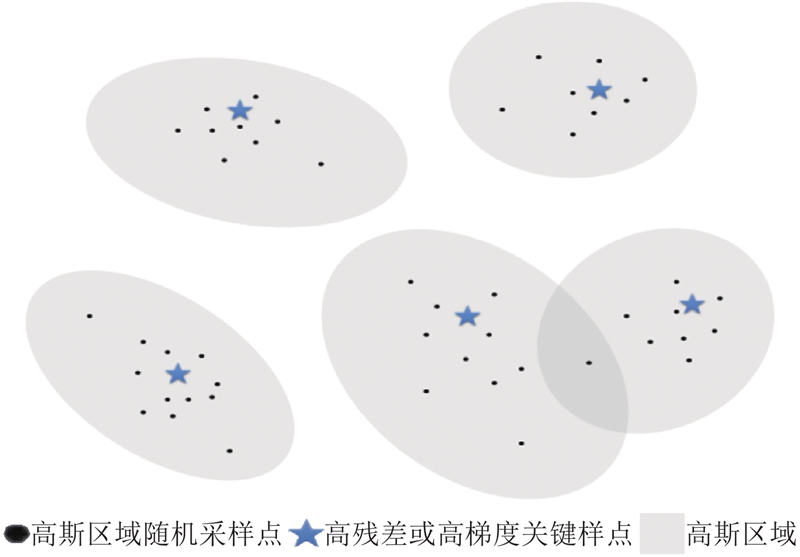
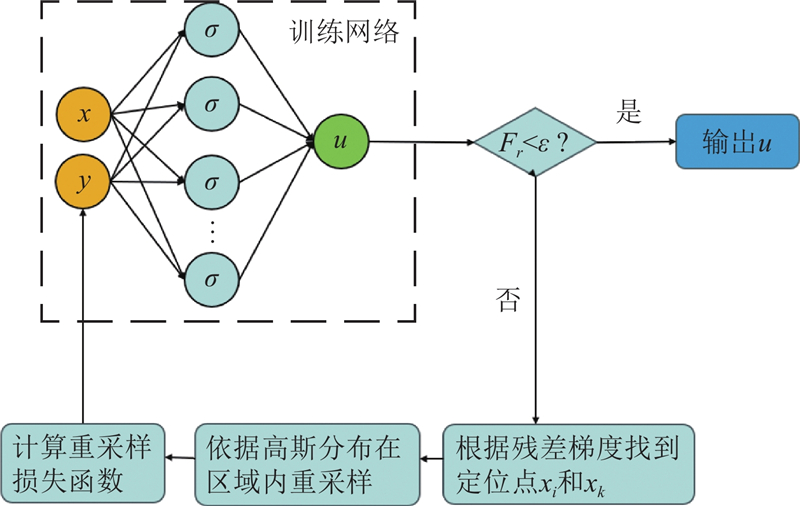
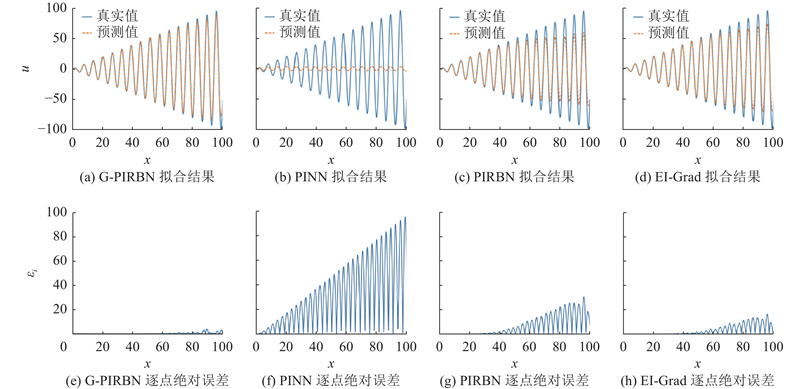
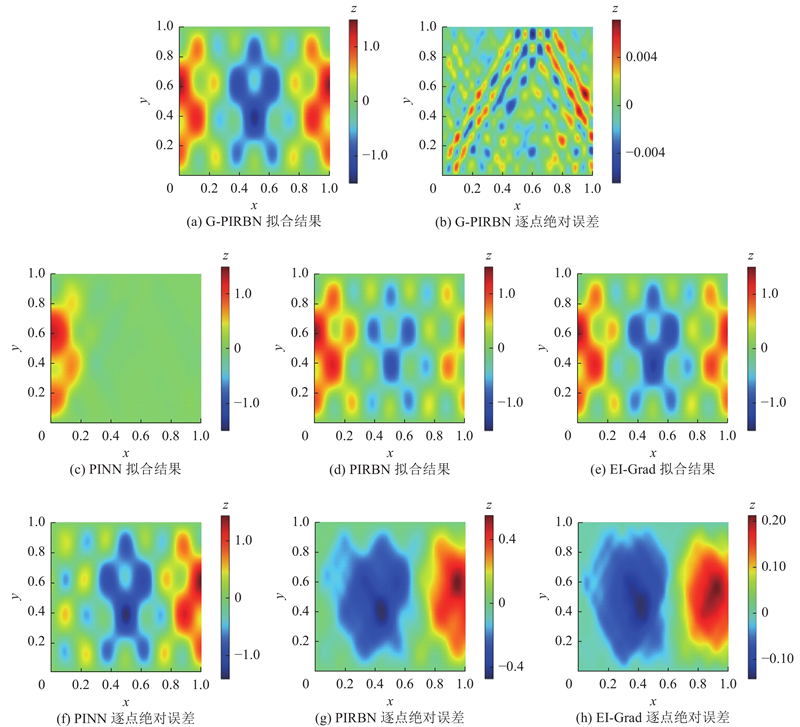
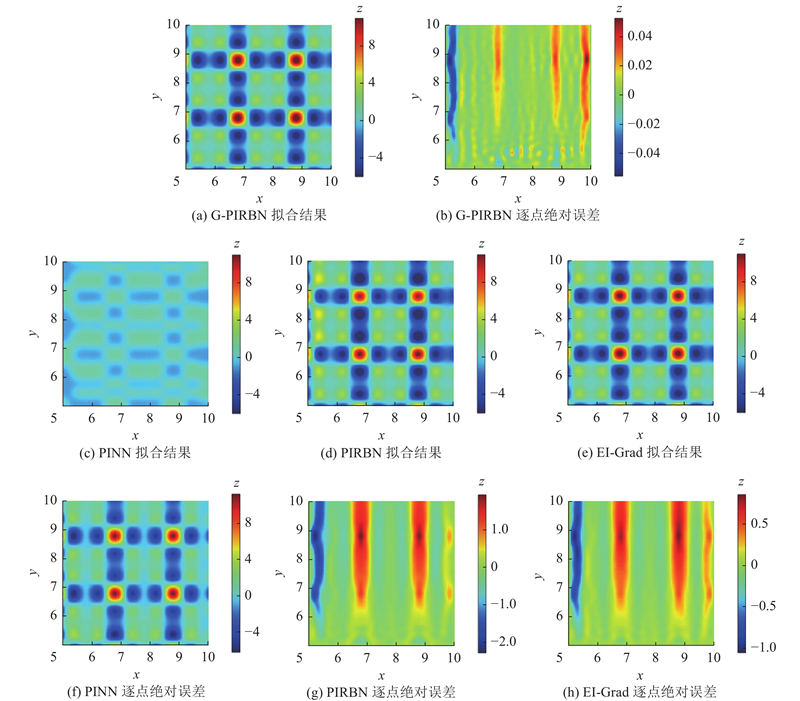
Abstract Physics-informed radial basis networks (PIRBNs) were found to be more effective than physics-informed neural networks (PINNs) in solving nonlinear partial differential equations (PDEs) with high-gradient features and sharp solutions. Inspired by adaptive finite element methods and incremental learning ideas, a radial basis network based on residual/gradient Gaussian adaptive sampling (G-PIRBN) was proposed to further improve the approximation accuracy of the model in fitting the high-gradient regions of nonlinear PDEs. During the training process, a Gaussian mixture distribution was generated using the current residual and gradient information, which was utilized for subsequent specific Gaussian distribution sampling. The newly added sampling points were trained together with historical data to accelerate the convergence of network loss and achieve higher fitting accuracy. Experimental results of point-wise absolute error, mean square error, and average time consumption for nonlinear spring equations, wave equations, and diffusion equations demonstrated that G-PIRBN exhibited higher fitting accuracy and faster fitting speed than PINN, PIRBN, and EI-Grad when solving nonlinear PDEs with high-gradient characteristics.
|
|
Received: 19 March 2025
Published: 06 May 2026
|
|
|
| Fund: 河北省自然科学基金资助项目(E2024203225,E2025203237);燕山大学科研培育项目(理工类)(2024LGZD001). |
基于残差/梯度高斯自适应采样的径向基网络
在求解具有高梯度特征和具有尖锐解的非线性偏微分方程时,物理信息径向基网络(PIRBN)比物理信息神经网络(PINN)更有效. 受自适应有限元方法和增量学习理念的启发,为了进一步提高模型在拟合非线性偏微分方程高梯度处的逼近精度,提出基于残差/梯度高斯自适应采样的径向基网络(G-PIRBN). 在训练过程中,使用当前残差和梯度信息生成高斯混合分布,用于后续特定的高斯分布采样. 将新增采样点与历史数据一起训练,加速损失的网络收敛并提高拟合精度. 非线性弹簧方程、波动方程和扩散方程的逐点绝对误差、均方误差和平均耗时对比实验结果表明,在求解具有高梯度特性的非线性偏微分方程时,G-PIRBN比PINN、PIRBN和EI-Grad的拟合精度更高,拟合速度更快.
关键词:
深度学习,
残差/梯度高斯自适应采样,
物理信息径向基网络(PIRBN),
自适应采样,
偏微分方程
|
|
| [1] |
VOULODIMOS A, DOULAMIS N, DOULAMIS A, et al Deep learning for computer vision: a brief review[J]. Computational Intelligence and Neuroscience, 2018, 2018 (1): 7068349
doi: 10.1016/bs.host.2023.01.003
|
|
|
| [2] |
SUN D, LIANG Y, YANG Y, et al. Research on optimization of natural language processing model based on multimodal deep learning [C]// Proceedings of the IEEE 2nd International Conference on Image Processing and Computer Applications. Shenyang: IEEE, 2024: 1358–1362.
|
|
|
| [3] |
RICHTMYER R D, MORTON K W. Difference methods for initial-value problems [M]. New York: [s.n.], 1967.
|
|
|
| [4] |
WANG X, YIN Z Y, WU W, et al Neural network-augmented differentiable finite element method for boundary value problems[J]. International Journal of Mechanical Sciences, 2025, 285: 109783
doi: 10.1016/j.ijmecsci.2024.109783
|
|
|
| [5] |
YANG C, NIU R, ZHANG P Numerical analyses of liquid slosh by finite volume and lattice Boltzmann methods[J]. Aerospace Science and Technology, 2021, 113: 106681
doi: 10.1016/j.ast.2021.106681
|
|
|
| [6] |
RAISSI M, PERDIKARIS P, KARNIADAKIS G E Physics-informed neural networks: a deep learning framework for solving forward and inverse problems involving nonlinear partial differential equations[J]. Journal of Computational Physics, 2019, 378: 686- 707
doi: 10.1016/j.jcp.2018.10.045
|
|
|
| [7] |
MUSTAJAB A H, LYU H, RIZVI Z, et al Physics-informed neural networks for high-frequency and multi-scale problems using transfer learning[J]. Applied Sciences, 2024, 14 (8): 3204
doi: 10.3390/app14083204
|
|
|
| [8] |
RAMABATHIRAN A A, RAMACHANDRAN P SPINN: sparse, physics-based, and partially interpretable neural networks for PDEs[J]. Journal of Computational Physics, 2021, 445: 110600
doi: 10.1016/j.jcp.2021.110600
|
|
|
| [9] |
JAGTAP A D, EM KARNIADAKIS G Extended physics-informed neural networks (XPINNs): a generalized space-time domain decomposition based deep learning framework for nonlinear partial differential equations[J]. Communications in Computational Physics, 2025, 28 (5): 2002- 2041
doi: 10.4208/cicp.oa-2020-0164
|
|
|
| [10] |
DOLEAN V, HEINLEIN A, MISHRA S, et al Multilevel domain decomposition-based architectures for physics-informed neural networks[J]. Computer Methods in Applied Mechanics and Engineering, 2024, 429: 117116
doi: 10.1016/j.cma.2024.117116
|
|
|
| [11] |
LIU D, WANG Y A Dual-Dimer method for training physics-constrained neural networks with minimax architecture[J]. Neural Networks, 2021, 136: 112- 125
doi: 10.1016/j.neunet.2020.12.028
|
|
|
| [12] |
TANG K, WAN X, LIAO Q Deep density estimation via invertible block-triangular mapping[J]. Theoretical and Applied Mechanics Letters, 2020, 10 (3): 143- 148
doi: 10.1016/j.taml.2020.01.023
|
|
|
| [13] |
LIU Y, CHEN L, DING J, et al An adaptive sampling method based on expected improvement function and residual gradient in PINNs[J]. IEEE Access, 2024, 12: 92130- 92141
doi: 10.1109/ACCESS.2024.3422224
|
|
|
| [14] |
JACOT A, GABRIEL F, HONGLER C. Neural tangent kernel: convergence and generalization in neural networks (invited paper) [C]// Proceedings of the 53rd Annual ACM SIGACT Symposium on Theory of Computing. [S.l.]: ACM, 2021: 6.
|
|
|
| [15] |
SCABINI L F S, BRUNO O M Structure and performance of fully connected neural networks: emerging complex network properties[J]. Physica A: Statistical Mechanics and Its Applications, 2023, 615: 128585
doi: 10.1016/j.physa.2023.128585
|
|
|
| [16] |
BAI J, LIU G R, GUPTA A, et al Physics-informed radial basis network (PIRBN): a local approximating neural network for solving nonlinear partial differential equations[J]. Computer Methods in Applied Mechanics and Engineering, 2023, 415: 116290
doi: 10.1016/j.cma.2023.116290
|
|
|
| [17] |
BROOMHEAD D S, LOWE D Multivariable functional interpolation and adaptive networks[J]. Complex System, 1988, 2: 321- 355
|
|
|
| [18] |
CHEN C S, NOORIZADEGAN A, YOUNG D L, et al On the selection of a better radial basis function and its shape parameter in interpolation problems[J]. Applied Mathematics and Computation, 2023, 442: 127713
doi: 10.1016/j.amc.2022.127713
|
|
|
| [19] |
ZHANG W, HE Y, YANG S A multi-step probability density prediction model based on Gaussian approximation of quantiles for offshore wind power[J]. Renewable Energy, 2023, 202: 992- 1011
doi: 10.1016/j.renene.2022.11.111
|
|
|
| [20] |
YOSHIDA I, NAKAMURA T, AU S K Bayesian updating of model parameters using adaptive Gaussian process regression and particle filter[J]. Structural Safety, 2023, 102: 102328
doi: 10.1016/j.strusafe.2023.102328
|
|
|
| [21] |
ZHANG C, REZAVAND M, ZHU Y, et al SPHinXsys: an open-source multi-physics and multi-resolution library based on smoothed particle hydrodynamics[J]. Computer Physics Communications, 2021, 267: 108066
doi: 10.1016/j.cpc.2021.108066
|
|
|
|
Viewed |
|
|
|
Full text
|
|
|
|
|
Abstract
|
|
|
|
|
Cited |
|
|
|
|
| |
Shared |
|
|
|
|
| |
Discussed |
|
|
|
|