|
|
|
| Lightweight detection method of water leakage in tunnel based on HMARU-net |
Xiaochun WU( ),Ning GUO ),Ning GUO |
| School of Automation and Electrical Engineering, Lanzhou Jiaotong University, Lanzhou 730070, China |
|
|
|
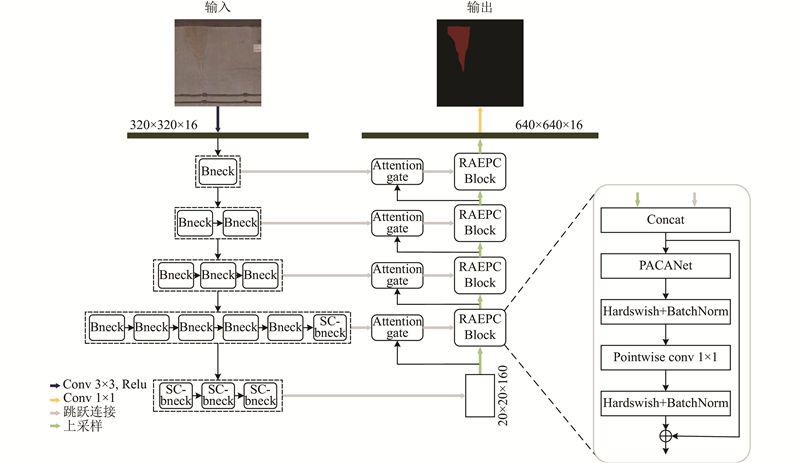
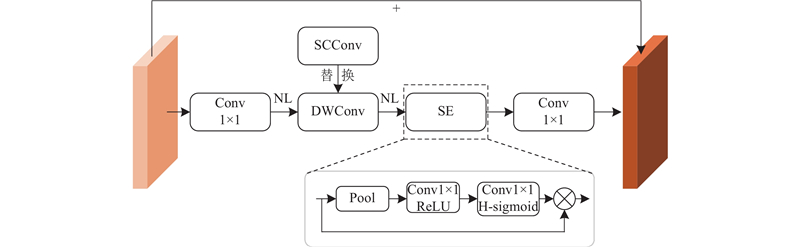
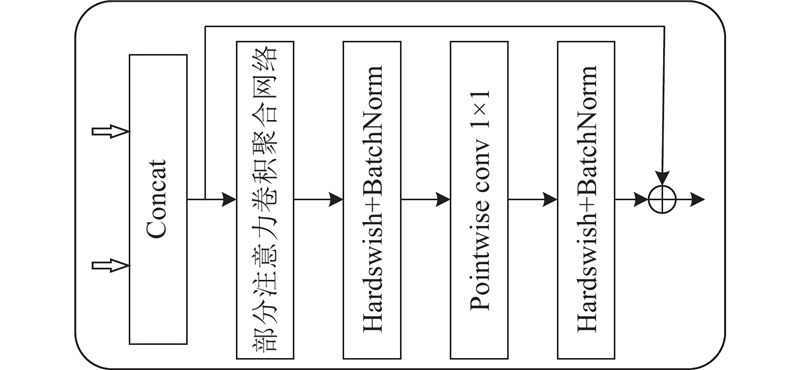
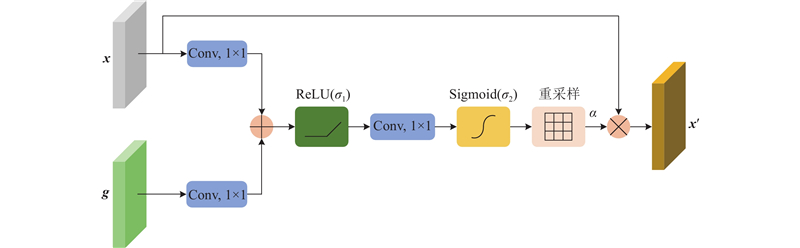
Abstract The lightweight segmentation model HMARU-net was proposed in order to address the issues of low detection accuracy, slow detection speed, and poor interference resistance in existing subway tunnel lining water leakage detection models. HC-MobileNetV3 combined with self-calibrating convolution was employed as the backbone feature extraction network, achieving lightweight modeling while enhancing multi-scale feature extraction capability. The partial attention convolutional aggregation network was designed to enhance global information modeling and complex detail feature extraction through attention mechanism and residual structure. A residual module (RAEPC Block) was incorporated into the decoder to reduce computational demand while improving segmentation accuracy and interference resistance. An Attention Gate introduced in the skip-connection layer effectively mitigated semantic discrepancy between encoder and decoder. The experimental results demonstrated that HMARU-net achieved the mean intersection over union of 86.0%, mean pixel accuracy of 93.07%, and accuracy of 98.33%. Model complexity was significantly reduced, with only 3.134×10⁶ parameters and 6.872×10⁹ computations, enabling image processing speed of 78.967 frames per second. HMARU-net significantly improved detection accuracy and efficiency while offering strong lightweight advantage compared with other mainstream semantic segmentation models.
|
|
Received: 02 April 2025
Published: 04 February 2026
|
|
|
| Fund: 国家自然科学基金资助项目(61661027);中央引导地方科技发展资金资助项目(24ZYQA044);甘肃省重点研发计划资助项目(22YF7GA141). |
基于HMARU-net的隧道渗漏水轻量化检测方法
针对现有地铁隧道衬砌渗漏水检测模型检测精度较低、检测速度较慢、抗干扰能力较差的问题,提出轻量化分割模型HMARU-net. 采用结合自校准卷积的HC-MobileNetV3作为主干特征提取网络,轻量化模型并提升多尺度特征提取能力. 设计部分注意力卷积聚合网络PACANet,通过注意力机制和残差结构,增强全局信息建模和复杂细节特征提取的能力. 构建残差模块RAEPC Block组成解码器,减少计算需求,提高分割精度和抗干扰能力. 在跳跃连接层引入Attention Gate,有效降低编、解码器之间的语义差异. 实验结果表明,HMARU-net的平均交并比、平均像素准确度和准确率分别达到86.0%、93.07%和98.33%. 模型复杂度大幅降低,参数量、计算量仅为3.134×10⁶和6.872×10⁹,图片处理速度达到78.967 帧/s. 与其他主流语义分割模型相比,HMARU-net显著提升了检测精度与效率,具有较强的轻量化优势.
关键词:
渗漏水,
语义分割,
轻量化,
病害检测,
深度学习
|
|
| [1] |
侯秀芳, 冯晨, 燕汉民, 等 2024年中国内地城市轨道交通运营线路概况[J]. 都市快轨交通, 2025, 38 (1): 13- 19
HOU Xiufang, FENG Chen, YAN Hanmin, et al Overview of urban rail transit operations in Chinese China’s mainland in 2024[J]. Urban Rapid Rail Transit, 2025, 38 (1): 13- 19
|
|
|
| [2] |
TAN L, CHEN X, HU X, et al. DMDSNet: a computer vision-based dual multi-task model for tunnel bolt detection and corrosion segmentation [C]//Proceedings of the IEEE 26th International Conference on Intelligent Transportation Systems. Bilbao: IEEE, 2024: 4827–4833.
|
|
|
| [3] |
李健超, 柴雪松, 马学志, 等 铁路隧道衬砌表观病害等级评定研究[J]. 铁道建筑, 2023, 63 (4): 73- 76
LI Jianchao, CHAI Xuesong, MA Xuezhi, et al Research on evaluation of surface disease grade for railway tunnel lining[J]. Railway Engineering, 2023, 63 (4): 73- 76
doi: 10.3969/j.issn.1003-1995.2023.04.17
|
|
|
| [4] |
常瑞清. 襄渝线隧道渗漏水病害分析与修理工作策略优化研究 [D]. 北京: 中国铁道科学研究院, 2023: 1–10.
CHANG Ruiqing. Analysis of water-seepage disease and optimization of repair strategy in Xiangyu Railway Tunnel [D]. Beijing: China Academy of Railway Sciences, 2023: 1-10.
|
|
|
| [5] |
黄宏伟, 李庆桐 基于深度学习的盾构隧道渗漏水病害图像识别[J]. 岩石力学与工程学报, 2017, 36 (12): 2861- 2871
HUANG Hongwei, LI Qingtong Image recognition for water leakage in shield tunnel based on deep learning[J]. Chinese Journal of Rock Mechanics and Engineering, 2017, 36 (12): 2861- 2871
doi: 10.13722/j.cnki.jrme.2017.0552
|
|
|
| [6] |
宋娟, 贺龙喜, 龙会平 基于深度学习的隧道衬砌多病害检测算法[J]. 浙江大学学报: 工学版, 2024, 58 (6): 1161- 1173
SONG Juan, HE Longxi, LONG Huiping Deep learning-based algorithm for multi defect detection in tunnel lining[J]. Journal of Zhejiang University: Engineering Science, 2024, 58 (6): 1161- 1173
doi: 10.3785/j.issn.1008-973X.2024.06.007
|
|
|
| [7] |
王健, 郑理科, 吴斌杰, 等 改进Mask RCNN的盾构隧道渗漏水检测方法[J]. 测绘通报, 2024, (2): 170- 177
WANG Jian, ZHENG Like, WU Binjie, et al Improved Mask RCNN method for shield tunnel leakage detection[J]. Bulletin of Surveying and Mapping, 2024, (2): 170- 177
doi: 10.13474/j.cnki.11-2246.2024.0232
|
|
|
| [8] |
周中, 张俊杰, 龚琛杰, 等 基于深度语义分割的隧道渗漏水智能识别[J]. 岩石力学与工程学报, 2022, 41 (10): 2082- 2093
ZHOU Zhong, ZHANG Junjie, GONG Chenjie, et al Automatic identification of tunnel leakage based on deep semantic segmentation[J]. Chinese Journal of Rock Mechanics and Engineering, 2022, 41 (10): 2082- 2093
doi: 10.13722/j.cnki.jrme.2022.0016
|
|
|
| [9] |
TAN L, HU X, TANG T, et al A lightweight metro tunnel water leakage identification algorithm via machine vision[J]. Engineering Failure Analysis, 2023, 150: 107327
doi: 10.1016/j.engfailanal.2023.107327
|
|
|
| [10] |
WANG P, SHI G Image segmentation of tunnel water leakage defects in complex environments using an improved Unet model[J]. Scientific Reports, 2024, 14: 24286
doi: 10.1038/s41598-024-75723-4
|
|
|
| [11] |
RONNEBERGER O, FISCHER P, BROX T. U-Net: convolutional networks for biomedical image segmentation [C]//Medical Image Computing and Computer-Assisted Intervention. Cham: Springer, 2015: 234–241.
|
|
|
| [12] |
杨栋杰, 高贤君, 冉树浩, 等 基于多重多尺度融合注意力网络的建筑物提取[J]. 浙江大学学报: 工学版, 2022, 56 (10): 1924- 1934
YANG Dongjie, GAO Xianjun, RAN Shuhao, et al Building extraction based on multiple multiscale-feature fusion attention network[J]. Journal of Zhejiang University: Engineering Science, 2022, 56 (10): 1924- 1934
doi: 10.3785/j.issn.1008-973X.2022.10.004
|
|
|
| [13] |
吴泽康, 赵姗, 李宏伟, 等 遥感图像语义分割空间全局上下文信息网络[J]. 浙江大学学报: 工学版, 2022, 56 (4): 795- 802
WU Zekang, ZHAO Shan, LI Hongwei, et al Spatial global context information network for semantic segmentation of remote sensing image[J]. Journal of Zhejiang University: Engineering Science, 2022, 56 (4): 795- 802
doi: 10.3785/j.issn.1008-973X.2022.04.019
|
|
|
| [14] |
SIMONYAN K, ZISSERMAN A. Very deep convolutional networks for large-scale image recognition [EB/OL]. [2025-03-15]. https://arxiv.org/abs/1409.1556
|
|
|
| [15] |
HOWARD A, SANDLER M, CHEN B, et al. Searching for MobileNetV3 [C]//Proceedings of the IEEE/CVF International Conference on Computer Vision. Seoul: IEEE, 2019: 1314-1324.
|
|
|
| [16] |
LIU J J, HOU Q, CHENG M M, et al. Improving convolutional networks with self-calibrated convolutions [C]//Proceedings of the IEEE/CVF Conference on Computer Vision and Pattern Recognition. Seattle: IEEE, 2020: 10093–10102.
|
|
|
| [17] |
CHEN J, KAO S H, HE H, et al. Run, don’t walk: chasing higher FLOPS for faster neural networks [C]//Proceedings of the IEEE/CVF Conference on Computer Vision and Pattern Recognition. Vancouver: IEEE, 2023: 12021–12031.
|
|
|
| [18] |
OKTAY O, SCHLEMPER J, LE FOLGOC L, et al. Attention U-Net: learning where to look for the pancreas [EB/OL]. [2025-03-15]. https://arxiv.org/abs/1804.03999
|
|
|
| [19] |
LIN T Y, GOYAL P, GIRSHICK R, et al. Focal loss for dense object detection [C]//Proceedings of the IEEE International Conference on Computer Vision. Venice: IEEE, 2017: 2999–3007.
|
|
|
| [20] |
CHEN L C, ZHU Y, PAPANDREOU G, et al. Encoder-decoder with atrous separable convolution for semantic image segmentation [C]// Proceedings of the European Conference on Computer Vision. Cham: Springer, 2018: 833–851.
|
|
|
| [21] |
ZHAO H, SHI J, QI X, et al. Pyramid scene parsing network [C]//Proceedings of the IEEE Conference on Computer Vision and Pattern Recognition. Honolulu: IEEE, 2017: 6230–6239.
|
|
|
| [22] |
XIE E, WANG W, YU Z, et al. SegFormer: simple and efficient design for semantic segmentation with transformers [EB/OL]. [2025-03-15]. https://arxiv.org/abs/2105.15203.
|
|
|
| [23] |
郭道俊, 周幸宇, 许崇帮, 等 基于DeepLabV3+网络改进的快速隧道病害分割方法[J]. 公路交通科技, 2023, 40 (8): 127- 135
GUO Daojun, ZHOU Xingyu, XU Chongbang, et al Improved fast tunnel disease segmentation method based on DeepLabV3+ network[J]. Journal of Highway and Transportation Research and Development, 2023, 40 (8): 127- 135
doi: 10.3969/j.issn.1002-0268.2023.08.018
|
|
|
| [24] |
WANG D, HOU G, CHEN Q, et al Segmentation of tunnel water leakage based on a lightweight DeepLabV3+ model[J]. Measurement Science and Technology, 2025, 36 (1): 015414
doi: 10.1088/1361-6501/ad894f
|
|
|
| [25] |
陈曦, 张坤, 王伟, 等 基于TR-Unet的隧道渗漏水智能识别方法[J]. 应用基础与工程科学学报, 2025, 33 (2): 514- 525
CHEN Xi, ZHANG Kun, WANG Wei, et al Intelligent identification of tunnel water leakage based on TR-Unet[J]. Journal of Basic Science and Engineering, 2025, 33 (2): 514- 525
doi: 10.16058/j.issn.1005-0930.2025.02.018
|
|
|
|
Viewed |
|
|
|
Full text
|
|
|
|
|
Abstract
|
|
|
|
|
Cited |
|
|
|
|
| |
Shared |
|
|
|
|
| |
Discussed |
|
|
|
|