Please wait a minute...
浙江大学学报(工学版)  2026, Vol. 60 Issue (5): 1047-1058    DOI: 10.3785/j.issn.1008-973X.2026.05.014
机械工程     
磁流变减振器力学模型的模糊综合评价方法
王骏骋(),章世伟
浙江理工大学 机械工程学院,浙江 杭州 310018
Fuzzy comprehensive evaluation method for mechanical model of magnetorheological damper
Juncheng WANG(),Shiwei ZHANG
School of Mechanical Engineering, Zhejiang Sci-Tech University, Hangzhou 310018, China
 全文: PDF(1424 KB)   HTML
摘要:

提出用于磁流变减振器力学模型的新评价方法,构建包含统计学参数、模型滞回曲线形状和模型运行效率的三维评价指标体系,配套选取7项二级评价指标,以突破单维度评价局限. 为了解决传统主观赋权法局限,采用融合熵权法与变异系数法的组合赋权策略,通过线性加权融合实现二级评价指标综合权重分配;基于模糊综合评价理论构建多级评判矩阵,结合层次分析法确定一级评价指标权重系数,通过加权计算得到模型综合评价值. 基于磁流变减振器动态特性试验,对Bingham与魔术公式模型开展参数拟合与性能评价分析. 结果表明:所提评价方法在统计学参数、模型滞回曲线形状和模型运行效率上实现了量化解耦评估.

关键词: 磁流变减振器力学模型模型保真度模型业务价值模型软件驱动质量模糊综合评价    
Abstract:

A new evaluation method for the mechanical models of magnetorheological damper was proposed. A three-dimensional evaluation index system was established, incorporating statistical parameters, hysteresis curve shape, and model computational efficiency. Seven secondary evaluation indexes were selected to overcome the limitations of single-dimensional assessment. To address the constraints of traditional subjective weighting methods, a combined weighting strategy integrating the entropy weight method and the coefficient of variation method was adopted. The comprehensive weights of secondary evaluation indexes were determined through linear weighting integration. A multi-level evaluation matrix was constructed based on fuzzy comprehensive evaluation theory, while the analytic hierarchy process was applied to determine the weight coefficients of first-level evaluation indexes. The overall evaluation value of the model was subsequently calculated via weighted synthesis. Based on dynamic characteristic tests of magnetorheological dampers, parameter fitting and performance evaluation were conducted for both the Bingham and magic formula models. Results demonstrate that the proposed method enables quantitative decoupled assessment across statistical parameters, hysteresis curve shape, and computational efficiency.

Key words: magnetorheological damper    mechanical model    model fidelity    model business value    model software-driven quality    fuzzy comprehensive evaluation
收稿日期: 2025-06-06 出版日期: 2026-05-06
CLC:  TP 393  
基金资助: 国家自然科学基金资助项目(52205135).
作者简介: 王骏骋(1990—),男,副教授,硕导,从事新能源汽车底盘系统动力学、自动驾驶决策控制研究. orcid.org/0000-0003-0539-0063. E-mail:wangjc90@163.com
服务  
把本文推荐给朋友
加入引用管理器
E-mail Alert
作者相关文章  
王骏骋
章世伟

引用本文:

王骏骋,章世伟. 磁流变减振器力学模型的模糊综合评价方法[J]. 浙江大学学报(工学版), 2026, 60(5): 1047-1058.

Juncheng WANG,Shiwei ZHANG. Fuzzy comprehensive evaluation method for mechanical model of magnetorheological damper. Journal of ZheJiang University (Engineering Science), 2026, 60(5): 1047-1058.

链接本文:

https://www.zjujournals.com/eng/CN/10.3785/j.issn.1008-973X.2026.05.014        https://www.zjujournals.com/eng/CN/Y2026/V60/I5/1047

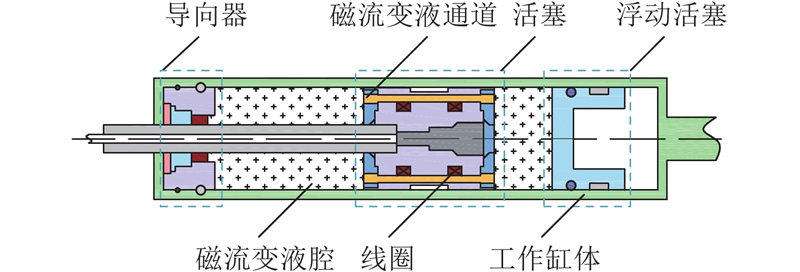
图 1  磁流变减振器内部结构
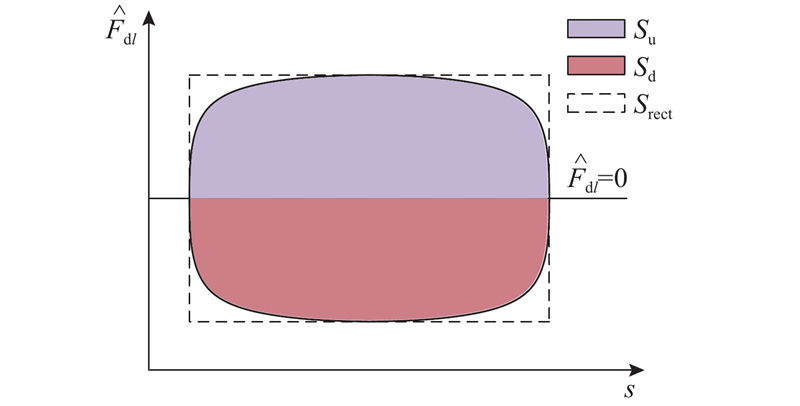
图 2  磁流变减振器力学模型的力-位移图
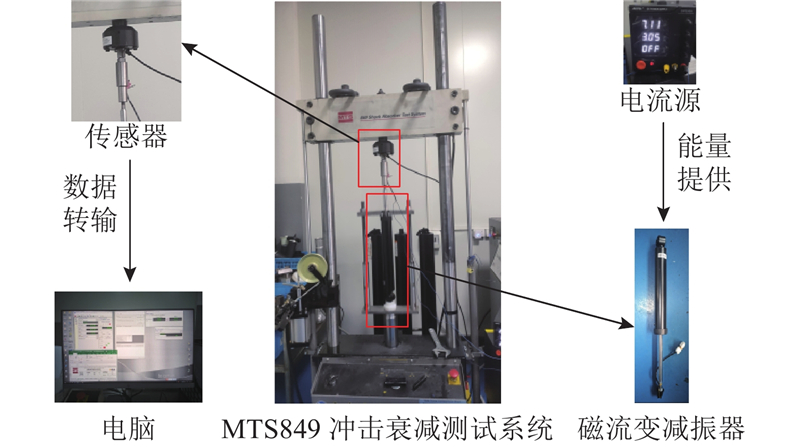
图 3  台架试验设备
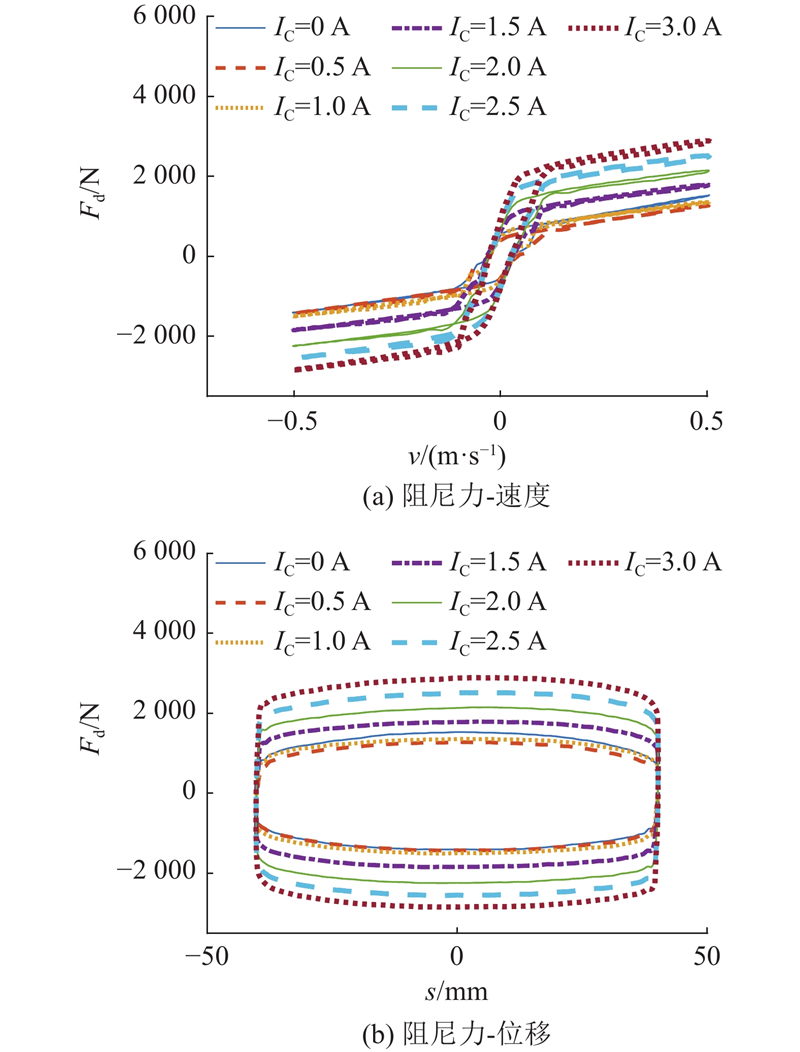
图 4  台架试验得到的磁流变减振器参数特性曲线
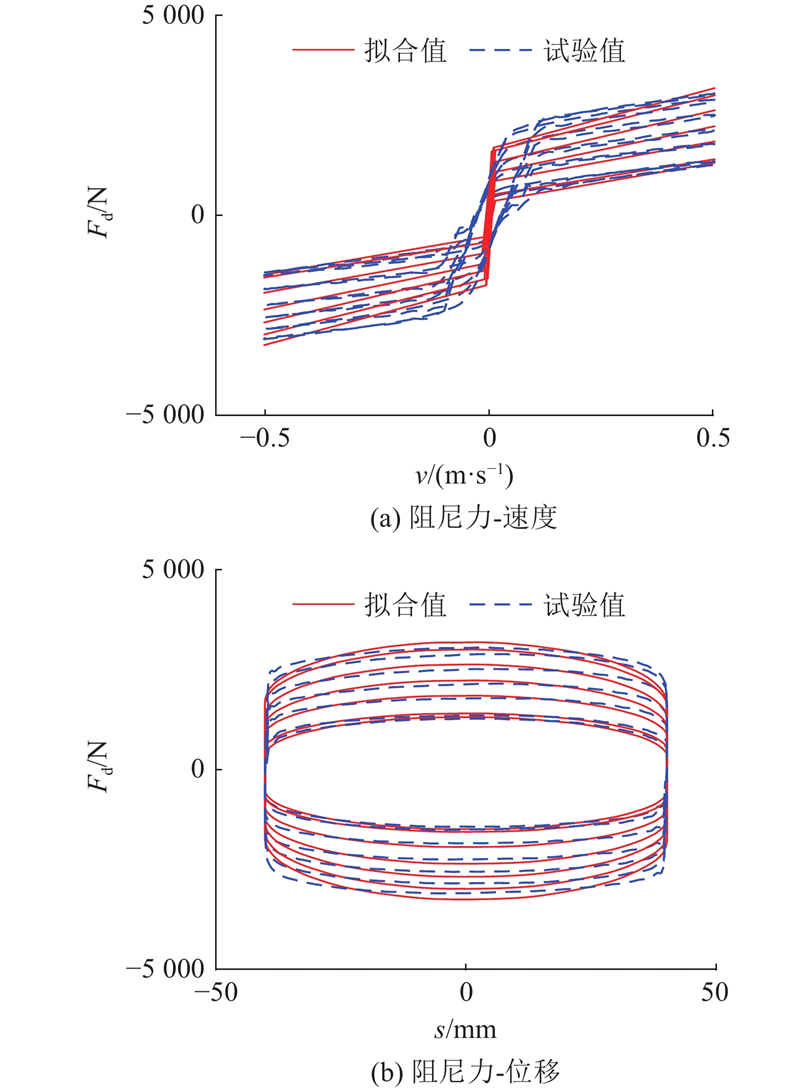
图 5  Bingham模型拟合的磁流变减振器参数特性曲线
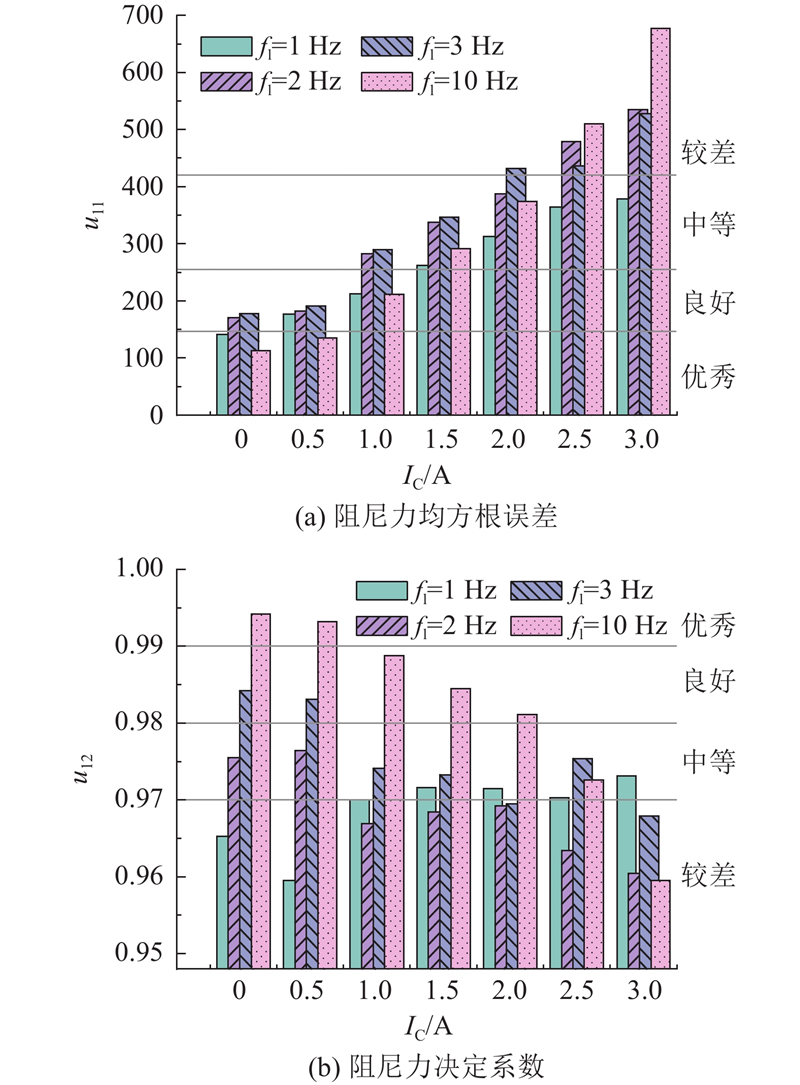
fl/HzIC/Au11u12fl/HzIC/Au11u12
10140.82730.965330177.26040.9842
0.5176.60490.95950.5190.78800.9831
1.0212.79560.97001.0289.99710.9741
1.5262.27930.97161.5346.59830.9733
2.0313.02420.97152.0431.43270.9695
2.5364.62290.97032.5436.41880.9754
3.0378.53980.97313.0527.62790.9679
20170.33270.9755100112.90170.9942
0.5182.28070.97640.5134.70940.9932
1.0282.40860.96691.0210.90370.9888
1.5337.39370.96841.5291.77600.9845
2.0387.54260.96922.0374.06230.9811
2.5478.70020.96342.5509.83530.9726
3.0534.88620.96043.0677.55010.9595
表 1  Bingham模型保真度结果
fl/HzIC/Au21/%u22/%u23/%
100.01491.08033.7329
0.50.01211.15184.2791
1.00.01360.56213.4933
1.50.01350.19184.9035
2.00.01760.08955.4025
2.50.02160.99655.8992
3.00.02420.15456.5548
200.14270.51543.6284
0.50.10600.09553.5557
1.00.26190.14094.6963
1.50.21790.11884.3538
2.00.23530.48254.6931
2.50.23560.48935.2297
3.00.17560.29565.3954
300.04200.96171.0887
0.50.04870.49341.1622
1.00.09480.09852.6257
1.50.09880.71402.6121
2.00.11170.94743.3687
2.50.10670.86872.7479
3.00.11310.90613.7842
1000.00740.61394.3078
0.50.00510.52734.4172
1.00.00080.70752.6381
1.50.00150.27160.7305
2.00.00260.56680.2494
2.50.00851.04282.3044
3.00.02451.23954.3657
表 2  Bingham模型业务价值结果
fl/HzIC/Au31/su32/MBfl/HzIC/Au31/su32/MB
102.0406197.44302.2096222.60
0.51.7626205.620.51.6176223.11
1.01.8016198.591.01.6706206.61
1.51.6956197.631.51.8146214.86
2.01.6826205.732.01.7366222.96
2.51.7076197.632.51.6556223.04
3.01.7216197.633.01.7186214.86
201.9566204.4810010.0306425.03
0.51.7716187.910.59.5936425.10
1.01.8576196.021.09.3296426.15
1.51.7666204.271.59.6836425.10
2.01.6286204.192.09.7366427.01
2.51.7406204.272.59.6856425.13
3.01.6676187.843.09.5256408.90
表 3  Bingham模型软件驱动质量结果
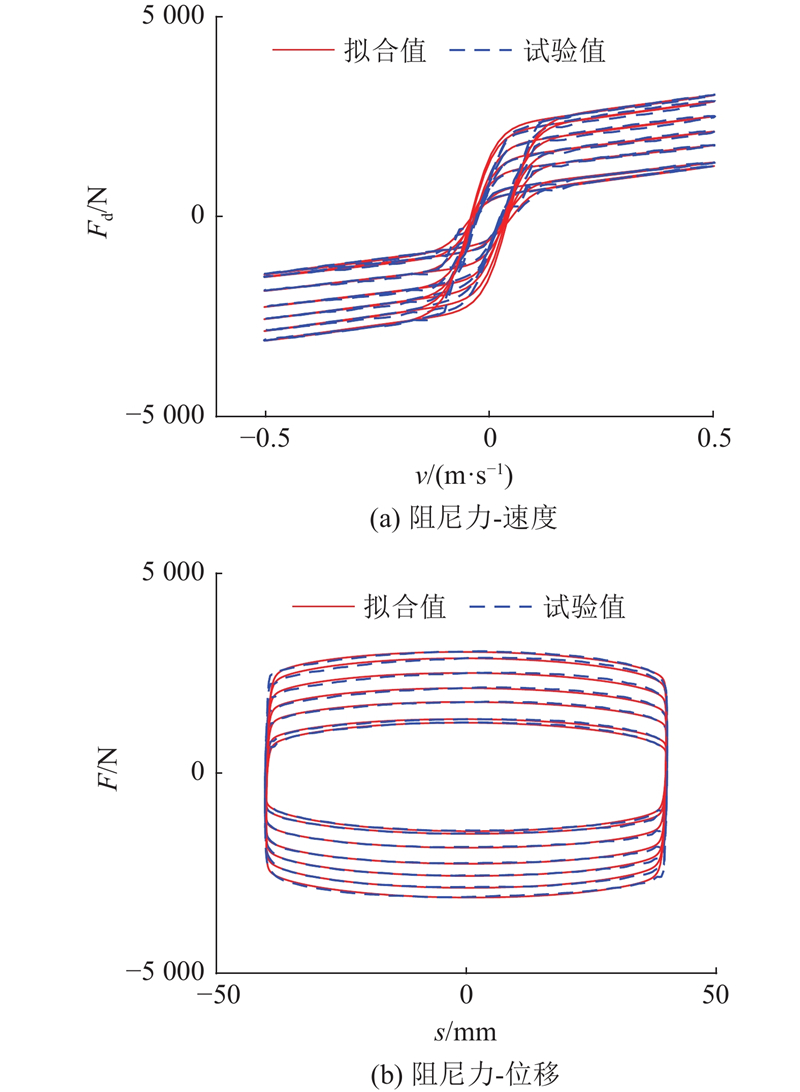
图 6  魔术公式模型拟合的磁流变减振器参数特性曲线
fl/HzIC/Au11u12fl/HzIC/Au11u12
1059.39030.994030103.94630.9946
0.569.12220.99400.5107.44480.9947
1.091.28760.99461.0131.44040.9948
1.5113.23690.99481.5153.82150.9948
2.0138.57010.99452.0178.44850.9949
2.5167.21430.99392.5201.75300.9948
3.0175.38740.99433.0210.97800.9950
2079.43370.9948100131.89470.9921
0.582.81290.99520.5128.81220.9938
1.0108.89470.99521.0149.09380.9944
1.5137.03880.99491.5167.96760.9949
2.0156.47420.99512.0186.91030.9954
2.5179.01500.99502.5228.85370.9946
3.0187.32740.99533.0291.32980.9927
表 4  魔术公式模型保真度结果
fl/HzIC/Au21/%u22/%u23/%
100.04811.00250.4587
0.50.05331.01440.7076
1.00.04470.54581.3298
1.50.05000.24860.5929
2.00.05560.15410.7675
2.50.04350.20330.7906
3.00.05160.01100.5664
200.05320.54910.3476
0.50.05100.05970.2994
1.00.05030.08160.5289
1.50.05980.06510.1090
2.00.05970.42800.2799
2.50.04000.42330.4092
3.00.04060.23060.1987
300.02621.41370.9577
0.50.01140.89910.9491
1.00.01280.68660.6106
1.50.00810.12220.7443
2.00.01370.04420.4846
2.50.01160.00770.7614
3.00.01970.13870.4908
1000.01010.60180.0753
0.50.00700.46605.3871
1.00.00890.73074.5847
1.50.00990.83093.4373
2.00.01050.70662.8868
2.50.01101.30151.7233
3.00.00572.32920.7684
表 5  魔术公式模型业务价值结果
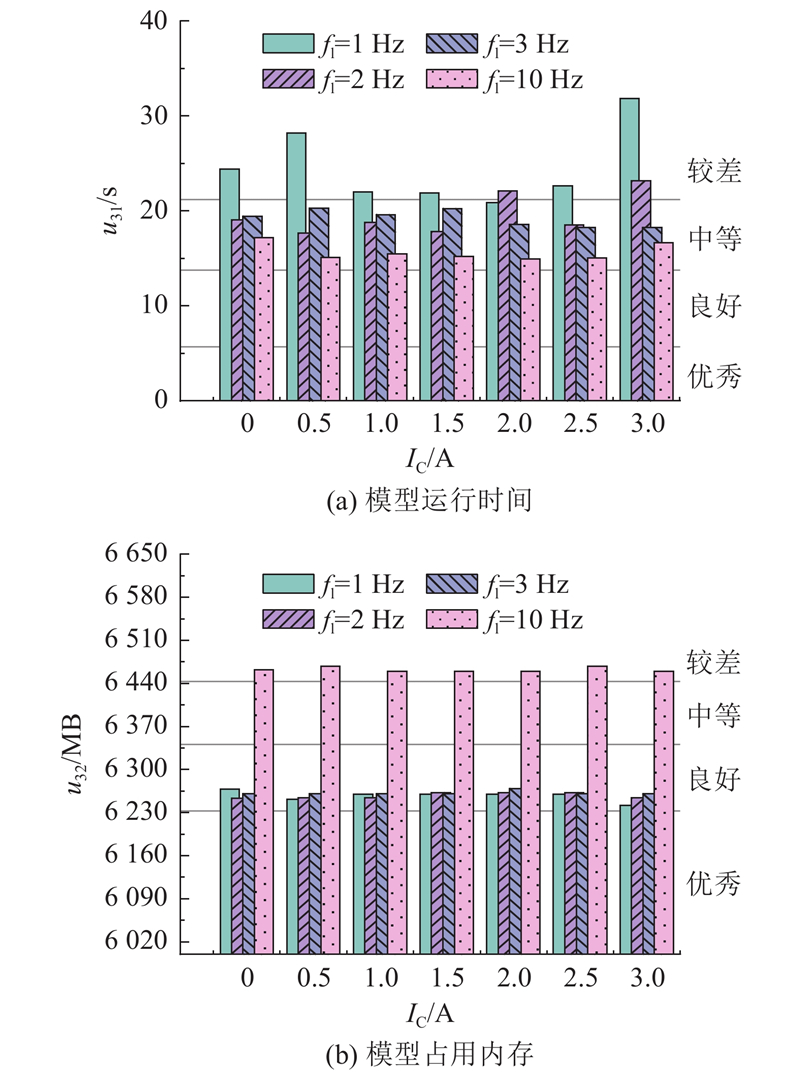
fl/HzIC/Au31/su32/MBfl/HzIC/Au31/su32/MB
1024.4196268.073019.4526260.52
0.528.2216251.940.520.2816260.84
1.022.0146260.451.019.6126260.81
1.521.8956259.431.520.2696260.84
2.020.8676259.432.018.5556269.09
2.522.6596259.432.518.2716260.84
3.031.8776241.383.018.2396260.84
2019.0686253.7210017.1986461.91
0.517.6836254.300.515.1256468.10
1.018.8116254.331.015.5126460.00
1.517.8146262.511.515.2256459.97
2.022.1096262.512.014.9706460.00
2.518.5376262.512.515.0386468.16
3.023.1536254.333.016.6716460.03
表 6  魔术公式模型软件驱动质量结果
评级得分评级区间
u11u12
优秀100[0, 146.66](0.99, 1.00]
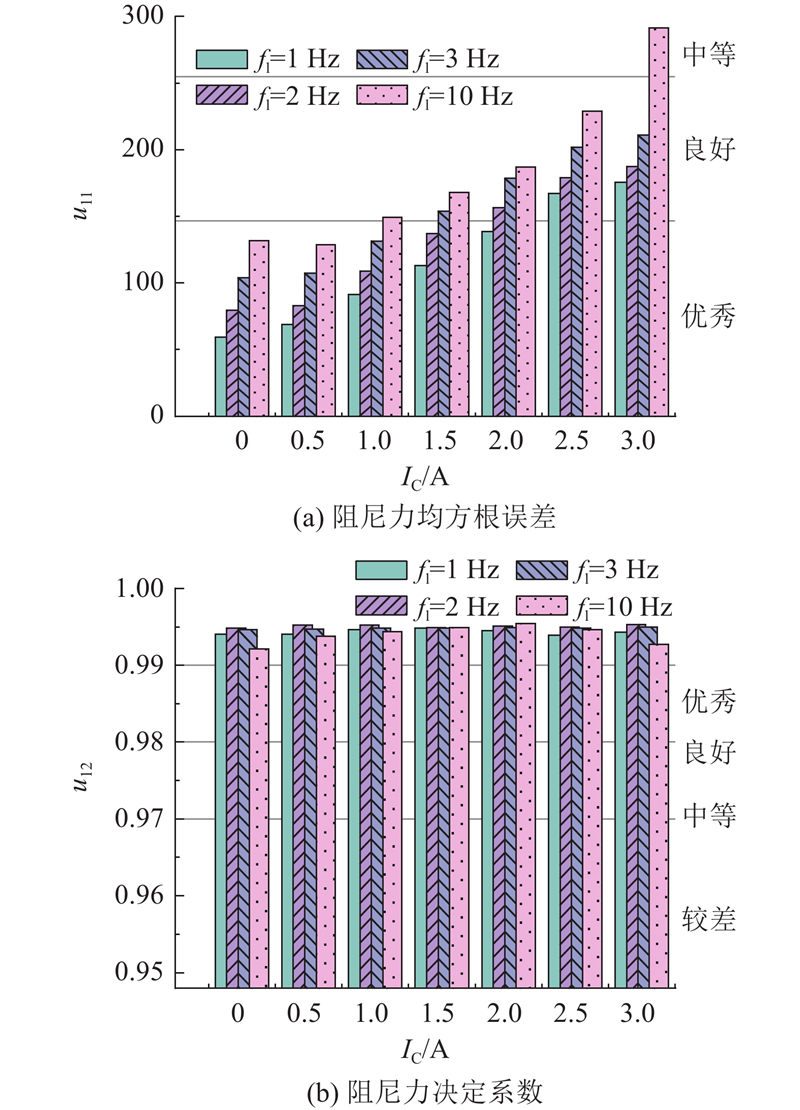
良好85(146.66, 254.92](0.98, 0.99]
中等70(254.92, 420.20](0.97, 0.98]
较差55(420.20, +∞)[0, 0.97]
表 7  模型保真度二级评价指标评级区间划分
图 7  Bingham模型保真度二级评价指标与评级区间
评级得分评级区间
u21/%u22/%u23/%
优秀100[0, 0.03][0, 0.35][0, 1.56]
良好85(0.03, 0.08](0.35, 0.81](1.56, 3.28]
中等70(0.08, 0.17](0.81, 1.69](3.28, 4.79]
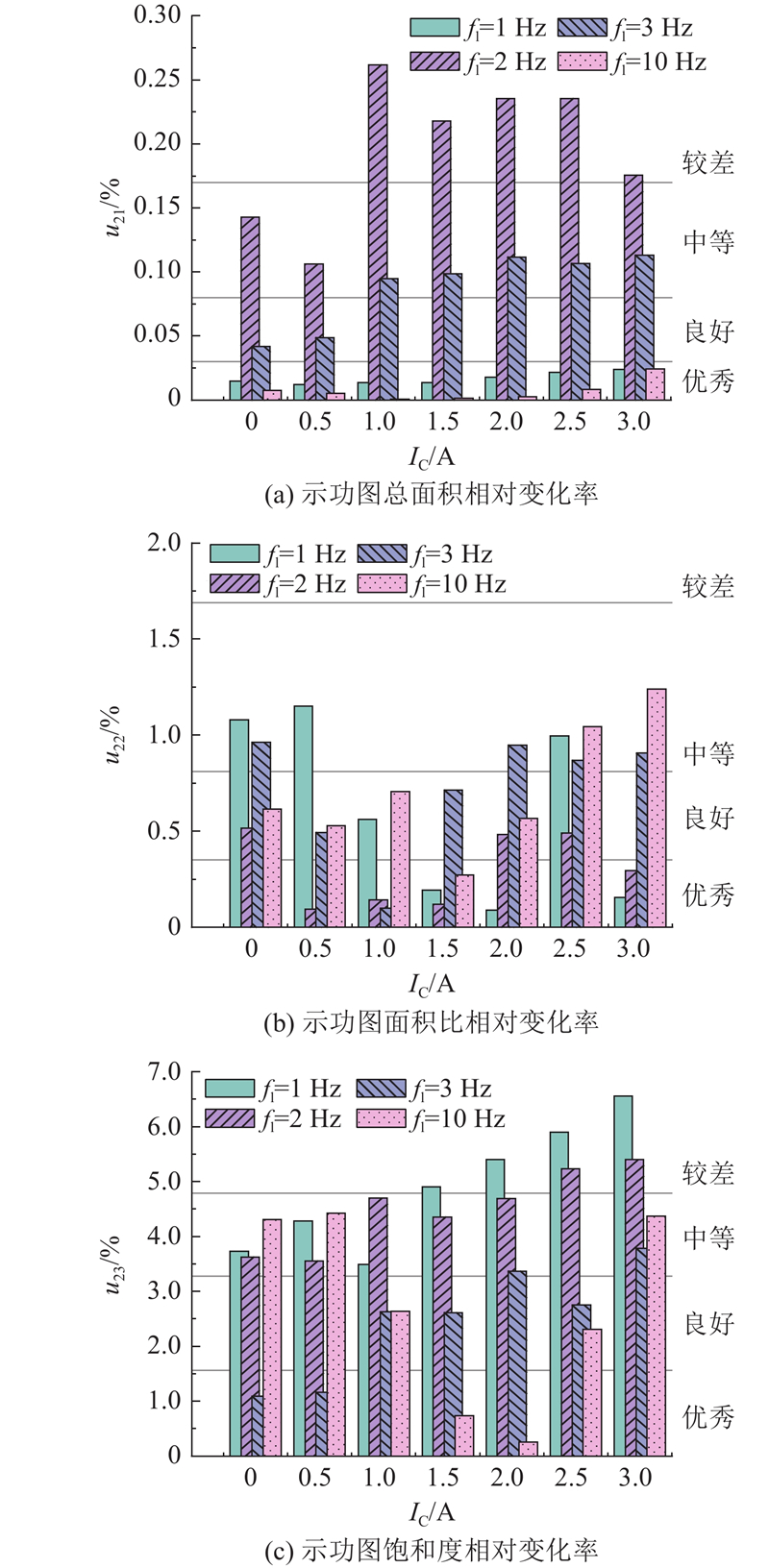
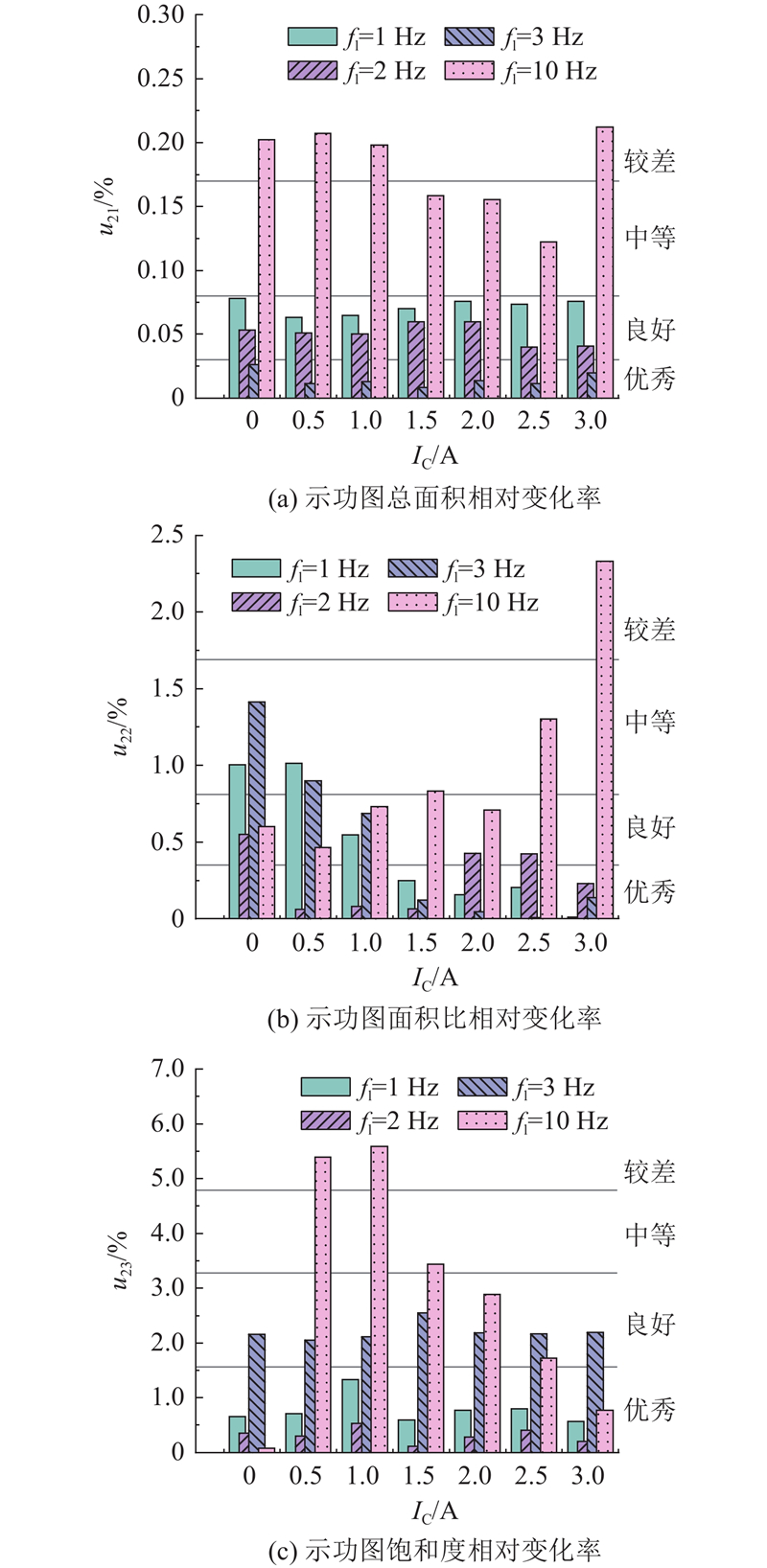
较差55(0.17, +∞)(1.69, +∞)(4.79, +∞)
表 8  模型业务价值二级评价指标评级区间划分
图 8  Bingham模型业务价值二级评价指标与评级区间
评级得分评级区间
u31/su32/MB
优秀100[0, 5.71][0, 6232.27]
良好85(5.71, 13.76](6232.27, 6341.08]
中等70(13.76, 21.20](6341.08, 6442.90]
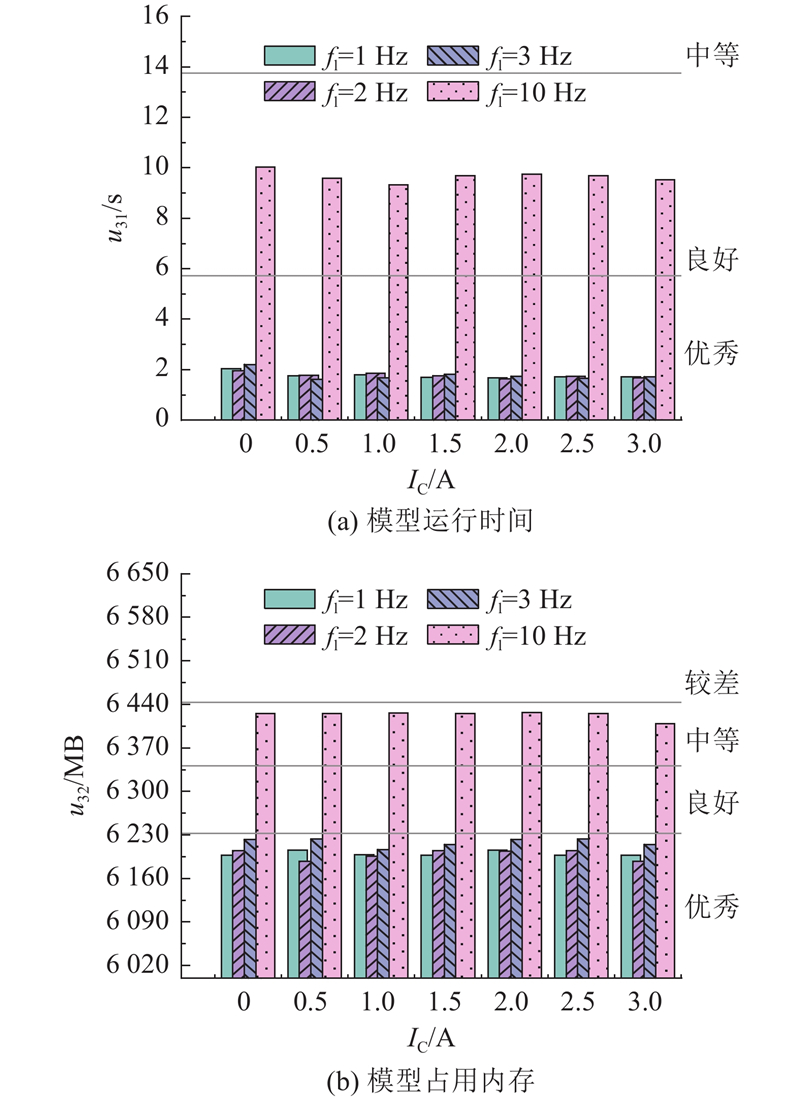
较差55(21.20, +∞)(6442.90, +∞)
表 9  模型软件驱动质量二级评价指标评级区间划分
图 9  Bingham模型软件驱动质量二级评价指标与评级区间
一级评价指标hpq
U1U2U3
U1137
U21/315
U31/71/51
表 10  一级评价指标重要性对应表
图 10  魔术公式模型保真度二级评价指标与评级区间
图 11  魔术公式模型业务价值二级评价指标与评级区间
图 12  魔术公式模型软件驱动质量二级评价指标与评级区间
参数模型z1z2z3J
Bingham70.372980.688094.288874.9352
魔术公式95.588492.052774.058693.0913
表 11  不同参数模型的评价指标对比
1 叶青, 姜笑, 张垚, 等 考虑响应时滞的磁流变半主动悬架H∞控制与试验研究[J]. 机械工程学报, 2024, 60 (18): 276- 287
YE Qing, JIANG Xiao, ZHANG Yao, et al H∞ control and experimental study of magnetorheological semi-active suspension with actuator response delay[J]. Journal of Mechanical Engineering, 2024, 60 (18): 276- 287
doi: 10.3901/JME.2024.18.276
2 HU T, JIANG L, PAN L, et al Development of a semi-active suspension using a compact magnetorheological damper with negative-stiffness components[J]. Mechanical Systems and Signal Processing, 2025, 223: 111842
doi: 10.1016/j.ymssp.2024.111842
3 LIANG H, FU J, LI W, et al Theoretical switch model of novel asymmetric magnetorheological damper for shock and vibration application[J]. Smart Materials and Structures, 2024, 33 (1): 015008
doi: 10.1088/1361-665X/ad10c0
4 LIU Y, WANG Q, XING X, et al Development and characterization of a magnetorheological damper with low-velocity sensitivity[J]. Mechanics of Advanced Materials and Structures, 2025, 32 (23): 5818- 5829
doi: 10.1080/15376494.2024.2427931
5 YANG Y, LI Y J, HUANG X H, et al Force lag phenomenon in multi-coil fluid-deficient magnetorheological dampers: experimental investigation and dynamic modeling[J]. Smart Materials and Structures, 2025, 34 (2): 025004
doi: 10.1088/1361-665X/ad9676
6 张丽霞, 庞齐齐, 潘福全, 等 磁流变减振器魔术公式模型在悬架控制中的应用[J]. 中国机械工程, 2020, 31 (14): 1659- 1665
ZHANG Lixia, PANG Qiqi, PAN Fuquan, et al Suspension control applications of magnetorheological damper magic formula model[J]. China Mechanical Engineering, 2020, 31 (14): 1659- 1665
7 HU G, YING S, QI H, et al Design, analysis and optimization of a hybrid fluid flow magnetorheological damper based on multiphysics coupling model[J]. Mechanical Systems and Signal Processing, 2023, 205: 110877
doi: 10.1016/j.ymssp.2023.110877
8 LI J, LUO J, ZHANG F, et al Modeling of magnetorheological dampers based on a dual-flow neural network with efficient channel attention[J]. Smart Materials and Structures, 2023, 32 (10): 105006
doi: 10.1088/1361-665X/acf016
9 PEI P, QUEK S T, PENG Y Enriched global–local multi-objective optimization scheme for fuzzy logic controller-driven magnetorheological damper-based structural system[J]. Mechanical Systems and Signal Processing, 2023, 193: 110267
doi: 10.1016/j.ymssp.2023.110267
10 李嘉豪, 张永浩, 杜新新, 等 磁流变液阻尼器分阶段建模与流道参数敏感性分析[J]. 机械工程学报, 2022, 58 (11): 143- 155
LI Jiahao, ZHANG Yonghao, DU Xinxin, et al On phase modeling and channel parameters sensitivity analysis for magnetorheological fluid damper[J]. Journal of Mechanical Engineering, 2022, 58 (11): 143- 155
doi: 10.3901/JME.2022.11.143
11 JIANG R, RUI X, WEI M, et al A phenomenological model of magnetorheological damper considering fluid deficiency[J]. Journal of Sound and Vibration, 2023, 562: 117851
doi: 10.1016/j.jsv.2023.117851
12 DELIJANI Y M, CHENG S, GHERIB F Sequential neural network model for the identification of magnetorheological damper parameters[J]. Smart Materials and Structures, 2024, 33 (1): 015002
doi: 10.1088/1361-665X/ad0f36
13 郝荣彪, 赵宝生, 党贺, 等 基于改进Bouc-Wen模型的磁流变阻尼器建模及验证[J]. 应用力学学报, 2021, 38 (4): 1574- 1579
HAO Rongbiao, ZHAO Baosheng, DANG He, et al Modeling and verification of magnetorheological dampers based on improved Bouc-Wen model[J]. Chinese Journal of Applied Mechanics, 2021, 38 (4): 1574- 1579
doi: 10.11776/cjam.38.04.B044
14 XING X, CHEN Z, YU D, et al An invertible hysteresis model for magnetorheological damper with improved adaption capability in frequency and amplitude[J]. Smart Materials and Structures, 2024, 33 (5): 055006
doi: 10.1088/1361-665X/ad38a5
15 欧阳武, 程启超, 金勇, 等 基于熵权模糊综合评价法的水润滑尾轴承性能评估[J]. 中国机械工程, 2020, 31 (12): 1407- 1414
OUYANG Wu, CHENG Qichao, JIN Yong, et al Performance evaluation of water lubricated stern bearings based on entropy weight fuzzy comprehensive evaluation method[J]. China Mechanical Engineering, 2020, 31 (12): 1407- 1414
doi: 10.3969/j.issn.1004-132X.2020.12.003
16 ZHONG C, YANG Q, LIANG J, et al Fuzzy comprehensive evaluation with AHP and entropy methods and health risk assessment of groundwater in Yinchuan Basin, northwest China[J]. Environmental Research, 2022, 204: 111956
doi: 10.1016/j.envres.2021.111956
17 HOU J, GAO T, YANG Y, et al Battery inconsistency evaluation based on hierarchical weight fusion and fuzzy comprehensive evaluation method[J]. Journal of Energy Storage, 2024, 84: 110878
doi: 10.1016/j.est.2024.110878
18 CHEN X, LIU S, LIU R W, et al Quantifying Arctic oil spilling event risk by integrating an analytic network process and a fuzzy comprehensive evaluation model[J]. Ocean and Coastal Management, 2022, 228: 106326
doi: 10.1016/j.ocecoaman.2022.106326
19 WANG Z, CAO Y, QIAO H, et al Research on the optimization technology of mechanical product design plan based on fuzzy comprehensive evaluation analysis method[J]. Scientific Programming, 2022, 2022: 1458003
20 WANG F, HAN S, LI Y, et al A hierarchical fuzzy comprehensive evaluation algorithm for running states of an electromechanical system[J]. Systems Science and Control Engineering, 2021, 9 (Suppl.1): 103- 113
21 LI Q, MENG X X, LIU Y B, et al Risk assessment of floor water inrush using entropy weight and variation coefficient model[J]. Geotechnical and Geological Engineering, 2019, 37 (3): 1493- 1501
doi: 10.1007/s10706-018-0702-9
22 张萌谡, 刘春天, 李希今, 等 基于K-means聚类算法的绩效考核模糊综合评价系统设计[J]. 吉林大学学报: 工学版, 2021, 51 (5): 1851- 1856
ZHANG Mengsu, LIU Chuntian, LI Xijin, et al Design of fuzzy comprehensive evaluation system for performance appraisal based on K-means clustering algorithm[J]. Journal of Jilin University: Engineering and Technology Edition, 2021, 51 (5): 1851- 1856
[1] 肖华平,李翰林,刘书海. 水下机械手研究进展[J]. 浙江大学学报(工学版), 2026, 60(1): 99-116.
[2] 汪御飞,李康康,张海彬,陈渊博,王光庆. 基于压电与电磁复合效应的超声振动能量采集方法[J]. 浙江大学学报(工学版), 2025, 59(6): 1293-1302.
[3] 李仲兴,贾英竹,耿国庆,覃夷旭,杨鑫昌. 基于多方法加权融合的矿用车质心侧偏角估计[J]. 浙江大学学报(工学版), 2025, 59(10): 2106-2114.
[4] 王小龙,吕海峰,黄晋英,刘广璞. 磁流变阻尼器无模型前馈/反馈复合控制[J]. 浙江大学学报(工学版), 2022, 56(5): 873-878.
[5] 高帅领,夏军强,董柏良,周美蓉,侯精明. 雨水口泄流对城市洪涝影响的数学模型[J]. 浙江大学学报(工学版), 2022, 56(3): 590-597.
[6] 林浩,李雷孝,王慧,马志强,万剑雄. 基于相关向量机和模糊综合评价的路况预测模型[J]. 浙江大学学报(工学版), 2021, 55(6): 1072-1082.
[7] 张铁,胡亮亮,邹焱飚. 基于混合遗传算法的机器人改进摩擦模型辨识[J]. 浙江大学学报(工学版), 2021, 55(5): 801-809.
[8] 陈英龙,闫迪,张增猛,宁大勇,弓永军. 基于水压直驱的软体单元的动静态特性[J]. 浙江大学学报(工学版), 2019, 53(8): 1602-1609.
[9] 吕良,陈虹,宫洵,赵海光,胡云峰. 汽油发动机冷却系统建模与水温控制[J]. 浙江大学学报(工学版), 2019, 53(6): 1119-1129.
[10] 张铁,肖蒙,邹焱飚,肖佳栋. 基于强化学习的机器人曲面恒力跟踪研究[J]. 浙江大学学报(工学版), 2019, 53(10): 1865-1873.
[11] 傅晓云, 雷磊, 杨钢, 李宝仁. 喷水推进型水下滑翔机的水平翼参数配置及定常运动分析[J]. 浙江大学学报(工学版), 2018, 52(8): 1499-1508.
[12] 张铁, 梁骁翃. 平面关节型机器人关节力矩的卡尔曼估计[J]. 浙江大学学报(工学版), 2018, 52(5): 951-959.
[13] 郑钰馨, 奚鹰, 卜王辉, 李梦如. RV减速器5自由度纯扭转模型非线性特性分析[J]. 浙江大学学报(工学版), 2018, 52(11): 2098-2109.
[14] 陈昭晖, 倪一清. 自传感磁流变阻尼器实时阻尼力跟踪控制[J]. 浙江大学学报(工学版), 2017, 51(8): 1551-1558.
[15] 徐焕祥,俞小莉,王雷,樊之鹏,窦文博,魏巍,李道飞. 压缩空气-燃油混合动力排气能量回收利用[J]. 浙江大学学报(工学版), 2016, 50(7): 1353-1359.