|
|
|
| Spread spectrum scheme design and resource allocation for internet of things over micro-satellites |
Zhejian ZHENG1,2,3( ),Xiaojun JIN1,2,3,*(),Zhonghe JIN1,2,3 |
1. Micro-Satellite Research Center, Zhejiang University, Hangzhou 310027, China
2. Key Laboratory of Micro-Nano Satellite Research of Zhejiang Province, Zhejiang University, Hangzhou 310027, China
3. Huanjiang Laboratory, Zhuji 311899, China |
|
|
|
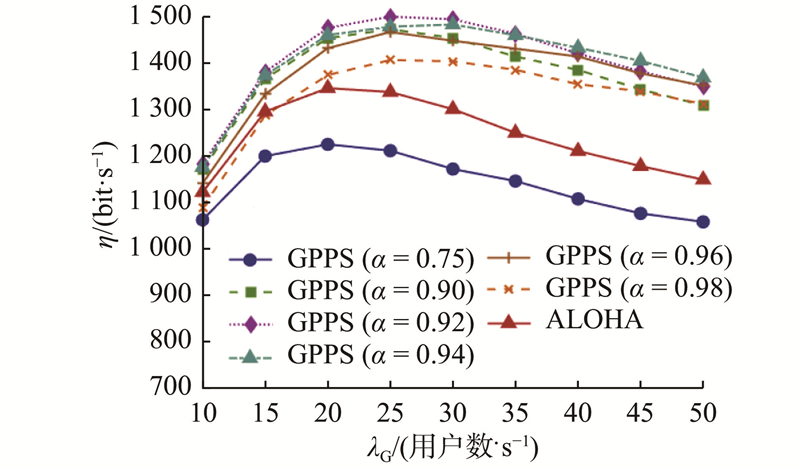
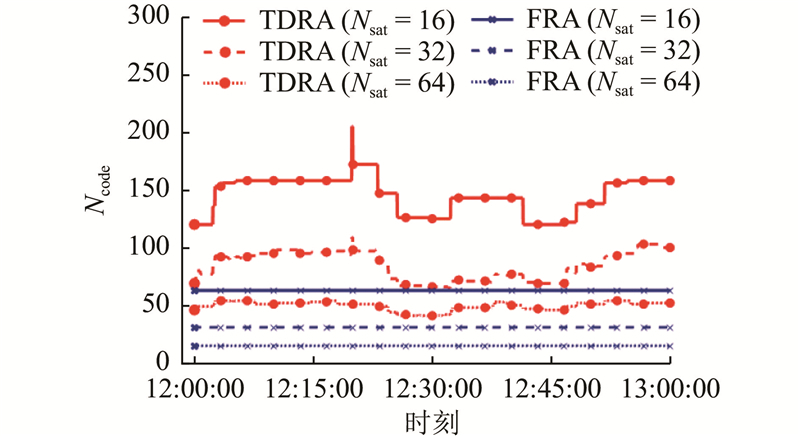
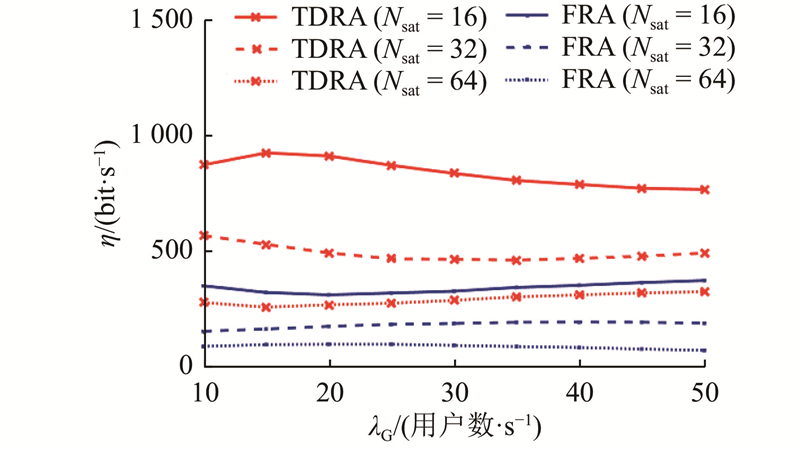
Abstract A multi-user spread spectrum communication scheme integrating cyclic extended synchronization code(CESC)with belief propagation(BP)decoding and successive interference cancellation(SIC)was proposed in order to enhance user access performance and interference suppression capability in massive-user access scenarios. The detection probability of weak-signal users was enhanced by compensating their synchronization code length. The access success rate was increased by 3.06% and the single-access cost was reduced by 40.52 bits compared with the power control strategy. A grouping and priority-based packet scheduling (GPPS)strategy was introduced in a hybrid grant-based and grant-free framework in order to improve transmission performance. A portion of spreading codes was allocated exclusively to grant-based users, which led to 13.05% increase in average throughput compared with the grant-free slotted ALOHA scheme. A topology-aware distributed resource allocation(TDRA)strategy was proposed in order to enhance the utilization efficiency of codes, enabling spatial reuse of resources. The average number of available spreading codes was improved by 216.37%, and the average throughput was improved by 226.86% compared with the fixed resource allocation(FRA)strategy. Results indicate that the proposed method can significantly strengthen the interference suppression and resource allocation capabilities of micro-satellite internet of things (IoT) under massive user access.
|
|
Received: 04 December 2025
Published: 21 October 2026
|
|
|
| Fund: 国家自然科学基金资助项目(62073289). |
|
Corresponding Authors:
Xiaojun JIN
E-mail: 22324035@zju.edu.cn;axemaster@zju.edu.cn
|
小卫星物联网扩频体制设计与资源分配策略
为了提升海量用户接入场景下的用户接入性能与干扰抑制能力,提出将循环扩展同步码(CESC)与置信传播(BP)译码及串行干扰消除(SIC)融合的多用户扩频通信方案,通过对弱信号用户的同步码长度进行补偿,提升捕获概率. 与功率控制策略相比,该方案的接入成功率提高了3.06%,单次接入成本降低了40.52 bit. 为了提升传输性能,提出授权与免授权混合体系下基于分组与优先级的数据包调度(GPPS)策略,将部分扩频码作为授权用户专用传输码,使平均吞吐率较免授权时隙ALOHA方案提升了13.05%. 为了进一步提高码利用率,提出基于拓扑感知的分布式资源分配(TDRA)策略以实现资源的空间复用,较固定资源分配(FRA)策略,平均可支配扩频码数量提升了216.37%,平均吞吐率提升了226.86%. 研究结果表明,所提方法可以显著增强微小卫星物联网应对海量用户接入的干扰抑制与资源分配能力.
关键词:
卫星物联网,
微小卫星,
扩频通信,
资源分配,
数据包调度,
拓扑感知
|
|
| [1] |
Centenaro M, Costa C E, Granelli F, et al A survey on technologies, standards and open challenges in satellite IoT[J]. IEEE Communications Surveys and Tutorials, 2021, 23 (3): 1693- 1720
doi: 10.1109/COMST.2021.3078433
|
|
|
| [2] |
Maral G, Bousquet M, Sun Z. Satellite communications systems: systems, techniques and technology [M]. Hoboken: Wiley, 2020.
|
|
|
| [3] |
Kumar V, Singh D, Singh S V, et al. The role of converged network in disruptive technology [C]// 2020 International Conference on Intelligent Engineering and Management. Piscataway: IEEE, 2020: 483-486.
|
|
|
| [4] |
Kodheli O, Lagunas E, Maturo N, et al Satellite communications in the new space era: a survey and future challenges[J]. IEEE Communications Surveys and Tutorials, 2020, 23 (1): 70- 109
doi: 10.20944/preprints202501.0581.v1
|
|
|
| [5] |
Vázquez M Á, Perez-neira A, Christopoulos D, et al Precoding in multibeam satellite communications: present and future challenges[J]. IEEE Wireless Communications, 2016, 23 (6): 88- 95
doi: 10.1109/MWC.2016.1500047WC
|
|
|
| [6] |
Jia M, Zhang X, Gu X, et al Interbeam interference constrained resource allocation for shared spectrum multibeam satellite communication systems[J]. IEEE Internet of Things Journal, 2018, 6 (4): 6052- 6059
doi: 10.1109/jiot.2018.2870878
|
|
|
| [7] |
Pratt S R, Raines R A, Fossa C E, et al An operational and performance overview of the IRIDIUM low earth orbit satellite system[J]. IEEE Communications Surveys, 2009, 2 (2): 2- 10
doi: 10.1109/comst.1999.5340513
|
|
|
| [8] |
Chu J, Chen X, Zhong C, et al Robust design for NOMA-based multibeam LEO satellite Internet of Things[J]. IEEE Internet of Things Journal, 2020, 8 (3): 1959- 1970
doi: 10.1109/iccc57788.2023.10233532
|
|
|
| [9] |
Dzhezyan G, Kulhandjian H, Kulhandjian M, et al. Low-cost optical wireless CDMA transceiver design for IoT applications [C]// 2023 IEEE Latin-American Conference on Communications. Piscataway: IEEE, 2023: 1-6.
|
|
|
| [10] |
Grenier A, Lohan E S, Ometov A, et al A survey on low-power GNSS[J]. IEEE Communications Surveys and Tutorials, 2023, 25 (3): 1482- 1509
doi: 10.1109/COMST.2023.3265841
|
|
|
| [11] |
Hui M, Zhai S, Wang D, et al A review of LEO satellite communication payloads for integrated communication, navigation, and remote sensing: opportunities, challenges, future directions[J]. IEEE Internet of Things Journal, 2025, 12 (12): 18954- 18992
doi: 10.1109/JIOT.2025.3553942
|
|
|
| [12] |
Zuo Y, Yue M, Yang H, et al Integrating communication, sensing and computing in satellite internet of things: challenges and opportunities[J]. IEEE Wireless Communications, 2024, 31 (3): 332- 338
doi: 10.1109/MWC.019.2200574
|
|
|
| [13] |
Le T T T, Hassan N U, Chen X, et al A survey on random access protocols in direct-access LEO satellite-based IoT communication[J]. IEEE Communications Surveys and Tutorials, 2024, 27 (1): 426- 462
|
|
|
| [14] |
朱登京. 基于多目标优化的CDMA功率控制设计与仿真[D]. 上海: 上海工程技术大学, 2022.
Zhu Dengjing. Design and simulation of CDMA power control based on multi-objective optimization [D]. Shanghai: Shanghai University of Engineering Science, 2022.
|
|
|
| [15] |
Xia B, Wang J, Xiao K, et al Outage performance analysis for the advanced SIC receiver in wireless NOMA systems[J]. IEEE Transactions on Vehicular Technology, 2018, 67 (7): 6711- 6715
doi: 10.1109/TVT.2018.2813524
|
|
|
| [16] |
Nguyen D T, Park Y. Performance improvement of optical satellite communications by interleaved IEEE 802.11 LDPC [C]// 10th International Conference on Ubiquitous and Future Networks. Piscataway: IEEE, 2018: 575-579.
|
|
|
| [17] |
Wang P, Yin L, Lu J Efficient helicopter-satellite communication scheme based on check-hybrid LDPC coding[J]. Tsinghua Science and Technology, 2018, 23 (3): 323- 332
doi: 10.26599/tst.2018.9010038
|
|
|
| [18] |
Ding X, Ren Y, Xie X, et al Improving user capacity of satellite internet of things via joint user grouping and multi-beam processing[J]. IEEE Transactions on Communications, 2024, 72 (7): 3957- 3969
doi: 10.1109/TCOMM.2024.3370445
|
|
|
| [19] |
Beigi N A K, Soleymani M R. Interference management using cooperative NOMA in multi-beam satellite systems[C]// 2018 IEEE International Conference on Communications. Piscataway: IEEE, 2018: 1-6.
|
|
|
| [20] |
Zamoum S, Lacan J, Boucheret M L, et al Complexity analysis for recent ALOHA random access techniques in satellite communications[J]. International Journal of Satellite Communications and Networking, 2021, 39 (2): 142- 159
doi: 10.1002/sat.1370
|
|
|
| [21] |
Recayte E, Amatetti C. Multi-satellite NOMA-irregular repetition slotted ALOHA for IoT networks [C]// IEEE International Conference on Communications. Piscataway: IEEE, 2025: 2024-5209.
|
|
|
| [22] |
Qiu L, Chen Q, Chen S, et al Priority-aware parallel transmission towards dense satellite remote sensing and communication integrated networks[J]. IEEE Transactions on Cognitive Communications and Networking, 2024, 11 (3): 1788- 1802
doi: 10.1109/tccn.2024.3487139
|
|
|
| [23] |
Zhang H, Xie H, Sun Y, et al. Dynamic pilot allocation and pricing strategies for priority-based access in LEO satellites IoT networks [C]//15th International Conference on Information and Communication Technology Convergence. Piscataway: IEEE, 2024: 981-986.
|
|
|
| [24] |
Kaplan E D, Hegarty C. Understanding GPS/GNSS: principles and applications [M]. Norwood: Artech House, 2017.
|
|
|
| [25] |
Chen J, Dholakia A, Eleftheriou E, et al Reduced-complexity decoding of LDPC codes[J]. IEEE Transactions on Communications, 2005, 53 (8): 1288- 1299
doi: 10.1109/TCOMM.2005.852852
|
|
|
| [26] |
ITU-R S.1528 Satellite antenna radiation patterns for non-geostationary orbit satellite antennas operating in the fixed-satellite service below 30 GHz [S/OL]. https://www.itu.int/rec/R-REC-S.1528/en.
|
|
|
| [27] |
Tsai S H, Lin Y P, Kuo C C J MAI-free MC-CDMA systems based on Hadamard-Walsh codes[J]. IEEE Transactions on Signal Processing, 2006, 54 (8): 3166- 3179
doi: 10.1109/TSP.2006.875387
|
|
|
| [28] |
辛肖明, 陈琼 m序列优选对及平衡Gold码序列[J]. 北京理工大学学报, 1990, (S3): 106- 113
Xin Xiaoming, Chen Qiong Preferred pairs of m-sequences and balanced Gold codes[J]. Journal of Beijing Institute of Technology, 1990, (S3): 106- 113
|
|
|
| [29] |
Meng E, Li R, Yu J, et al Joint CCI mitigation and power control for MC-DS-CDMA in LEO satellite networks[J]. IEEE Internet of Things Journal, 2022, 9 (18): 17627- 17639
doi: 10.1109/JIOT.2022.3156376
|
|
|
| [30] |
Mahmood A, Zeeshan M, Ashraf T A new hybrid CDMA-NOMA scheme with power allocation and user clustering for capacity improvement[J]. Telecommunication Systems, 2021, 78 (2): 225- 237
doi: 10.1007/s11235-021-00805-x
|
|
|
| [31] |
徐兆斌, 谢志强, 袁新博, 等 用于低轨卫星扩频通信系统的高动态快捕算法[J]. 浙江大学学报(工学版), 2025, 59 (8): 1727- 1737
Xu Zhaobin, Xie Zhiqiang, Yuan Xinbo, et al High dynamic fast acquisition algorithm for low orbit satellite spread spectrum communication system[J]. Journal of Zhejiang University (Engineering Science), 2025, 59 (8): 1727- 1737
doi: 10.3785/j.issn.1008-973X.2025.08.020
|
|
|
| [32] |
杜江华. 低信噪比条件下同步技术研究及通信链路设计[D]. 成都: 电子科技大学, 2025: 33-43.
Du Jianghua. Research on synchronization technology and communication link design under low SNR conditions [D]. Chengdu: University of Electronic Science and Technology of China, 2025: 33-43.
|
|
|
| [33] |
程一凡, 曲至诚, 张更新 低轨卫星星座物联网业务量建模[J]. 电子与信息学报, 2021, 43 (4): 1050- 1056
Cheng Yifan, Qu Zhicheng, Zhang Gengxin Traffic modeling for low earth orbit satellite constellation internet of things[J]. Journal of Electronics and Information Technology, 2021, 43 (4): 1050- 1056
doi: 10.11999/JEIT200091
|
|
|
| [34] |
Del Rio Herrero O, De Gaudenzi R High efficiency satellite multiple access scheme for machine-to-machine communications[J]. IEEE Transactions on Aerospace and Electronic Systems, 2012, 48 (4): 2961- 2989
doi: 10.1109/TAES.2012.6324672
|
|
|
| [35] |
周文东. LoRa体制低轨卫星物联网场景下的上行接入性能分析以及终端参数配置方法研究[D]. 南京: 南京邮电大学, 2023: 35-58.
Zhou Wendong. Analysis of uplink access performance and research on terminal parameter configuration methods for LoRa system low earth orbit satellite IoT scenarios [D]. Nanjing: Nanjing University of Posts and Telecommunications, 2023: 35-58.
|
|
|
|
Viewed |
|
|
|
Full text
|
|
|
|
|
Abstract
|
|
|
|
|
Cited |
|
|
|
|
| |
Shared |
|
|
|
|
| |
Discussed |
|
|
|
|