|
|
|
| Nonlinear model of impact of built environment on illegal parking demand |
Keliang LIU1,2( ),Jian CHEN3,*(),Zhixuan QIU4,Yu ZHANG5,Bo KANG1,Meng AN1,Xiumin SHEN1,2 ),Jian CHEN3,*(),Zhixuan QIU4,Yu ZHANG5,Bo KANG1,Meng AN1,Xiumin SHEN1,2 |
1. Department of Traffic Management Engineering, Chongqing Police College, Chongqing 401331, China
2. Chongqing Police College Low-Altitude Policing Innovation and Application Engineering Research Center, Chongqing 401331, China
3. School of Smart City, Chongqing Jiaotong University, Chongqing 400074, China
4. Traffic Patrol Detachment of Dadukou Public Security Sub-bureau, Chongqing Public Security Bureau, Chongqing 400084, China
5. Traffic Patrol Detachment of Jiangbei Public Security Sub-bureau, Chongqing Public Security Bureau, Chongqing 400021, China |
|
|
|
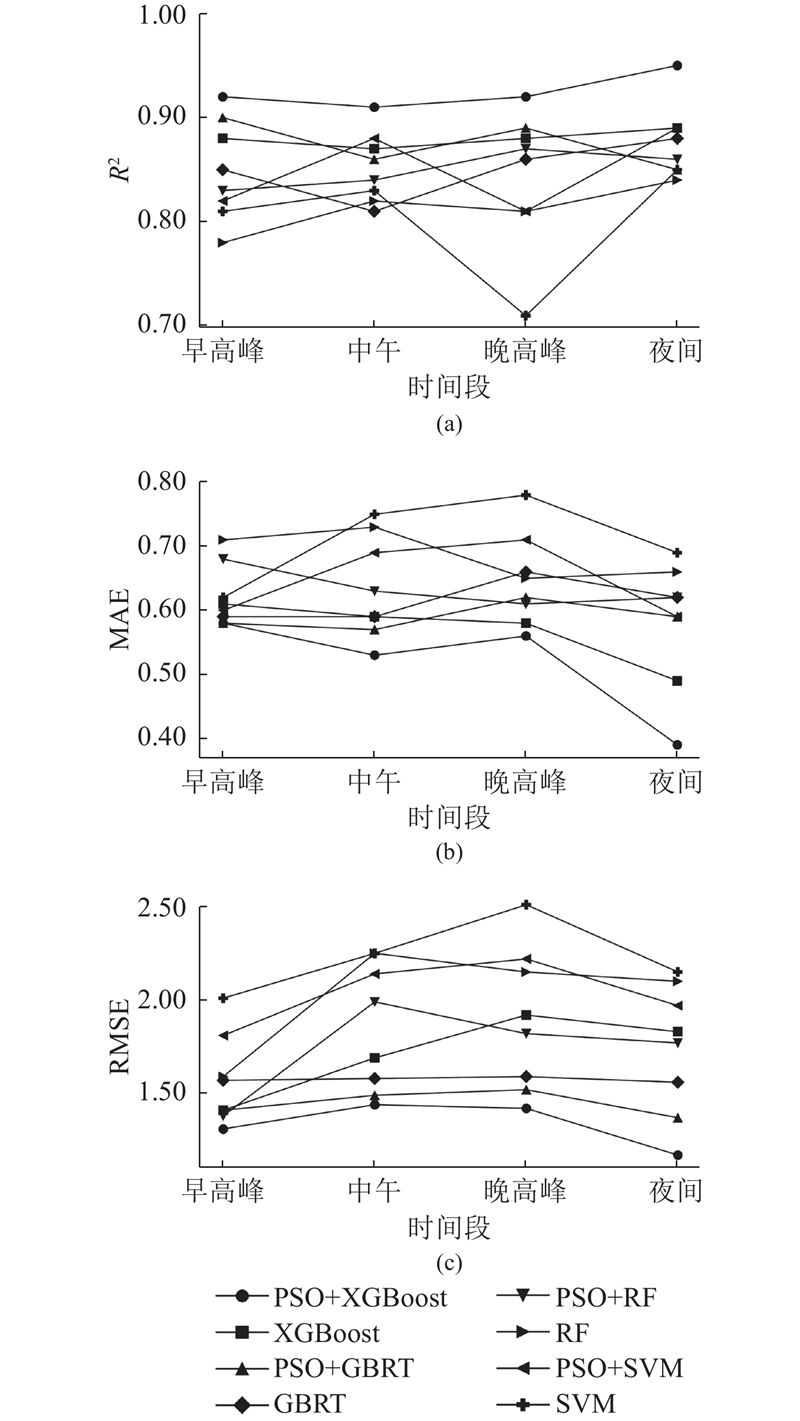
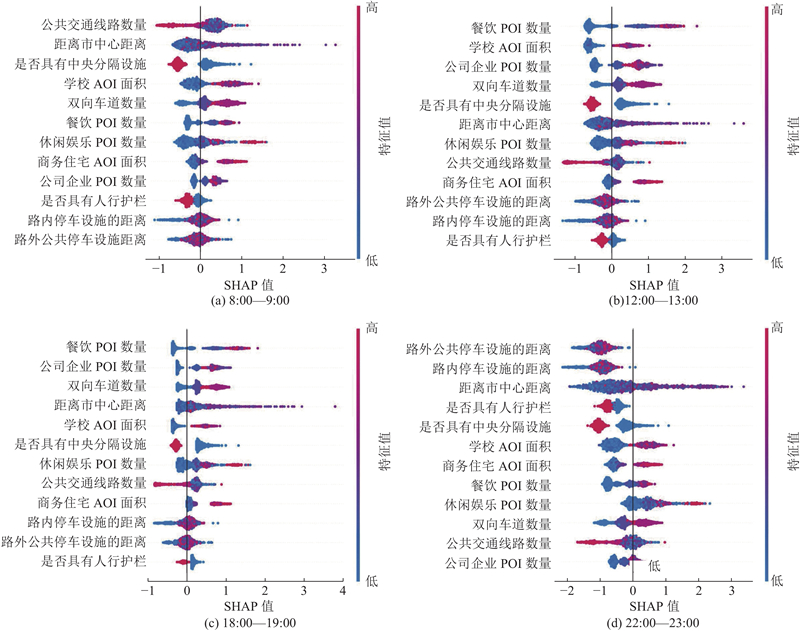
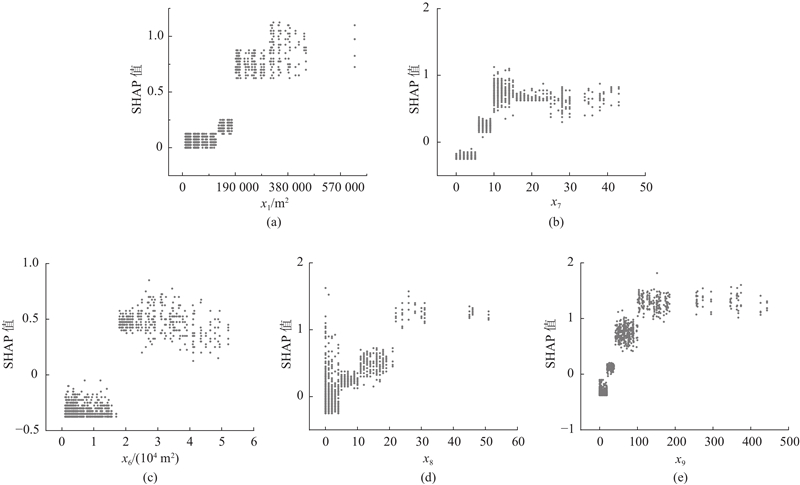
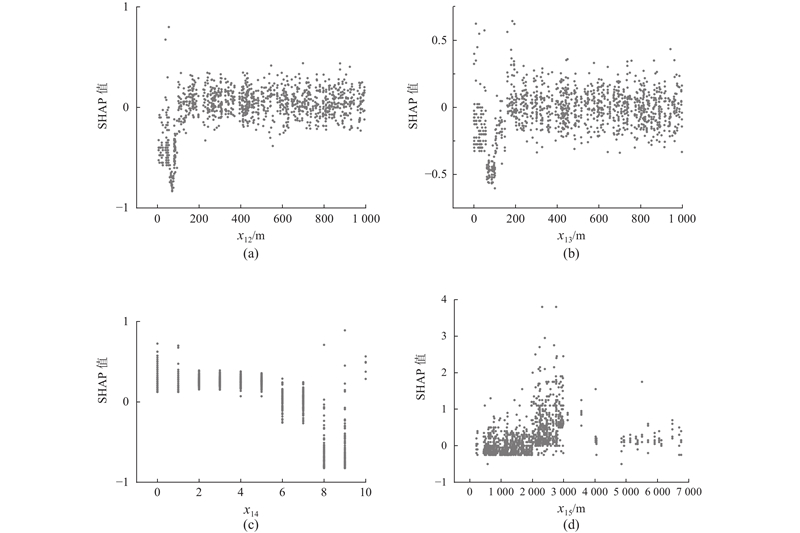
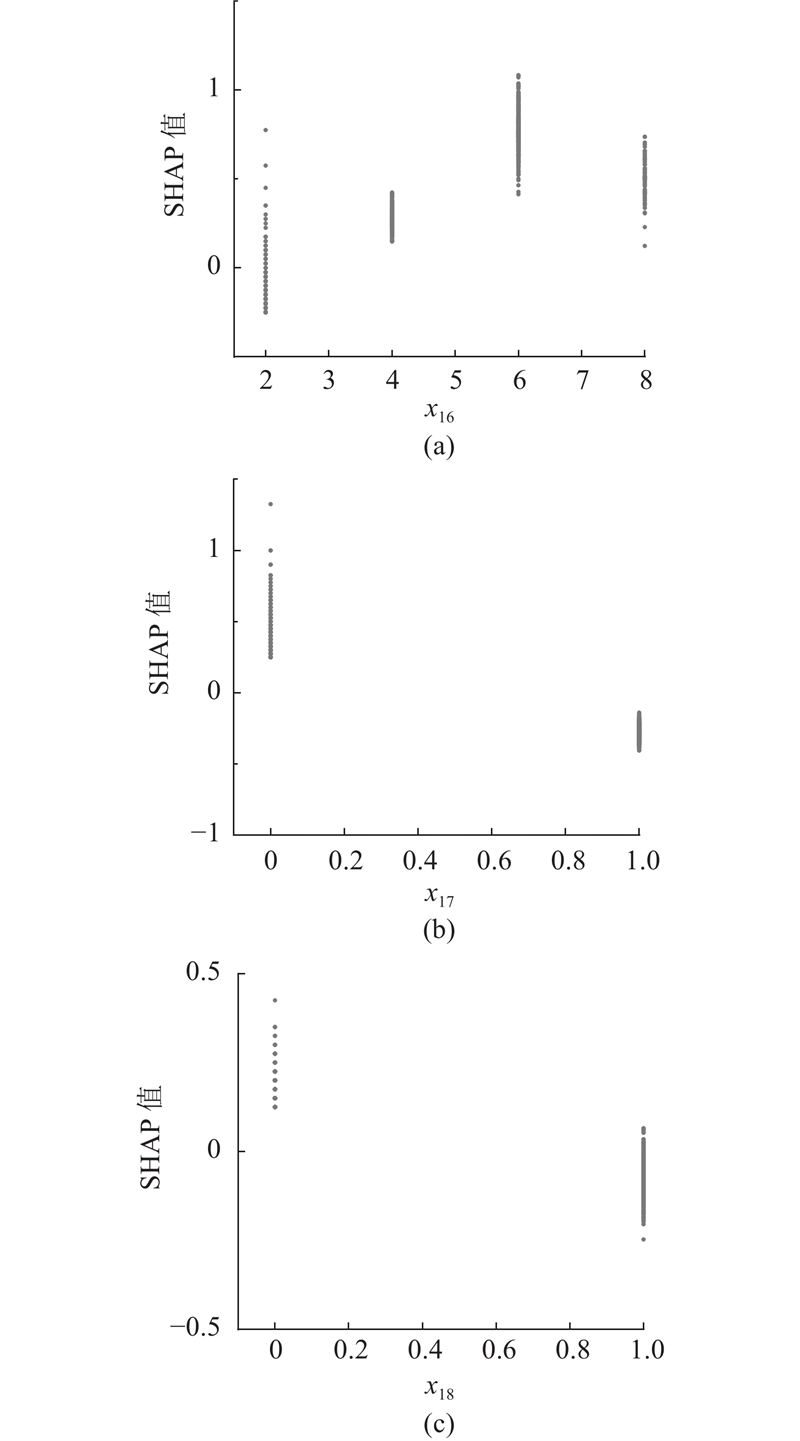
Abstract 41 344 violation records collected over two months by electronic enforcement cameras in the study area were analyzed in order to uncover the spatiotemporal mechanism of illegal parking and propose targeted management strategy. Area of interest (AOI), point of interest (POI) and road network data were integrated to construct a built environment indicator system, encompassing land use, transportation supply and road design. A particle swarm optimization–extreme gradient boosting (PSO-XGBoost) model was applied to examine the relationship between parking violation and built environment factor across different time period. Model interpretation was conducted using Shapley additive explanation (SHAP). The PSO-XGBoost model achieved R2 exceeding 0.90 for four key time intervals on weekday (8:00—9:00, 12:00—13:00, 18:00—19:00 and 22:00—23:00), outperforming traditional machine learning model. The impact of built environment factor varies across time period. The number of public transit route is most influential during morning and evening peak. Restaurant POI and school AOI are more influential during midday. Accessibility of off-street parking facility is most critical at night. SHAP interaction effect reveals nonlinear and threshold characteristic, indicating that some countermeasures lose effectiveness once specific range is exceeded. These findings highlight the need to develop time-specific and area-specific parking management strategy that account for built environment heterogeneity, thereby supporting refined governance of illegal parking.
|
|
Received: 16 January 2026
Published: 06 May 2026
|
|
|
| Fund: 国家自然科学基金资助项目(52472339);中国?东盟(广西)警学研究院研究课题资助项目(DMJXYB202512);重庆警察学院校级一流课程项目“交通工程”(jykc2502). |
|
Corresponding Authors:
Jian CHEN
E-mail: liukeliang93@163.com;chenjian@cqjtu.edu.cn
|
建成环境对违法停车需求的非线性影响模型
为了揭示违法停车的空间影响机理并提出针对性治理措施,基于研究区域2个月共41 344条电子警察抓拍数据,融合兴趣面(AOI)、兴趣点(POI)和路网信息,构建土地利用、交通供给与道路设计三维度建成环境指标体系. 采用粒子群优化–极端梯度提升(PSO-XGBoost)模型对不同时段违停数量与建成环境关系进行建模,利用Shapley加性解释(SHAP)方法进行解释. 结果表明,PSO-XGBoost在工作日8:00—9:00、12:00—13:00、18:00—19:00和22:00—23:00 4个时间段的拟合优度均超过90%,显著优于传统的机器学习模型. 不同时间段违停受建成环境因素影响存在明显差异,如早晚高峰主要受公共交通线路数量的影响,中午时段受餐饮POI和学校AOI影响,夜间受路外停车设施可达性的影响最大. SHAP交互效应揭示了违停的非线性与阈值特征,部分改善措施在超过特定区间后可能失效. 研究表明,应结合建成环境差异制定时段化与精细化的停车治理策略,以实现违停的有效管控.
关键词:
城市交通,
停车管理,
违法停车,
机器学习,
SHAP分析
|
|
| [1] |
ZHOU X, DING X, YAN J, et al Spatial heterogeneity of urban illegal parking behavior: a geographically weighted Poisson regression approach[J]. Journal of Transport Geography, 2023, 110: 103636
doi: 10.1016/j.jtrangeo.2023.103636
|
|
|
| [2] |
CULLINANE K, POLAK J Illegal parking and the enforcement of parking regulations: causes, effects and interactions[J]. Transport Reviews, 1992, 12 (1): 49- 75
doi: 10.1080/01441649208716803
|
|
|
| [3] |
GALATIOTO F, BELL M C. Simulation of illegal double parking: quantifying the traffic and pollutant impacts [C]// Proceedings of the 4th International Congress on Transport Infrastructure and Systems. Palermo: Società Italiana Infrastrutture Viarie, 2007: 12-14.
|
|
|
| [4] |
EDQUIST J, RUDIN-BROWN C M, LENNÉ M G The effects of on-street parking and road environment visual complexity on travel speed and reaction time[J]. Accident Analysis and Prevention, 2012, 45: 759- 765
doi: 10.1016/j.aap.2011.10.001
|
|
|
| [5] |
KIM K W, PARK W J, PARK S T A study on plan to improve illegal parking using big data[J]. Indian Journal of Science and Technology, 2015, 8 (21): 1- 5
doi: 10.17485/ijst/2015/v8i21/78274
|
|
|
| [6] |
HENSHER D A, KING J Parking demand and responsiveness to supply, pricing and location in the Sydney central business district[J]. Transportation Research Part A: Policy and Practice, 2001, 35 (3): 177- 196
doi: 10.1016/S0965-8564(99)00054-3
|
|
|
| [7] |
PEREZ C L Illegal parking in urban streets: connection with the geometric characteristics and its mitigation through traffic calming measures[J]. Αειχώρος: Κείμενα Χωροταξίας, Πολεοδομίας και Ανάπτυξης (Aeichoros: Texts of Spatial Planning, Urban Planning and Development), 2020, (30): 45- 63
|
|
|
| [8] |
GAO J, OZBAY K. Modeling double parking impacts on urban street [C]//Transportation Research Board 95th Annual Meeting. Washington, D. C.: Transportation Research Board of the National Academies, 2016: 12.
|
|
|
| [9] |
THANH T T M, FRIEDRICH H Legalizing the illegal parking, a solution for parking scarcity in developing countries[J]. Transportation Research Procedia, 2017, 25: 4950- 4965
doi: 10.1016/j.trpro.2017.05.374
|
|
|
| [10] |
LEE C H, KIM M S, SEO S M A study on the analysis effect factors of illegal parking using data mining techniques[J]. The Journal of the Korea Institute of Intelligent Transport Systems, 2014, 13 (4): 63- 72
doi: 10.12815/kits.2014.13.4.063
|
|
|
| [11] |
KAWAMURA K, SRIRAJ P S, SURAT H R, et al Analysis of factors that affect the frequency of truck parking violations in urban areas[J]. Transportation Research Record: Journal of the Transportation Research Board, 2014, 2411 (1): 20- 26
doi: 10.3141/2411-03
|
|
|
| [12] |
GAO J, XIE K, OZBAY K Exploring the spatial dependence and selection bias of double parking citations data[J]. Transportation Research Record: Journal of the Transportation Research Board, 2018, 2672 (42): 159- 169
doi: 10.1177/0361198118792323
|
|
|
| [13] |
刘柯良, 陈坚, 邱智宣, 等 城市路内违章停车时空特征及影响因素作用模型[J]. 交通运输系统工程与信息, 2024, 24 (2): 234- 248
LIU Keliang, CHEN Jian, QIU Zhixuan, et al Spatio-temporal characterization of urban on-street illegal parking and modeling of role influencing factors[J]. Journal of Transportation Systems Engineering and Information Technology, 2024, 24 (2): 234- 248
doi: 10.16097/j.cnki.1009-6744.2024.02.024
|
|
|
| [14] |
SUI X, FENG Z, ZHANG S Spatio-temporal heterogeneity in street illegal parking: a case study in New York[J]. Journal of Transport Geography, 2025, 127: 104262
doi: 10.1016/j.jtrangeo.2025.104262
|
|
|
| [15] |
陈智娟. 路内停车特征及停车收费博弈过程研究 [D]. 北京: 北京交通大学, 2016.
CHEN Zhijuan. Study on parking characteristics and charging game process inside road parking [D]. Beijing: Beijing Jiaotong University, 2016.
|
|
|
| [16] |
YANG S, MA W, PI X, et al A deep learning approach to real-time parking occupancy prediction in transportation networks incorporating multiple spatio-temporal data sources[J]. Transportation Research Part C: Emerging Technologies, 2019, 107: 248- 265
doi: 10.1016/j.trc.2019.08.010
|
|
|
| [17] |
陈奕璠, 张步镐, 党振, 等 建成环境对共享单车使用特征的非线性影响研究[J]. 交通运输系统工程与信息, 2024, 24 (2): 217- 224
CHEN Yifan, ZHANG Buhao, DANG Zhen, et al Exploring nonlinear effects of built environment on dockless bike sharing usage[J]. Journal of Transportation Systems Engineering and Information Technology, 2024, 24 (2): 217- 224
doi: 10.16097/j.cnki.1009-6744.2024.02.022
|
|
|
| [18] |
戢晓峰, 邓若凡, 乔新, 等 建成环境对共享单车时间集聚模式的非线性影响[J]. 吉林大学学报: 工学版, 2025, 55 (7): 2233- 2242
JI Xiaofeng, DENG Ruofan, QIAO Xin, et al Nonlinear influence of built environment on temporal aggregation modes of shared bicycles[J]. Journal of Jilin University: Engineering and Technology Edition, 2025, 55 (7): 2233- 2242
|
|
|
| [19] |
DING C, CAO X, NAESS P Applying gradient boosting decision trees to examine non-linear effects of the built environment on driving distance in Oslo[J]. Transportation Research Part A: Policy and Practice, 2018, 110: 107- 117
doi: 10.1016/j.tra.2018.02.009
|
|
|
| [20] |
LIU K, CHEN J, LI R, et al Nonlinear effects of community built environment on car usage behavior: a machine learning approach[J]. Sustainability, 2022, 14 (11): 1- 17
|
|
|
| [21] |
TAO T, NAESS P Exploring nonlinear built environment effects on driving with a mixed-methods approach[J]. Transportation Research Part D: Transport and Environment, 2022, 111: 103443
doi: 10.1016/j.trd.2022.103443
|
|
|
| [22] |
INGVARDSON J B, NIELSEN O A The relationship between norms, satisfaction and public transport use: a comparison across six European cities using structural equation modelling[J]. Transportation Research Part A: Policy and Practice, 2019, 126: 37- 57
doi: 10.1016/j.tra.2019.05.016
|
|
|
| [23] |
HSIEH H S, HSIA H C Can continued anti-epidemic measures help post-COVID-19 public transport recovery? evidence from Taiwan[J]. Journal of Transport and Health, 2022, 26: 101392
doi: 10.1016/j.jth.2022.101392
|
|
|
|
Viewed |
|
|
|
Full text
|
|
|
|
|
Abstract
|
|
|
|
|
Cited |
|
|
|
|
| |
Shared |
|
|
|
|
| |
Discussed |
|
|
|
|