|
|
|
| Analysis of influencing factors on travel mode choice based on activity pattern clustering |
Xiangcheng SHEN1( ),Yilin SUN1,2,*(),Shujie CHEN2 ),Yilin SUN1,2,*(),Shujie CHEN2 |
1. College of Civil Engineering and Architecture, Zhejiang University, Hangzhou 310058, China
2. Polytechnic Institute of Zhejiang University, Hangzhou 310058, China |
|
|
|
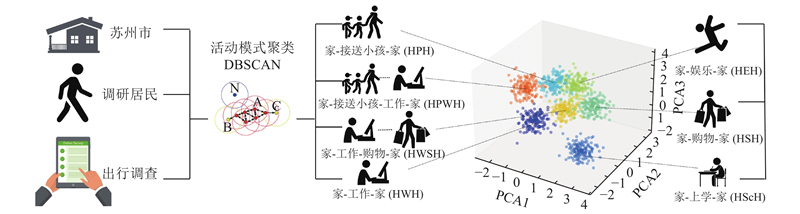
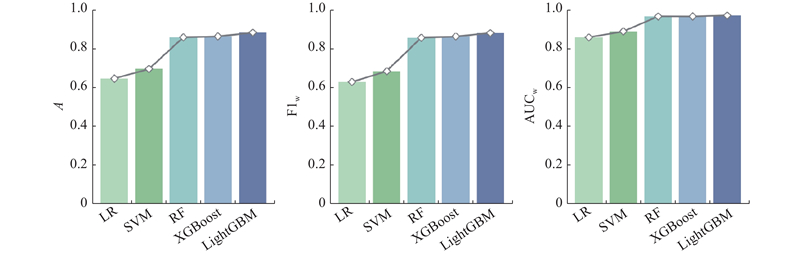
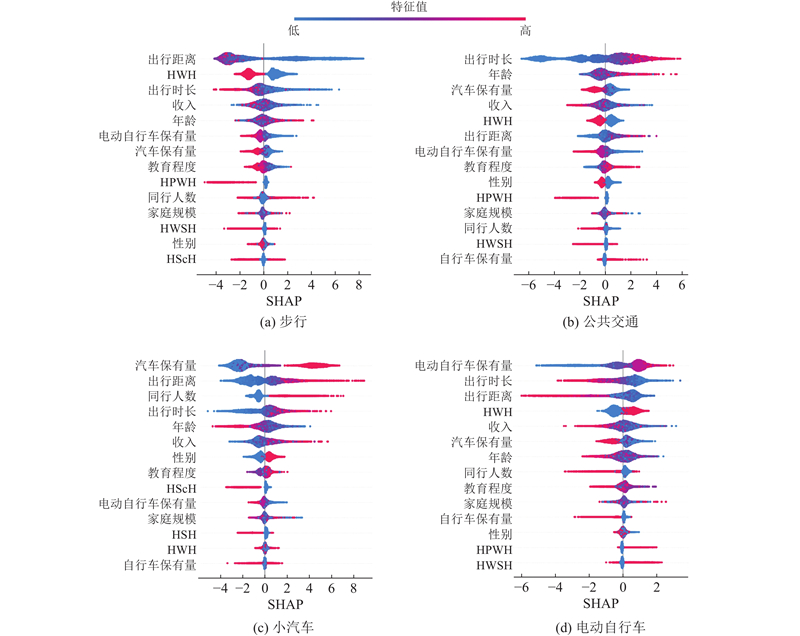
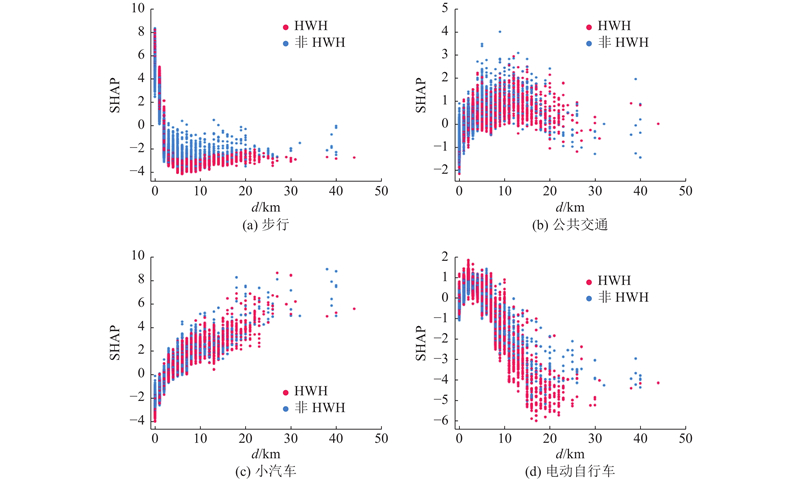
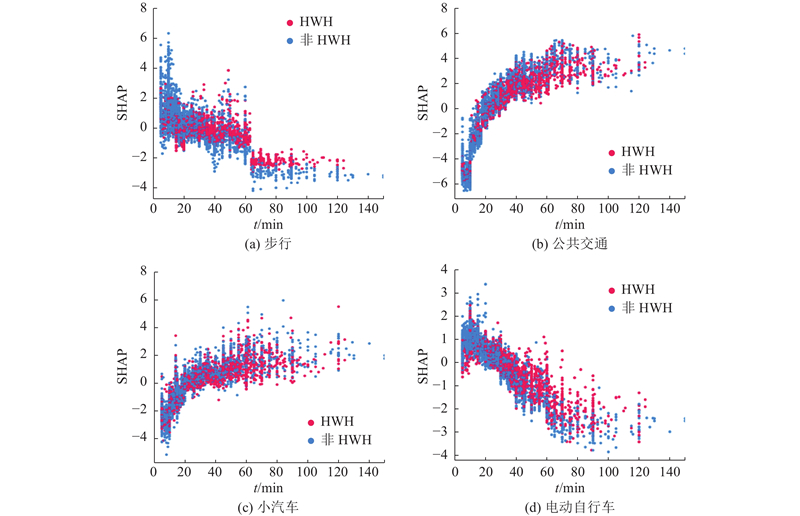
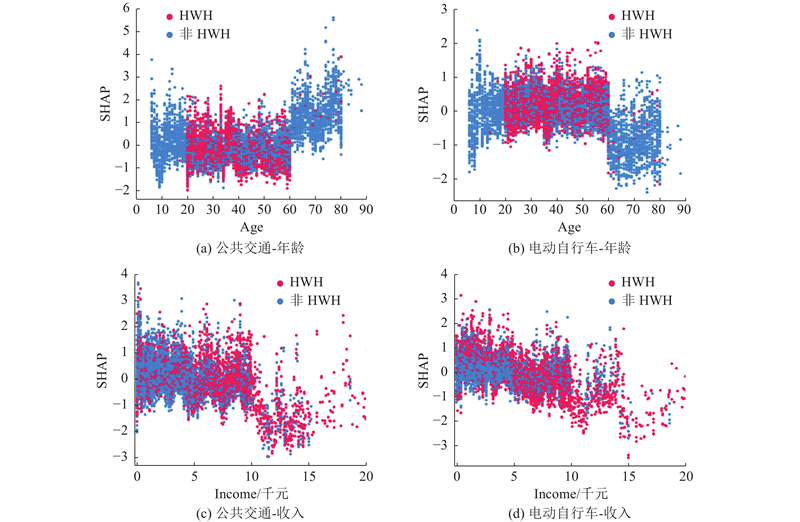
Abstract The synergistic impact mechanism of residents’ daily activity patterns and spatio-temporal travel factors on their travel mode choice was investigated. Based on travel survey data, the density-based spatial clustering of applications with noise (DBSCAN) method was employed to perform time-slice reconstruction and pattern recognition of individuals’ daily activity patterns, extracting 7 activity pattern characteristics, including the typical Home-Work-Home (HWH) commute pattern. Subsequently, a light gradient boosting machine (LightGBM) machine learning model was constructed to predict residents’ travel mode choice, with the SHapley Additive exPlanations (SHAP) method used to interpret the mechanisms of key influencing factors. The findings revealed the following two key results: 1) Travel distance and duration were the core determinants of mode choice. 2) There was a significant interaction between the HWH pattern and spatio-temporal factors: compared to other groups, HWH commuters showed a lower preference for public transportation for trips under 40 min, yet a stronger preference for electric bicycles for trips between 20 and 40 min. These confirmed the activity pattern type-driven heterogeneity of travel behavior.
|
|
Received: 23 May 2025
Published: 19 March 2026
|
|
|
| Fund: 国家自然科学基金重点项目(52131202);浙江省“尖兵”“领雁”研发攻关计划资助项目(2024C01214). |
|
Corresponding Authors:
Yilin SUN
E-mail: 22312303@zju.edu.cn;yilinsun@zju.edu.cn
|
基于活动链聚类的居民出行方式选择影响因素分析
为了揭示居民单日活动链与出行时空要素对其出行方式选择的协同影响机制,基于出行调查数据,采用基于密度的噪声应用空间聚类(DBSCAN)方法对个体单日活动链进行时间切片重构与模式识别,提取出包含典型通勤模式(Home-Work-Home, HWH)在内的7类活动链特征. 在此基础上,构建轻量级梯度提升机(LightGBM)机器学习模型预测居民出行方式选择,并运用SHAP方法解析关键影响因素的作用机理. 研究发现:1)出行距离和时长是影响方式选择的核心决定因素; 2)HWH活动链与时空要素存在显著交互效应,表现为通勤群体在短时长(<40 min)中对公共交通的偏好程度显著低于其他群体,而在20~40 min出行时长区间内对电动自行车表现出更强的选择偏好,证实了活动链类型驱动的出行行为异质性特征.
关键词:
活动链,
出行方式选择,
机器学习,
通勤活动,
DBSCAN聚类
|
|
| [1] |
KITAMURA R An evaluation of activity-based travel analysis[J]. Transportation, 1988, 15 (1): 9- 34
doi: 10.1007/bf00167973
|
|
|
| [2] |
HIDAYATI I, TAN W, YAMU C Conceptualizing mobility inequality: mobility and accessibility for the marginalized[J]. Journal of Planning Literature, 2021, 36 (4): 492- 507
doi: 10.1177/08854122211012898
|
|
|
| [3] |
DE DIOS ORTÚZAR J, WILLUMSEN L G. Modelling transport [M]. [S.l.]: John Wiley & Sons, 2024.
|
|
|
| [4] |
ZHOU Y, YUAN Q, YANG C, et al Who you are determines how you travel: clustering human activity patterns with a Markov-chain-based mixture model[J]. Travel Behaviour and Society, 2021, 24: 102- 112
doi: 10.1016/j.tbs.2021.03.005
|
|
|
| [5] |
DHARMOWIJOYO D B E, SUSILO Y O, KARLSTRÖM A Analysing the complexity of day-to-day individual activity-travel patterns using a multidimensional sequence alignment model: a case study in the Bandung Metropolitan Area, Indonesia[J]. Journal of Transport Geography, 2017, 64: 1- 12
doi: 10.1016/j.jtrangeo.2017.08.001
|
|
|
| [6] |
DIANAT A, HAWKINS J, HABIB K N Assessing the impacts of COVID-19 on activity-travel scheduling: a survey in the greater Toronto area[J]. Transportation Research Part A: Policy and Practice, 2022, 162: 296- 314
doi: 10.1016/j.tra.2022.06.008
|
|
|
| [7] |
MOECKEL R, HUANG W C, JI J, et al The activity-based model ABIT: modeling 24 hours, 7 days a week[J]. Transportation Research Procedia, 2024, 78: 499- 506
doi: 10.1016/j.trpro.2024.02.062
|
|
|
| [8] |
XIAO C, TANG J, LEE J J, et al Urban travel chain estimation based on combination of CHMM and LDA model[J]. IET Intelligent Transport Systems, 2025, 19: e70004
doi: 10.1049/itr2.70004
|
|
|
| [9] |
VO K D, LAM W H K, LI Z C A mixed-equilibrium model of individual and household activity-travel choices in multimodal transportation networks[J]. Transportation Research Part C: Emerging Technologies, 2021, 131: 103337
doi: 10.1016/j.trc.2021.103337
|
|
|
| [10] |
HUANG L, XIA F, CHEN H, et al Reconstructing human activities via coupling mobile phone data with location-based social networks[J]. Travel Behaviour and Society, 2023, 33: 100606
doi: 10.1016/j.tbs.2023.100606
|
|
|
| [11] |
HAFEZI M H, DAISY N S, MILLWARD H, et al Ensemble learning activity scheduler for activity based travel demand models[J]. Transportation Research Part C: Emerging Technologies, 2021, 123: 102972
doi: 10.1016/j.trc.2021.102972
|
|
|
| [12] |
KHAN N A, HABIB M A Microsimulation of activity generation, activity scheduling and shared travel choices within an activity-based travel demand modelling system[J]. Travel Behaviour and Society, 2023, 32: 100590
doi: 10.1016/j.tbs.2023.100590
|
|
|
| [13] |
LI Q, ZOU D, XU Y Combining individual travel behaviour and collective preferences for next location prediction[J]. Transportmetrica A: Transport Science, 2022, 18 (3): 1754- 1776
doi: 10.1080/23249935.2021.1968066
|
|
|
| [14] |
王江波, 连芝锐, 冯涛, 等 基于机器学习的时空出行选择行为研究综述与展望[J]. 地理科学进展, 2024, 43 (8): 1649- 1665
WANG Jiangbo, LIAN Zhirui, FENG Tao, et al A review and outlook of machine learning-based travel choice behavior research[J]. Progress in Geography, 2024, 43 (8): 1649- 1665
|
|
|
| [15] |
FU X, ZHANG Y, DE DIOS ORTÚZAR J, et al Activity-travel pattern inference based on multi-source big data[J]. Transport Reviews, 2025, 45 (1): 26- 48
doi: 10.1080/01441647.2024.2400341
|
|
|
| [16] |
FU X, YAO Z, ZHANG Y, et al. Exploring variabilities of multi-week activity-travel patterns: a deep embedded clustering approach [J]. Transportation, 2025: 1–36.
|
|
|
| [17] |
WANG D, YANG M Gendered mobility and activity pattern: implications for gendered mental health[J]. Journal of Transport Geography, 2023, 110: 103639
doi: 10.1016/j.jtrangeo.2023.103639
|
|
|
| [18] |
LIU F, GAO Z, JANSSENS D, et al Identifying business activity-travel patterns based on GPS data[J]. Transportation Research Part C: Emerging Technologies, 2021, 128: 103136
doi: 10.1016/j.trc.2021.103136
|
|
|
| [19] |
付晓, 陈梓丹, 黄洁 基于手机信令数据的城市居民非通勤出行群体画像: 以苏州市为例[J]. 地理科学, 2022, 42 (10): 1727- 1734
FU Xiao, CHEN Zidan, HUANG Jie Non-work travel group profiles of urban residents based on mobile phone signaling data: a case of Suzhou[J]. Scientia Geographica Sinica, 2022, 42 (10): 1727- 1734
|
|
|
| [20] |
HU Y, WEE B V, ETTEMA D Intra-household decisions and the impact of the built environment on activity-travel behavior: a review of the literature[J]. Journal of Transport Geography, 2023, 106: 103485
doi: 10.1016/j.jtrangeo.2022.103485
|
|
|
| [21] |
ARENTZE T A, TIMMERMANS H J P A need-based model of multi-day, multi-person activity generation[J]. Transportation Research Part B: Methodological, 2009, 43 (2): 251- 265
doi: 10.1016/j.trb.2008.05.007
|
|
|
| [22] |
WANG S, WU X, CHEN Y Association between perceived transportation disadvantages and opportunity inaccessibility: a social equity study[J]. Transportation Research Part D: Transport and Environment, 2021, 101: 103119
doi: 10.1016/j.trd.2021.103119
|
|
|
| [23] |
苏州市统计局. 苏州市第七次全国人口普查公报(第四号) [EB/OL]. (2021–05–31) [2025–04–27]. http://tjj.suzhou.gov.cn/sztjj/tjgb/202105/63f291317a62483ba1b6872b64b45b98.shtml.
|
|
|
| [24] |
YANG C, ZHANG Y, ZHAN X, et al Fusing mobile phone and travel survey data to model urban activity dynamics[J]. Journal of Advanced Transportation, 2020, 2020: 5321385
doi: 10.1155/2020/5321385
|
|
|
| [25] |
WANG W, OSARAGI T Generating and understanding human daily activity sequences using Time-Varying Markov Chain models[J]. Travel Behaviour and Society, 2024, 34: 100711
doi: 10.1016/j.tbs.2023.100711
|
|
|
| [26] |
LI W, ZHANG Y, CHEN Y, et al Multi-day activity pattern recognition based on semantic embeddings of activity chains[J]. Travel Behaviour and Society, 2024, 34: 100682
doi: 10.1016/j.tbs.2023.100682
|
|
|
| [27] |
何艳, 孙轶琳, 赵志健, 等 融合碳激励潜变量的低碳出行方式选择模型[J]. 浙江大学学报: 工学版, 2024, 58 (8): 1628- 1635+1658
HE Yan, SUN Yilin, ZHAO Zhijian, et al Modeling low-carbon travel mode choice by incorporating carbon incentive latent variable[J]. Journal of Zhejiang University: Engineering Science, 2024, 58 (8): 1628- 1635+1658
|
|
|
| [28] |
LUNDBERG S M, LEE S I. A unified approach to interpreting model predictions [C]// Advances in Neural Information Processing Systems 30. Red Hook: Curran Associates Inc., 2017: 4768–4777.
|
|
|
| [29] |
XIONG J, XU L, WEI Z, et al Identifying, analyzing, and forecasting commuting patterns in urban public Transportation: a review[J]. Expert Systems with Applications, 2024, 249: 123646
doi: 10.1016/j.eswa.2024.123646
|
|
|
|
Viewed |
|
|
|
Full text
|
|
|
|
|
Abstract
|
|
|
|
|
Cited |
|
|
|
|
| |
Shared |
|
|
|
|
| |
Discussed |
|
|
|
|