|
|
|
| Federated collaborative framework-based semi-supervised remaining useful life prediction under cross-operating conditions |
Qiyuan LI1( ),Xin CHENG1,Wenqing MA1,Kaigan ZHANG1,Tangbin XIA1,2,*(),Lifeng XI1,2 ),Xin CHENG1,Wenqing MA1,Kaigan ZHANG1,Tangbin XIA1,2,*(),Lifeng XI1,2 |
1. Department of Industrial Engineering and Management, School of Mechanical Engineering, Shanghai Jiao Tong University, Shanghai 200240, China
2. Special Environment Digital Manufacturing Equipment Technology Innovation Center, Mianyang 621900, China |
|
|
|
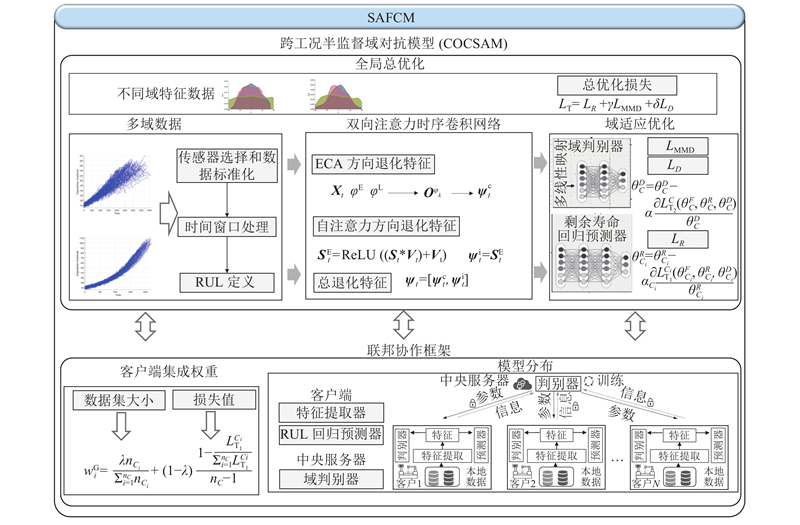
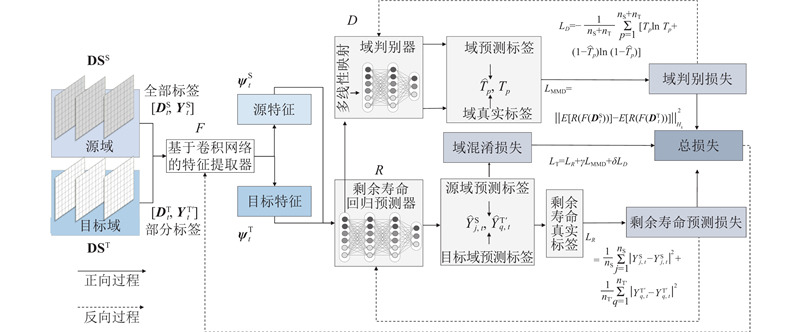
Abstract In response to the distribution differences under different operating conditions and the privacy protection constraints of signal data, a semi-supervised domain adversarial federated collaborative model (SAFCM) was designed to realize the remaining useful life prediction of mechanical equipment under cross-operating conditions and privacy preservation. A bidirectional attention temporal convolutional network was designed to extract domain-invariant features through two directions of channel attention mechanism and self-attention mechanism. By using this convolutional network as a feature extractor, a cross-operating-condition semi-supervised domain adversarial model (COCSAM) was constructed to achieve highly robust domain adaptation between imbalanced domains through domain adversarial learning and domain distance measurement. The COCSAM was integrated into the federated collaborative framework to build the SAFCM. Through differentiated distribution and dynamic weighted updates of the sub-models, asynchronous network updates were achieved under data privacy protection, promoting the full utilization of data and efficient domain adaptation. Two datasets from different application scenarios were utilized to conduct the interpretability analysis and robustness study, the results of which demonstrated the robustness and superiority of the proposed SAFCM in real industrial scenarios.
|
|
Received: 28 February 2025
Published: 15 December 2025
|
|
|
| Fund: 国家重点研发计划资助项目(2022YFF0605700);上海市自然科学基金资助项目(25ZR1401196). |
|
Corresponding Authors:
Tangbin XIA
E-mail: communicate@sjtu.edu.cn;xtbxtb@sjtu.edu.cn
|
联邦协作框架下的跨工况半监督剩余使用寿命预测
针对不同工况下信号数据分布的差异性与隐私保护限制,设计半监督域对抗联邦协作模型(SAFCM),实现数据跨工况和隐私保护下机械设备的剩余寿命预测. 设计双向注意力时序卷积网络,从通道注意力和自注意力机制2个方向进行域不变特征提取;以该卷积网络作为特征提取器,构建跨工况半监督域对抗模型(COCSAM),通过域对抗学习和域距离度量在不平衡域之间实现高鲁棒性的域适应;将COCSAM集成到联邦协作框架中,搭建SAFCM,通过子模型的差异化分布和动态加权更新,实现数据隐私保护下的网络异步更新,促进数据的充分利用和高效域适应. 采用2个不同应用场景下的数据集进行解释性分析和鲁棒性研究,结果证明所提模型在真实工业场景中具有稳健性和优越性.
关键词:
剩余使用寿命,
半监督,
域适应,
跨工况,
联邦学习
|
|
| [1] |
FERREIRA C, GONÇALVES G Remaining useful life prediction and challenges: a literature review on the use of machine learning methods[J]. Journal of Manufacturing Systems, 2022, 63: 550- 562
doi: 10.1016/j.jmsy.2022.05.010
|
|
|
| [2] |
许昱晖, 舒俊清, 宋亚, 等 基于多时间尺度相似性的涡扇发动机寿命预测[J]. 浙江大学学报: 工学版, 2021, 55 (10): 1937- 1947
XU Yuhui, SHU Junqing, SONG Ya, et al Remaining useful life prediction of turbofan engine based on similarity in multiple time scales[J]. Journal of Zhejiang University: Engineering Science, 2021, 55 (10): 1937- 1947
|
|
|
| [3] |
SANZ-GORRACHATEGUI I, PASTOR-FLORES P, PAJOVIC M, et al Remaining useful life estimation for LFP cells in second-life applications[J]. IEEE Transactions on Instrumentation and Measurement, 2021, 70: 1- 10
|
|
|
| [4] |
JIANG Y, ZHAO M, ZHAO W, et al Prediction of sea temperature using temporal convolutional network and LSTM-GRU network[J]. Complex Engineering Systems, 2021, 1: 6
|
|
|
| [5] |
GUO B, QIAO Z, DONG H, et al Temporal convolutional approach with residual multi-head attention mechanism for remaining useful life of manufacturing tools[J]. Engineering Applications of Artificial Intelligence, 2024, 128: 107538
doi: 10.1016/j.engappai.2023.107538
|
|
|
| [6] |
ZHANG Z, SONG W, LI Q Dual-aspect self-attention based on Transformer for remaining useful life prediction[J]. IEEE Transactions on Instrumentation and Measurement, 2022, 71: 2505711
|
|
|
| [7] |
LIAO X, CHEN S, WEN P, et al Remaining useful life with self-attention assisted physics-informed neural network[J]. Advanced Engineering Informatics, 2023, 58: 102195
doi: 10.1016/j.aei.2023.102195
|
|
|
| [8] |
ZHAO K, JIA Z, JIA F, et al Multi-scale integrated deep self-attention network for predicting remaining useful life of aero-engine[J]. Engineering Applications of Artificial Intelligence, 2023, 120: 105860
doi: 10.1016/j.engappai.2023.105860
|
|
|
| [9] |
ZHU Y, ZI Y, XU J, et al An unsupervised dual-regression domain adversarial adaption network for tool wear prediction in multi-working conditions[J]. Measurement, 2022, 200: 111644
doi: 10.1016/j.measurement.2022.111644
|
|
|
| [10] |
MIAO M, YU J, ZHAO Z A sparse domain adaption network for remaining useful life prediction of rolling bearings under different working conditions[J]. Reliability Engineering & System Safety, 2022, 219: 108259
|
|
|
| [11] |
王昊, 肖慧灵, 王丽亚, 等 一种基于改进迁移策略与膨胀卷积神经网络的轴承故障诊断方法[J]. 工业工程与管理, 2022, 27 (1): 94- 101
WANG Hao, XIAO Huiling, WANG Liya, et al Bearing fault diagnosis based on improved transfer strategy and dilated convolutional neural network[J]. Industrial Engineering and Management, 2022, 27 (1): 94- 101
|
|
|
| [12] |
WU K, LI J, ZUO L, et al Weighted adversarial domain adaptation for machine remaining useful life prediction[J]. IEEE Transactions on Instrumentation and Measurement, 2022, 71: 3526511
|
|
|
| [13] |
蔡伟立, 胡小锋, 刘梦湘 基于迁移学习的刀具剩余寿命预测方法[J]. 计算机集成制造系统, 2021, 27 (6): 1541- 1549
CAI Weili, HU Xiaofeng, LIU Mengxiang Prediction method of tool remaining useful life based on transfer learning[J]. Computer Integrated Manufacturing Systems, 2021, 27 (6): 1541- 1549
|
|
|
| [14] |
MCMAHAN B, MOORE E, RAMAGE D, et al. Communication-efficient learning of deep networks from decentralized data [C]// Proceedings of the 20th International Conference on Artificial Intelligence and Statistics. Fort Lauderdale: PMLR, 2017: 1273–1282.
|
|
|
| [15] |
ZHOU F, ZHANG Z, LI S Research on federated learning method for fault diagnosis in multiple working conditions[J]. Complex Engineering Systems, 2021, 1: 7
|
|
|
| [16] |
ZHANG Z, MING Y, WANG Y A federated transfer learning approach for surface electromyographic hand gesture recognition with emphasis on privacy preservation[J]. Engineering Applications of Artificial Intelligence, 2024, 136: 108952
doi: 10.1016/j.engappai.2024.108952
|
|
|
| [17] |
刘翀赫, 余官定, 刘胜利 基于无线D2D网络的分层联邦学习[J]. 浙江大学学报: 工学版, 2023, 57 (5): 892- 899
LIU Chonghe, YU Guanding, LIU Shengli Hierarchical federated learning based on wireless D2D networks[J]. Journal of Zhejiang University: Engineering Science, 2023, 57 (5): 892- 899
|
|
|
| [18] |
WANG Q, WU B, ZHU P, et al. ECA-Net: efficient channel attention for deep convolutional neural networks [C]// Proceedings of the IEEE/CVF Conference on Computer Vision and Pattern Recognition. Seattle: IEEE, 2020: 11531–11539.
|
|
|
| [19] |
VASWANI A, SHAZEER N, PARMAR N, et al. Attention is all you need [C]// Proceedings of the International Conference on Neural Information Processing Systems. Long Beach: Curran Associates Inc, 2017: 6000–6010.
|
|
|
| [20] |
SILVA F M, ALMEIDA L B. Acceleration techniques for the backpropagation algorithm [C]// European Association for Signal Processing Workshop. Barcelona: EURASIP, 1990: 110–119.
|
|
|
| [21] |
SAXENA A, GOEBEL K, SIMON D, et al. Damage propagation modeling for aircraft engine run-to-failure simulation [C]// Proceedings of the International Conference on Prognostics and Health Management. Denver: IEEE, 2008: 1–9.
|
|
|
| [22] |
LI X, DING Q, SUN J Q Remaining useful life estimation in prognostics using deep convolution neural networks[J]. Reliability Engineering & System Safety, 2018, 172: 1- 11
|
|
|
| [23] |
韩冬阳, 林泽宇, 郑宇, 等 基于选择性深度神经网络集成的涡扇发动机剩余寿命预测[J]. 浙江大学学报: 工学版, 2022, 56 (11): 2109- 2118
HAN Dongyang, LIN Zeyu, ZHENG Yu, et al Remaining useful life estimation of turbofan engine based on selective ensemble of deep neural networks[J]. Journal of Zhejiang University: Engineering Science, 2022, 56 (11): 2109- 2118
|
|
|
| [24] |
DE OLIVEIRA DA COSTA P R, AKÇAY A, ZHANG Y, et al Remaining useful lifetime prediction via deep domain adaptation[J]. Reliability Engineering & System Safety, 2020, 195: 106682
|
|
|
| [25] |
SUN B, FENG J, SAENKO K. Correlation alignment for unsupervised domain adaptation [M]// CSURKA G. Domain adaptation in computer vision applications. Cham: Springer, 2017: 153–171.
|
|
|
| [26] |
RAGAB M, CHEN Z, WU M, et al Contrastive adversarial domain adaptation for machine remaining useful life prediction[J]. IEEE Transactions on Industrial Informatics, 2021, 17 (8): 5239- 5249
doi: 10.1109/TII.2020.3032690
|
|
|
|
Viewed |
|
|
|
Full text
|
|
|
|
|
Abstract
|
|
|
|
|
Cited |
|
|
|
|
| |
Shared |
|
|
|
|
| |
Discussed |
|
|
|
|