|
|
|
| Homomorphic state abstraction and policy optimization based on orthogonal projection |
Liang ZHAO( ),Yongqiang LI*(),Shuo ZHAO |
| School of Information Engineering, Zhejiang University of Technology, Hangzhou 310023, China |
|
|
|
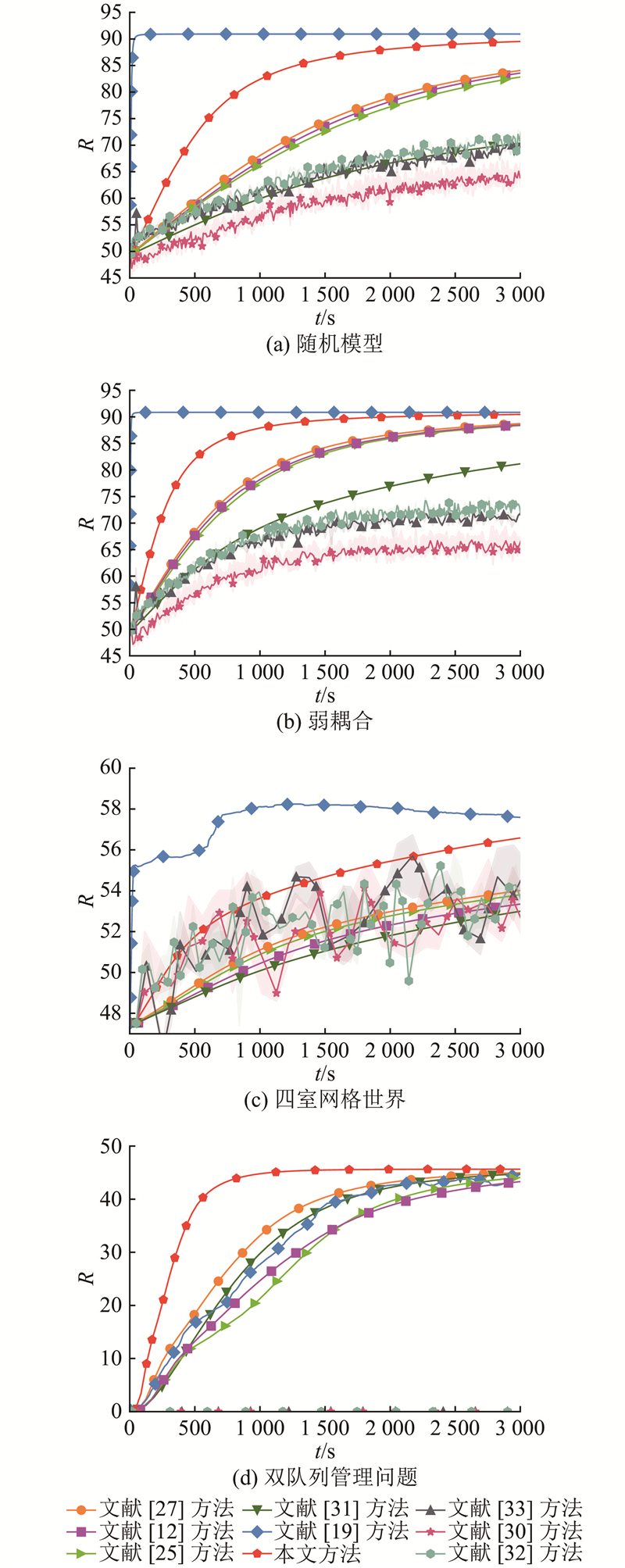
Abstract An orthogonal projection-based method for constructing homomorphic Markov chains was proposed aiming at the problem of the numerical instability and loose performance lower bounds in homomorphic state abstraction for Markov decision process (MDP), which were caused by pseudo-inverse calculations. Orthogonal constraints were introduced into the encoding matrix to replace the traditional least-squares projection. Then the stability of the abstract mapping was significantly enhanced. A computable policy performance lower bound was derived within this framework. A policy gradient method was designed for the direct optimization of this bound. Then the abstract representations and the policy parameters were jointly updated. Results showed that significant advantages were consistently demonstrated in terms of convergence speed, stability and final returns compared with seven baseline algorithms in various tasks with symmetric and complex topological structures. Training oscillations were effectively suppressed, and a tighter performance lower bound was obtained in structural bottleneck tasks.
|
|
Received: 15 December 2025
Published: 21 October 2026
|
|
|
| Fund: 国家自然科学基金资助项目(U2341216). |
|
Corresponding Authors:
Yongqiang LI
E-mail: zl2024@zjut.edu.cn;yqli@zjut.edu.cn
|
基于正交投影的同态状态抽象与策略优化
针对马尔可夫决策过程(MDP)中现有同态状态抽象方法因依赖伪逆计算而导致的数值不稳定及性能下界松弛问题,提出基于正交投影的同态马尔可夫链构建方法. 通过在编码矩阵中引入正交约束来替代传统最小二乘投影,显著提升了抽象映射的稳定性. 在此框架下,推导得到可计算的策略性能下界,设计策略梯度算法对该下界进行直接优化,从而实现抽象表示与策略参数的联合更新. 结果表明,与7种基线算法相比,本文方法在多种包含对称与复杂拓扑结构的任务中,在收敛速度、稳定性和最终回报上均展现出显著优势;在结构性瓶颈任务中,该方法能够有效抑制训练振荡,同时获得更紧致的性能下界.
关键词:
强化学习,
同态马尔可夫链,
状态抽象,
正交投影,
策略梯度
|
|
| [1] |
赵威, 张万枝, 侯加林, 等 基于多智能体强化学习的农业机器人路径规划方法[J]. 浙江大学学报(工学版), 2025, 59 (7): 1492- 1503
Zhao Wei, Zhang Wanzhi, Hou Jialin, et al A path planning method based on multi-agent reinforcement learning for agricultural robots[J]. Journal of Zhejiang University(Engineering Science), 2025, 59 (7): 1492- 1503
|
|
|
| [2] |
高洪伟, 尚秉旭, 张鑫康, 等 基于可达集和强化学习的智能汽车决策规划[J]. 浙江大学学报(工学版), 2025, 59 (9): 1996- 2004
Gao Hongwei, Shang Bingxu, Zhang Xinkang, et al Decision-making and planning of intelligent vehicles based on reachable sets and reinforcement learning[J]. Journal of Zhejiang University(Engineering Science), 2025, 59 (9): 1996- 2004
|
|
|
| [3] |
汤佳伟, 郭铁铮, 闻英友 基于强化学习的Kubernetes云边协同计算调度算法[J]. 浙江大学学报(工学版), 2025, 59 (11): 2400- 2408
Tang Jiawei, Guo Tiezheng, Wen Yingyou Computing scheduling algorithm for Kubernetes cloud-edge synergy based on reinforcement learning[J]. Journal of Zhejiang University(Engineering Science), 2025, 59 (11): 2400- 2408
|
|
|
| [4] |
Azar M G, Munos R, Kappen H J Minimax PAC bounds on the sample complexity of reinforcement learning with a generative model[J]. Machine Learning, 2013, 91 (3): 325- 349
doi: 10.1007/s10994-013-5368-1
|
|
|
| [5] |
Gao Bin, Pavel L On passivity, reinforcement learning, and higher order learning in multiagent finite games[J]. IEEE Transactions on Automatic Control, 2021, 66 (1): 121- 136
doi: 10.1109/TAC.2020.2978037
|
|
|
| [6] |
Sidford A, Wang Mengdi, Wu Xian, et al Variance reduced value iteration and faster algorithms for solving Markov decision processes[J]. Naval Research Logistics, 2023, 70 (5): 423- 442
doi: 10.1002/nav.21992
|
|
|
| [7] |
Aoki M Some approximation methods for estimation and control of large-scale systems[J]. IEEE Transactions on Automatic Control, 1978, 23 (2): 173- 182
doi: 10.1109/TAC.1978.1101705
|
|
|
| [8] |
Lastman G, Sinha N A comparison of the balanced matrix method and the aggregation method of model reduction[J]. IEEE Transactions on Automatic Control, 1985, 30 (3): 301- 304
doi: 10.1109/TAC.1985.1103941
|
|
|
| [9] |
Li Haitao, Liu Yang, Wang Shunli, et al State feedback stabilization of large-scale logical control networks via network aggregation[J]. IEEE Transactions on Automatic Control, 2021, 66 (12): 6033- 6040
doi: 10.1109/TAC.2021.3057139
|
|
|
| [10] |
Sahabandu D, Moothedath S, Allen J, et al RL-ARNE: a reinforcement learning algorithm for computing average reward Nash equilibrium of nonzero-sum stochastic games[J]. IEEE Transactions on Automatic Control, 2024, 69 (11): 7824- 7831
doi: 10.1109/TAC.2024.3403693
|
|
|
| [11] |
杜晓昕, 王浩, 崔连和, 等 基于聚类和探测精英引导的蜻蜓算法[J]. 浙江大学学报 (工学版), 2022, 56 (5): 977- 986
Du Xiaoxin , Wang Hao, Cui Lianhe, et al Dragonfly algorithm based on clustering and probe elite guidance[J]. Journal of Zhejiang University (Engineering Science), 2022, 56 (5): 977- 986
|
|
|
| [12] |
Bertsekas D P, Castanon D A Adaptive aggregation methods for infinite horizon dynamic programming[J]. IEEE Transactions on Automatic Control, 1989, 34 (6): 589- 598
doi: 10.1109/9.24227
|
|
|
| [13] |
Li Lihong, Walsh T J, Littman M L. Towards a unified theory of state abstraction for MDPs [C] // Proceedings of the 9th International Symposium on Artificial Intelligence and Mathematics. Fort Lauderdale: Florida Atlantic University, 2006: 531–539.
|
|
|
| [14] |
Whitehead S D, Ballard D H Learning to perceive and act by trial and error[J]. Machine Learning, 1991, 7 (1): 45- 83
doi: 10.1023/A:1022619109594
|
|
|
| [15] |
Abel D, Hershkowitz D, Littman M L. Near optimal behavior via approximate state abstraction [C] // International Conference on Machine Learning, 2016: 2915–2924.
|
|
|
| [16] |
Ravindran B. An algebraic approach to abstraction in reinforcement learning [D]. Amherst: University of Massachusetts Amherst, 2004: 1-182.
|
|
|
| [17] |
Ferns N, Panangaden P, Precup D Bisimulation metrics for continuous Markov decision processes[J]. SIAM Journal on Computing, 2011, 40 (6): 1662- 1714
doi: 10.1137/10080484X
|
|
|
| [18] |
Van der Pol E, Worrall D E, Van Hoof H, et al. MDP homomorphic networks: Group symmetries in reinforcement learning [C] // Advances in Neural Information Processing Systems. Red Hook: Curran Associates, Inc. 2020, 33: 4199–4210.
|
|
|
| [19] |
Zhao Shuo, Li Yongqiang, Feng Yu, et al. Homomorphic mappings for value-preserving state aggregation in Markov decision processes [PP/OL]. arXiv (2025-10-11)[2025-12-01]. https://arxiv.org/abs/2510.09965.
|
|
|
| [20] |
Mahadevan S, Maggioni M Proto-value functions: a Laplacian framework for learning representation and control in Markov decision processes[J]. Journal of Machine Learning Research, 2007, 8: 2169- 2231
|
|
|
| [21] |
Geist M, Scherrer B. Off-policy learning with linear function approximation [C] // Proceedings of the 31st International Conference on Machine Learning, 2014: 262–270.
|
|
|
| [22] |
Ravindran B, Barto A G. Approximate homomorphisms: a framework for non-exact minimization in Markov decision processes [C] // Proceedings of the 5th International Conference on Knowledge Based Computer Systems. Mumbai: Allied Publishers, 2004.
|
|
|
| [23] |
Bao Bing, Yin Baoqun , Xi Hongsheng. Infinite-horizon policy-gradient estimation with variable discount factor for Markov decision process [C] //3rd International Conference on Innovative Computing Information and Control. Dalian: IEEE, 2008: 584–584.
|
|
|
| [24] |
Ferns N, Precup D. Bisimulation metrics are optimal value functions [C] // Proceedings of the Conference on Uncertainty in Artificial Intelligence. Quebec City: AUAI Press, 2014: 210–219.
|
|
|
| [25] |
Forghieri O, Castel H, Hyon E, et al. Progressive state space disaggregation for infinite horizon dynamic programming [C] // Proceedings of the 34th International Conference on Automated Planning and Scheduling. Banff: AAAI Press, 2024, 34(1): 221–229.
|
|
|
| [26] |
Sutton R S, Precup D, Singh S Between MDPs and semi-MDPs: a framework for temporal abstraction in reinforcement learning[J]. Artificial Intelligence, 1999, 112 (1/2): 181- 211
doi: 10.1016/s0004-3702(99)00052-1
|
|
|
| [27] |
Sutton R S, Barto A G. Reinforcement learning: an introduction [M]. Cambridge: MIT Press, 2018.
|
|
|
| [28] |
Ohno K, Ichiki K Computing optimal policies for controlled tandem queueing systems[J]. Operations Research, 1987, 35 (1): 121- 126
doi: 10.1287/opre.35.1.121
|
|
|
| [29] |
Tournaire T, Jin Y, Aghasaryan A, et al. Factored reinforcement learning for auto-scaling in tandem queues [C] // Proceedings of the IEEE/IFIP Network Operations and Management Symposium. Budapest: IEEE, 2022: 1–7.
|
|
|
| [30] |
Ayoub A, Jia Z, Szepesvari C, et al. Model-based reinforcement learning with value-targeted regression [C] // Proceedings of the 37th International Conference on Machine Learning, 2020: 463–474.
|
|
|
| [31] |
Chen Guanting, Gaebler J D, Peng M, et al. An adaptive state aggregation algorithm for Markov decision processes [PP/OL]. arXiv (2021-07-23)[2025-12-01]. https://arxiv.org/abs/2107.11053.
|
|
|
| [32] |
Ishfaq H, Cui Qiwen, Nguyen V, et al. Randomized exploration in reinforcement learning with general value function approximation [C]// Proceedings of the 38th International Conference on Machine Learning, 2021: 4607–4616.
|
|
|
|
Viewed |
|
|
|
Full text
|
|
|
|
|
Abstract
|
|
|
|
|
Cited |
|
|
|
|
| |
Shared |
|
|
|
|
| |
Discussed |
|
|
|
|