|
|
|
| Collaborative control of mixed traffic intersections integrating multi-agent reinforcement learning and maximum pressure control |
Ningbo CAO1( ),Qichao WAN1,Liying ZHAO2,*(),Zimeng LI1,Baolin HUANG1 ),Qichao WAN1,Liying ZHAO2,*(),Zimeng LI1,Baolin HUANG1 |
1. College of Transportation Engineering, Chang’an University, Xi’an 710061, China
2. School of Economics and Management, Xi’an University of Technology, Xi’an 710048, China |
|
|
|
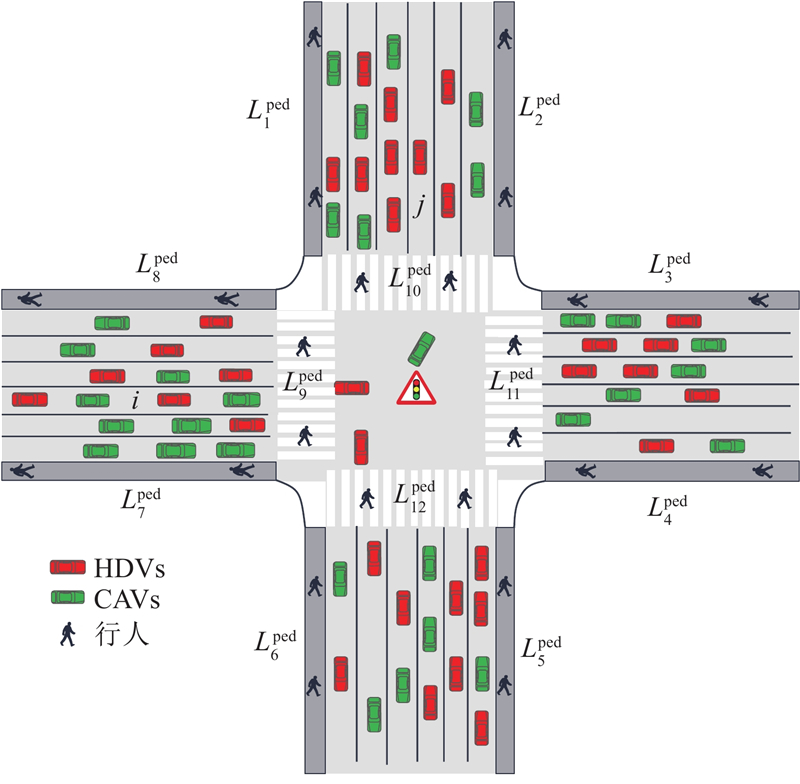
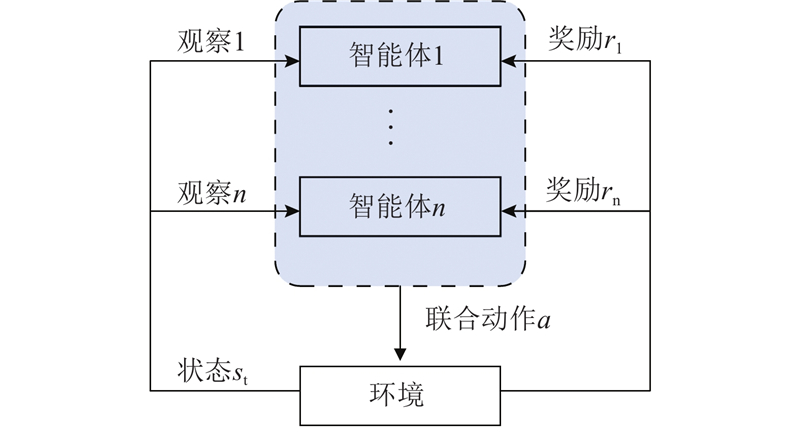
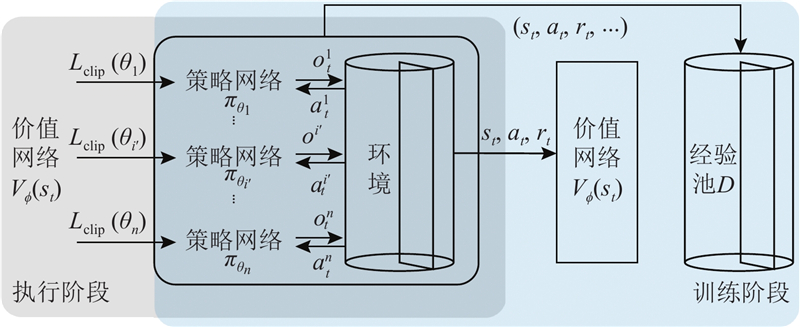
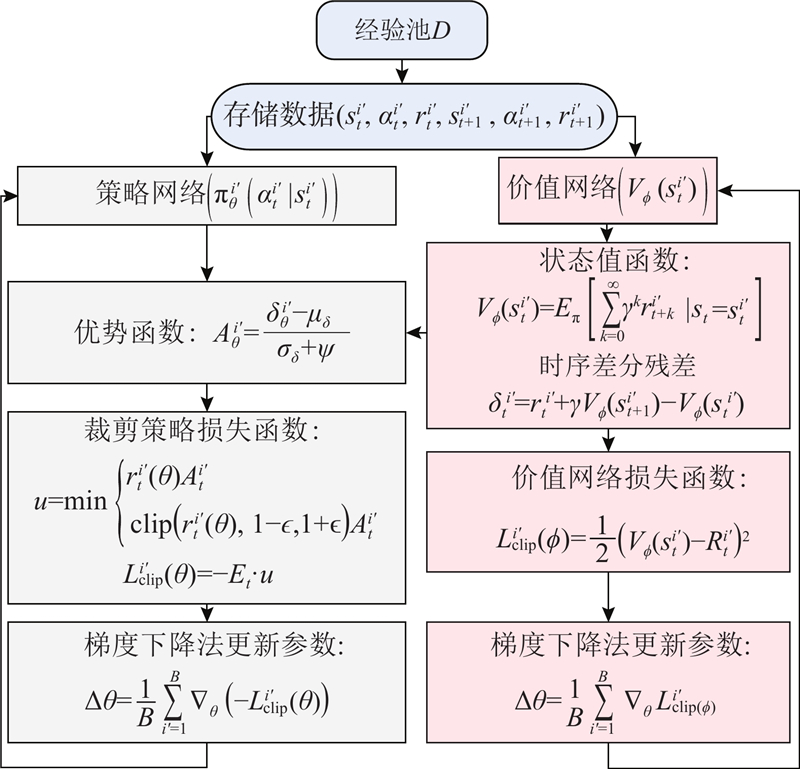
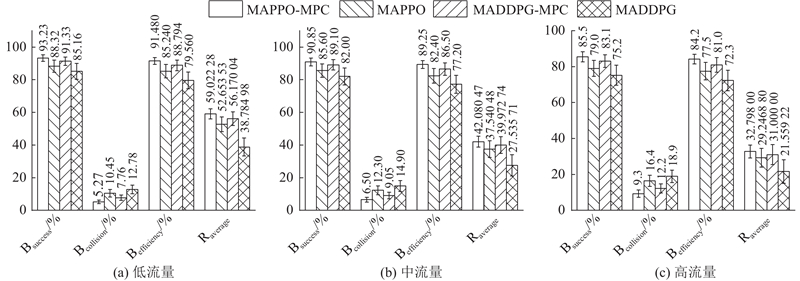
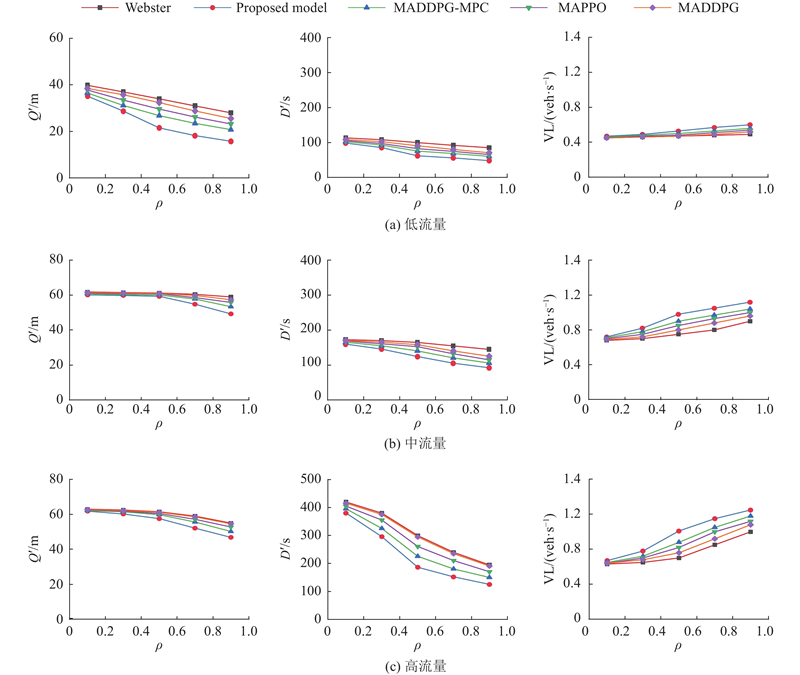
Abstract A collaborative control approach integrating multi-agent proximal policy optimization (MAPPO) and maximum pressure control (MPC) was developed to address traffic control challenges at mixed traffic intersections involving connected autonomous vehicles (CAVs), human-driven vehicles (HDVs), and pedestrians. A hierarchical state space and an action space were designed through the formulation of a decentralized partially observable Markov decision process (Dec-POMDP). Reward functions considering the balance among safety, traffic efficiency, phase switching frequency, and regulatory compliance were introduced. The proposed model was validated under low, medium, and high traffic flow conditions using a centralized training with decentralized execution framework on the SUMO simulation platform. Experimental results demonstrated that the proposed MAPPO-MPC method significantly improved the throughput (by up to 44.3%) while reducing the queue length (by up to 49.3%), average vehicle delay (by up to 43.2%), and pedestrian waiting time (by up to 43.53%). Moreover, the model exhibited more substantial performance advantages when the CAV penetration rate exceeded 50%, outperforming the traditional Webster-based methods and the baseline models.
|
|
Received: 14 July 2025
Published: 16 July 2026
|
|
|
| Fund: 中央高校基本科研业务资助项目(300102345602);陕西省自然科学基础研究计划资助项目(2024JC-YBMS-376);陕西省社会科学基金资助项目(2021R025);陕西省教育厅科学研究计划资助项目(23JK0557);陕西省社会科学基金资助项目(2022R028). |
|
Corresponding Authors:
Liying ZHAO
E-mail: 819868226@qq.com;lyzhao@xaut.edu.cn
|
集成多智能体强化学习和最大压强控制的混行交叉口协同控制
针对混行交叉口包含网联自动驾驶车(CAVs)、人驾车辆(HDVs)及行人的交通控制问题,提出融合多智能体近端策略优化(MAPPO)与最大压强控制(MPC)的协同控制方法. 通过构建分布式部分可观测马尔可夫决策过程(Dec-POMDP),设计分层状态空间与动作空间,并引入能够同时考虑安全性、通行效率、相位切换频率及规则依从性的奖励函数. 采用集中式训练与分布式执行框架,基于SUMO仿真平台在低、中、高交通流量场景下对模型性能进行验证. 结果表明,所提出的MAPPO-MPC方法能够显著提升吞吐量(最高提升44.3%),降低排队长度(最高降低49.3%)、车辆平均延误(最高降低43.2%)和行人等待时间(最高降低43.53%),且在CAV渗透率超过50%时表现出更显著的性能优势,优于传统Webster方法以及基线模型.
关键词:
交通运输工程,
混行交叉口,
多智能体强化学习,
最大压强控制
|
|
| [1] |
WU J, HUANG Z, LV C Uncertainty-aware model-based reinforcement learning: methodology and application in autonomous driving[J]. IEEE Transactions on Intelligent Vehicles, 2022, 8 (1): 194- 203
|
|
|
| [2] |
KIRAN B R, SOBH I, TALPAERT V, et al Deep reinforcement learning for autonomous driving: a survey[J]. IEEE Transactions on Intelligent Transportation Systems, 2021, 23 (6): 1- 18
|
|
|
| [3] |
ZHAO Z, XUN J, WEN X, et al. Safe reinforcement learning for single train trajectory optimization via shield SARSA [J]. IEEE Transactions on Intelligent Transportation Systems, 24(1), 412–428.
|
|
|
| [4] |
罗彪, 胡天萌, 周育豪, 等 多智能体强化学习控制与决策研究综述[J]. 自动化学报, 2025, 51 (3): 510- 539
LUO Biao, HU Tianmeng, ZHOU Yuhao, et al Survey on multi-agent reinforcement learning for control and decision-making[J]. Acta Automat Sin, 2025, 51 (3): 510- 539
doi: 10.16383/j.aas.c240392
|
|
|
| [5] |
PENG B, KESKIN M F, KULCSÁR B, et al Connected autonomous vehicles for improving mixed traffic efficiency in unsignalized intersections with deep reinforcement learning[J]. Communications in Transportation Research, 2021, 1 (1): 5- 17
|
|
|
| [6] |
许曼晨, 于镝, 赵理, 等 基于MAPPO的无信号灯交叉口自动驾驶决策[J]. 吉林大学学报: 信息科学版, 2024, 42 (5): 790- 798
XU Manchen, YU Di, ZHAO Li, et al Autonomous driving decision-making at signal-free intersections based on MAPPO[J]. Journal of Jilin University: Information Science Edition, 2024, 42 (5): 790- 798
doi: 10.3969/j.issn.1671-5896.2024.05.003
|
|
|
| [7] |
WEI H, CHEN C, ZHENG G, et al. Presslight: learning max pressure control to coordinate traffic signals in arterial network [C]// 2019 ACM 25th SIGKDD International Conference on Knowledge Discovery and Data Mining. Anchorage: ACM, 2019: 1290–1298.
|
|
|
| [8] |
BDEIR A, BOEDER S, DERNEDDE T, et al. RP-DQN: An application of Q-learning to vehicle routing problems [C]// German Conference on Artificial Intelligence. Cham: Springer, 2021: 3–16.
|
|
|
| [9] |
SHARIF A, MARIJAN D. Evaluating the robustness of deep reinforcement learning for autonomous policies in a multi-agent urban driving environment [C]// 2022 IEEE 22th International Conference on Software Quality, Reliability and Security. Guangzhou: IEEE, 2022: 785–796.
|
|
|
| [10] |
YU C, WANG X, XU X, et al Distributed multiagent coordinated learning for autonomous driving in highways based on dynamic coordination graphs[J]. IEEE Transactions on Intelligent Transportation Systems, 2020, 21 (2): 735- 748
doi: 10.1109/TITS.2019.2893683
|
|
|
| [11] |
孙彧, 曹雷, 陈希亮, 等 多智能体深度强化学习研究综述[J]. 计算机工程与应用, 2020, 56 (5): 13- 24
SUN Yu, CAO Lei, CHEN Xiliang, et al Overview of multi-agent deep reinforcement learning[J]. Computer Engineering and Applications, 2020, 56 (5): 13- 24
|
|
|
| [12] |
ZHANG X, LI S, WANG B, et al. Multi-vehicle collaborative lane changing based on multi-agent reinforcement learning [C]// 2024 IEEE Intelligent Vehicles Symposium. Jeju Island: IEEE, 2024: 1214–1221.
|
|
|
| [13] |
ZHOU W, CHEN D, YAN J, et al Multi-agent reinforcement learning for cooperative lane changing of connected and autonomous vehicles in mixed traffic[J]. Autonomous Intelligent Systems, 2022, 2 (1): 1- 11
doi: 10.1007/s43684-021-00019-7
|
|
|
| [14] |
MATE K, BECSI T Multi-agent reinforcement learning for highway platooning[J]. Electronics, 2023, 12 (24): 1–13
|
|
|
| [15] |
SCHESTER L, ORTIZ L E. A systematic study of multi-agent deep reinforcement learning for safe and robust autonomous highway ramp entry [EB/OL]. [2025–01–17]. https://arxiv.org/pdf/2411.14593.
|
|
|
| [16] |
SCHULMAN J , WOLSKI F, Dhariwal P, et al. Proximal policy optimization algorithms [EB/OL]. [2025–07–10]. https://arxiv.org/pdf/1707.06347.
|
|
|
| [17] |
YU C, VELU A, VINITSKY E, et al The surprising effectiveness of PPO in cooperative multi-agent games[J]. Advances in Neural Information Processing Systems, 2021, 35: 24611- 24624
|
|
|
| [18] |
KRAEMER L, BANERJEE B Multi-agent reinforcement learning as a rehearsal for decentralized planning[J]. Neurocomputing, 2016, 190: 82- 94
doi: 10.1016/j.neucom.2016.01.031
|
|
|
|
Viewed |
|
|
|
Full text
|
|
|
|
|
Abstract
|
|
|
|
|
Cited |
|
|
|
|
| |
Shared |
|
|
|
|
| |
Discussed |
|
|
|
|