|
|
|
| Information bottleneck-based social recommendation optimization model |
Xiaodong CAI( ),Sheng FANG,Ting LI ),Sheng FANG,Ting LI |
| School of Information and Communication, Guilin University of Electronic Technology, Guilin 541004, China |
|
|
|
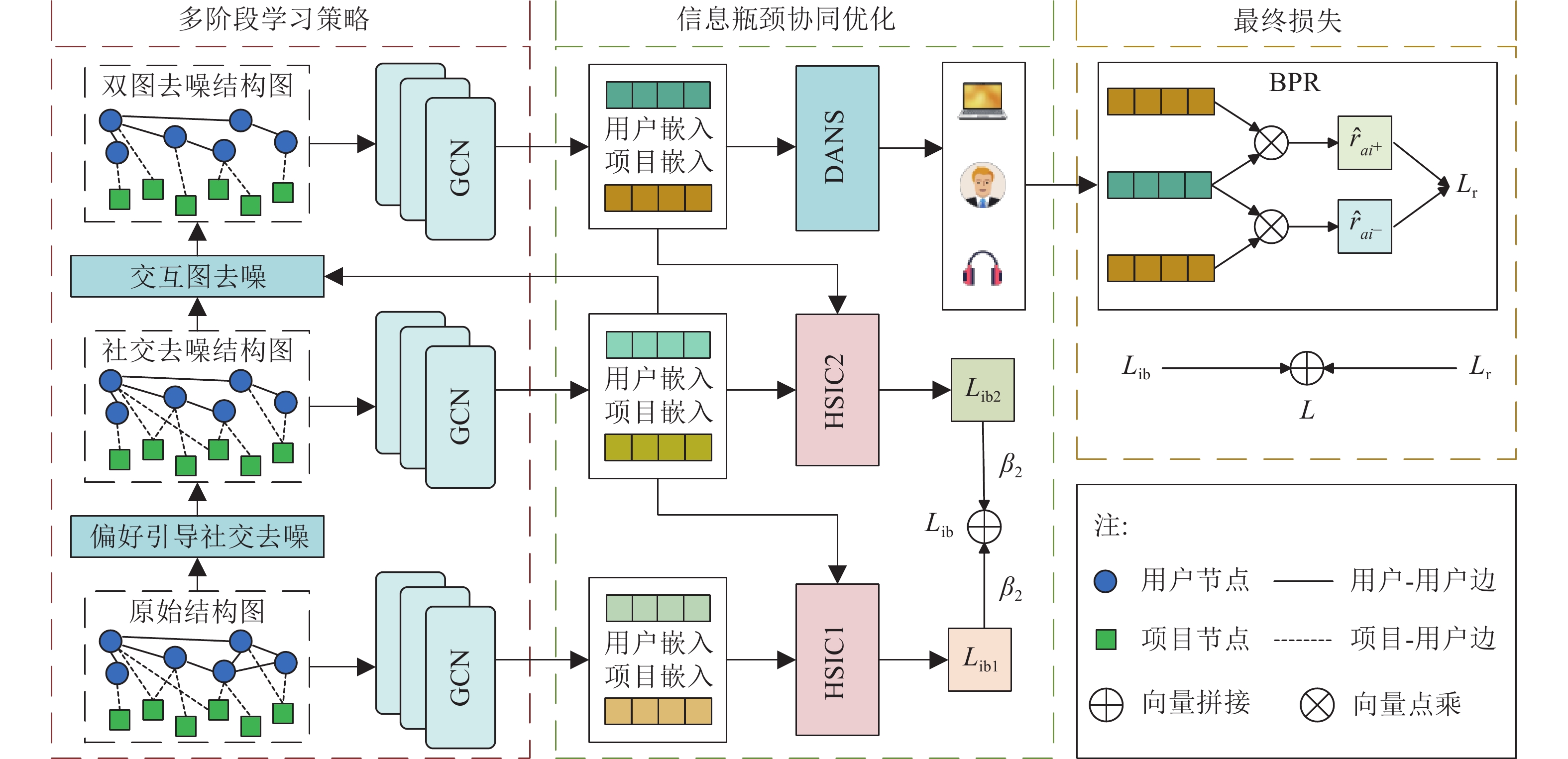
Abstract Existing social denoising strategies often rely on user-item interaction data for preference-guided denoising, basically ignoring the problem that the interaction data itself may be noisy, and there are limitations in the hardness control of existing negative sampling strategies, which will reduce the model’s recommendation performance. To address these issues, an information bottleneck-based social recommendation optimization model, IB-SRO, was proposed. First, an information bottleneck-guided dual-view collaborative denoising module was introduced, in which social network noise and user-item interaction noise were asynchronously optimized through a multi-stage learning strategy. A collaborative optimization method guided by the information bottleneck was applied to sequentially optimize the two types of noise, increasing the independence between different views and enhancing the denoising effect. Moreover, a novel difference-aware negative sampling strategy was designed. By combining similarity and difference-aware functions, the strategy was enabled to adaptively select appropriately hard negative samples based on the predicted scores of positive samples, enhancing the learning of user preferences and thereby improving the model’s performance. Experimental results showed that compared with the state-of-the-art models, IB-SRO achieved average improvements of 6.87%, 6.72%, and 2.73% on the Epinions, Yelp, and Douban-Book datasets respectively in Top-N recommendation tasks, which verified the effectiveness of the model.
|
|
Received: 23 April 2025
Published: 28 July 2026
|
|
|
| Fund: 广西创新驱动发展专项(AA20302001). |
基于信息瓶颈的社交推荐优化模型
现有的社交去噪策略往往依赖于用户-项目交互数据进行偏好引导去噪,基本忽略了交互数据本身可能存在噪声的问题,且现有的负采样策略在硬度控制方面存在局限性,这将降低模型的推荐性能. 针对上述问题,提出基于信息瓶颈的社交推荐优化模型IB-SRO. 构建信息瓶颈引导的双视图协同去噪模块,该模块通过多阶段学习策略异步优化社交网络噪声与用户-项目交互噪声,并结合信息瓶颈协同优化方法对2种噪声进行阶段性优化,以增强不同视图之间的独立性,从而提高去噪效果. 设计新的差异感知负采样策略,通过混合相似度和差异感知函数来改进负采样策略,使其能够根据正样本的预测情况自适应选择合适硬度的负样本,以增强用户偏好的学习从而提高模型性能. 实验结果表明,在Top-N推荐任务中,IB-SRO相较于当前最先进的基线模型,在Epinions、Yelp和Douban-Book这3个数据集上分别实现了6.87%、6.72%和2.73%的平均提升,验证了模型的有效性.
关键词:
社交推荐,
噪声,
信息瓶颈,
双视图协同去噪,
差异感知负采样
|
|
| [1] |
JANNACH D, ZANKER M, FELFERNIG A, et al. Recommender systems: an introduction [M]. Cambridge: Cambridge University Press, 2010.
|
|
|
| [2] |
BOND R M, FARISS C J, JONES J J, et al A 61-million-person experiment in social influence and political mobilization[J]. Nature, 2012, 489 (7415): 295- 298
doi: 10.1038/nature11421
|
|
|
| [3] |
JAMALI M, ESTER M. A matrix factorization technique with trust propagation for recommendation in social networks [C]// 4th ACM Conference on Recommender Systems. Barcelona: ACM, 2010: 135–142.
|
|
|
| [4] |
DERR T, MA Y, TANG J. Signed graph convolutional networks [C]// IEEE International Conference on Data Mining. Singapore: IEEE, 2018: 929–934.
|
|
|
| [5] |
SHARMA K, LEE Y C, NAMBI S, et al A survey of graph neural networks for social recommender systems[J]. ACM Computing Surveys, 2024, 56 (10): 1- 34
|
|
|
| [6] |
FAN W, MA Y, LI Q, et al. Graph neural networks for social recommendation [C]// World Wide Web Conference. San Francisco: ACM, 2019: 417–426.
|
|
|
| [7] |
WU L, LI J, SUN P, et al DiffNet: a neural influence and interest diffusion network for social recommendation[J]. IEEE Transactions on Knowledge and Data Engineering, 2022, 34 (10): 4753- 4766
doi: 10.1109/TKDE.2020.3048414
|
|
|
| [8] |
LIAO J, ZHOU W, LUO F, et al SocialLGN: light graph convolution network for social recommendation[J]. Information Sciences, 2022, 589: 595- 607
doi: 10.1016/j.ins.2022.01.001
|
|
|
| [9] |
CAI M, CHEN L, WANG Y, et al. Popularity-aware alignment and contrast for mitigating popularity bias [C]// 30th ACM SIGKDD Conference on Knowledge Discovery and Data Mining. Barcelona: ACM, 2024: 187–198.
|
|
|
| [10] |
LIN S, ZHOU S, CHEN J, et al ReCRec: reasoning the causes of implicit feedback for debiased recommendation[J]. ACM Transactions on Information Systems, 2024, 42 (6): 1- 26
doi: 10.1145/3672275
|
|
|
| [11] |
QUAN Y, DING J, GAO C, et al. Robust preference-guided denoising for graph based social recommendation [C]// ACM Web Conference 2023. Austin: ACM, 2023: 1097–1108.
|
|
|
| [12] |
PAN Y, HE F, YU H A correlative denoising autoencoder to model social influence for top-N recommender system[J]. Frontiers of Computer Science, 2019, 14 (3): 143301
doi: 10.1007/s11704-019-8123-3
|
|
|
| [13] |
YU J, YIN H, LI J, et al Enhancing social recommendation with adversarial graph convolutional networks[J]. IEEE Transactions on Knowledge and Data Engineering, 2022, 34 (8): 3727- 3739
doi: 10.1109/TKDE.2020.3033673
|
|
|
| [14] |
HE X, FAN W, WANG R, et al Balancing user preferences by social networks: a condition-guided social recommendation model for mitigating popularity bias[J]. Neural Networks, 2025, 187: 107317
doi: 10.1016/j.neunet.2025.107317
|
|
|
| [15] |
YANG Y, WU L, WANG Z, et al. Graph bottlenecked social recommendation [C]// 30th ACM SIGKDD Conference on Knowledge Discovery and Data Mining. Barcelona: ACM, 2024: 3853–3862.
|
|
|
| [16] |
RENDLE S, FREUDENTHALER C, GANTNER Z, et al. BPR: Bayesian personalized ranking from implicit feedback [C]// Proceedings of the 25th Conference on Uncertainty in Artificial Intelligence. Menlo Park: AUAI Press, 2009: 452–461.
|
|
|
| [17] |
HUANG T, DONG Y, DING M, et al. MixGCF: an improved training method for graph neural network-based recommender systems [C]// Proceedings of the 27th ACM SIGKDD Conference on Knowledge Discovery and Data Mining. Singapore: ACM, 2021: 665–674.
|
|
|
| [18] |
SHI W, CHEN J, FENG F, et al. On the theories behind hard negative sampling for recommendation [C]// ACM Web Conference 2023. Austin: ACM, 2023: 812–822.
|
|
|
| [19] |
LAI R, CHEN L, ZHAO Y, et al. Disentangled negative sampling for collaborative filtering [C]// 16th ACM International Conference on Web Search and Data Mining. Singapore: ACM, 2023: 96–104.
|
|
|
| [20] |
LI Z, XIA L, HUANG C. RecDiff: diffusion model for social recommendation [C]// 33rd ACM International Conference on Information and Knowledge Management. Boise: ACM, 2024: 1346–1355.
|
|
|
| [21] |
HE X, DENG K, WANG X, et al. LightGCN: simplifying and powering graph convolution network for recommendation [C]// 43rd International ACM SIGIR Conference on Research and Development in Information Retrieval. [S.l.]: ACM, 2020: 639–648.
|
|
|
| [22] |
MA W K, LEWIS J P, KLEIJN W B The HSIC bottleneck: deep learning without back-propagation[J]. Proceedings of the AAAI Conference on Artificial Intelligence, 2020, 34 (4): 5085- 5092
doi: 10.1609/aaai.v34i04.5950
|
|
|
|
Viewed |
|
|
|
Full text
|
|
|
|
|
Abstract
|
|
|
|
|
Cited |
|
|
|
|
| |
Shared |
|
|
|
|
| |
Discussed |
|
|
|
|