|
|
|
| Mechanical model of top-and-seat angle steel connection considering moment-stiffness dependency |
Yiwen LI1,2( ),Zhiguang ZHOU1,*() ),Zhiguang ZHOU1,*() |
1. College of Civil Engineering, Tongji University, Shanghai 200092, China
2. Faculty of Construction and Environment, The Hong Kong Polytechnic University, Hong Kong 999077, China |
|
|
|
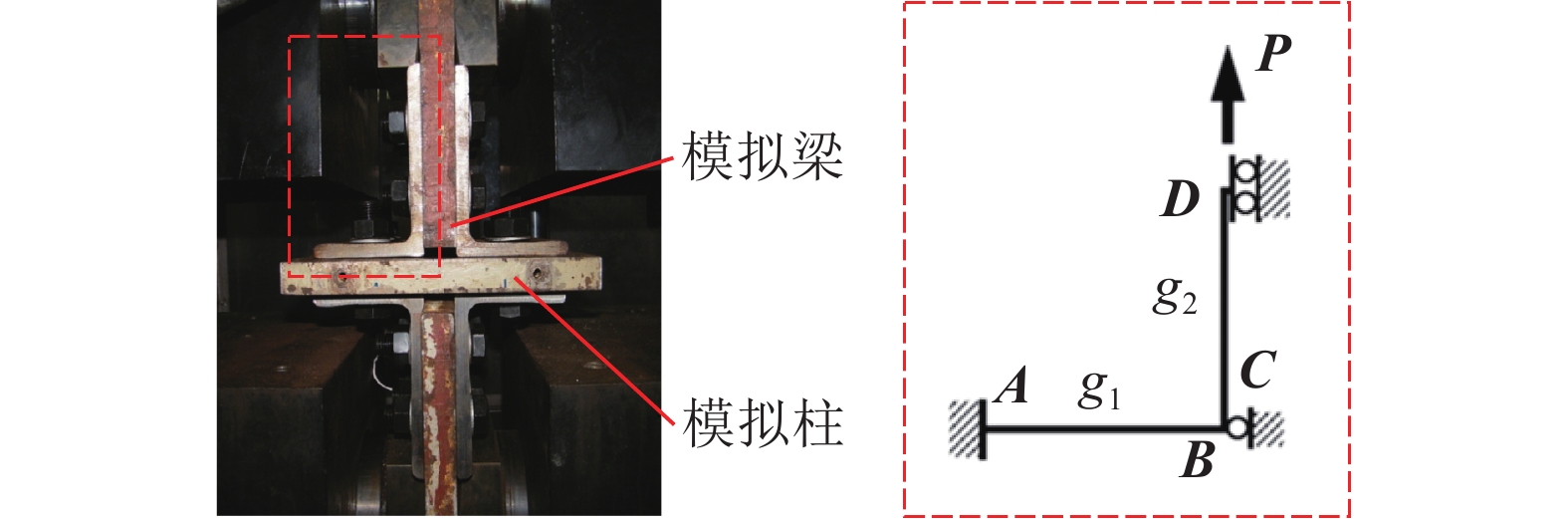
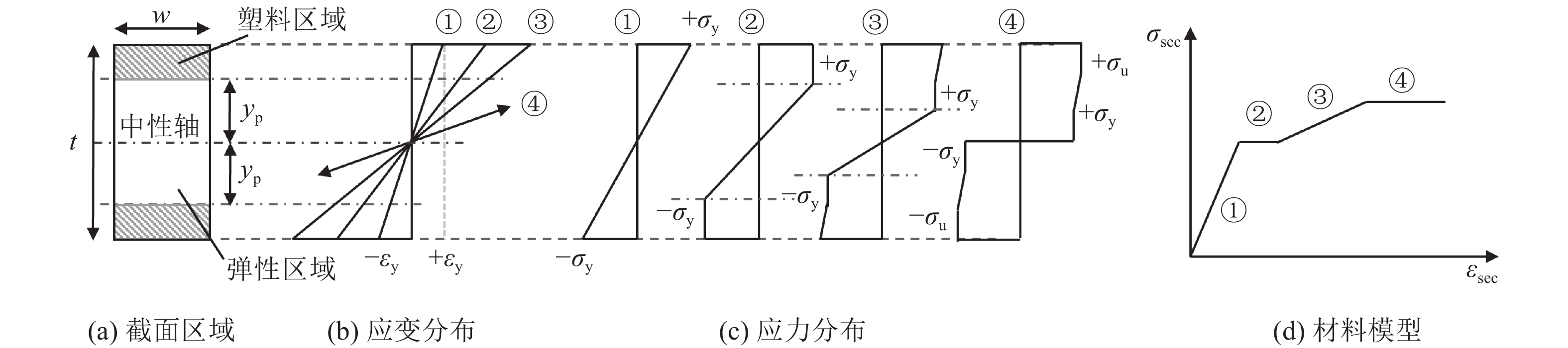
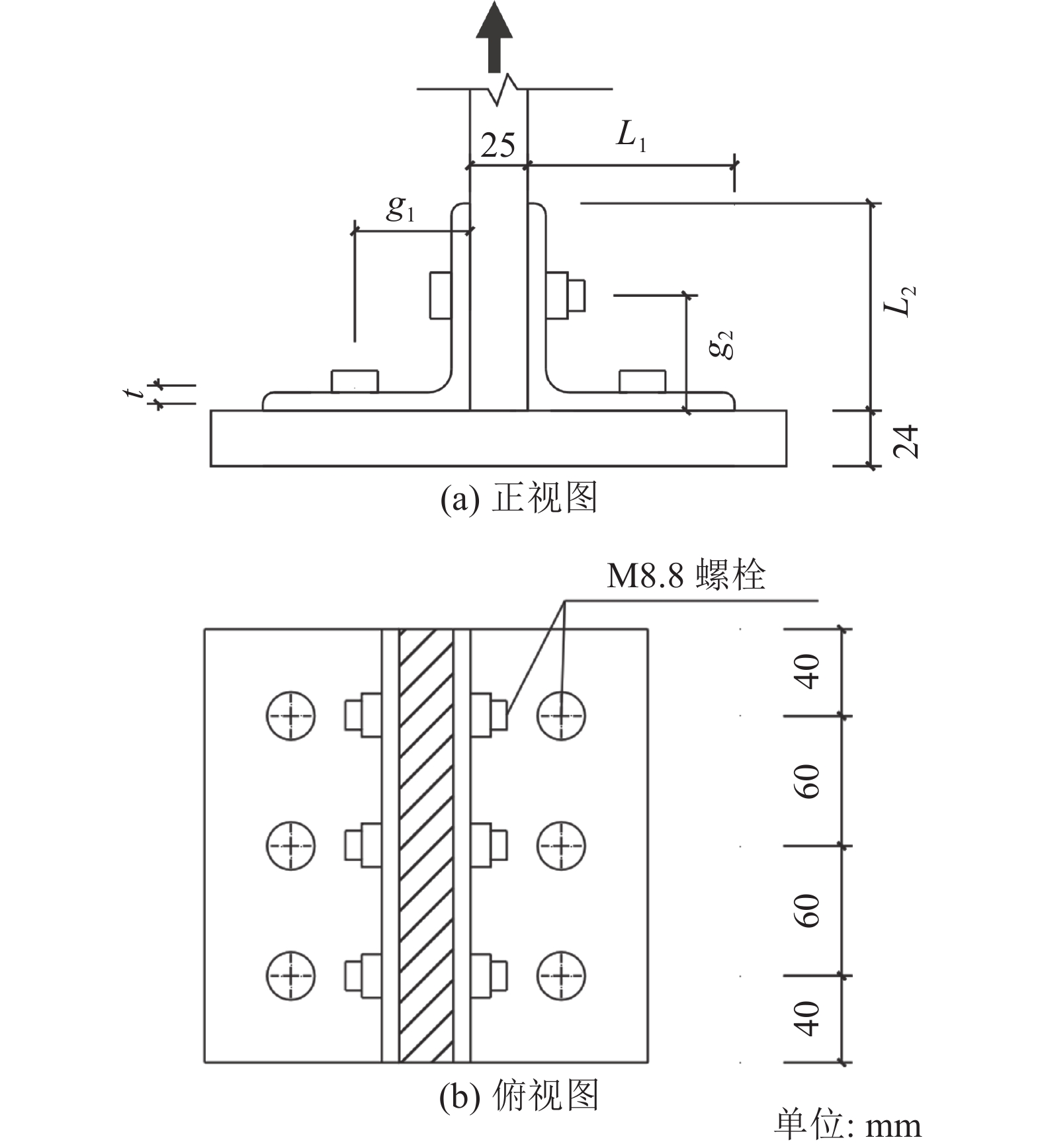
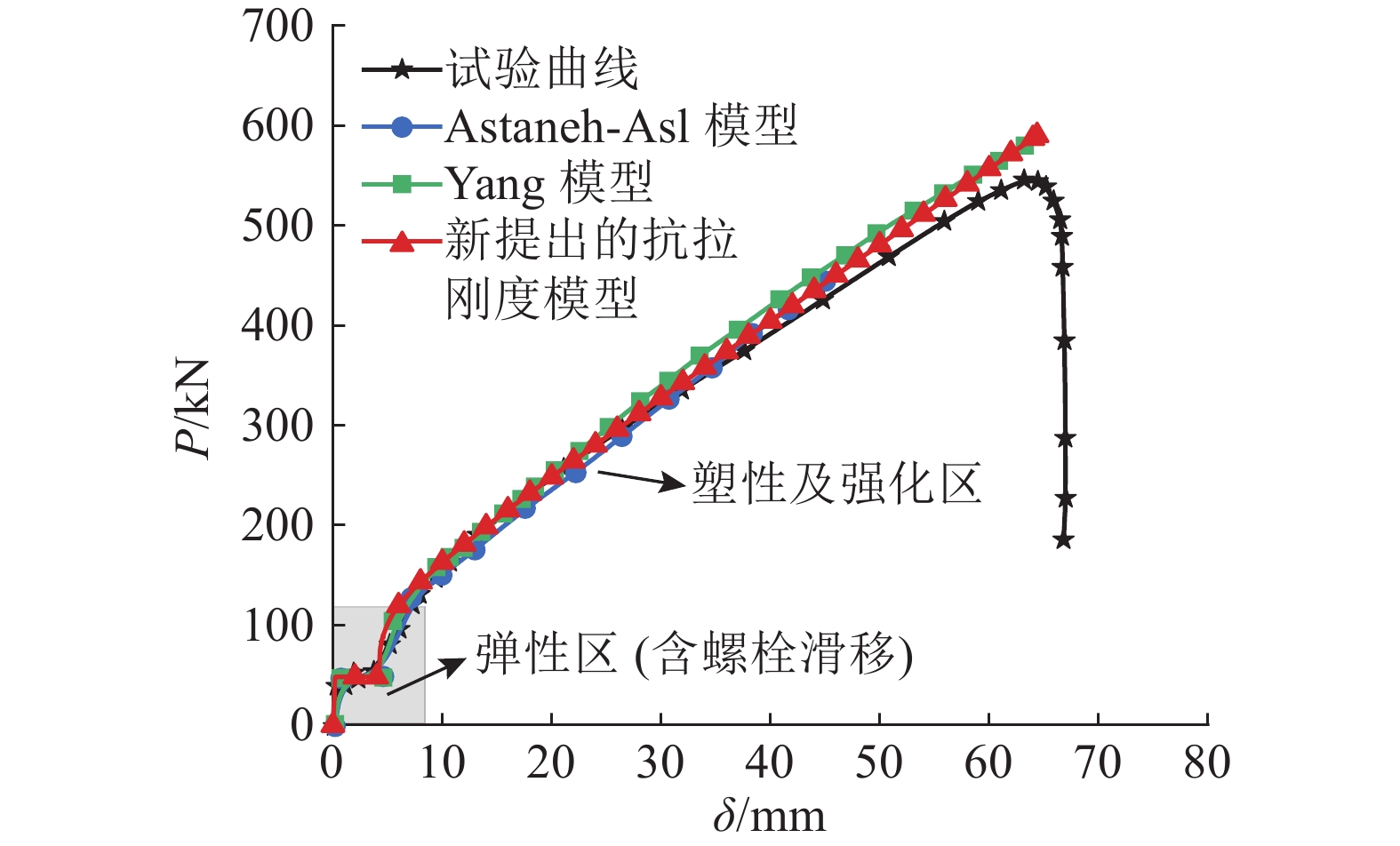
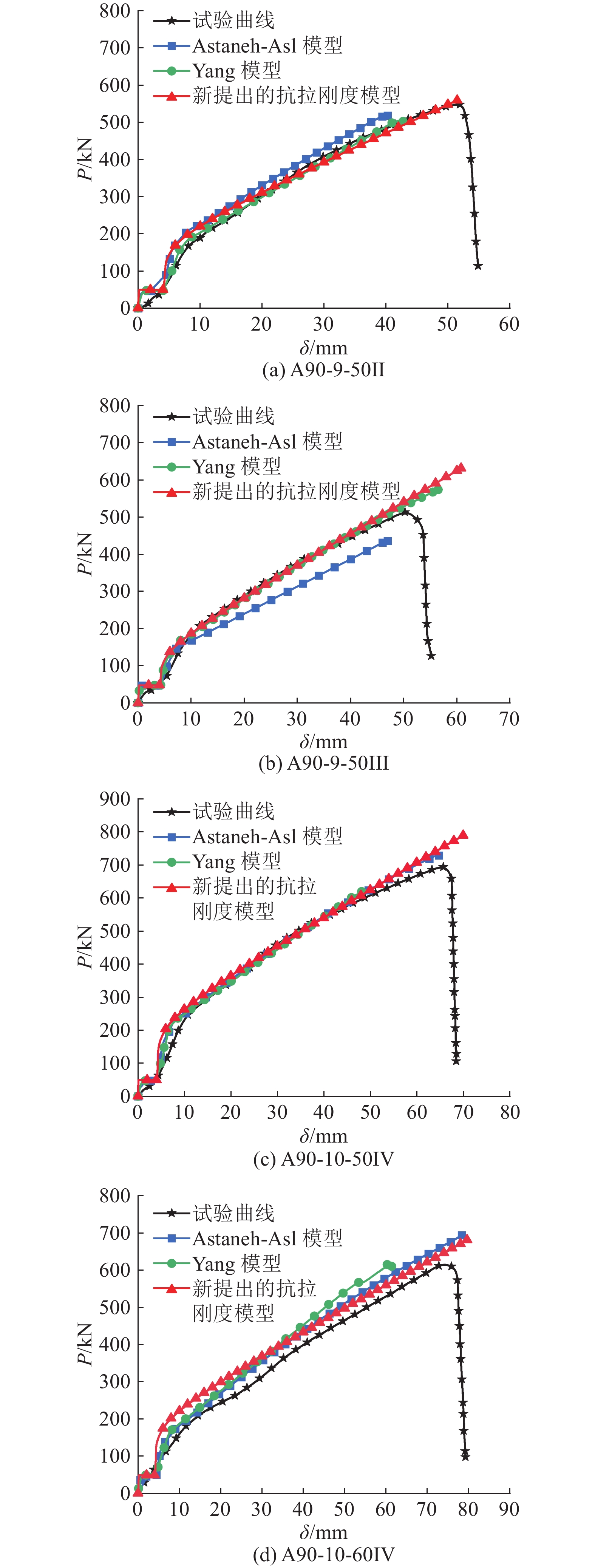
Abstract An analytical model for the tensile stiffness of top-and-seat angle steel connections was proposed based on fundamental mechanical principles aiming at the problem of insufficient prediction accuracy of load-bearing capacity. An explicit functional relationship between the bending stiffness of angle-steel cross-section and the corresponding bending moment was established by utilizing stress integration over the angle steel cross-section and the notion of strain energy equivalence. The force-displacement curves of top-and-seat angle steel connections were obtained based on a realistic "frame model" that better reflected the actual stress state by solving this tensile stiffness model through an incremental-iterative approach. The prediction accuracy and effectiveness of the new model were verified compared with typical published experimental data and the conventional plastic hinge model. The proposed model could reproduce the complete force-displacement skeleton curve of the connection with high fidelity, precisely capturing the smooth nonlinear characteristics of tensile stiffness in elasto-plastic transition zone of angle steel connections. The prediction error of the ultimate bearing capacity was reduced from 23.41% to 6.68% by the new model, and the prediction error of the yield load was improved from 43.16% to 31.60% compared with the traditional plastic hinge model.
|
|
Received: 11 September 2025
Published: 20 July 2026
|
|
|
| Fund: 国家重点研发计划资助项目(2024YFC3015100). |
|
Corresponding Authors:
Zhiguang ZHOU
E-mail: yi-wen.li@connect.polyu.hk;zgzhou@tongji.edu.cn
|
考虑弯矩-刚度相关性的顶底角钢连接力学模型
针对现有理论模型对承载力预测精度不足的问题,提出基于力学基本原理的顶底角钢连接抗拉刚度分析模型. 根据角钢构件截面应力积分和应变能等效原理,建立角钢构件截面抗弯刚度与其所承受弯矩之间的显式函数关系. 基于符合实际受力的“刚架模型”,通过增量迭代法求解该抗拉刚度模型,获得顶底角钢连接的力-位移曲线. 通过与已发表的典型试验数据及传统塑性铰模型进行对比,验证了所提抗拉刚度模型的预测精度和有效性. 所提模型能够高保真地复现角钢连接的完整力-位移骨架曲线,精准捕捉角钢连接弹塑性过渡区的抗拉刚度光滑非线性特性. 相较于传统塑性铰模型,所提模型对极限承载力的预测误差从 23.41% 降低至 6.68%,对屈服荷载的预测误差从43.16%降至31.60%.
关键词:
角钢连接,
力学模型,
变刚度,
弹塑性分析,
构件模型
|
|
| [1] |
MAHIN S A Lessons from damage to steel buildings during the northridge earthquake[J]. Engineering Structures, 1998, 20 (4): 261- 270
doi: 10.1016/s0141-0296(97)00032-1
|
|
|
| [2] |
吴芸, 彭少民, 张其林 角钢连接钢框架抗震性能试验研究与数值分析[J]. 同济大学学报: 自然科学版, 2005, 33 (11): 1438- 1442
WU Yun, PENG Shaomin, ZHANG Qilin Experimental and numerical studies on seismic behaviors of steel frames with top-seat and double web angel connections[J]. Journal of Tongji University: Natural Science, 2005, 33 (11): 1438- 1442
doi: 10.3321/j.issn:0253-374X.2005.11.004
|
|
|
| [3] |
BÉLAND T, BRADLEY C R, NELSON J, et al Experimental parametric characterization of bolted angle connection behavior[J]. Journal of Structural Engineering, 2020, 146 (8): 04020160
doi: 10.1061/(ASCE)ST.1943-541X.0002662
|
|
|
| [4] |
柳长江, 顾强 顶底角钢连接节点的低周疲劳性能分析[J]. 地震工程与工程振动, 2006, 26 (5): 152- 155
LIU Changjiang, GU Qiang Analysis of low-cycle fatigue behavior of top-seat angle steel connections[J]. Earthquake Engineering and Engineering Vibration, 2006, 26 (5): 152- 155
doi: 10.3969/j.issn.1000-1301.2006.05.024
|
|
|
| [5] |
张逍瑶, 刘永华, 梁娟 顶底角钢连接半刚性梁柱钢节点的滞回性能模拟分析[J]. 世界地震工程, 2015, 31 (3): 86- 93
ZHANG Xiaoyao, LIU Yonghua, LIANG Juan Hysteretic performance simulation analysis of semi-rigid steel beam-column joints with top and seat angle connections[J]. World Earthquake Engineering, 2015, 31 (3): 86- 93
|
|
|
| [6] |
PILUSO V, FAELLA C, RIZZANO G Ultimate behavior of bolted T-stubs – II. model validation[J]. Journal of Structural Engineering, 2001, 127 (6): 694- 704
|
|
|
| [7] |
KIM J, GHABOUSSI J, ELNASHAI A S Hysteretic mechanical-informational modeling of bolted steel frame connections[J]. Engineering Structures, 2012, 45: 1- 11
doi: 10.1016/j.engstruct.2012.06.014
|
|
|
| [8] |
SHEN J, ASTANEH-ASL A Hysteretic behavior of bolted-angle connections[J]. Journal of Constructional Steel Research, 1999, 51 (3): 201- 218
doi: 10.1016/S0143-974X(99)00030-9
|
|
|
| [9] |
HU J W, LEON R T, PARK T Mechanical models for the analysis of bolted T-stub connections under cyclic loads[J]. Journal of Constructional Steel Research, 2012, 78: 45- 57
doi: 10.1016/j.jcsr.2012.05.011
|
|
|
| [10] |
袁锐文, 杨蔚彪, 卢雷 顶底角钢连接的初始刚度和极限承载力计算[J]. 建筑结构, 2009, 39 (9): 91- 93
YUAN Ruiwen, YANG Weibiao, LU Lei Calculation of initial stiffness and ultimate bearing capacity of top-and-seat angle connections[J]. Building Structure, 2009, 39 (9): 91- 93
|
|
|
| [11] |
蔡小宁, 孟少平, 孙巍巍, 等 顶底角钢连接半刚性钢结构抗震性能数值分析[J]. 工程力学, 2012, 29 (7): 124- 129
CAI Xiaoning, MENG Shaoping, SUN Weiwei, et al Numerical analysis for seismic behavior of semi-rigid steel frames with top-and-seat angles[J]. Engineering Mechanics, 2012, 29 (7): 124- 129
|
|
|
| [12] |
YANG B, TAN K H Robustness of bolted-angle connections against progressive collapse: mechanical modelling of bolted-angle connections under tension[J]. Engineering Structures, 2013, 57: 153- 168
doi: 10.1016/j.engstruct.2013.08.041
|
|
|
| [13] |
ASTANEH A, NADER M N, MALIK L Cyclic behavior of double angle connections[J]. Journal of Structural Engineering, 1989, 115 (5): 1101- 1118
doi: 10.1061/(ASCE)0733-9445(1989)115:5(1101)
|
|
|
| [14] |
DE STEFANO M, ASTANEH A Axial force-displacement behavior of steel double angles[J]. Journal of Constructional Steel Research, 1991, 20 (3): 161- 181
doi: 10.1016/0143-974X(91)90030-5
|
|
|
|
Viewed |
|
|
|
Full text
|
|
|
|
|
Abstract
|
|
|
|
|
Cited |
|
|
|
|
| |
Shared |
|
|
|
|
| |
Discussed |
|
|
|
|