|
|
|
| Object recognition of excavator operation based on improved CNN-LSTM |
Congyu HU1( ),Chenbo YIN1,*(),Wei MA1,Chao YANG1,Shikuan YAN2 ),Chenbo YIN1,*(),Wei MA1,Chao YANG1,Shikuan YAN2 |
1. College of Mechanical and Power Engineering, Nanjing Tech University, Nanjing 211816, China
2. Jiangsu Tianzhou Testing Technology Limited Company, Nanjing 210019, China |
|
|
|
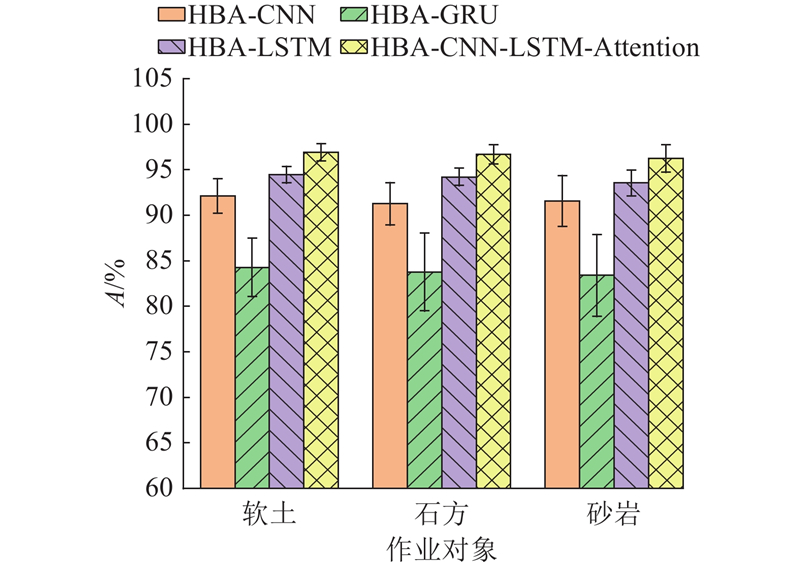
Abstract A hybrid neural network model (HBA-CNN-LSTM-Attention) was proposed for excavator operation object recognition in order to address the limitations of conventional excavator operation object recognition methods, which often suffered from complex computational models and high sensitivity to lighting conditions in practical applications. The strength of convolutional neural network (CNN) in spatial feature extraction was integrated and the squeeze-and-excitation (SE) attention mechanism was incorporated to adaptively optimize feature channel weights, thereby enhancing the effectiveness of feature representation. The model attained greater stability when dealing with dynamic operating scenarios by exploiting the modeling capability of long short-term memory (LSTM) network for temporal information. The maximum information coefficient (MIC) was employed to select input feature in order to further improve performance, highlighting the critical feature. The honey badger algorithm (HBA) was used to automatically tune the hyperparameters of the network, ensuring an optimal configuration during training. Experiments conducted on a representative operational dataset showed that the proposed model achieved a classification accuracy of 96.61%, representing a significant improvement over conventional model. Results verified the effectiveness and practicality of the hybrid model in complex operating environment.
|
|
Received: 30 June 2025
Published: 04 February 2026
|
|
|
| Fund: 国家重点研发计划资助项目(2021YFB2011904). |
|
Corresponding Authors:
Chenbo YIN
E-mail: hucongyu_iacm@163.com;yinchenbo@njtech.edu.cn
|
基于改进CNN-LSTM的挖掘机作业对象识别
针对传统挖掘机作业对象识别方法因计算模型复杂、易受光照条件影响,在实际应用中表现出明显局限性的问题,提出组合神经网络模型(HBA-CNN-LSTM-Attention),用于挖掘机作业对象识别. 该模型融合卷积神经网络(CNN)在提取空间特征方面的优势,引入压缩与激励(SE)注意力机制,实现对特征通道权重的自适应优化,提高了特征表达的有效性. 借助长短期记忆网络(LSTM)在处理时序信息中的建模能力,使模型在应对动态作业场景时更具稳定性. 为了进一步增强模型性能,采用最大信息系数(MIC)对输入特征进行筛选,以突出关键特征. 利用蜜獾优化算法(HBA)自动调整网络结构中的超参数,确保模型在训练过程中达到最优配置. 在典型作业数据集上的实验显示,该模型在分类任务中取得了96.61%的准确率,较传统模型在精度上有显著的提升. 实验结果验证了组合模型在复杂作业环境下的有效性与实用性.
关键词:
挖掘机,
作业对象,
组合神经网络,
特征选择,
蜜獾优化算法(HBA),
注意力机制
|
|
| [1] |
JIN Z, PAGILLA P, MASKE H, et al Task learning, intent prediction, and adaptive blended shared control with application to excavators[J]. IEEE Transactions on Control Systems Technology, 2021, 29 (1): 18- 28
doi: 10.1109/TCST.2019.2959536
|
|
|
| [2] |
陆亮, 吴军凯, 孙宁, 等 智能建造: 工程机械智能化[J]. 液压与气动, 2022, 46 (6): 1- 9
LU Liang, WU Junkai, SUN Ning, et al Intelligent construction: construction machinery intelligentization[J]. Chinese Hydraulics and Pneumatics, 2022, 46 (6): 1- 9
doi: 10.11832/j.issn.1000-4858.2022.06.001
|
|
|
| [3] |
李运华, 范茹军, 杨丽曼, 等 智能化挖掘机的研究现状与发展趋势[J]. 机械工程学报, 2020, 56 (13): 165- 178
LI Yunhua, FAN Rujun, YANG Liman, et al Research status and development trend of intelligent excavators[J]. Journal of Mechanical Engineering, 2020, 56 (13): 165- 178
doi: 10.3901/JME.2020.13.165
|
|
|
| [4] |
赵圣奎, 侯向泽, 王波 基于模糊控制算法的露天铁矿挖掘机控制研究[J]. 自动化应用, 2024, (24): 91- 93
ZHAO Shengkui, HOU Xiangze, WANG Bo Research on control of open-pit iron mine excavator based on fuzzy control algorithm[J]. Automation Application, 2024, (24): 91- 93
|
|
|
| [5] |
DOBSON A, MARSHALL J, LARSSON J Admittance control for robotic loading: design and experiments with a 1-tonne loader and a 14-tonne load-haul-dump machine[J]. Journal of Field Robotics, 2017, 34 (1): 123- 150
doi: 10.1002/rob.21654
|
|
|
| [6] |
MOGHADDAM R Y, KOTCHON A, LIPSETT M G Method and apparatus for on-line estimation of soil parameters during excavation[J]. Journal of Terramechanics, 2012, 49 (3/4): 173- 181
|
|
|
| [7] |
ALTHOEFER K, TAN C P, ZWEIRI Y H, et al Hybrid soil parameter measurement and estimation scheme for excavation automation[J]. IEEE Transactions on Instrumentation and Measurement, 2009, 58 (10): 3633- 3641
doi: 10.1109/TIM.2009.2018699
|
|
|
| [8] |
LI J, CHEN C, LI Y, et al Difficulty assessment of shoveling stacked materials based on the fusion of neural network and radar chart information[J]. Automation in Construction, 2021, 132: 103966
doi: 10.1016/j.autcon.2021.103966
|
|
|
| [9] |
SARATA S, KOYACHI N, SUGAWARA K. Field test of autonomous loading operation by wheel loader [C]//Proceedings of the IEEE/RSJ International Conference on Intelligent Robots and Systems. Nice: IEEE, 2008: 2661–2666.
|
|
|
| [10] |
FERNANDO H, MARSHALL J What lies beneath: material classification for autonomous excavators using proprioceptive force sensing and machine learning[J]. Automation in Construction, 2020, 119: 103374
doi: 10.1016/j.autcon.2020.103374
|
|
|
| [11] |
LI S, WANG S, CHEN X, et al Application of physics-informed machine learning for excavator working resistance modeling[J]. Mechanical Systems and Signal Processing, 2024, 209: 111117
doi: 10.1016/j.ymssp.2024.111117
|
|
|
| [12] |
YUAN G, LI X, QIU P, et al Feature selection method based on wavelet similarity combined with maximum information coefficient[J]. Information Sciences, 2025, 699: 121801
doi: 10.1016/j.ins.2024.121801
|
|
|
| [13] |
王斐, 梁晓庚, 王彦奎, 等 增强小波系数的飞行数据奇异值阈值降噪[J]. 火力与指挥控制, 2013, 38 (7): 171- 173
WANG Fei, LIANG Xiaogeng, WANG Yankui, et al Flight data de-noising using enhanced wavelet coefficients and threshold shrinkage in wavelet transform with singular value decomposition[J]. Fire Control and Command Control, 2013, 38 (7): 171- 173
|
|
|
| [14] |
刘旭宙, 秦满忠, 郭晓, 等. 用噪声概率密度函数对比地震计观测性能 [C]//2018年中国地球科学联合学术年会论文集(二十四)——专题48: 环境地球物理技术应用与研究进展、专题49: 浅地表地球物理进展. 北京: [s. n. ], 2018: 64–67.
LIU Xuzhou, QIN Manzhong, GUO Xiao, et al. Comparison of seismometer observation performance with noise probability density function [C]// 2018 China Geosciences Joint Academic Annual Meeting (Vol. 24)—Session 48: Advances in Environmental Geophysical Technology Applications and Exploration; Session 49: Advances in Near-Surface Geophysics. Beijing: [s. n.], 2018: 64−67.
|
|
|
| [15] |
WU J, HAO Z, WANG S, et al Nonlinear comb narrow-band noise removal using unscented Kalman filter: feasibility and field test analysis[J]. Measurement, 2025, 242: 115928
doi: 10.1016/j.measurement.2024.115928
|
|
|
| [16] |
KOLARIK M, BURGET R, RIHA K. Comparing normalization methods for limited batch size segmentation neural networks [C]//Proceedings of the 43rd International Conference on Telecommunications and Signal Processing. Milan: IEEE, 2020: 677-680.
|
|
|
| [17] |
WANG Y, HONG K, ZOU J, et al A CNN-based visual sorting system with cloud-edge computing for flexible manufacturing systems[J]. IEEE Transactions on Industrial Informatics, 2020, 16 (7): 4726- 4735
doi: 10.1109/TII.2019.2947539
|
|
|
| [18] |
CHAKRABORTY S, BANIK J, ADDHYA S, et al. Study of dependency on number of LSTM units for character based text generation models [C]//Proceedings of the International Conference on Computer Science, Engineering and Applications. Gunupur: IEEE, 2020: 1–5.
|
|
|
|
Viewed |
|
|
|
Full text
|
|
|
|
|
Abstract
|
|
|
|
|
Cited |
|
|
|
|
| |
Shared |
|
|
|
|
| |
Discussed |
|
|
|
|