|
|
|
| Causal prior-guided spatiotemporal traffic flow prediction model |
Yue HOU1( ),Yan WANG1,Yuxuan DONG1,Jianguo ZHAO1,Lindong ZHANG1,Jing MA2,3,Zengqiang SU3 |
1. School of Electronic and Information Engineering, Lanzhou Jiaotong University, Lanzhou 730070, China
2. School of Computer Science and Technology, Xi’an Jiaotong University, Xi’an 710000, China
3. Gansu Province Transportation Planning Survey andb Design Institute Limited Company, Lanzhou 730070, China |
|
|
|
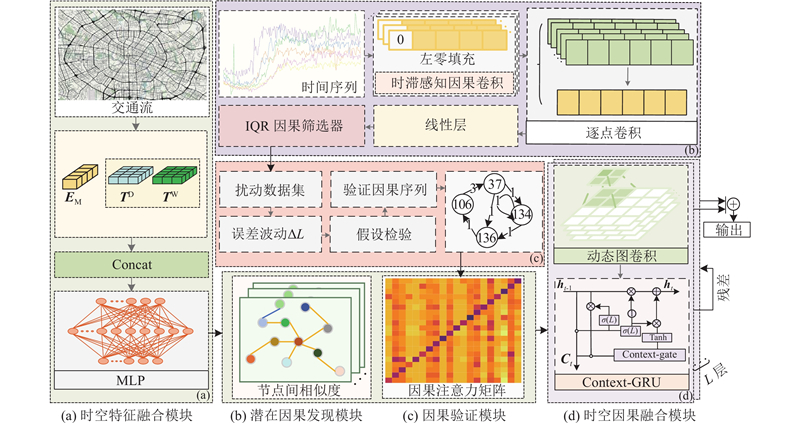
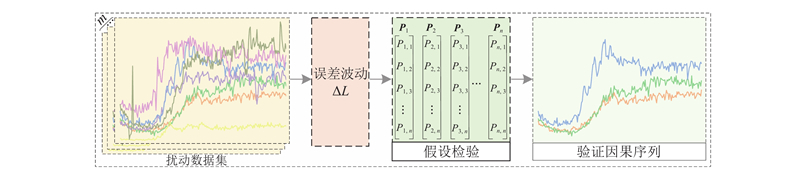
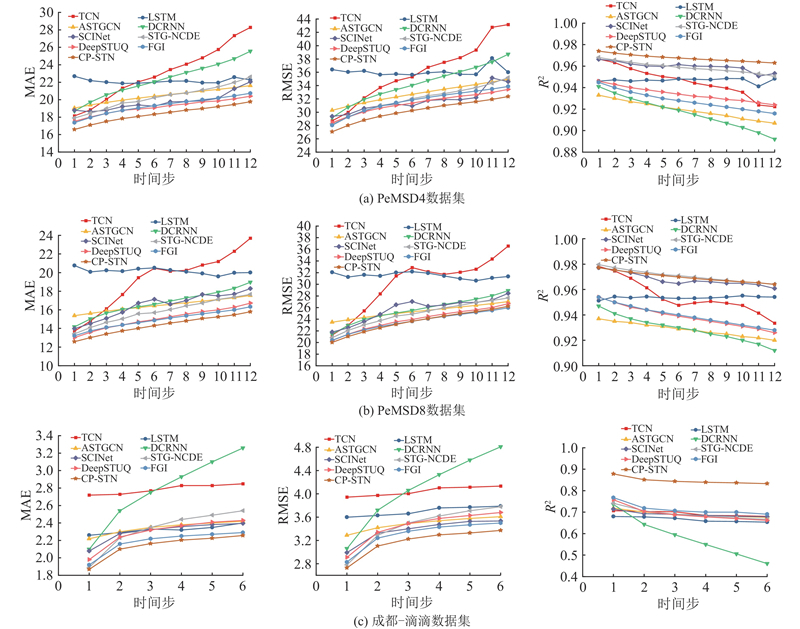
Abstract A causal prior-guided spatiotemporal traffic flow prediction model was proposed in order to address the challenges of identifying the driving factors behind traffic flow variations and improving prediction performance. The spatiotemporal feature fusion module was used to discretize the spatial dimension and integrate it with periodic embeddings in order to enhance the representation of complex nonlinear feature. The latent causal discovery module was utilized to introduce a lag-aware causal convolution and a causal filter in order to capture potential causal relationship among time series. The causal validation module was used to identify true causal relationship under a hypothesis testing framework in order to calculate time delay between nodes with causal effect. The causally validated structure was embedded as prior knowledge into a dynamic graph convolution module in order to guide information propagation and feature aggregation. The experimental results demonstrated that the proposed model achieved reduction in MAE by 4.9197%, 3.9518% and 2.1968% on PeMSD4, PeMSD8 and Chengdu-DiDi datasets, respectively, compared with baseline models. The effectiveness of the causal mechanism in traffic flow prediction was verified.
|
|
Received: 12 September 2025
Published: 21 October 2026
|
|
|
| Fund: 国家自然科学基金资助项目(62363020);甘肃省交通运输厅科技项目(2025-28). |
因果先验引导的交通流时空预测模型
针对交通网络中流量变化驱动因素难以识别、预测性能有待提升的问题,提出因果先验引导的交通流时空预测模型. 采用时空特征融合模块,对空间维度进行离散化建模,并与周期性嵌入相融合,增强模型对复杂非线性特征的表征能力. 利用潜在因果发现模块,引入时滞表征因果卷积和因果筛选器,挖掘时间序列间的潜在因果关系. 采用因果验证模块,在假设检验框架下筛选真实因果关系,计算具有因果效应的节点之间的时延信息. 将经因果验证的结构作为先验知识嵌入动态图卷积模块,指导信息传播与特征聚合. 实验结果表明,与基线模型相比,所提模型在PeMSD4、PeMSD8和成都-滴滴数据集上的MAE指标分别降低了4.9197%、3.9518%、2.1968%,验证了因果机制在交通流预测中的有效性.
关键词:
交通流预测,
因果发现,
因果验证,
深度学习,
时空性
|
|
| [1] |
崔建勋, 要甲, 赵泊媛 基于深度学习的短期交通流预测方法综述[J]. 交通运输工程学报, 2024, 24 (2): 50- 64
Cui Jianxun, Yao Jia, Zhao Boyuan A review of short-term traffic flow prediction methods based on deep learning[J]. Journal of Transportation Engineering, 2024, 24 (2): 50- 64
doi: 10.19818/j.cnki.1671-1637.2024.02.003
|
|
|
| [2] |
秦凡. 基于时空图神经网络的交通流量预测方法研究[D]. 北京: 北京化工大学, 2025.
Qin Fan. Research on traffic flow prediction method based on spatio-temporal graph neural network [D]. Beijing: Beijing University of Chemical Technology, 2025.
|
|
|
| [3] |
Li Y G, Yu R, Shahabi C, et al. Diffusion convolutional recurrent neural network: data-driven traffic forecasting [PP/OL]. arXiv (2017-07-06) [2025-05-27]. https://arxiv.org/abs/1707.01926.
|
|
|
| [4] |
Zhang H, Lu G, Zhan M, et al Semi-supervised classification of graph convolutional networks with Laplacian rank constraints[J]. Neural Process Lett 54, 2022, 54 (4): 2645- 2656
doi: 10.1007/s11063-020-10404-7
|
|
|
| [5] |
ZAREMBA W, SUTSKEVER I, VINYALS O. Recurrent neural network regularization [PP/OL]. arXiv (2015-02-19) [2025-05-27]. https://arxiv.org/abs/1409.2329.
|
|
|
| [6] |
Guo S, Lin Y, Feng N, et al. Attention based spatial-temporal graph convolutional networks for traffic flow forecasting [C]//Proceedings of the AAAI Conference on Artificial Intelligence. Honolulu: AAAI Press, 2019: 922−929.
|
|
|
| [7] |
林霆堉, 邬群勇, 王珂月 基于时间图卷积网络的交通流时空预测模型[J]. 贵州大学学报(自然科学版), 2025, 42 (4): 88- 93
Lin Tingyu, Wu Qunyong, Wang Keyue Traffic flow spatiotemporal prediction model based on temporal graph convolutional network[J]. Journal of Guizhou University (Natural Science Edition), 2025, 42 (4): 88- 93
doi: 10.15958/j.cnki.gdxbzrb.2025.04.11
|
|
|
| [8] |
Song C, Lin Y, Guo S, et al. Spatial-temporal synchronous graph convolutional networks: a new framework for spatial-temporal network data forecasting [C]// Proceedings of the AAAI Conference on Artificial Intelligence. Palo Alto: AAAI Press, 2020: 914–921.
|
|
|
| [9] |
贺文武, 裴博彧, 李雅婷, 等 基于双向自适应门控图卷积网络的交通流预测[J]. 交通运输系统工程与信息, 2023, 23 (1): 187- 197
He Wenwu, Pei Boyu, Li Yating, et al Traffic flow prediction based on bidirectional adaptive gated graph convolutional network[J]. Journal of Transportation Systems Engineering and Information, 2023, 23 (1): 187- 197
doi: 10.16097/j.cnki.1009-6744.2023.01.020
|
|
|
| [10] |
Zhao Y, Deng P, Liu J, et al. Causal conditional hidden Markov model for multimodal traffic prediction [C]//Proceedings of the AAAI Conference on Artificial Intelligence. Washington, DC: AAAI Press, 2023: 4929-4936.
|
|
|
| [11] |
Liu W, Zheng Y, Chawla S, et al. Discovering spatio-temporal causal interactions in traffic data streams [C]//Proceedings of the 17th ACM SIGKDD International Conference on Knowledge Discovery and Data Mining. New York: ACM, 2011: 1010–1018.
|
|
|
| [12] |
Kapoor V, Saxena D, Raychoudhury V, et al. Real time building and maintaining causal congestion graph for intelligent traffic management [C]//2018 IEEE International Conference on Pervasive Computing and Communications Workshops. Athens: IEEE, 2018: 770-775.
|
|
|
| [13] |
Granger C W J Investigating causal relations by econometric models and cross-spectral methods[J]. Econometrica: Journal of the Econometric Society, 1969, 37 (3): 424- 438
|
|
|
| [14] |
Li L, Su X, Wang Y, et al Robust causal dependence mining in big data network and its application to traffic flow predictions[J]. Transportation Research Part C: Emerging Technologies, 2015, 58: 292- 307
doi: 10.1016/j.trc.2015.03.003
|
|
|
| [15] |
He S, Luo Q, Du R, et al STGC-GNNs: a GNN-based traffic prediction framework with a spatial–temporal Granger causality graph[J]. Physica A: Statistical Mechanics and its Applications, 2023, 623: 128913
doi: 10.1016/j.physa.2023.128913
|
|
|
| [16] |
Zhang Z, Ren S, Qian X, et al. Learning flexible time-windowed granger causality integrating heterogeneous interventional time series data [C]//Proceedings of the 30th ACM SIGKDD Conference on Knowledge Discovery and Data Mining. New York: ACM, 2024: 4408-4418.
|
|
|
| [17] |
Liu M, Zeng A, Chen M, et al Scinet: time series modeling and forecasting with sample convolution and interaction[J]. Advances in Neural Information Processing Systems, 2022, 35: 5816- 5828
|
|
|
| [18] |
Choi J, Choi H, Hwang J, et al Graph neural controlled differential equations for traffic forecasting[J]. Proceedings of the AAAI Conference on Artificial Intelligence, 2022, 36 (6): 6367- 6374
doi: 10.21203/rs.3.rs-3972614/v1
|
|
|
| [19] |
Qian W Z, Zhang D L, Zhao Y, et al. Uncertainty quantification for traffic forecasting: a unified approach [C]//2023 IEEE 39th International Conference on Data Engineering. Anaheim: IEEE, 2023: 992−1004.
|
|
|
| [20] |
Fu J, Zhou W, Chen Z Bayesian graph convolutional network for traffic prediction[J]. Neurocomputing, 2024, 582: 127507
doi: 10.1016/j.neucom.2024.127507
|
|
|
| [21] |
Hou Y, Zhang D, Li D, et al Regional traffic flow combination prediction model considering virtual space of the road network[J]. Physica A: Statistical Mechanics and its Applications, 2024, 637: 129598
doi: 10.1016/j.physa.2024.129598
|
|
|
|
Viewed |
|
|
|
Full text
|
|
|
|
|
Abstract
|
|
|
|
|
Cited |
|
|
|
|
| |
Shared |
|
|
|
|
| |
Discussed |
|
|
|
|