|
|
|
| Concrete crack detection in dark environments based on biomimetic tactile technology |
Zixiang LI1( ),Kecheng LU1,Haibing CAI1,Weishuai XIE1,Guangdong ZHANG2 ),Kecheng LU1,Haibing CAI1,Weishuai XIE1,Guangdong ZHANG2 |
1. School of Civil Engineering and Architecture, Anhui University of Science and Technology, Huainan 232001, China
2. Shantui Construction Machinery Limited Company, Jining 272000, China |
|
|
|
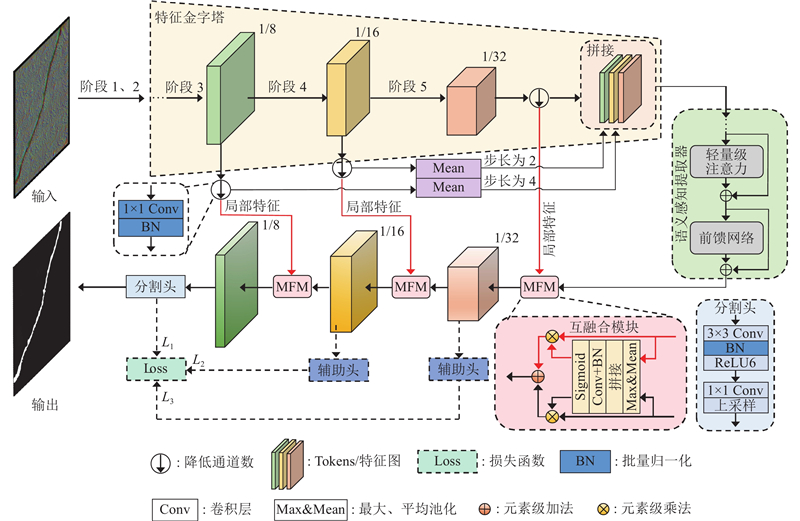
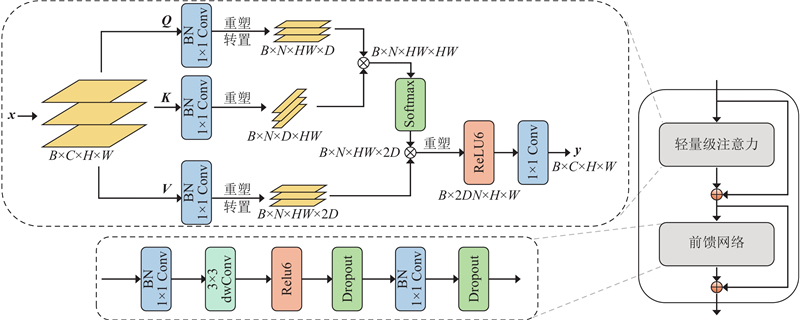
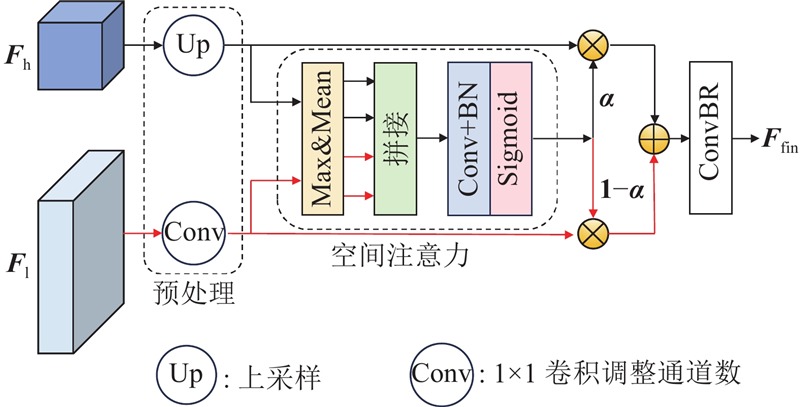
Abstract To address the challenge of difficult identification of concrete cracks in extremely dark environments, a concrete crack recognition method based on biomimetic tactile technology was proposed. By simulating the tactile perception mechanism of organisms, a tactile sensing system and a deep learning model were constructed to achieve crack detection in dark environments. A high-sensitivity silicone tactile probe was designed and combined with a multi-light source imaging system and the Lambertian reflection model, and the three-dimensional texture of cracks was reconstructed through elastomer deformation and light-shadow gradient changes, overcoming the reliance on visual information in dark environments. On this basis, a tactile segmentation network for concrete cracks (TSCC-Net) was constructed. Through the collaboration of a semantic perception extractor, mutual fusion module, and auxiliary supervision module, precise segmentation of cracks in tactile images was achieved. Experimental results showed that TSCC-Net achieved an IOU of 86.3% in tactile image crack recognition, with a model parameter size of 12.86 MB and an inference speed of 114.5 fps, significantly outperforming traditional visual models. In particular, TSCC-Net demonstrated stronger robustness in narrow cracks and areas with complex textures compared to models such as U-Net, Segformer, and DeepLabV3+.
|
|
Received: 25 September 2025
Published: 06 May 2026
|
|
|
| Fund: 安徽理工大学高层次引进人才科研启动基金资助项目(2022yjrc76);国家自然科学基金青年项目(C类)(52508426);安徽省住房城乡建设科学技术计划项目(2023-YF011). |
基于触觉仿生技术的黑暗环境混凝土裂缝检测
混凝土裂缝在极端黑暗环境中难以识别,为此提出基于触觉仿生技术的混凝土裂缝识别方法. 通过模拟生物触觉感知机理,构建触觉传感系统与深度学习模型,实现黑暗环境下的裂缝检测. 设计高灵敏度硅胶触觉探头,结合多光源成像系统与朗伯反射模型,通过弹性体形变与光影梯度变化重建裂缝三维纹理,突破黑暗环境对视觉信息的依赖. 构建触觉混凝土裂缝分割网络(TSCC-Net),通过语义感知提取器、互融合模块与辅助监督模块的协同,实现触觉图像中裂缝的精准分割. 实验结果表明,TSCC-Net在触觉图像裂缝识别中交并比达到86.3%,模型参数量为12.86 MB,推理速度达到114.5 帧/s,显著优于传统视觉模型;TSCC-Net在窄缝与纹理复杂区域表现出比U-Net、Segformer及DeepLabV3+更强的鲁棒性.
关键词:
触觉仿生技术,
混凝土裂缝,
计算机视觉,
深度学习模型,
语义分割网络
|
|
| [1] |
叶华文, 蒋成川, 何建希, 等 混凝土铺装层开裂对正交异性钢桥面疲劳性能劣化作用研究[J]. 土木工程学报, 2024, 57 (9): 46- 55
YE Huawen, JIANG Chengchuan, HE Jianxi, et al Effect of concrete overlay cracking on fatigue deterioration of orthotropic steel bridge deck[J]. China Civil Engineering Journal, 2024, 57 (9): 46- 55
|
|
|
| [2] |
徐栋, 贾勤龙, 端木祥永 基于SLGM和T-LSIS的大跨混凝土箱梁桥裂缝统一识别与开裂机理研究[J]. 土木工程学报, 2025, 58 (2): 33- 49
XU Dong, JIA Qinlong, DUANMU Xiangyong Unified identification and cracking mechanism research of cracks in long-span concrete box girder bridges using SLGM and T-LSIS[J]. China Civil Engineering Journal, 2025, 58 (2): 33- 49
|
|
|
| [3] |
崔洪军, 王玉帛, 朱敏清, 等 隧道群明暗转换对暗反应时间的影响[J]. 交通运输工程学报, 2021, 21 (2): 200- 208
CUI Hongjun, WANG Yubo, ZHU Minqing, et al Influence of tunnel group light-dark conversion on dark reaction time[J]. Journal of Traffic and Transportation Engineering, 2021, 21 (2): 200- 208
|
|
|
| [4] |
潘杉, 于挺, 陈伟, 等 基于结构和纹理感知的井下低光照自监督图像增强方法[J]. 煤炭学报, 2025, 50 (4): 2310- 2320
PAN Shan, YU Ting, CHEN Wei, et al Underground low-light self-supervised image enhancement method based on structure and texture perception[J]. Journal of China Coal Society, 2025, 50 (4): 2310- 2320
doi: 10.13225/j.cnki.jccs.2024.0234
|
|
|
| [5] |
杨涵, 李斯涵, 舒江鹏, 等 基于阵列超声和特征融合神经网络的钢筋混凝土结构内部裂缝检测[J]. 建筑结构学报, 2024, 45 (7): 89- 99
YANG Han, LI Sihan, SHU Jiangpeng, et al Internal crack recognition of reinforce concrete structure based on array ultrasound and feature fusion neural network[J]. Journal of Building Structures, 2024, 45 (7): 89- 99
doi: 10.14006/j.jzjgxb.2023.0729
|
|
|
| [6] |
谭国金, 欧吉, 艾永明, 等 基于改进DeepLabv3+模型的桥梁裂缝图像分割方法[J]. 吉林大学学报: 工学版, 2024, 54 (1): 173- 179
TAN Guojin, OU Ji, AI Yongming, et al Bridge crack image segmentation method based on improved DeepLabv3+ model[J]. Journal of Jilin University: Engineering and Technology Edition, 2024, 54 (1): 173- 179
doi: 10.13229/j.cnki.jdxbgxb.20220205
|
|
|
| [7] |
YU H, ZHU L, LI D, et al Comparative study on concrete crack detection of tunnel based on different deep learning algorithms[J]. Frontiers in Earth Science, 2022, 9: 817785
doi: 10.3389/feart.2021.817785
|
|
|
| [8] |
FANG J, YANG C, SHI Y, et al External attention based TransUNet and label expansion strategy for crack detection[J]. IEEE Transactions on Intelligent Transportation Systems, 2022, 23 (10): 19054- 19063
doi: 10.1109/TITS.2022.3154407
|
|
|
| [9] |
LI H, ZHANG H, ZHU H, et al Automatic crack detection on concrete and asphalt surfaces using semantic segmentation network with hierarchical Transformer[J]. Engineering Structures, 2024, 307: 117903
doi: 10.1016/j.engstruct.2024.117903
|
|
|
| [10] |
BAI R, GAO J, LI Z, et al Research on crack disease identification based on visible spectrum in harsh tunnel environment[J]. IEEE Access, 2023, 11: 123268- 123278
doi: 10.1109/ACCESS.2023.3329991
|
|
|
| [11] |
LIU F, WANG L UNet-based model for crack detection integrating visual explanations[J]. Construction and Building Materials, 2022, 322: 126265
doi: 10.1016/j.conbuildmat.2021.126265
|
|
|
| [12] |
徐文远, 李帅, 纪泳丞, 等 RTFormerF10: 基于RTFormer-slim模型融合红外与可见光图像的裂缝分割研究[J]. 中国公路学报, 2025, 38 (4): 69- 84
XU Wenyuan, LI Shuai, JI Yongcheng, et al RTFormerF10: research on crack segmentation based on RTFormer-slim model fusion of infrared and visible light images[J]. China Journal of Highway and Transport, 2025, 38 (4): 69- 84
doi: 10.19721/j.cnki.1001-7372.2025.04.006
|
|
|
| [13] |
YU T, ZHU A, CHEN Y Efficient crack detection method for tunnel lining surface cracks based on infrared images[J]. Journal of Computing in Civil Engineering, 2017, 31 (3): 04016067
doi: 10.1061/(ASCE)CP.1943-5487.0000645
|
|
|
| [14] |
YAN Y, MAO Z, WU J, et al Towards automated detection and quantification of concrete cracks using integrated images and lidar data from unmanned aerial vehicles[J]. Structural Control and Health Monitoring, 2021, 28 (8): e2757
doi: 10.1002/stc.2757
|
|
|
| [15] |
HE J, YANG B, SU Y Integrated transfer learning method for image recognition based on neural network[J]. IETE Journal of Research, 2023, 69 (8): 5196- 5203
doi: 10.1080/03772063.2021.1978877
|
|
|
| [16] |
HAN C, MA T, JU H, et al Multi-stage generative adversarial networks for generating pavement crack images[J]. Engineering Applications of Artificial Intelligence, 2024, 131: 107767
doi: 10.1016/j.engappai.2023.107767
|
|
|
| [17] |
ZHOU Z, LI S, YAN L, et al Intelligent recognition of tunnel lining defects based on deep learning: methods, challenges and prospects[J]. Engineering Failure Analysis, 2025, 170: 109332
doi: 10.1016/j.engfailanal.2025.109332
|
|
|
| [18] |
邓露, 褚鸿鹄, 龙砺芝, 等 基于深度学习的土木基础设施裂缝检测综述[J]. 中国公路学报, 2023, 36 (2): 1- 21
DENG Lu, CHU Honghu, LONG Lizhi, et al Review of deep learning-based crack detection for civil infrastructures[J]. China Journal of Highway and Transport, 2023, 36 (2): 1- 21
|
|
|
| [19] |
顾一丁, 李世彬 压力/弯曲双模态柔性触觉传感器用于手部动作识别[J]. 传感器与微系统, 2025, 44 (5): 44- 47
GU Yiding, LI Shibin Pressure/bending bimodal flexible tactile sensor for hand motion recognition[J]. Transducer and Microsystem Technologies, 2025, 44 (5): 44- 47
doi: 10.13873/J.1000-9787(2025)05-0044-04
|
|
|
| [20] |
胡捷, 刘仁鑫, 杨卫平, 等 用于生物组织弹性模量检测的压电触觉传感器[J]. 仪器仪表学报, 2025, 46 (2): 325- 334
HU Jie, LIU Renxin, YANG Weiping, et al Design of piezoelectric tactile sensors for elastic modulus detection of biological tissues[J]. Chinese Journal of Scientific Instrument, 2025, 46 (2): 325- 334
doi: 10.19650/j.cnki.cjsi.J2413534
|
|
|
| [21] |
GRADINARIU A I, RACLES C, STOICA I, et al Silicones for maxillofacial prostheses and their modifications in service[J]. Materials, 2024, 17 (13): 3297
doi: 10.3390/ma17133297
|
|
|
| [22] |
LU Z, LIU Z, ZHANG X, et al 3D force identification and prediction using deep learning based on a Gelsight-structured sensor[J]. Sensors and Actuators A: Physical, 2024, 367: 115036
doi: 10.1016/j.sna.2024.115036
|
|
|
| [23] |
CHEN W, XU Y, CHEN Z, et al Bidirectional Sim-to-Real transfer for GelSight tactile sensors with CycleGAN[J]. IEEE Robotics and Automation Letters, 2022, 7 (3): 6187- 6194
doi: 10.1109/LRA.2022.3167064
|
|
|
| [24] |
乔景慧, 苏冠赫, 闫书源 三分量双色反射模型驱动的透明PET瓶图像高光去除方法研究[J]. 电子测量与仪器学报, 2025, 39 (2): 92- 101
QIAO Jinghui, SU Guanhe, YAN Shuyuan Research on highlight removal method driven by three component dichromatic reflection model for transparent PET bottle images[J]. Journal of Electronic Measurement and Instrumentation, 2025, 39 (2): 92- 101
doi: 10.13382/j.jemi.B2407784
|
|
|
| [25] |
ALDOSSARY M, ALMUTAIRI J, ALZAMIL I Federated LeViT-ResUNet for scalable and privacy-preserving agricultural monitoring using drone and Internet of Things data[J]. Agronomy, 2025, 15 (4): 928
doi: 10.3390/agronomy15040928
|
|
|
| [26] |
JIANG C, XIA S, ZHOU F, et al Detecting CVT measurement errors using a voltage online monitoring system and maximum approximate coefficient growth rate[J]. IEEE Sensors Journal, 2024, 24 (21): 35181- 35190
doi: 10.1109/JSEN.2024.3459054
|
|
|
| [27] |
WANG Z, JIANG Q, ZHAO S, et al Deep blind image quality assessment powered by online hard example mining[J]. IEEE Transactions on Multimedia, 2023, 25: 4774- 4784
doi: 10.1109/TMM.2023.3257564
|
|
|
|
Viewed |
|
|
|
Full text
|
|
|
|
|
Abstract
|
|
|
|
|
Cited |
|
|
|
|
| |
Shared |
|
|
|
|
| |
Discussed |
|
|
|
|