|
|
|
| Convolutional neural network accelerator based on variable-precision systolic-array structure |
Ting QIN( ),Zhao LI*(),Yuting YAN,Yafei DU |
| School of Computer Science and Technology, Shandong University of Technology, Zibo 255049, China |
|
|
|
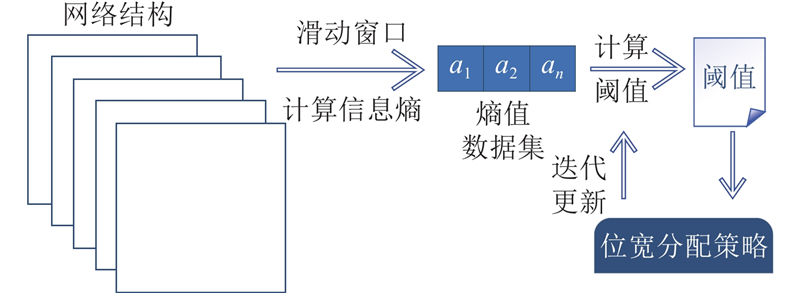
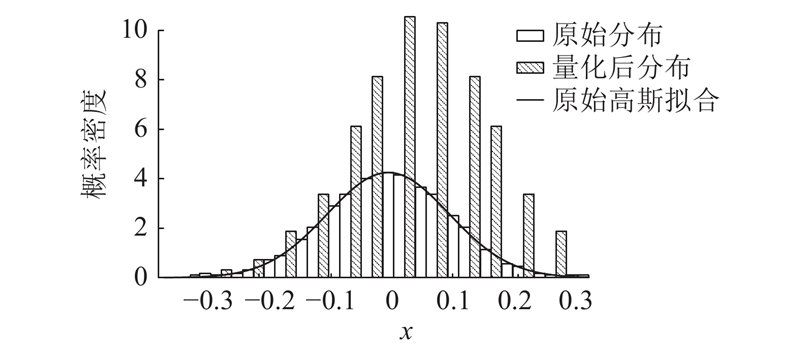
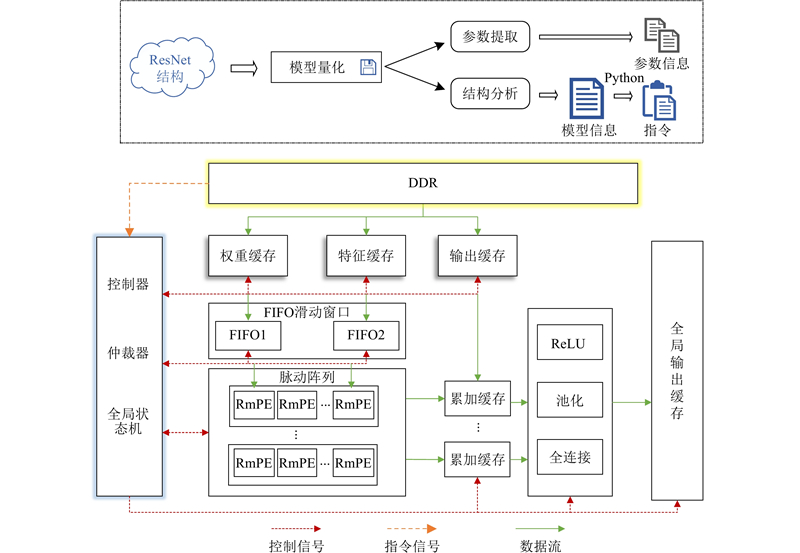
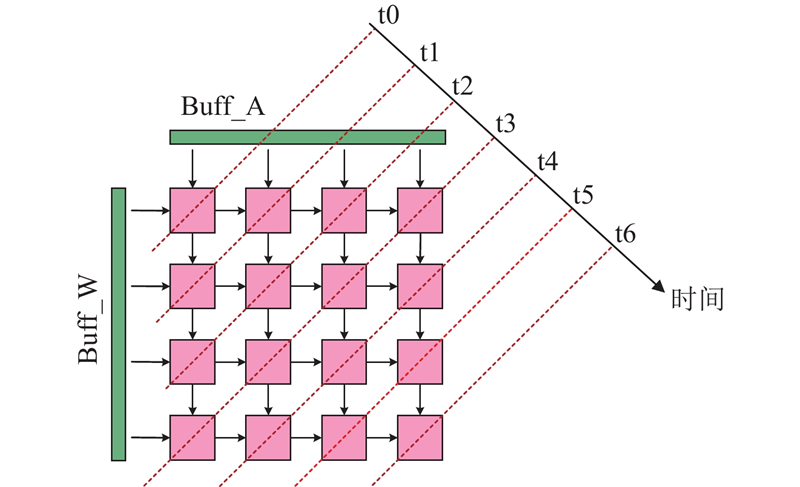
Abstract A CNN accelerator design based on a variable-precision systolic-array architecture was proposed to address inefficient resource provisioning and accuracy degradation in existing approaches. At the algorithm level, an entropy-based quantization strategy was introduced to evaluate the information content of each layer, and mixed-precision configurations (INT4/INT8) were assigned across the network. A KL-divergence loss term was incorporated into quantization-aware training to reduce the accuracy degradation caused by low-bit quantization. At the hardware-architecture level, a dedicated field-programmable gate array (FPGA) accelerator was developed to implement the proposed quantization scheme. An output-stationary systolic array was adopted as the computation core, and variable-precision processing elements were integrated into the accelerator. Each processing element was designed with a single digital signal processor (DSP) block and was configured to perform two parallel multiplications to improve computational density. Furthermore, a FIFO-based sliding-window buffer was employed to enhance on-chip data reuse. Batch normalization was fused with convolution to establish an efficient end-to-end processing pipeline. The performance of the proposed accelerator was evaluated on a Xilinx Kintex-7 platform. Results showed that the accelerator achieved a throughput of 96 GOP/s, a latency of 0.56 ms per-image, and a power consumption of 13.54 W, respectively. The proposed design demonstrates implementation feasibility for edge-deployment scenarios.
|
|
Received: 05 December 2025
Published: 16 October 2026
|
|
|
| Fund: 国家重点研发计划资助项目(2022YFE0107300);山东省重点研发计划资助项目(2025TSGCCZZB0338). |
|
Corresponding Authors:
Zhao LI
E-mail: qin_ting7749@163.com;lizhao_buaa@126.com
|
基于可变精度脉动阵列结构的卷积神经网络加速器
为了缓解现有方法中资源配置不合理与精度下降的问题,提出基于可变精度脉动阵列结构的CNN加速器设计方案. 在算法层面,引入基于信息熵的量化策略,评估各层信息含量并为网络分配INT4/INT8混合精度;在量化感知训练中加入KL散度损失,降低低比特量化带来的精度损失. 在硬件架构层面,构建用于执行该量化策略的专用现场可编程门阵列(FPGA)加速器;以输出固定式脉动阵列为计算核心,集成可变精度处理单元;为每个处理单元设计数字信号处理器(DSP)模块,实现并行双乘法运算以提升计算密度. 加速器采用先进先出(FIFO)滑动窗口缓存以提高片上数据复用率,将批归一化操作融入卷积计算以构建端到端处理流水线. 在Xilinx Kintex-7平台上实测所提加速器的性能. 结果表明,加速器的吞吐量、单张图片推理延迟和功耗分别为96 GOP/s、0.56 ms和13.54 W,该方案具备面向边缘应用场景的实现可行性.
关键词:
卷积神经网络(CNN),
混合精度量化,
定点量化,
脉动阵列,
现场可编程门阵列(FPGA)
|
|
| [1] |
陈江浩, 杨军 结合深度可分离卷积的多源遥感融合影像目标检测[J]. 浙江大学学报: 工学版, 2025, 59 (12): 2545- 2555
CHEN Jianghao, YANG Jun Object detection for multi-source remote sensing fused images based on depthwise separable convolution[J]. Journal of Zhejiang University: Engineering Science, 2025, 59 (12): 2545- 2555
|
|
|
| [2] |
AHMED W, KOMMINENI V K, KÖNIG-RIES B, et al Evaluating the method reproducibility of deep learning models in biodiversity research[J]. PeerJ Computer Science, 2025, 11: e2618
|
|
|
| [3] |
BHARATHI V, RANJITHA M An optimized deep learning method for automatic translator for ancient hieroglyphic language from scanned images to English text[J]. SN Computer Science, 2025, 6 (6): 639
doi: 10.1007/s42979-025-04165-0
|
|
|
| [4] |
EL-TAHER A, AZAB S, MOHAMMED A. From artifact to text: a novel deep learning approach for ancient Egyptian language processing [C]// Proceedings of the Intelligent Methods, Systems, and Applications. Giza: IEEE, 2025: 434–441.
|
|
|
| [5] |
JHA K, JAIN A, SRIVASTAVA S A challenge-response based authentication approach for multimodal biometric system using deep learning techniques[J]. Scalable Computing: Practice and Experience, 2025, 26 (5): 2118- 2129
|
|
|
| [6] |
CHANDRABANSHI V, DOMNIC S Leveraging 3D-CNN and graph neural network with attention mechanism for visual speech recognition[J]. Signal, Image and Video Processing, 2025, 19 (10): 844
doi: 10.1007/s11760-025-04438-4
|
|
|
| [7] |
NAGEL M, FOURNARAKIS M, AMJAD R, et al. A white paper on neural network quantization [EB/OL]. (2021–06–15) [2025–11–10]. https://arxiv.org/pdf/2106.08295.
|
|
|
| [8] |
HAN S, MAO H, DALLY W J. Deep compression: compressing deep neural networks with pruning, trained quantization and Huffman coding [EB/OL]. (2016–02–15) [2025–11–10]. https://arxiv.org/pdf/1510.00149.
|
|
|
| [9] |
SAHA R, SAGAN N, SRIVASTAVA V, et al. Compressing large language models using low rank and low precision decomposition [C]// Proceedings of the 38th International Conference on Neural Information Processing Systems. [S.l.]: Curran Associates Inc. , 2024: 88981–89018.
|
|
|
| [10] |
WANG S, KANG Y Gradient distribution-aware INT8 training for neural networks[J]. Neurocomputing, 2023, 541: 126269
|
|
|
| [11] |
DONG Z, YAO Z, GHOLAMI A, et al. HAWQ: Hessian aware quantization of neural networks with mixed-precision [C]// Proceedings of the IEEE/CVF International Conference on Computer Vision. Seoul: IEEE, 2020: 293–302.
|
|
|
| [12] |
DONG Z, YAO Z, CAI Y, et al. HAWQ-V2: Hessian aware trace-weighted quantization of neural networks [C]// 34th Conference on Neural Information Processing Systems. Vancouver: [s.n.], 2020: 1–12.
|
|
|
| [13] |
KLOBERDANZ E, LE W. MixQuant: mixed precision quantization with a bit-width optimization search [EB/OL]. (2023–09–29)[2025–11–10]. https://arxiv.org/pdf/2309.17341.
|
|
|
| [14] |
TANG C, OUYANG K, WANG Z, et al. Mixed-precision neural network quantization via learned layer-wise importance [C]// Computer Vision – ECCV 2022. Cham: Springer, 2022: 259–275.
|
|
|
| [15] |
MA Y, JIN T, ZHENG X, et al OMPQ: orthogonal mixed precision quantization[J]. Proceedings of the AAAI Conference on Artificial Intelligence, 2023, 37 (7): 9029- 9037
|
|
|
| [16] |
SHANNON C E A mathematical theory of communication[J]. The Bell System Technical Journal, 1948, 27 (3): 379- 423
|
|
|
| [17] |
BOUDJADAR J, ISLAM S U, BUYYA R Dynamic FPGA reconfiguration for scalable embedded artificial intelligence (AI): a co-design methodology for convolutional neural networks (CNN) acceleration[J]. Future Generation Computer Systems, 2025, 169: 107777
|
|
|
| [18] |
ZHANG C, PRASANNA V. Frequency domain acceleration of convolutional neural networks on CPU-FPGA shared memory system [C]// Proceedings of the 2017 ACM/SIGDA International Symposium on Field-Programmable Gate Arrays. Monterey: ACM, 2017: 35–44.
|
|
|
| [19] |
ZENG H, CHEN R, ZHANG C, et al. A framework for generating high throughput CNN implementations on FPGAs [C]// Proceedings of the 2018 ACM/SIGDA International Symposium on Field-Programmable Gate Arrays. Monterey: ACM, 2018: 117–126.
|
|
|
| [20] |
WINOGRAD S. Arithmetic complexity of computations [M]. Philadelphia: Society for Industrial and Applied Mathematics, 1980.
|
|
|
| [21] |
PODILI A, ZHANG C, PRASANNA V. Fast and efficient implementation of convolutional neural networks on FPGA [C]// Proceedings of the IEEE 28th International Conference on Application-specific Systems, Architectures and Processors. Seattle: IEEE, 2017: 11–18.
|
|
|
| [22] |
LU L, LIANG Y, XIAO Q, et al. Evaluating fast algorithms for convolutional neural networks on FPGAs [C]// Proceedings of the IEEE 25th Annual International Symposium on Field-Programmable Custom Computing Machines. [S.l.]: IEEE, 2017: 101–108.
|
|
|
| [23] |
ZHANG X, SONG X, LIU S, et al MRSA: a multi-mode reconfigurable systolic array architecture based on channel-wise stationary dataflow for CNNs[J]. Microelectronics Journal, 2026, 168: 106983
|
|
|
| [24] |
JOSE A, JACOB J. Novel FPGA based systolic array design for dynamic workflows [C]// Proceedings of the 2nd International Conference on Trends in Engineering Systems and Technologies. Ernakulam: IEEE, 2025: 1–5.
|
|
|
| [25] |
YE H, ZHENG X, HUA S, et al. Systolic array-based CNN accelerator for gesture recognition [EB/OL]. [2025–11–10]. https://www.cs.columbia.edu/~sedwards/classes/2025/4840-spring/proposals/Systolic.pdf.
|
|
|
| [26] |
XU H, LI Z, JIN Z, et al. Effective and efficient mixed precision quantization of speech foundation models [C]// Proceedings of the ICASSP 2025 - 2025 IEEE International Conference on Acoustics, Speech and Signal Processing. Hyderabad: IEEE, 2025: 1–5.
|
|
|
| [27] |
KUMAR N, NARANG A, LALL B Kullback–Leibler divergence-based regularized normalization for low-resource tasks[J]. IEEE Transactions on Artificial Intelligence, 2024, 5 (6): 2638- 2650
|
|
|
| [28] |
CHOI J, WANG Z, VENKATARAMANI S, et al. PACT: parameterized clipping activation for quantized neural networks [EB/OL]. (2018–07–17) [2025–11–10]. https://arxiv.org/pdf/1805.06085.
|
|
|
| [29] |
ESSER S K, MCKINSTRY J L, BABLANI D, et al. Learned step size quantization: US11423054 [P]. 2023–11–21.
|
|
|
| [30] |
ISIK M, INADAGBO K, AKTAS H. Design optimization for high-performance computing using FPGA [C]// Information Management and Big Data. Cham: Springer, 2024: 142–156.
|
|
|
| [31] |
HE Y, LIU W, TAHIR M, et al Research on efficient CNN acceleration through mixed precision quantization: a comprehensive methodology[J]. International Journal of Advanced Computer Science and Applications, 2023, 14 (12): 806- 817
|
|
|
| [32] |
ABTAHI T, SHEA C, KULKARNI A, et al Accelerating convolutional neural network with FFT on embedded hardware[J]. IEEE Transactions on Very Large Scale Integration (VLSI) Systems, 2018, 26 (9): 1737- 1749
|
|
|
| [33] |
画芊昊, 李博, 杜宸罡 基于FPGA的深度可分离卷积加速器研究[J]. 计算机测量与控制, 2024, 32 (5): 267- 273
HUA Qianhao, LI Bo, DU Chengang Research on deep separable convolution accelerator based on FPGA[J]. Computer Measurement and Control, 2024, 32 (5): 267- 273
|
|
|
| [34] |
李珍琪, 王强, 齐星云, 等 轻量化卷积神经网络硬件加速设计及FPGA实现[J]. 计算机工程与科学, 2025, 47 (4): 582- 591
LI Zhenqi, WANG Qiang, QI Xingyun, et al Design and FPGA implementation of lightweight convolutional neural network hardware acceleration[J]. Computer Engineering and Science, 2025, 47 (4): 582- 591
|
|
|
|
Viewed |
|
|
|
Full text
|
|
|
|
|
Abstract
|
|
|
|
|
Cited |
|
|
|
|
| |
Shared |
|
|
|
|
| |
Discussed |
|
|
|
|