|
|
|
| Multi-dimensional evaluation of Chinese metaphors based on large language models |
Xiaoxi HUANG( ),Zhengchao ZHA,Shijia LU ),Zhengchao ZHA,Shijia LU |
| School of Computer Science, Hangzhou Dianzi University, Hangzhou 310018, China |
|
|
|
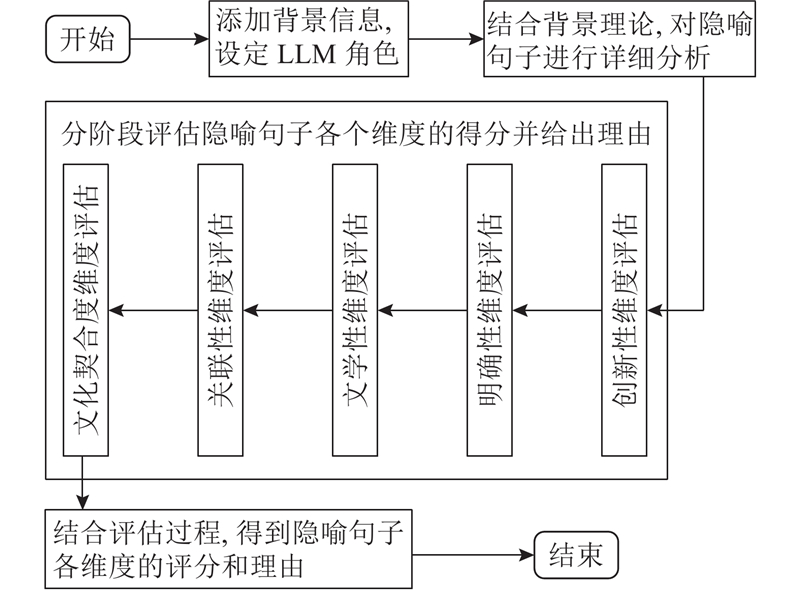
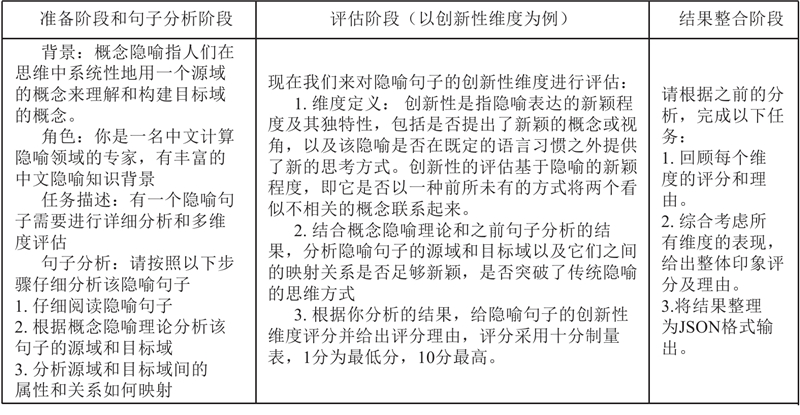
Abstract The application of large language models (LLMs) was studied in evaluating the quality of Chinese metaphorical sentences. Building upon prior research and insights from cognitive linguistics, a multi-dimensional evaluation framework tailored to Chinese metaphors was developed. A high-quality human-annotated dataset was constructed based on the framework to serve as a benchmark for validating LLM performance in metaphor assessment tasks. Guided by conceptual metaphor theory, an LLM-based evaluation pipeline was proposed that integrates multi-turn dialogue and chain-of-thought prompting. Experiments were conducted to test the model’s effectiveness in two distinct tasks: direct scoring of metaphor quality and pairwise comparison for selecting superior metaphors within groups. Results demonstrate strong alignment between LLM evaluations and human judgments. In direct scoring tasks, the Pearson correlation coefficient reached 0.807, and for within-group selection tasks, Cohen’s Kappa coefficient of 0.831 was achieved. The proposed evaluation pipeline integrated conceptual metaphor theory with LLMs and achieved strong results on Chinese metaphor assessment.
|
|
Received: 05 March 2025
Published: 03 February 2026
|
|
|
| Fund: 教育部人文社会科学研究规划基金项目(18YJA740016). |
基于大语言模型的中文隐喻多维度评估
探讨大语言模型(LLMs)在中文隐喻句子质量评估中的应用. 结合以往工作和认知语言学知识,制定中文隐喻的多维度评估标准. 按照该标准构建高质量的人工评估数据集作为基准,以验证大语言模型在中文隐喻评估任务上的表现. 以概念隐喻理论为指导,将多轮对话和思维链提示相结合,提出基于大语言模型的中文隐喻多维度评估框架. 实验结果显示,大语言模型在直接评分任务上与人工评分结果的皮尔逊相关系数为0.807,在组内择优任务上与人工评分结果的卡帕系数为0.831;大语言模型的评估结果与人工评分结果的一致性极高. 所提评估框架结合概念隐喻理论与大语言模型,能够出色地完成中文隐喻评估任务.
关键词:
隐喻评估,
中文隐喻,
概念隐喻理论,
大语言模型(LLM),
提示工程,
多轮对话,
思维链
|
|
| [1] |
SHUTOVA E Design and evaluation of metaphor processing systems[J]. Computational Linguistics, 2015, 41 (4): 579- 623
doi: 10.1162/COLI_a_00233
|
|
|
| [2] |
PAPINENI K, ROUKOS S, WARD T, et al. BLEU: a method for automatic evaluation of machine translation [C]// Proceedings of the 40th Annual Meeting on Association for Computational Linguistics. ACM, 2002: 311–318.
|
|
|
| [3] |
LIN C Y. ROUGE: a package for automatic evaluation of summaries [C]// Proceedings of the Annual Meeting of the Association for Computational Linguistics. Barcelona: ACL, 2004: 74–81.
|
|
|
| [4] |
LI Y, LIN C, GUERIN F. Nominal metaphor generation with multitask learning [C]// Proceedings of the 15th International Conference on Natural Language Generation. Waterville: ACL, 2022: 225–235.
|
|
|
| [5] |
ZHANG Z, HAN X, ZHOU H, et al CPM: a large-scale generative Chinese pre-trained language model[J]. AI Open, 2021, 2: 93- 99
doi: 10.1016/j.aiopen.2021.07.001
|
|
|
| [6] |
LI J, GALLEY M, BROCKETT C, et al. A diversity-promoting objective function for neural conversation models [C]// Proceedings of the 2016 Conference of the North American Chapter of the Association for Computational Linguistics: Human Language Technologies. San Diego: ACL, 2016: 110–119.
|
|
|
| [7] |
CHAKRABARTY T, ZHANG X, MURESAN S, et al. MERMAID: metaphor generation with symbolism and discriminative decoding [C]// Proceedings of the 2021 Conference of the North American Chapter of the Association for Computational Linguistics: Human Language Technologies. [S.l.]: ACL, 2021: 4250–4261.
|
|
|
| [8] |
REIMERS N, GUREVYCH I. Sentence-BERT: sentence embeddings using siamese BERT-networks [C]// Proceedings of the 2019 Conference on Empirical Methods in Natural Language Processing and the 9th International Joint Conference on Natural Language Processing. Hong Kong: ACL, 2019: 3980–3990.
|
|
|
| [9] |
ZHANG T, KISHORE V, WU F, et al. BERTScore: evaluating text generation with BERT [EB/OL]. (2020–02–24)[2025–04–27]. https://arxiv.org/pdf/1904.09675.
|
|
|
| [10] |
DEVLIN J, CHANG M W, LEE K, et al. BERT: pre-training of deep bidirectional transformers for language understanding [C]// Proceedings of the 2019 Conference of the North American Chapter of the Association for Computational Linguistics. Minneapolis: ACL, 2019: 4171–4186.
|
|
|
| [11] |
HEINTZ I, GABBARD R, SRIVASTAVA M, et al. Automatic extraction of linguistic metaphors with LDA topic modeling [C]// Proceedings of the First Workshop on Metaphor in NLP. Atlanta: ACL, 2013: 58–66.
|
|
|
| [12] |
DISTEFANO P V, PATTERSON J D, BEATY R E Automatic scoring of metaphor creativity with large language models[J]. Creativity Research Journal, 2025, 37 (4): 555- 569
doi: 10.1080/10400419.2024.2326343
|
|
|
| [13] |
CONNEAU A, KHANDELWAL K, GOYAL N, et al. Unsupervised cross-lingual representation learning at scale [C]// Proceedings of the 58th Annual Meeting of the Association for Computational Linguistics. [S.l.]: ACL, 2020: 8440–8451.
|
|
|
| [14] |
RADFORD A, WU J, CHILD R, et al Language models are unsupervised multitask learners[J]. OpenAI Blog, 2019, 1 (8): 9
|
|
|
| [15] |
LIU Y, ITER D, XU Y, et al. G-EVAL: NLG evaluation using GPT-4 with better human alignment [C]// Proceedings of the 2023 Conference on Empirical Methods in Natural Language Processing. Singapore: ACL, 2023: 2511–2522.
|
|
|
| [16] |
OpenAI, ACHIAM J, ADLER S, et al. GPT-4 technical report [EB/OL]. (2024–03–04)[2025–04–27]. https://arxiv.org/pdf/2303.08774.
|
|
|
| [17] |
WANG J, WANG J, ZHANG X. Chinese metaphor recognition using a multi-stage prompting large language model [C]// Natural Language Processing and Chinese Computing. Singapore: Springer, 2025: 234–246.
|
|
|
| [18] |
TONG X, CHOENNI R, LEWIS M, et al. Metaphor understanding challenge dataset for LLMs [C]// Proceedings of the 62nd Annual Meeting of the Association for Computational Linguistics. Bangkok: ACL, 2024: 3517–3536.
|
|
|
| [19] |
GAO H, ZHANG J, ZHANG P, et al. Consistency rating of semantic transparency: an evaluation method for metaphor competence in idiom understanding tasks [C]// Proceedings of the 31st International Conference on Computational Linguistics. Abu Dhabi: ACL, 2025: 10460–10471.
|
|
|
| [20] |
SHAO Y, YAO X, QU X, et al. CMDAG: a Chinese metaphor dataset with annotated grounds as cot for boosting metaphor generation [C]// Proceedings of the 2024 Joint International Conference on Computational Linguistics, Language Resources and Evaluation. Torino: [s.n.], 2024: 3357–3366.
|
|
|
| [21] |
WEI J, WANG X, SCHUURMANS D, et al. Chain-of-thought prompting elicits reasoning in large language models [C]// Proceedings of the 36th International Conference on Neural Information Processing Systems. New Orleans: ACM, 2022: 24824–24837.
|
|
|
| [22] |
LAKOFF G, JOHNSON M. Metaphors we live by [M]. Chicago: University of Chicago Press, 2003.
|
|
|
| [23] |
LAKOFF G, JOHNSON M. Conceptual metaphor in everyday language [M]// SARASVATHY S, DEW N, VENKATARAMAN S. Shaping entrepreneurship research. London: Routledge, 2020: 475–504.
|
|
|
| [24] |
LAKOFF G. The contemporary theory of metaphor [M]. Cambridge: Cambridge University Press, 1993.
|
|
|
| [25] |
FAUCONNIER G, TURNER M. The way we think: conceptual blending and the mind’s hidden complexities [M]. New York: Basic Books, 2002.
|
|
|
| [26] |
KÖVECSES Z, BENCZES R. Metaphor: a practical introduction [M]. 2nd ed. Oxford: Oxford University Press, 2010.
|
|
|
| [27] |
GENTNER D, HOLYOAK K J, KOKINOV B N. The analogical mind: perspectives from cognitive science [M]. Cambridge: MIT Press, 2001.
|
|
|
| [28] |
KÖVECSES Z. Metaphor in culture: universality and variation [M]. Cambridge: Cambridge University Press, 2007.
|
|
|
| [29] |
PEARSON K Contributions to the mathematical theory of evolution[J]. Philosophical Transactions of the Royal Society of London Series A, 1894, 185: 71- 110
|
|
|
| [30] |
MCHUGH M L Interrater reliability: the kappa statistic[J]. Biochemia Medica, 2012, 22 (3): 276- 282
|
|
|
| [31] |
张明昊, 张东瑜, 林鸿飞. 基于 HowNet 的无监督汉语动词隐喻识别方法[C]// 第二十届中国计算语言学大会论文集. 呼和浩特: [s.n.], 2021: 258–268.
ZHANG Minghao, ZHANG Dongyu, LIN Hongfei. Unsupervised Chinese verb metaphor recognition method based on HowNet [C]// Proceedings of the 20th Chinese National Conference on Computational Linguistics. Hohhot: [s.n.], 2021: 258–268.
|
|
|
| [32] |
ZHANG Z, HAN X, LIU Z, et al. ERNIE: enhanced language representation with informative entities [C]// Proceedings of the 57th Annual Meeting of the Association for Computational Linguistics. Florence: ACL, 2019: 1441–1451.
|
|
|
| [33] |
BAI J, BAI S, CHU Y, et al. Qwen technical report [EB/OL]. (2023–09–28)[2025–04–27]. https://arxiv.org/pdf/2309.16609.
|
|
|
| [34] |
Team GLM. ChatGLM: a family of large language models from GLM-130B to GLM-4 all tools [EB/OL]. (2024–07–30)[2025–04–27]. https://arxiv.org/pdf/2406.12793.
|
|
|
| [35] |
HADA R, GUMMA V, DE WYNTER A, et al. Are large language model-based evaluators the solution to scaling up multilingual evaluation? [C]// 2020 ACM/IEEE 47th Annual International Symposium on Computer Architecture (ISCA). [S.l.]: ACL, 2023: 1051–1070.
|
|
|
|
Viewed |
|
|
|
Full text
|
|
|
|
|
Abstract
|
|
|
|
|
Cited |
|
|
|
|
| |
Shared |
|
|
|
|
| |
Discussed |
|
|
|
|