|
|
|
| Electro-mechanical coupling constitutive model for dielectric elastomers considering entanglement effect |
Haixiao CAI( ),Zike CHEN,Rui XIAO*() ),Zike CHEN,Rui XIAO*() |
| Department of Engineering Mechanics, School of Aeronautics and Astronautics, Zhejiang University, Hangzhou 310027, China |
|
|
|
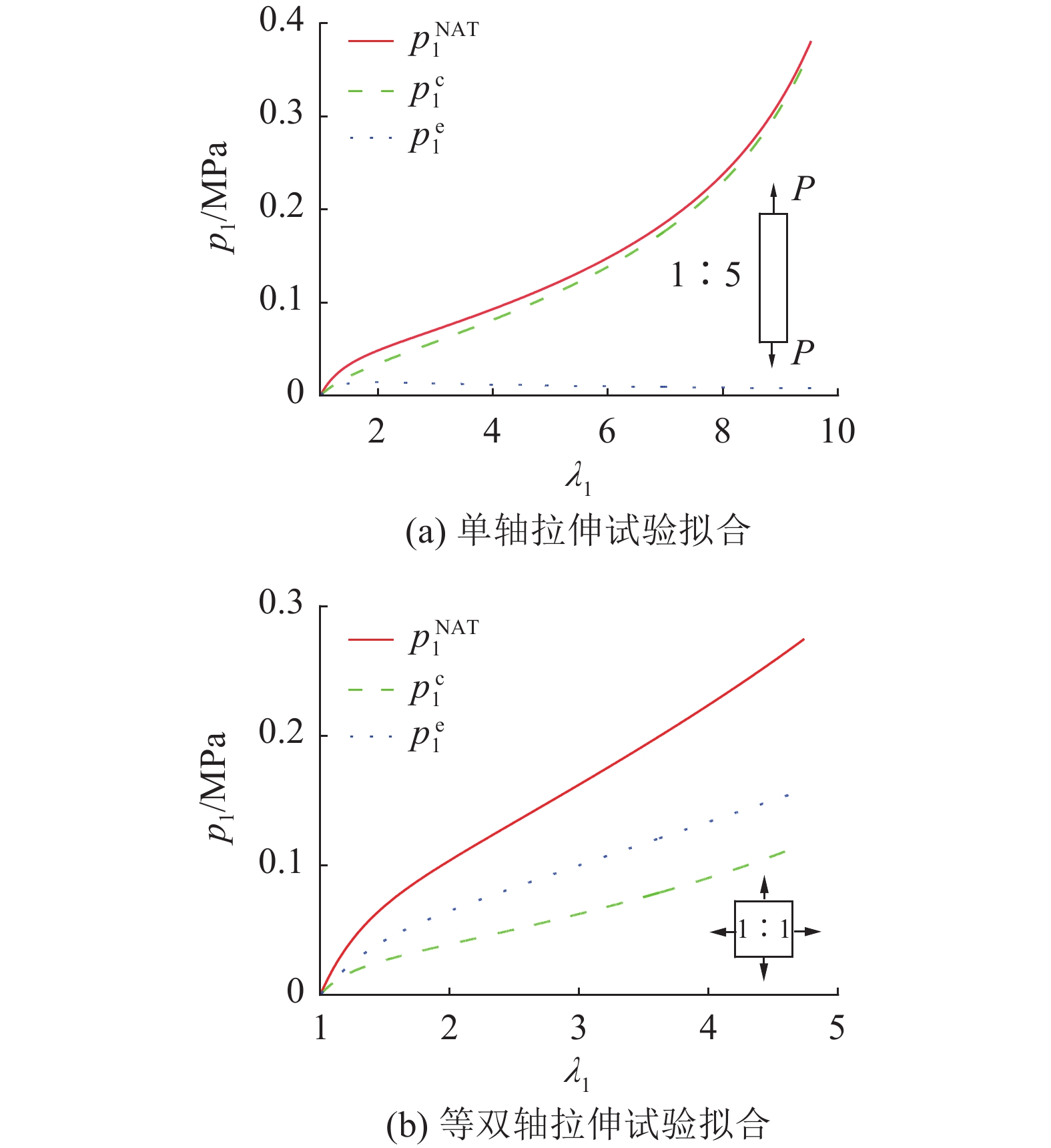
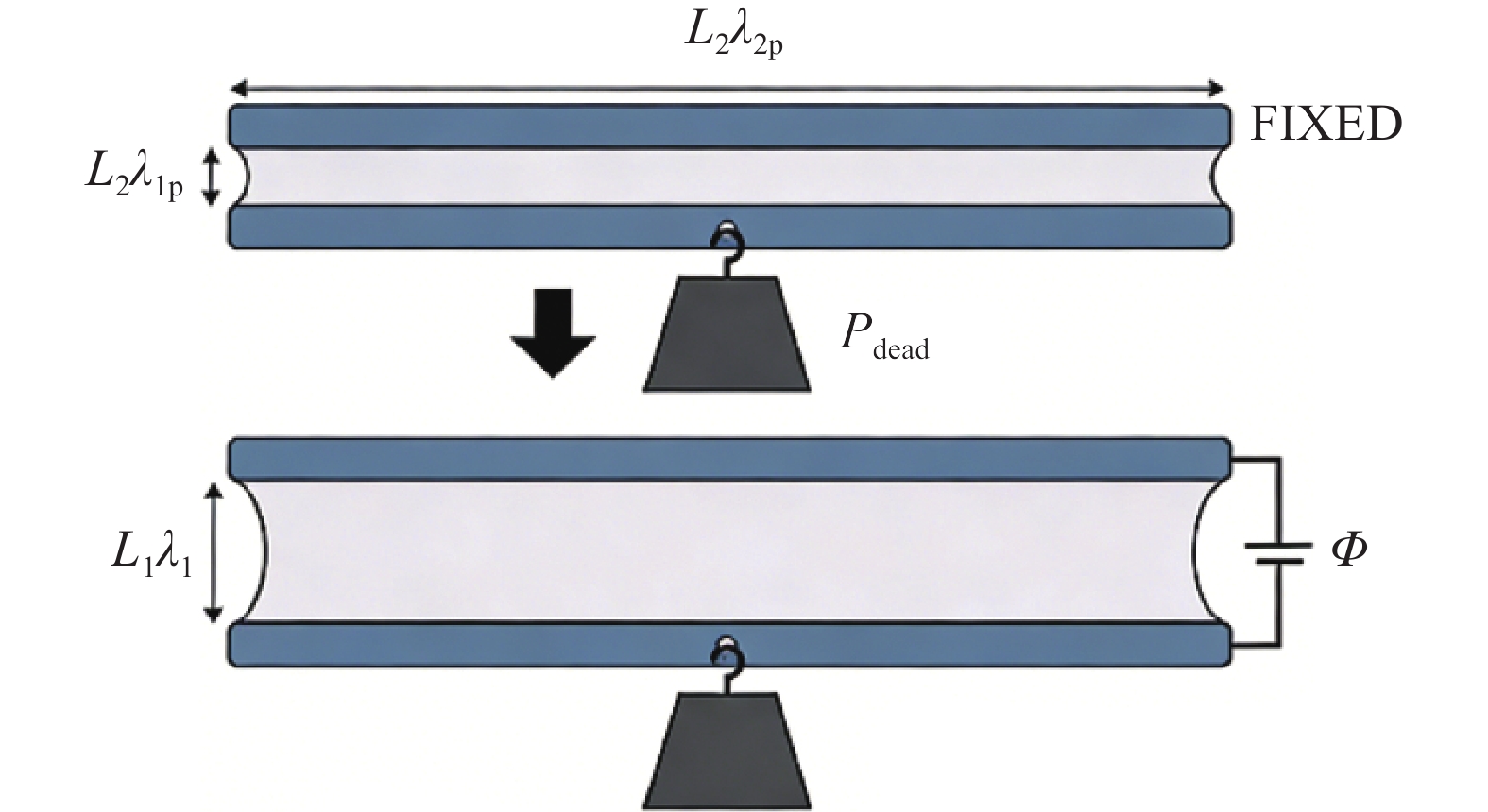
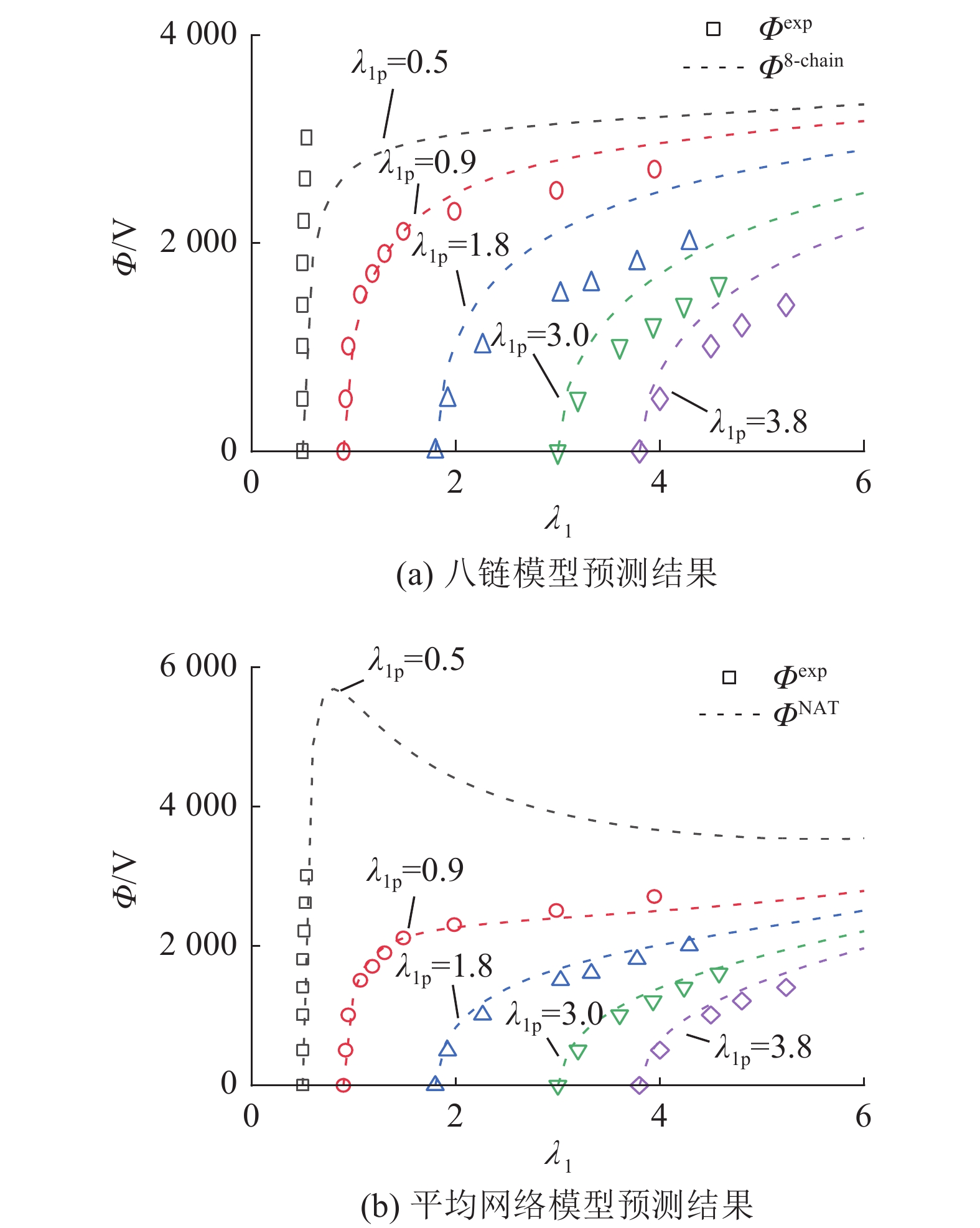
Abstract Classical hyperelastic models (such as eight-chain and full-chain models) struggled to accurately describe uniaxial and biaxial tensile behaviors of dielectric elastomers simultaneously, causing inaccurate predictions of actual electro-induced responses in existing electro-mechanical coupling theories. To address this limitation, entanglement effect was introduced into the hyperelastic framework based on the tube model theory, and a novel hyperelastic model depending only on first and second invariants of strain tensor and containing three material parameters was constructed. Combined with ideal dielectric hypothesis, an electro-mechanical coupling constitutive model for dielectric elastomers with four parameters was established. The predictive capability of the proposed model was validated by fitting experimental data from uniaxial tension, biaxial tension, and pure shear electro-mechanical coupling tests of acrylic elastomers. Compared with traditional electro-mechanical coupling models based on eight-chain models, the constitutive model considering entanglement effect significantly improved fitting accuracy for multiaxial tensile behaviors and effectively described electro-induced deformation responses. The established model is expected to provide theoretical support for structural design of soft actuators, and future work can incorporate viscoelasticity and damage effects into the electro-mechanical coupling framework.
|
|
Received: 27 December 2025
Published: 28 July 2026
|
|
|
| Fund: 国家自然科学基金创新群体资助项目(12321002). |
|
Corresponding Authors:
Rui XIAO
E-mail: 12524057@zju.edu.cn;rxiao@zju.edu.cn
|
考虑缠结效应的介电弹性体力-电耦合本构模型
经典超弹性模型(如八链模型和全链模型)难以同时准确描述介电弹性体单轴与双轴拉伸力学行为,进而导致现有力-电耦合理论无法精准预测实际电致变形响应. 针对这一不足,基于管模型理论,在超弹性框架中引入分子链缠结效应,构建仅依赖应变张量第一与第二不变量、包含3个材料参数的新型超弹性模型. 结合理想介电假说,建立具有4个参数的介电弹性体力-电耦合本构模型. 通过拟合丙烯酸酯类弹性体的单轴拉伸、双轴拉伸及纯剪切力-电耦合实验数据,验证模型预测能力. 与传统基于八链模型构建的力-电耦合理论相比,考虑缠结效应的本构模型显著提升多轴拉伸行为拟合精度,并有效描述材料电致变形响应. 建立的模型有望为软体驱动器结构设计提供理论支撑,未来工作可将黏弹性与损伤效应纳入力-电耦合框架.
关键词:
介电弹性体,
软材料,
本构模型,
超弹性,
力电耦合
|
|
| [1] |
MEHNERT M, HOSSAIN M, STEINMANN P A complete thermo-electro-viscoelastic characterization of dielectric elastomers, Part I: experimental investigations[J]. Journal of the Mechanics and Physics of Solids, 2021, 157: 104603
doi: 10.1016/j.jmps.2021.104603
|
|
|
| [2] |
ROMASANTA L J, LOPEZ-MANCHADO M A, VERDEJO R Increasing the performance of dielectric elastomer actuators: a review from the materials perspective[J]. Progress in Polymer Science, 2015, 51: 188- 211
doi: 10.1016/j.progpolymsci.2015.08.002
|
|
|
| [3] |
GU G Y, ZHU J, ZHU L M, et al A survey on dielectric elastomer actuators for soft robots[J]. Bioinspiration and Biomimetics, 2017, 12 (1): 011003
doi: 10.1088/1748-3190/12/1/011003
|
|
|
| [4] |
ZHAO Z, CHEN Y, HU X, et al Vibrations and waves in soft dielectric elastomer structures[J]. International Journal of Mechanical Sciences, 2023, 239: 107885
doi: 10.1016/j.ijmecsci.2022.107885
|
|
|
| [5] |
PELRINE R, KORNBLUH R, PEI Q, et al High-speed electrically actuated elastomers with strain greater than 100%[J]. Science, 2000, 287 (5454): 836- 839
doi: 10.1126/science.287.5454.836
|
|
|
| [6] |
SUO Z, ZHAO X, GREENE W H A nonlinear field theory of deformable dielectrics[J]. Journal of the Mechanics and Physics of Solids, 2008, 56 (2): 467- 486
doi: 10.1016/j.jmps.2007.05.021
|
|
|
| [7] |
HENANN D L, CHESTER S A, BERTOLDI K Modeling of dielectric elastomers: design of actuators and energy harvesting devices[J]. Journal of the Mechanics and Physics of Solids, 2013, 61 (10): 2047- 2066
doi: 10.1016/j.jmps.2013.05.003
|
|
|
| [8] |
TRELOAR L R G. The physics of rubber elasticity [M]. Oxford: Oxford University Press, 1975.
|
|
|
| [9] |
STEINMANN P, HOSSAIN M, POSSART G Hyperelastic models for rubber-like materials: consistent tangent operators and suitability for Treloar’s data[J]. Archive of Applied Mechanics, 2012, 82 (9): 1183- 1217
doi: 10.1007/s00419-012-0610-z
|
|
|
| [10] |
SHEN S, ZHONG D, QU S, et al A hyperelastic-damage model based on the strain invariants[J]. Extreme Mechanics Letters, 2022, 52: 101641
doi: 10.1016/j.eml.2022.101641
|
|
|
| [11] |
ZHU L, ZHAN L, XIAO R A comparative study of the entanglement models toward simulating hyperelastic behaviors[J]. Journal of Applied Mechanics, 2024, 91 (2): 021007
doi: 10.1115/1.4063348
|
|
|
| [12] |
MATHEW A T, VO T V K, KOH S J A A molecular perspective to analytical modeling that reveals new instabilities in dielectric elastomer transducers[J]. Journal of the Mechanics and Physics of Solids, 2019, 132: 103703
doi: 10.1016/j.jmps.2019.103703
|
|
|
| [13] |
JIANG L, BETTS A, KENNEDY D, et al Eliminating electromechanical instability in dielectric elastomers by employing pre-stretch[J]. Journal of Physics D: Applied Physics, 2016, 49 (26): 265401
doi: 10.1088/0022-3727/49/26/265401
|
|
|
| [14] |
ZHAO X, KOH S J A, SUO Z Nonequilibrium thermodynamics of dielectric elastomers[J]. International Journal of Applied Mechanics, 2011, 3 (2): 203- 217
doi: 10.1142/S1758825111000944
|
|
|
| [15] |
MIEHE C, GÖKTEPE S, LULEI F A micro-macro approach to rubber-like materials: part I: the non-affine micro-sphere model of rubber elasticity[J]. Journal of the Mechanics and Physics of Solids, 2004, 52 (11): 2617- 2660
doi: 10.1016/j.jmps.2004.03.011
|
|
|
| [16] |
KUHN W, GRÜN F. Beziehungen zwischen elastischen Konstanten und Dehnungsdoppelbrechung hochelastischer Stoffe [EB/OL]. [2025−11−01]. https://link.springer.com/article/10.1007/bf01793684.
|
|
|
| [17] |
DOI M, EDWARDS S F. The theory of polymer dynamics [M]. Oxford: Oxford University Press, 1988.
|
|
|
| [18] |
KHIÊM V N, ITSKOV M Analytical network-averaging of the tube model: rubber elasticity[J]. Journal of the Mechanics and Physics of Solids, 2016, 95: 254- 269
doi: 10.1016/j.jmps.2016.05.030
|
|
|
| [19] |
肖锐, 向玉海, 钟旦明, 等 考虑缠结效应的超弹性本构模型[J]. 力学学报, 2021, 53 (4): 1028- 1037
XIAO Rui, XIANG Yuhai, ZHONG Danming, et al Hyperelastic model with entanglement effect[J]. Chinese Journal of Theoretical and Applied Mechanics, 2021, 53 (4): 1028- 1037
|
|
|
| [20] |
HUANG R, SUO Z Electromechanical phase transition in dielectric elastomers[J]. Proceedings of the Royal Society A: Mathematical, Physical and Engineering Sciences, 2012, 468 (2140): 1014- 1040
doi: 10.1098/rspa.2011.0452
|
|
|
| [21] |
JIANG L, BETTS A, KENNEDY D, et al Eliminating electromechanical instability in dielectric elastomers by employing pre-stretch[J]. Journal of Physics D: Applied Physics, 2016, 49 (26): 265401
doi: 10.1088/0022-3727/49/26/265401
|
|
|
| [22] |
CARPI F, CHIARELLI P, MAZZOLDI A, et al Electromechanical characterisation of dielectric elastomer planar actuators: comparative evaluation of different electrode materials and different counterloads[J]. Sensors and Actuators A: Physical, 2003, 107 (1): 85- 95
doi: 10.1016/S0924-4247(03)00257-7
|
|
|
| [23] |
XIAO R, CHEN Z, SHI Y, et al A continuum model for novel electromechanical-instability-free dielectric elastomers[J]. Journal of the Mechanics and Physics of Solids, 2025, 196: 105994
doi: 10.1016/j.jmps.2024.105994
|
|
|
| [24] |
SHI Y, ASKOUNIS E, PLAMTHOTTAM R, et al A processable, high-performance dielectric elastomer and multilayering process[J]. Science, 2022, 377 (6602): 228- 232
doi: 10.1126/science.abn0099
|
|
|
| [25] |
DAVIDSON J D, GOULBOURNE N C A nonaffine network model for elastomers undergoing finite deformations[J]. Journal of the Mechanics and Physics of Solids, 2013, 61 (8): 1784- 1797
doi: 10.1016/j.jmps.2013.03.009
|
|
|
| [26] |
XIANG Y, ZHONG D, WANG P, et al A general constitutive model of soft elastomers[J]. Journal of the Mechanics and Physics of Solids, 2018, 117: 110- 122
doi: 10.1016/j.jmps.2018.04.016
|
|
|
| [27] |
刘立武, 李金嵘, 吕雄飞, 等 电活性介电弹性体的本构理论和稳定性研究进展[J]. 中国科学: 技术科学, 2015, 45 (5): 450- 463
LIU Liwu, LI Jinrong, LV Xiongfei, et al Progress in constitutive theory and stability research of electroactive dielectric elastomers[J]. Scientia Sinica: Technologica, 2015, 45 (5): 450- 463
|
|
|
| [28] |
SOMMER-LARSEN P, KOFOD G, SHRIDHAR M H, et al Performance of dielectric elastomer actuators and materials[J]. Smart Structures and Materials 2002: Electroactive Polymer Actuators and Devices, 2002, 4695: 158- 166
|
|
|
| [29] |
YANG E, FRECKER M, MOCKENSTURM E Viscoelastic model of dielectric elastomer membranes[J]. Smart Structures and Materials 2005: Electroactive Polymer Actuators and Devices, 2005, 5759: 82
doi: 10.1117/12.600289
|
|
|
| [30] |
WISSLER M, MAZZA E Electromechanical coupling in dielectric elastomer actuators[J]. Sensors and Actuators A: Physical, 2007, 138 (2): 384- 393
doi: 10.1016/j.sna.2007.05.029
|
|
|
| [31] |
GOULBOURNE N, MOCKENSTURM E, FRECKER M A nonlinear model for dielectric elastomer membranes[J]. Journal of Applied Mechanics, 2005, 72 (6): 899- 906
doi: 10.1115/1.2047597
|
|
|
| [32] |
DORFMANN A, OGDEN R W Nonlinear electroelasticity[J]. Acta Mechanica, 2005, 174 (3): 167- 183
|
|
|
| [33] |
MCMEEKING R, LANDIS C Electrostatic forcesand stored energy for deformable dielectric materials[J]. Journal of Applied Mechanics, 2005, 72 (4): 581- 590
doi: 10.1115/1.1940661
|
|
|
| [34] |
李树虎, 贾华敏, 李茂东, 等 超弹性体本构模型的理论和特种试验方法[J]. 弹性体, 2011, 21 (1): 58- 64
LI Shuhu, JIA Huamin, LI Maodong, et al Theory and testing method of hyperelastic material constitutive model[J]. China Elastomerics, 2011, 21 (1): 58- 64
|
|
|
| [35] |
DAL H, AÇıKGÖZ K, BADIENIA Y On the performance of isotropic hyperelastic constitutive models for rubber-like materials: a state of the art review[J]. Applied Mechanics Reviews, 2021, 73 (2): 020802
doi: 10.1115/1.4050978
|
|
|
| [36] |
LIN J, MREDHA M T I, WADU R R M, et al Time-dependent constitutive behaviors of a dynamically crosslinked glycerogel governed by bond kinetics and chain diffusion[J]. Journal of the Mechanics and Physics of Solids, 2025, 194: 105951
doi: 10.1016/j.jmps.2024.105951
|
|
|
| [37] |
HU M, WANG L, WEI Z, et al Fracture and fatigue characteristics of monodomain and polydomain liquid crystal elastomers[J]. Soft Matter, 2025, 21 (1): 113- 121
doi: 10.1039/D4SM01042F
|
|
|
|
Viewed |
|
|
|
Full text
|
|
|
|
|
Abstract
|
|
|
|
|
Cited |
|
|
|
|
| |
Shared |
|
|
|
|
| |
Discussed |
|
|
|
|