|
|
|
| Collaborative optimization of geometric design and signal timing at continuous flow intersection |
Lang SONG1,2( ),Xiaowei HU1,*(),Shanchuan YU2,Shi AN1 ),Xiaowei HU1,*(),Shanchuan YU2,Shi AN1 |
1. School of Transportation Science and Engineering, Harbin Institute of Technology, Harbin 150090, China
2. Digital Transportation and Smart City Research Institute, National Engineering and Research Center for Mountainous Highways, Chongqing 400067, China |
|
|
|
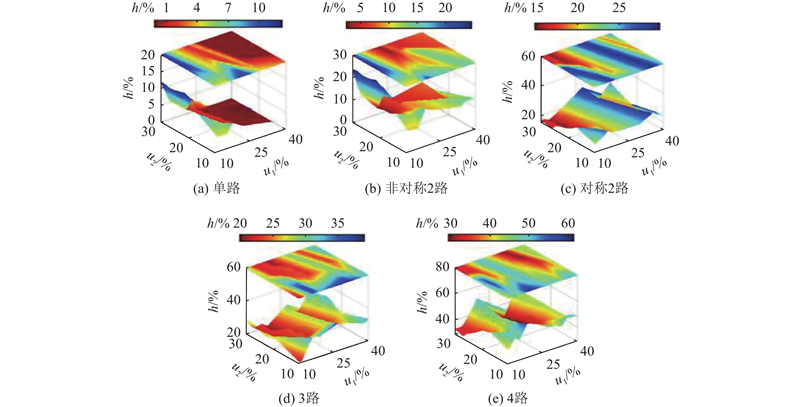
Abstract In order to ensure that the application of continuous flow intersections meets practical needs through selecting the shift left-turn design in 1 to 4 directions at the intersection, combined with whether to adopt right-turn lanes, conventional right-turn exit lanes, conventional exit lanes and other micro-improvement styles, this work proposed the coordinated optimization of geometric design and signal timing at continuous flow intersections based on the extended 2401 design schemes. Considering constraints of lane division, main signal control, pre-signal control, main and pre-signal coordination, and flow distribution, a mixed integer linear programming model was constructed. The results showed that the capacity of single-lane, asymmetric two-lane, symmetrical two-lane, three-lane and four-way shifted left turn settings increased by about 5%, 10%, 25%, 35% and 50% compared with that of conventional intersections. The capacity of continuous intersections increased significantly with the increase of sections with shifted left turn lanes. The optimal application scenario of four-way setting is the intersection where the road flow of each section is not very different. The application scenario of three-way setting is closely related to the traffic composition. The symmetrical two-way setting is suitable for the symmetrical traffic scenario and the shifted left turn lane is generally set on the main road with large traffic volume. The asymmetrical two-way setting performs better in the asymmetrical two-way traffic scenario, and the single-way setting is not recommended.
|
|
Received: 27 June 2025
Published: 23 May 2026
|
|
|
| Fund: 国家自然科学基金资助项目(52272332);重庆市自然科学基金资助项目(CSTB2023NSCQ-MSX0387);重庆市教委科学技术研究资助项目(KJQN202404301);重庆市建设科技计划资助项目(城科字2024第6-8号). |
|
Corresponding Authors:
Xiaowei HU
E-mail: lang_song@qq.com;xiaowei_hu@hit.edu.cn
|
连续流交叉口几何设计与信号配时协同优化
为确保连续流交叉口应用更符合实际需要,将在十字交叉口中选择1~4个方向设置移位左转设计,与是否采用右转专用道、常规右转驶出车道、常规驶出车道等微改进样式相组合,扩展到2 401种设计方案,提出连续流交叉口几何设计与信号配时协同优化方法. 考虑车道划分、主信号控制、预信号控制、主预信号协调、流量分配等约束条件,构建混合整数线性规划模型. 结果表明,与常规交叉口相比,单路、非对称2路、对称2路、3路、4路移位左转设置增加了5%、10%、25%、35%、50%通行能力;移位左转车道设置路段越多,通行能力提升越明显. 4路设置适用于各个路段流量相差不大的交叉口,3路设置适用场景与交通组成密切相关,对称2路设置适用于对称流量场景中且移位左转车道一般设置在大流量主路上,非对称2路设置在非对称2路流量场景中表现更好,不建议采用单路设置.
关键词:
交通工程,
连续流交叉口,
混合整数线性规划,
车道控制,
几何设计,
移位左转
|
|
| [1] |
宋浪, 安实, 俞山川, 等 设置借道左转车道的排阵式交叉口组合设计方法[J]. 交通运输工程学报, 2025, 25 (1): 295- 310
SONG Lang, AN Shi, YU Shanchuan, et al Combination design method of tandem intersections with contraflow left-turn lane[J]. Journal of Traffic and Transportation Engineering, 2025, 25 (1): 295- 310
doi: 10.19818/j.cnki.1671-1637.2025.01.021
|
|
|
| [2] |
JOVANOVIĆ A, KUKIĆ K, STEVANOVIĆ A, et al Restricted crossing U-turn traffic control by interval type-2 fuzzy logic[J]. Expert Systems with Applications, 2023, 211: 118613
doi: 10.1016/j.eswa.2022.118613
|
|
|
| [3] |
SONG L, CHENG H, WANG J, et al Geometric and operational optimization at reversible unconventional arterial intersection reducing traffic emissions[J]. Transportation Research Part D: Transport and Environment, 2025, 141: 104656
doi: 10.1016/j.trd.2025.104656
|
|
|
| [4] |
WU J, LIU P, ZHOU Y, et al Stationary condition based performance analysis of the contraflow left-turn lane design considering the influence of the upstream intersection[J]. Transportation Research Part C: Emerging Technologies, 2021, 122: 102919
doi: 10.1016/j.trc.2020.102919
|
|
|
| [5] |
ALKAISSI Z A Traffic simulation of continuous flow intersection with displaced left-turn: a case study[J]. Journal of Engineering and Applied Science, 2022, 69 (1): 1- 12
doi: 10.1186/s44147-021-00055-3
|
|
|
| [6] |
SALDIVAR-CARRANZA E, LI H, TAYLOR M, et al Continuous flow intersection performance measures using connected vehicle data[J]. Journal of Transportation Technologies, 2022, 12 (4): 861- 875
doi: 10.4236/jtts.2022.124047
|
|
|
| [7] |
ABO-BAKR S, ESAWEY M E, OSAMA A Operational and safety performance evaluation of parallel flow intersection[J]. Transportation Research Record, 2022, 2676 (6): 61- 74
doi: 10.1177/03611981211070283
|
|
|
| [8] |
DHATRAK A, EDARA P, BARED J G Performance analysis of parallel flow intersection and displaced left-turn intersection designs[J]. Transportation Research Record, 2010, 2171 (1): 33- 43
doi: 10.3141/2171-04
|
|
|
| [9] |
ESAWEY M E, SAYED T Unconventional USC intersection corridors: evaluation of potential implementation in Doha, Qatar[J]. Journal of Advanced Transportation, 2011, 45 (1): 38- 53
doi: 10.1002/atr.131
|
|
|
| [10] |
TANG L, LIU Y, LI J, et al Pedestrian crossing design and analysis for symmetric intersections: Efficiency and safety[J]. Transportation Research Part A: Policy and Practice, 2020, 142: 187- 206
doi: 10.1016/j.tra.2020.10.012
|
|
|
| [11] |
郭满, 梅振宇, 章立辉 自动车轨迹优化以实现分转向车流串联交叉口控制[J]. 浙江大学学报: 工学版, 2020, 54 (2): 275- 282
GUO Man, MEI Zhenyu, ZHANG Lihui Trajectory optimization of connected and autonomous vehicles to achieve tandem intersection control[J]. Journal of Zhejiang University: Engineering Science, 2020, 54 (2): 275- 282
|
|
|
| [12] |
GU W, MEI Y, CHEN H, et al An integrated intersection design for promoting bus and car traffic[J]. Transportation Research Part C: Emerging Technologies, 2021, 128: 103211
doi: 10.1016/j.trc.2021.103211
|
|
|
| [13] |
胡晓伟, 宋浪, 杨璐 全设置连续流交叉口信号配时及延误模型[J]. 中国公路学报, 2022, 35 (5): 189- 201
HU Xiaowei, SONG Lang, YANG Lu Signal timing and delay model for full continuous flow intersections[J]. China Journal of Highway and Transport, 2022, 35 (5): 189- 201
doi: 10.3969/j.issn.1001-7372.2022.05.019
|
|
|
| [14] |
YANG X, CHANG G, RAHWANJI S, et al Development of planning-stage models for analyzing continuous flow intersections[J]. Journal of Transportation Engineering, 2013, 139 (11): 1124- 1132
doi: 10.1061/(ASCE)TE.1943-5436.0000596
|
|
|
| [15] |
徐良杰, 朱然博, 陈国俊, 等 考虑绿波控制的双相位移位左转交叉口效用分析[J]. 东南大学学报: 自然科学版, 2021, 51 (5): 874- 882
XU Liangjie, ZHU Ranbo, CHEN Guojun, et al Utility analysis of dual phase displaced left-turn intersection considering green wave control[J]. Journal of Southeast University: Natural Science Edition, 2021, 51 (5): 874- 882
doi: 10.3969/j.issn.1001-0505.2021.05.020
|
|
|
| [16] |
宋浪, 朱湧, 王少飞, 等 连续流交叉口信号协调配时及延误模型[J]. 交通运输系统工程与信息, 2021, 21 (3): 55- 63
SONG Lang, ZHU Yong, WANG Shaofei, et al Signal coordination timing and delay model for continuous flow intersection[J]. Journal of Transportation Systems Engineering and Information Technology, 2021, 21 (3): 55- 63
doi: 10.16097/j.cnki.1009-6744.2021.03.007
|
|
|
| [17] |
YANG X, CHENG Y Development of signal optimization models for asymmetric two-leg continuous flow intersections[J]. Transportation Research Part C: Emerging Technologies, 2017, 74: 306- 326
doi: 10.1016/j.trc.2016.11.021
|
|
|
| [18] |
王旭, 安文娟, 王少飞, 等 T型交叉口移位左转几何设计及信号配时优化[J]. 公路交通技术, 2022, 38 (06): 149- 155
WANG Xu, AN Wenjuan, WANG Shaofei, et al Geometric design and signal timing optimization of displaced left-turn at T-shaped intersection[J]. Technology of Highway and Transport, 2022, 38 (06): 149- 155
doi: 10.13607/j.cnki.gljt.2022.06.023
|
|
|
| [19] |
SUN W, WU X, WANG Y, et al A continuous-flow-intersection-lite design and traffic control for oversaturated bottleneck intersections[J]. Transportation Research Part C: Emerging Technologies, 2015, 56: 18- 33
doi: 10.1016/j.trc.2015.03.011
|
|
|
| [20] |
ZHAO J, MA W, HEAD K L, et al Optimal operation of displaced left-turn intersections: a lane-based approach[J]. Transportation Research Part C: Emerging Technologies, 2015, 61: 29- 48
doi: 10.1016/j.trc.2015.10.012
|
|
|
| [21] |
JIANG X, GAO S Signal control method and performance evaluation of an improved displaced left-turn intersection design in unsaturated traffic conditions[J]. Transportmetrica B: Transport Dynamics, 2020, 8 (1): 264- 289
doi: 10.1080/21680566.2020.1764410
|
|
|
| [22] |
WANG T, ZHAO J, LI C Pedestrian delay model for continuous flow intersections under three design patterns[J]. Mathematical Problems in Engineering, 2019, 2019: 1016261
doi: 10.1155/2019/1016261
|
|
|
| [23] |
宋浪, 王健, 杨滨毓, 等 连续流交叉口左转非机动车交通组织创新设计[J]. 交通运输系统工程与信息, 2022, 22 (1): 225- 233,242
SONG Lang, WANG Jian, YANG Binyu, et al Innovative design of transportation organization for left-turn non-motor vehicles at continuous flow intersection[J]. Journal of Transportation Systems Engineering and Information Technology, 2022, 22 (1): 225- 233,242
doi: 10.16097/j.cnki.1009-6744.2022.01.024
|
|
|
| [24] |
ZHAO J, GAO X, KNOOP V L An innovative design for left turn bicycles at continuous flow intersections[J]. Transportmetrica B: Transport Dynamics, 2019, 7 (1): 1305- 1322
doi: 10.1080/21680566.2019.1614496
|
|
|
| [25] |
ZLATKOVIC M, KERGAYE C Development of crash modification factors for continuous flow intersections[J]. Put i saobraćaj, 2018, 64 (3): 5- 11
doi: 10.31075/PIS.64.03.01
|
|
|
| [26] |
WOLFGRAM J. A safety and emissions analysis of continuous flow intersections [D]. Amherst: University of Massachusetts Amherst, 2018.
|
|
|
| [27] |
蒋贤才, 高苏, 张龙洋 一种改进的移位左转车道信号控制方法及其效用分析[J]. 中国公路学报, 2019, 32 (9): 152- 163
JIANG Xiancai, GAO Su, ZHANG Longyang Signal control and utility analysis of an improved displaced left-turn lane[J]. China Journal of Highway and Transport, 2019, 32 (9): 152- 163
doi: 10.19721/j.cnki.1001-7372.2019.09.015
|
|
|
| [28] |
LEE S, WONG S C, LI Y C Real-time estimation of lane-based queue lengths at isolated signalized junctions[J]. Transportation Research Part C: Emerging Technologies, 2015, 56: 1- 17
doi: 10.1016/j.trc.2015.03.019
|
|
|
| [29] |
赵靖, 徐海军, 高幸, 等 连续流交叉口左转非机动车优化设计方法[J]. 交通运输系统工程与信息, 2018, 18 (6): 178- 186
ZHAO Jing, XU Haijun, GAO Xing, et al Optimization design method of left-turn bicycles crossing for continuous flow intersections[J]. Journal of Transportation Systems Engineering and Information Technology, 2018, 18 (6): 178- 186
doi: 10.16097/j.cnki.1009-6744.2018.06.025
|
|
|
|
Viewed |
|
|
|
Full text
|
|
|
|
|
Abstract
|
|
|
|
|
Cited |
|
|
|
|
| |
Shared |
|
|
|
|
| |
Discussed |
|
|
|
|