|
|
|
| Analysis of stress concentration factor of fatigue hot spot for tubular joints based on 3D scanning technology |
Yongliang MA1( ),Yingming ZHANG1,Guoqing LU2,Yuefu YANG3,Chaoshuai HAN4 ),Yingming ZHANG1,Guoqing LU2,Yuefu YANG3,Chaoshuai HAN4 |
1. School of Shipping and Naval Architecture, Chongqing Jiaotong University, Chongqing 400074, China
2. Port and Waterway Development Center, Bureau of Transportation of Zhenjiang, Zhenjiang 212003, China
3. College of Naval Architecture and Ocean Engineering, Naval University of Engineering, Wuhan 430033, China
4. Ocean College, Jiangsu University of Science and Technology, Zhenjiang 212003, China |
|
|
|
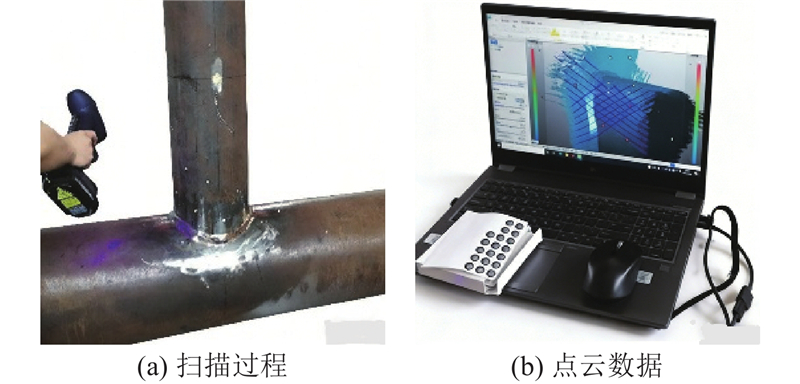
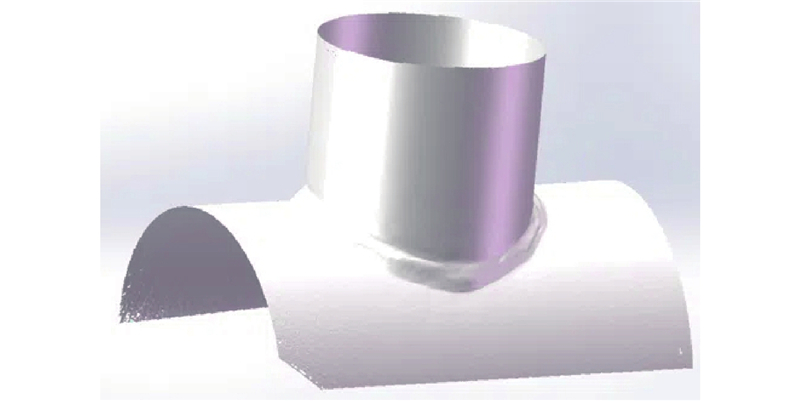
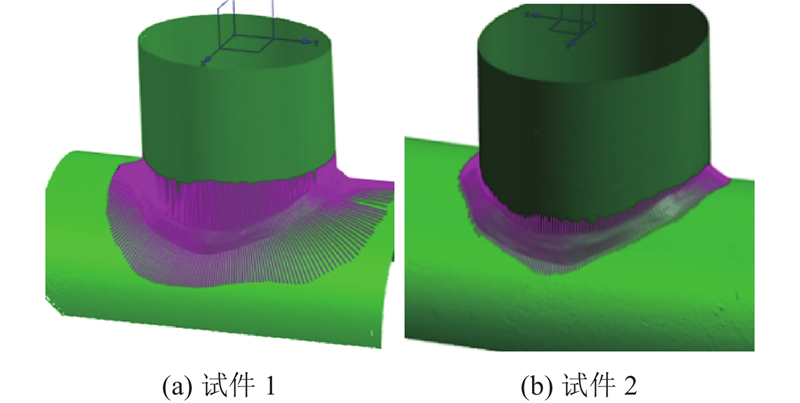
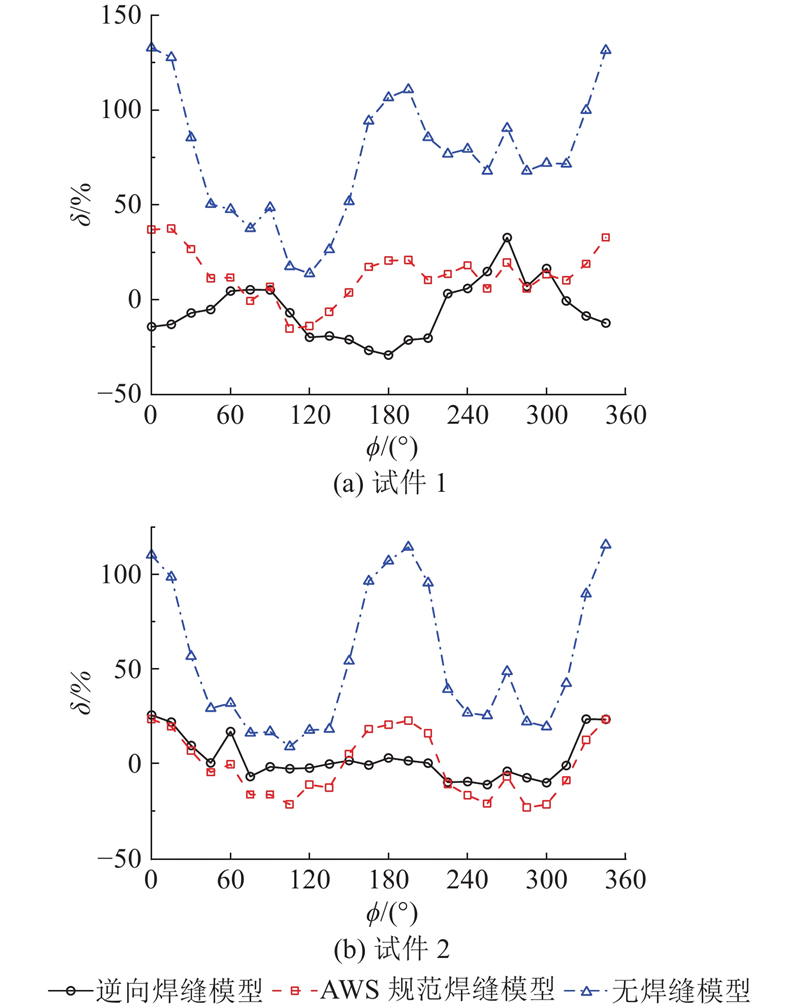
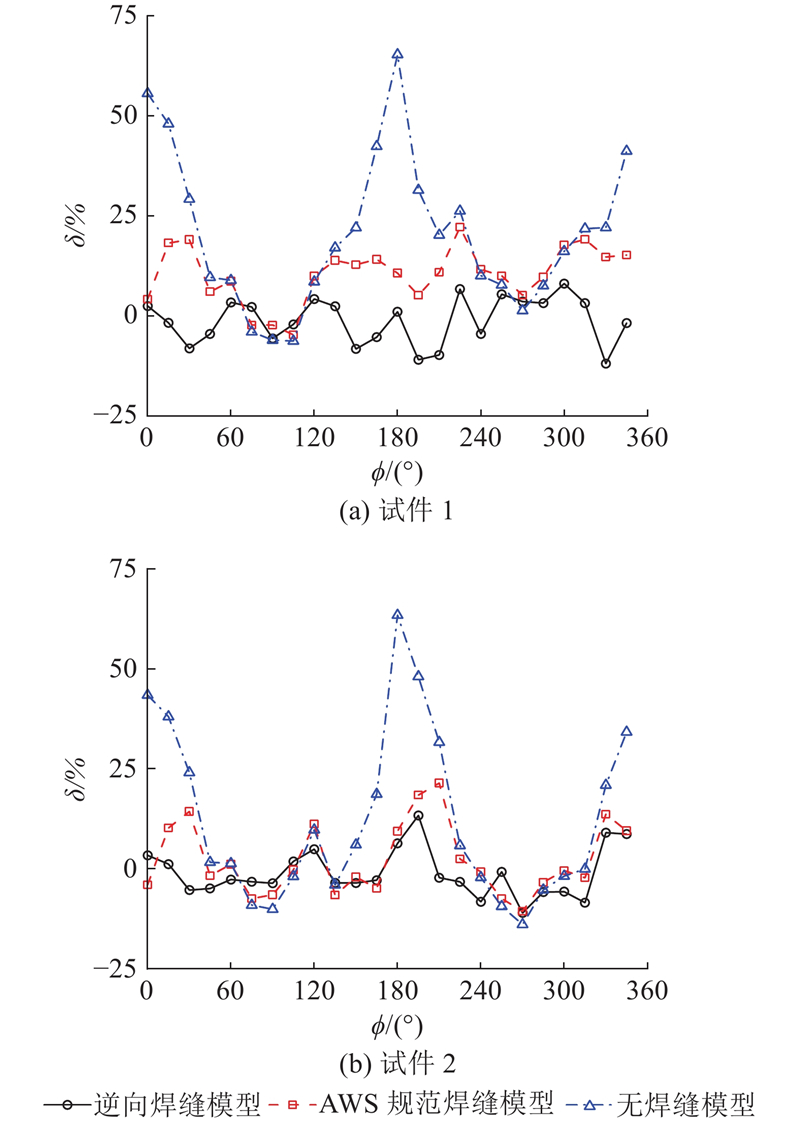
Abstract In order to precisely evaluate the stress concentration factor (SCF) of the welded tubular joints and verify the accuracy of existing methods, a T-joint was taken as the research object to propose a new modeling method. The weld shape data was obtained via 3D laser scanning technology, and a weld model was established through a reverse modeling approach. By importing the reverse-built weld model into the finite element software, a T-joint model containing the reverse weld model was composed. Axial tensile loading test on the T-joints was conducted, and the SCFs were obtained according to the surface stress interpolation method. The SCFs of the T-joint were calculated by using the proposed model, the American Welding Society (AWS) specification weld model, and the model without welds, followed by a comparative analysis between the calculation results with the test data. Results show that the calculation results of the proposed model are the closest to the test data, followed by the AWS specification weld model. However, the model without welds gives a conservative prediction and cannot accurately predict the distribution of SCFs along the weld toe. In the absence of weld shape data, the AWS specification weld model agrees with the test-data distribution to within 25% error. The proposed method can be conveniently extended to the simulation of other types of tubular joints.
|
|
Received: 31 January 2025
Published: 03 February 2026
|
|
|
| Fund: 国家自然科学基金资助项目(52001144). |
基于三维扫描技术的管节点疲劳热点应力集中系数分析
为了准确评估焊接管节点的疲劳热点应力集中系数(SCF),验证现有方法的准确性,提出新的建模方法. 以T形管节点为研究对象,通过三维激光扫描技术获取焊缝形状数据,利用逆向建模方法建立焊缝模型并导入有限元软件,形成含有焊缝的管节点模型. 进行轴向拉伸加载下的T形管节点测试,按照表面应力插值法得到SCF. 使用所提模型、美国焊接学会(AWS)规范焊缝模型和无焊缝模型计算试验管节点的SCF,将计算结果与测试数据进行对比分析. 结果表明,所提模型的计算结果与测试数据最接近,AWS规范焊缝模型其次,无焊缝模型的计算结果保守,且不能准确给出SCF沿焊趾的分布. 在缺乏焊缝数据时,AWS规范焊缝模型的计算结果符合测试数据的分布规律,且误差不超过25%. 所提方法可方便地推广到其他类型管节点模拟中.
关键词:
三维扫描技术,
逆向建模,
T形管节点,
应力集中系数 (SCF),
试验测试
|
|
| [1] |
ZAVVAR E, ROSA-SANTOS P, GHAFOORI E, et al Analysis of tubular joints in marine structures: a comprehensive review[J]. Marine Structures, 2025, 99: 103702
doi: 10.1016/j.marstruc.2024.103702
|
|
|
| [2] |
中国船级社. 海洋工程结构物疲劳强度评估技术指南 2022 [EB/OL]. (2022−05−11) [2024−05−18]. https://www.ccs.org.cn/ccswz/specialDetail?id=202205110218529632.
|
|
|
| [3] |
American Bureau of Shipping. Guide for fatigue assessment of offshore structures [S]. Houston: American Bureau of Shipping, 2020.
|
|
|
| [4] |
Det Norske Veritas. Fatigue design of offshore steel structures: DNV-RP-C203 [S]. Oslo: Det Norske Veritas, 2024.
|
|
|
| [5] |
American Petroleum Institute. Recommended practice for planning, designing and constructing fixed offshore platforms: working stress design: RP2A-WSD [S]. Washington DC: American Petroleum Institute, 2010.
|
|
|
| [6] |
International Standardization Organization. Petroleum and natural gas industries - fixed steel offshore structures: ISO 19902-2022 (E) [S]. Genova: International Standardization Organization, 2022.
|
|
|
| [7] |
International Standardization Organization. Fatigue — design procedure for welded hollow-section joints — recommendations: ISO 14347-2008 [S]. Genova: International Standardization Organization, 2008.
|
|
|
| [8] |
ZHAO X, HERION S, PACKER J, et al. Design guide for circular and rectangular hollow section welded joints under fatigue loading: CIDECT design guide No. 8 [M]. Cologne: TÜV-Verlag, 2001.
|
|
|
| [9] |
Lloyd’s Register of Shipping. Stress concentration factors for simple tubular joints: assessment of existing and development of new parametric formulae: OTH 354 [R]. Nottingham: Health and Safety Executive , 1997.
|
|
|
| [10] |
甘进, 乐京霞, 吴卫国, 等 海洋平台KK型管节点的疲劳性能试验研究[J]. 武汉理工大学学报: 交通科学与工程版, 2011, 35 (5): 980- 983
GAN Jin, LE Jingxia, WU Weiguo, et al Experimental study on fatigue properties of tubular KK-joints of offshore platform[J]. Journal of Wuhan University of Technology: Transportation Science and Engineering, 2011, 35 (5): 980- 983
doi: 10.3963/j.issn.1006-2823.2011.05.026
|
|
|
| [11] |
张哲文. 不锈钢T型相贯节点疲劳性能研究 [D]. 合肥: 合肥工业大学, 2021: 1–89.
ZHANG Zhewen. Research on fatiguebehaviour of stainless steel welded tubular T-joints [D]. Hefei: Hefei University of Technology, 2021: 1–89.
|
|
|
| [12] |
LOZANO-MINGUEZ E, BRENNAN F P, KOLIOS Α J Reanalysis of offshore T-joint fatigue life predictions based on a complete weld profile model[J]. Renewable Energy, 2014, 71: 486- 494
doi: 10.1016/j.renene.2014.05.064
|
|
|
| [13] |
HECTORS K, DE WAELE W Influence of weld geometry on stress concentration factor distributions in tubular joints[J]. Journal of Constructional Steel Research, 2021, 176: 106376
doi: 10.1016/j.jcsr.2020.106376
|
|
|
| [14] |
邵永波, LIE Seng-Tjhen K节点应力集中系数的试验和数值研究方法[J]. 工程力学, 2006, 23 (Suppl.1): 79- 85
SHAO Yongbo, LIE Seng-Tjhen Experimental and numerical studies of the stress concentration factor (SCF) of tubular K-joints[J]. Engineering Mechanics, 2006, 23 (Suppl.1): 79- 85
doi: 10.3969/j.issn.1000-4750.2006.z1.016
|
|
|
| [15] |
American Welding Society. Structural welding Code-steel: ANSI/AWS D1.1M-2015 [S]. Miami: American Welding Society, 2015.
|
|
|
| [16] |
BAO S, LI X, WANG B Study on hot spot stress of three-planar tubular Y-joints under combined axial loads[J]. Thin-Walled Structures, 2019, 140: 478- 494
doi: 10.1016/j.tws.2019.03.025
|
|
|
| [17] |
袁智深, 姚尧, 卢微然, 等 平面外弯矩作用下T形圆管节点热点应力分布[J]. 湖南大学学报: 自然科学版, 2022, 49 (5): 151- 159
YUAN Zhishen, YAO Yao, LU Weiran, et al Hot spot stress distribution of CHS T-joints under out-of-plane bending[J]. Journal of Hunan University: Natural Sciences, 2022, 49 (5): 151- 159
doi: 10.16339/j.cnki.hdxbzkb.2022059
|
|
|
| [18] |
AHMADI H, ZAVVAR E The effect of multi-planarity on the SCFs in offshore tubular KT-joints subjected to in-plane and out-of-plane bending loads[J]. Thin-Walled Structures, 2016, 106: 148- 165
doi: 10.1016/j.tws.2016.04.020
|
|
|
| [19] |
奚丽生, 方培君, 黄越, 等 海洋平台T型管节点相贯焊缝外形尺寸研究[J]. 海洋工程, 1990, 8 (2): 27- 34
XI Lisheng, FANG Peijun, HUANG Yue, et al A study of weld profiles of tubular T joints for offshore platforms[J]. The Ocean Engineering, 1990, 8 (2): 27- 34
doi: 10.16483/j.issn.1005-9865.1990.02.004
|
|
|
| [20] |
陈惠南, 赵怀普, 武国庆 T型管节点钢模型轴载下的热点应力测量和疲劳裂纹萌生寿命监测[J]. 机械强度, 1988, 10 (2): 52- 61
CHEN Huinan, ZHAO Huaipu, WU Guoqing The hot spot stresses measurment and initial fatigue crack life detection of steel welded tubular T joints under axial loading[J]. Journal of Mechanical Strength, 1988, 10 (2): 52- 61
|
|
|
| [21] |
兰德省, 易伟同, 祝磊, 等 基于三维扫描模型的兵马俑足踝有限元分析[J]. 文物保护与考古科学, 2021, 33 (3): 19- 26
LAN Desheng, YI Weitong, ZHU Lei, et al FEM simulation on the ankles of Terra-cotta Warriors based on 3D scanning models[J]. Sciences of Conservation and Archaeology, 2021, 33 (3): 19- 26
doi: 10.16334/j.cnki.cn31-1652/k.20200801852
|
|
|
| [22] |
KOLIOS A, WANG L, MEHMANPARAST A, et al Determination of stress concentration factors in offshore wind welded structures through a hybrid experimental and numerical approach[J]. Ocean Engineering, 2019, 178: 38- 47
doi: 10.1016/j.oceaneng.2019.02.073
|
|
|
| [23] |
杨犇, 章子华, 周春恒, 等 基于三维扫描的带肋钢筋-混凝土界面黏结失效精细有限元分析[J]. 工程力学, 2024, 41 (Suppl.1): 215- 221
YANG Ben, ZHANG Zihua, ZHOU Chunheng, et al Refined finite element analysis of interfacial bonding failure between ribbed steel rebar and concrete upon 3D scanning[J]. Engineering Mechanics, 2024, 41 (Suppl.1): 215- 221
doi: 10.6052/j.issn.1000-4750.2023.05.S024
|
|
|
| [24] |
Det Norske Veritas. Design of offshore wind turbine structures: DNV-OS-J101 [S]. Oslo: Det Norske Veritas, 2011.
|
|
|
| [25] |
鲍石榴. 海上风机三桩基础结构三平面Y型焊接钢管节点热点应力研究 [D]. 大连: 大连理工大学, 2020: 1–201.
BAO Shiliu. Study on hot spot stress for welded steel three-planar tubular Y-joints of offshore wind turbine tripod substructure [D]. Dalian: Dalian University of Technology, 2020: 1–201.
|
|
|
| [26] |
LEE Y, PAN J, HATHAWAY R B, 等. 疲劳试验测试分析理论与实践 [M]. 张然治, 译. 北京: 国防工业出版社, 2011: 5–7.
|
|
|
| [27] |
陆国庆. T型管节点疲劳热点应力集中系数的分析方法研究 [D]. 重庆: 重庆交通大学, 2024: 1–89.
LU Guoqing. Analysis method of fatigue hot spot stress concentration factor of tubular T-joints [D]. Chongqing: Chongqing Jiaotong University, 2024: 1–89.
|
|
|
| [28] |
THIBAUX P, COOREMAN S. Computation of stress concentration factors for tubular joints [C]// Proceedings of the 32nd International Conference on Ocean, Offshore and Arctic Engineering. Nantes: AMSE, 2013: 9–14.
|
|
|
| [29] |
EFTHYMIOU M. Development of SCF formulae and generalized influence functions for use in fatigue analysis [C]// Proceedings of Offshore Tubular Joints Conference, Recent Developments in Tubular Joint Technology. Surrey: UEG Offshore Research, 1988: 1–33.
|
|
|
| [30] |
祝磊, 叶桢翔, 赵岩 焊缝建模对T型圆钢管节点轴压承载力计算的影响[J]. 建筑结构, 2013, 43 (Suppl.2): 498- 501
ZHU Lei, YE Zhenxiang, ZHAO Yan Effect of weld modeling on computation of axial compressive strength of circular steel tubular T-joints[J]. Building Structure, 2013, 43 (Suppl.2): 498- 501
|
|
|
|
Viewed |
|
|
|
Full text
|
|
|
|
|
Abstract
|
|
|
|
|
Cited |
|
|
|
|
| |
Shared |
|
|
|
|
| |
Discussed |
|
|
|
|