|
|
|
| Ensemble learning-based prediction of salt cavern leaching and intelligent design of process parameters |
Jiasong CHEN1( ),Guijiu WANG1,Xuefeng BAI1,Chong DUAN1,Xilin SHI2,Guimin ZHANG3,Xiaofei LI4,Hui JIN4,Jinlong LI4,*() |
1. PipeChina Energy Storage Technology Co. Ltd, Shanghai 200011, China
2. Institute of Rock and Soil Mechanics, Chinese Academy of Sciences, Wuhan 430071, China
3. School of Mechanics and Civil Engineering, China University of Mining and Technology, Xuzhou 221116, China
4. Center for Hypergravity Experimental and Interdisciplinary Research, Zhejiang University, Hangzhou 310058, China |
|
|
|
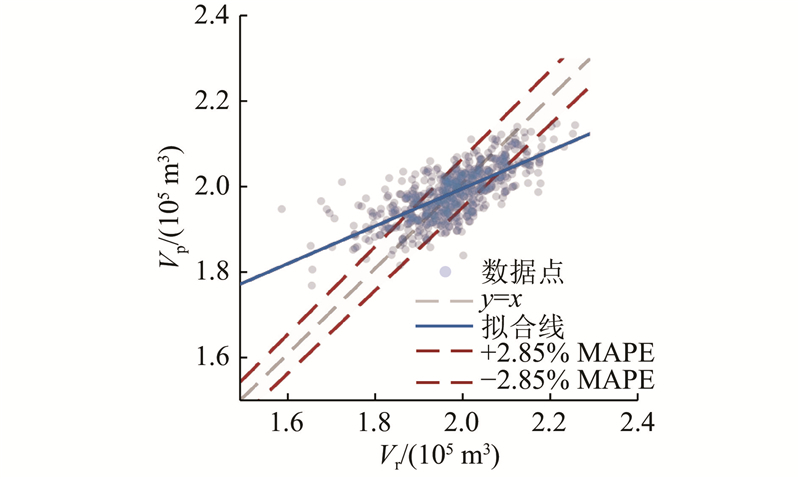
Abstract An ensemble learning-based surrogate model and a process parameter optimization method were proposed to improve the efficiency of solution mining design for salt cavern gas storage and reduce dependence on manual experience. A dataset containing 5324 samples was constructed using the self-developed single-well salt cavern storage cavity leaching simulation (SSCLS) software. The input variables included stratigraphic data and six-stage process parameters, while the output variables consisted of cavern volume and radius at key depth. Four types of tree-based models were used as base learners, and ridge regression was adopted as the meta-learner to establish the surrogate model. A design optimization workflow consisting of parameter generation, model prediction, deviation evaluation, and software verification was further developed. The test results showed that the mean absolute percentage error of volume prediction was 2.85%, and the mean absolute error of radius prediction for Jintan Well 52 was 2.17 m. A single prediction was completed within milliseconds, improving the computational efficiency by six orders of magnitude compared with conventional simulation. The proposed optimization method screened 830000 candidate parameter sets within 23 min and obtained an optimized scheme with a morphology deviation of 4.1%. The method can be used for preliminary scheme selection and rapid comparison of process parameters in salt cavern gas storage construction.
|
|
Received: 21 April 2026
Published: 21 October 2026
|
|
|
| Fund: 国家自然科学基金资助项目(42677186);国家管网集团储能技术有限公司科技项目(CNJS-SZZN202401). |
|
Corresponding Authors:
Jinlong LI
E-mail: chenjs01@pipechina.com.cn;lijinlong@zju.edu.cn
|
|
Cite this article:
Jiasong CHEN,Guijiu WANG,Xuefeng BAI,Chong DUAN,Xilin SHI,Guimin ZHANG,Xiaofei LI,Hui JIN,Jinlong LI. Ensemble learning-based prediction of salt cavern leaching and intelligent design of process parameters. Journal of ZheJiang University (Engineering Science), 2026, 60(12): 2725-2734.
URL:
https://www.zjujournals.com/eng/10.3785/j.issn.1008-973X.2026.12.018 OR https://www.zjujournals.com/eng/Y2026/V60/I12/2725
|
基于集成学习的盐穴造腔预测及工艺参数智能设计
针对盐穴储气库水溶造腔设计效率低、依赖人工经验的问题,提出基于集成学习的代理模型与工艺参数优化方法. 依托自研盐穴单井水溶造腔模拟软件(SSCLS),构建包含 5?324 组样本的数据集,输入为地层数据、6个阶段工艺参数,输出为成腔体积与关键深度半径. 采用4类树模型作为基学习器、岭回归作为元学习器,构建代理模型,并提出 “参数生成-模型预测-偏差评估-软件复核” 的设计优化流程. 测试结果表明,模型体积预测平均绝对百分比误差为 2.85%,金坛 52 号井半径预测平均绝对误差为 2.17 m;单次预测耗时为ms级,较传统模拟效率提升 6 个数量级;所提出的参数优化方法可在 23 min内从 83 万组参数中筛选出最优方案,形态差异度仅为 4.1%. 该方法可用于盐穴储气库造腔方案初选和工艺参数快速比选.
关键词:
盐穴储气库,
水溶造腔,
神经网络,
集成学习,
优化设计
|
|
| [1] |
丁国生, 魏欢 中国地下储气库建设20年回顾与展望[J]. 油气储运, 2020, 39 (1): 25- 31
Ding Guosheng, Wei Huan Review on 20 years’ UGS construction in China and the prospect[J]. Oil and Gas Storage and Transportation, 2020, 39 (1): 25- 31
|
|
|
| [2] |
李建君 中国地下储气库发展现状及展望[J]. 油气储运, 2022, 41 (7): 780- 786
Li Jianjun Development status and prospect of underground gas storage in China[J]. Oil and Gas Storage and Transportation, 2022, 41 (7): 780- 786
doi: 10.6047/j.issn.1000-8241.2022.07.004
|
|
|
| [3] |
李建中 利用岩盐层建设盐穴地下储气库[J]. 天然气工业, 2004, 24 (9): 119- 121
Li Jianzhong Using salt beds to build underground gas storages with salt caves[J]. Natural Gas Industry, 2004, 24 (9): 119- 121
doi: 10.3321/j.issn:1000-0976.2004.09.035
|
|
|
| [4] |
姚威, 肖恩山 我国盐穴储气库建设技术发展现状及趋势[J]. 中国井矿盐, 2024, 55 (4): 7- 10
Yao Wei, Xiao Enshan The present situation and trend of salt cavern gas storage construction technology in China[J]. China Well and Rock Salt, 2024, 55 (4): 7- 10
doi: 10.3969/j.issn.1001-0335.2024.04.004
|
|
|
| [5] |
Bayram F, Bektasoglu I Determination of actual dissolution rates from some rock properties in construction of deep salt cavern for natural gas storage[J]. International Journal of Rock Mechanics and Mining Sciences, 2020, 126: 104183
doi: 10.1016/j.ijrmms.2019.104183
|
|
|
| [6] |
Steding S, Kempka T, Zirkler A, et al Spatial and temporal evolution of leaching zones within potash seams reproduced by reactive transport simulations[J]. Water, 2021, 13 (2): 168
doi: 10.3390/w13020168
|
|
|
| [7] |
Najafimarghmaleki A, Dehghanpour H Evaluating fluid/rock interactions for energy storage in salt caverns: part I: brine-rock salt interactions[J]. Energy and Fuels, 2024, 38 (21): 20913- 20927
doi: 10.1021/acs.energyfuels.4c03271
|
|
|
| [8] |
Cristescu N D, Paraschiv I The optimal shape of rectangular-like caverns[J]. International Journal of Rock Mechanics and Mining Sciences and Geomechanics Abstracts, 1995, 32 (4): 285- 300
doi: 10.1016/0148-9062(96)87206-8
|
|
|
| [9] |
李银平, 葛鑫博, 王兵武, 等 盐穴地下储气库水溶造腔管柱的动力稳定性试验研究[J]. 天然气工业, 2016, 36 (7): 81- 87
Li Yinping, Ge Xinbo, Wang Bingwu, et al Dynamic stability tests on tubing string for solution mining of a salt cavern UGS[J]. Natural Gas Industry, 2016, 36 (7): 81- 87
doi: 10.3787/j.issn.1000-0976.2016.07.012
|
|
|
| [10] |
李建君, 王立东, 刘春, 等 金坛盐穴储气库腔体畸变影响因素[J]. 油气储运, 2014, 33 (3): 269- 273
Li Jianjun, Wang Lidong, Liu Chun, et al Factors affecting cavities distortion of Jintan Salt Cavern Gas Storage[J]. Oil and Gas Storage and Transportation, 2014, 33 (3): 269- 273
doi: 10.6047/j.issn.1000-8241.2014.03.010
|
|
|
| [11] |
李银平, 马洪岭, 施锡林, 等 我国盐穴地下储库建设的挑战与对策研究: 从“金坛模式”到“XX模式”[J]. 岩土力学, 2024, 45 (10): 2859- 2869
Li Yinping, Ma Hongling, Shi Xilin, et al Challenges and countermeasures in salt cavern underground storage in China: from “Jintan mode” to “XX mode”[J]. Rock and Soil Mechanics, 2024, 45 (10): 2859- 2869
doi: 10.16285/j.rsm.2024.0310
|
|
|
| [12] |
丁国生 金坛盐穴地下储气库建库关键技术综述[J]. 天然气工业, 2007, 27 (3): 111- 113
Ding Guosheng General introduction on key technologies of the construction of Jintan underground salt cavern gas storage[J]. Natural Gas Industry, 2007, 27 (3): 111- 113
doi: 10.3321/j.issn:1000-0976.2007.03.037
|
|
|
| [13] |
Pajonpai N, Bissen R, Pumjan S, et al Shape design and safety evaluation of salt caverns for CO2 storage in northeast Thailand[J]. International Journal of Greenhouse Gas Control, 2022, 120: 103773
doi: 10.1016/j.ijggc.2022.103773
|
|
|
| [14] |
Cyran K, Kowalski M Shape modelling and volume optimisation of salt caverns for energy storage[J]. Applied Sciences, 2021, 11 (1): 423
doi: 10.3390/app11010423
|
|
|
| [15] |
Kunstman A S, Urbanczyk K M. The new UBRO version: leaching simulation code for asymmetrical caverns: result of applying to a Mogilno gas cavern [C]// Solution Mining Research Institute Fall 1994 Meeting. Hannover: Solution Mining Research Institute, 1994: 451–486.
|
|
|
| [16] |
Kunstman A, Urbanczyk K, Saygun I T. Application of WinUbro software to modelling of cavern development in trona deposit [C]// Solution Mining Research Institute Spring 2009 Technical Conference. Krakow: Solution Mining Research Institute, 2009.
|
|
|
| [17] |
何俊, 井岗, 陈加松, 等 盐穴储气库天然气阻溶恒压运行技术[J]. 油气储运, 2020, 39 (11): 1298- 1303
He Jun, Jing Gang, Chen Jiasong, et al Constant-pressure operation technology for salt cavern gas storage through solution mining under gas[J]. Oil and Gas Storage and Transportation, 2020, 39 (11): 1298- 1303
|
|
|
| [18] |
李建君, 陈加松, 刘继芹, 等 盐穴储气库天然气阻溶回溶造腔工艺[J]. 油气储运, 2017, 36 (7): 816- 824
Li Jianjun, Chen Jiasong, Liu Jiqin, et al Re-leaching solution mining technology under natural gas for salt-cavern gas storage[J]. Oil and Gas Storage and Transportation, 2017, 36 (7): 816- 824
|
|
|
| [19] |
Li J, Shi X, Yang C, et al Mathematical model of salt cavern leaching for gas storage in high-insoluble salt formations[J]. Scientific Reports, 2018, 8: 372
doi: 10.1038/s41598-017-18546-w
|
|
|
| [20] |
Li J L, Tang Y, Shi X L, et al Modeling the construction of energy storage salt caverns in bedded salt[J]. Applied Energy, 2019, 255: 113866
doi: 10.1016/j.apenergy.2019.113866
|
|
|
| [21] |
Sedaee B, Mohammadi M, Esfahanizadeh L, et al Comprehensive modeling and developing a software for salt cavern underground gas storage[J]. Journal of Energy Storage, 2019, 25: 100876
doi: 10.1016/j.est.2019.100876
|
|
|
| [22] |
Li J L, Yang C H, Shi X L, et al Construction modeling and shape prediction of horizontal salt caverns for gas/oil storage in bedded salt[J]. Journal of Petroleum Science and Engineering, 2020, 190: 107058
doi: 10.1016/j.petrol.2020.107058
|
|
|
| [23] |
Li J L, Shi X L, Zhang S Construction modeling and parameter optimization of multi-step horizontal energy storage salt caverns[J]. Energy, 2020, 203: 117840
doi: 10.1016/j.energy.2020.117840
|
|
|
| [24] |
班凡生 盐穴储气库造腔技术现状与发展趋势[J]. 油气储运, 2017, 36 (7): 754- 758
Ban Fansheng Status and development trend of solution mining technologies used for salt-cavern gas storage[J]. Oil and Gas Storage and Transportation, 2017, 36 (7): 754- 758
|
|
|
| [25] |
Jiang D, Li Z, Liu W, et al Construction simulating and controlling of the two-well-vertical (TWV) salt caverns with gas blanket[J]. Journal of Natural Gas Science and Engineering, 2021, 96: 104291
doi: 10.1016/j.jngse.2021.104291
|
|
|
| [26] |
班凡生. 盐穴储气库水溶建腔优化设计研究 [D]. 廊坊: 中国科学院研究生院, 2008.
Ban Fansheng. Study on optimization design of solution mining cavern for underground gas storage [D]. Langfang: Chinese Academy of Sciences, 2008.
|
|
|
| [27] |
Kang Y, Yuan G, Guan Y, et al Optimization design of gas injection and brine discharge process parameters in salt cavern gas storage[J]. International Journal of Thermofluids, 2025, 27: 101128
doi: 10.1016/j.ijft.2025.101128
|
|
|
| [28] |
王元刚, 高寒, 薛雨 盐穴储气库水溶造腔的影响因素[J]. 油气储运, 2020, 39 (6): 662- 667
Wang Yuangang, Gao Han, Xue Yu Influencing factors of solution mining for salt cavern gas storage[J]. Oil and Gas Storage and Transportation, 2020, 39 (6): 662- 667
|
|
|
| [29] |
Li L, Gracie R, Dusseault M B, et al Modeling and verification of non-linear mineral dissolution processes with buoyancy effects[J]. International Journal of Rock Mechanics and Mining Sciences, 2023, 161: 105257
doi: 10.1016/j.ijrmms.2022.105257
|
|
|
| [30] |
Chromik M, Korzeniowski W The impact of design modifications on the effectiveness of energy storage construction in a salt cavern according to enhanced technology based on laboratory tests[J]. Energies, 2025, 18 (4): 805
doi: 10.3390/en18040805
|
|
|
| [31] |
Wang J, AN G, Shan B, et al Parameter optimization of solution mining under nitrogen for the construction of a gas storage salt cavern[J]. Journal of Natural Gas Science and Engineering, 2021, 91: 103954
doi: 10.1016/j.jngse.2021.103954
|
|
|
| [32] |
完颜祺琪, 丁国生, 赵岩, 等 盐穴型地下储气库建库评价关键技术及其应用[J]. 天然气工业, 2018, 38 (5): 111- 117
Wanyan Qiqi, Ding Guosheng, Zhao Yan, et al Key technologies for salt-cavern underground gas storage construction and evaluation and their application[J]. Natural Gas Industry, 2018, 38 (5): 111- 117
doi: 10.3787/j.issn.1000-0976.2018.05.013
|
|
|
| [33] |
Harati S, Gomari S R Designing geometrically stable salt Caverns for underground hydrogen storage: a case study from northeast England[J]. Energy and Fuels, 2025, 39 (35): 17067- 17082
doi: 10.1021/acs.energyfuels.5c02957
|
|
|
| [34] |
Thakkar P, Khatri S, Dobariya D, et al Advances in materials and machine learning techniques for energy storage devices: a comprehensive review[J]. Journal of Energy Storage, 2024, 81: 110452
doi: 10.1016/j.est.2024.110452
|
|
|
| [35] |
Wang Z, Chen J, Wang G, et al Geometry prediction and design for energy storage salt caverns using artificial neural network[J]. Energy, 2024, 308: 132820
doi: 10.1016/j.energy.2024.132820
|
|
|
| [36] |
Derakhshani R, Lankof L, Ghaseminejad A, et al Artificial intelligence-driven assessment of salt caverns for underground hydrogen storage in Poland[J]. Scientific Reports, 2024, 14: 14246
doi: 10.1038/s41598-024-64020-9
|
|
|
| [37] |
郭子熙, 马骉, 张帅, 等 深度学习在油气产量预测中的研究进展与技术展望[J]. 天然气工业, 2024, 44 (9): 88- 98
Guo Zixi, Ma Biao, Zhang Shuai, et al Research status and prospects of deep learning in oil and gas production prediction[J]. Natural Gas Industry, 2024, 44 (9): 88- 98
doi: 10.3787/j.issn.1000-0976.2024.09.008
|
|
|
| [38] |
Araújo J G, Brito H G, Galvão M V, et al Deep learning models applied flowrate estimation in offshore wells with electric submersible pump[J]. Energies, 2025, 18 (19): 5311
doi: 10.3390/en18195311
|
|
|
| [39] |
孙宝江, 周梓强, 孙骞 油气钻采工程中的人工智能方法研究进展[J]. 石油学报, 2025, 46 (11): 2141- 2173
Sun Baojiang, Zhou Ziqiang, Sun Qian Progress on artificial intelligence methods in oil and gas drilling and production[J]. Acta Petrolei Sinica, 2025, 46 (11): 2141- 2173
|
|
|
| [40] |
张凯, 陈旭, 刘丕养, 等 基于深度学习贝叶斯模型平均代理的油藏自动历史拟合研究[J]. 钻采工艺, 2025, 48 (1): 147- 156
Zhang Kai, Chen Xu, Liu Piyang, et al Study on automatic history matching of reservoirs based on deep learning Bayesian model averaging surrogates[J]. Drilling and Production Technology, 2025, 48 (1): 147- 156
doi: 10.3969/J.ISSN.1006-768X.2025.01.18
|
|
|
| [41] |
王森, 向杰, 冯其红, 等 基于深度学习加速的油藏数值模拟自动历史拟合方法[J]. 中国石油大学学报(自然科学版), 2024, 48 (5): 103- 114
Wang Sen, Xiang Jie, Feng Qihong, et al Deep-learning-based acceleration method for automatic history matching of reservoir numerical simulation[J]. Journal of China University of Petroleum (Edition of Natural Science), 2024, 48 (5): 103- 114
doi: 10.3969/j.issn.1673-5005.2024.05.011
|
|
|
| [42] |
Fu S, Mao S, Carbonero A, et al Deep learning-based surrogate modeling for underground hydrogen storage[J]. Advances in Water Resources, 2025, 203: 105014
doi: 10.1016/j.advwatres.2025.105014
|
|
|
| [43] |
叶家巍, 吴克柳, 陈掌星, 等 基于傅里叶神经算子代理模型的地热开采生产制度优化[J]. 大庆石油地质与开发, 2026, 45 (3): 158- 166
Ye Jiawei, Wu Keliu, Chen Zhangxing, et al Optimization of production system for geothermal exploitation based on surrogate model with Fourier Neural Operator[J]. Petroleum Geology and Oilfield Development in Daqing, 2026, 45 (3): 158- 166
doi: 10.19597/J.ISSN.1000-3754.202408029
|
|
|
| [44] |
马莅, 卢聪, 郭建春, 等 基于贝叶斯算法的致密储层压驱参数智能优化及其应用[J]. 大庆石油地质与开发, 2026, 45 (3): 91- 99
Ma Li, Lu Cong, Guo Jianchun, et al Intelligent optimization of fracturing-flooding parameters and its application in tight reservoirs based on Bayesian algorithm[J]. Petroleum Geology and Oilfield Development in Daqing, 2026, 45 (3): 91- 99
doi: 10.19597/J.ISSN.1000-3754.202502006
|
|
|
| [45] |
黄闻露, 阎建国, 任立龙, 等 模型反演和深度学习反演联合的地震波阻抗优化反演[J]. 物探与化探, 2024, 48 (4): 1076- 1085
Huang Wenlu, Yan Jianguo, Ren Lilong, et al Seismic impedance optimization inversion combining model inversion with deep learning inversion[J]. Geophysical and Geochemical Exploration, 2024, 48 (4): 1076- 1085
doi: 10.11720/wtyht.2024.1288
|
|
|
| [46] |
鄢宇鑫, 安永凯, 闫雪嫚 基于自适应LSTM代理模型和MCMC方法的地下水污染源反演识别研究[J]. 中国农村水利水电, 2026, (5): 60- 67
Yan Yuxin, An Yongkai, Yan Xueman Groundwater pollution source inversion identification based on adaptive LSTM proxy model and MCMC method[J]. China Rural Water and Hydropower, 2026, (5): 60- 67
doi: 10.12396/znsd.2500976
|
|
|
| [47] |
许林, 马海春, 王京平, 等 高地应力高温条件裂隙介质地下水非线性渗流研究进展[J]. 地学前缘, 2026, 33 (1): 313- 327
Xu Lin, Ma Haichun, Wang Jingping, et al Advances in groundwater nonlinear seepage in fractured media under conditions of high in-situ stress and temperature[J]. Earth Science Frontiers, 2026, 33 (1): 313- 327
doi: 10.13745/j.esf.sf.2025.10.29
|
|
|
| [48] |
Rumelhart D E, Hinton G E, Williams R J Learning representations by back-propagating errors[J]. Nature, 1986, 323 (6088): 533- 536
doi: 10.1038/323533a0
|
|
|
| [49] |
Hochreiter S, Schmidhuber J Long short-term memory[J]. Neural Computation, 1997, 9 (8): 1735- 1780
doi: 10.1162/neco.1997.9.8.1735
|
|
|
| [50] |
Cho K, Van Merriënboer B, Gulcehre C, et al. Learning phrase representations using RNN encoder-decoder for statistical machine translation [C]// Proceedings of the 2014 Conference on Empirical Methods in Natural Language Processing. Doha: ACL, 2014: 1724–1734.
|
|
|
| [51] |
Sajid M, Tanveer M, Suganthan P N Ensemble deep random vector functional link neural network based on fuzzy inference system[J]. IEEE Transactions on Fuzzy Systems, 2025, 33 (1): 479- 490
doi: 10.1109/TFUZZ.2024.3411614
|
|
|
| [52] |
Mohammed A, Kora R A comprehensive review on ensemble deep learning: opportunities and challenges[J]. Journal of King Saud University Computer and Information Sciences, 2023, 35 (2): 757- 774
doi: 10.1016/j.jksuci.2023.01.014
|
|
|
| [53] |
Bergstra J, Bengio Y Random search for hyper-parameter optimization[J]. Journal of Machine Learning Research, 2012, 13: 281- 305
doi: 10.1109/icitacee50144.2020.9239164
|
|
|
| [54] |
Li L, Jamieson K, Desalvo G, et al Hyperband: a novel bandit-based approach to hyperparameter optimization[J]. Journal of Machine Learning Research, 2018, 18 (185): 1- 52
|
|
|
| [55] |
付星辉, 胡超, 何卉, 等 声纳探测在地下盐穴测腔中的实践应用与分析[J]. 中国井矿盐, 2023, 54 (1): 11- 13,17
Fu Xinghui, Hu Chao, He Hui, et al Practical application and analysis of sonar detection in underground salt cavern[J]. China Well and Rock Salt, 2023, 54 (1): 11- 13,17
doi: 10.3969/j.issn.1001-0335.2023.01.004
|
|
|
| [56] |
王海峰 测腔声呐仪器原理、进展与展望[J]. 应用声学, 2024, 43 (3): 701- 708
Wang Haifeng Principle, progress and prospect of cavity measuring sonar instruments[J]. Journal of Applied Acoustics, 2024, 43 (3): 701- 708
doi: 10.11684/j.issn.1000-310X.2024.03.028
|
|
|
|
Viewed |
|
|
|
Full text
|
|
|
|
|
Abstract
|
|
|
|
|
Cited |
|
|
|
|
| |
Shared |
|
|
|
|
| |
Discussed |
|
|
|
|