Please wait a minute...
Journal of ZheJiang University (Engineering Science)  2026, Vol. 60 Issue (2): 351-359    DOI: 10.3785/j.issn.1008-973X.2026.02.013
    
Graph neural network recommendation model integrating global information and contrastive learning
Yanle WANG(),Ruifeng ZHANG,Qiang LI*()
School of Microelectronics, Tianjin University, Tianjin 300072, China
Download: HTML     PDF(1181KB) HTML
Export: BibTeX | EndNote (RIS)      

Abstract  

Existing collaborative filtering models based on the graph neural network (GNN) suffer from noise and data sparsity in the original graph. A novel graph neural network recommendation model (GICL) was proposed, employing singular value decomposition to retain the principal collaborative relationships from global information and suppress local noise. To capture latent relationships between nodes, representative embeddings were learned from both the graph structure and semantic space as augmented neighbors, and contrastive learning tasks were constructed based on these expanded neighbors. Specifically, a structural contrastive view was created by aggregating homogeneous node information using GNN, while a semantic contrastive view was constructed by partitioning the original graph into semantic subgraphs and using their prototypes. The graph collaborative filtering task was jointly trained with two contrastive auxiliary tasks to alleviate the data sparsity issue. Experimental results on four public datasets demonstrate that the GICL consistently outperforms many mainstream recommendation models.


Key wordsgraph neural network (GNN)      collaborative filtering      contrastive learning      global information      data sparsity     
Received: 14 February 2025      Published: 03 February 2026
CLC:  TP 393  
Fund:  国家自然科学基金资助项目(62071323);天津市自然科学基金资助项目(22JCZDJC00220).
Corresponding Authors: Qiang LI     E-mail: W747867298@163.com;liqiang@tju.edu.cn
Cite this article:

Yanle WANG,Ruifeng ZHANG,Qiang LI. Graph neural network recommendation model integrating global information and contrastive learning. Journal of ZheJiang University (Engineering Science), 2026, 60(2): 351-359.

URL:

https://www.zjujournals.com/eng/10.3785/j.issn.1008-973X.2026.02.013     OR     https://www.zjujournals.com/eng/Y2026/V60/I2/351


融合全局信息和对比学习的图神经网络推荐模型

基于图神经网络(GNN)的现有协同过滤模型存在原始图噪声和数据稀疏问题,为此提出新的图神经网络推荐模型(GICL),利用奇异值分解保留全局信息中主要的协同关系,抑制局部噪声. 为了挖掘节点之间的潜在关系,从图结构和语义空间中学习代表性嵌入作为节点的增强邻居,基于拓展的邻居构建对比学习任务. 利用GNN在交互图上聚集的同质节点信息创建节点的结构对比视图. 将原始图划分为语义子图,计算子图上的原型作为语义对比视图;将图协同过滤任务与2个对比辅助任务进行联合训练,缓解数据稀疏问题. 在4个公开数据集上的实验结果表明,GICL的推荐性能优于众多主流推荐模型.


关键词: 图神经网络(GNN),  协同过滤,  对比学习,  全局信息,  数据稀疏 
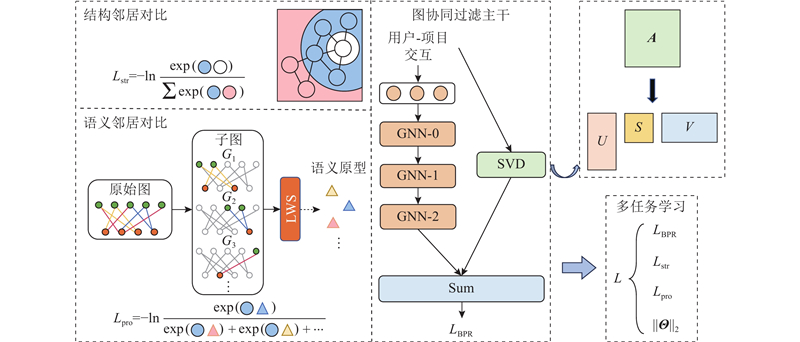
Fig.1 Overall framework of graph neural network recommendation model integrating global information and contrastive learning
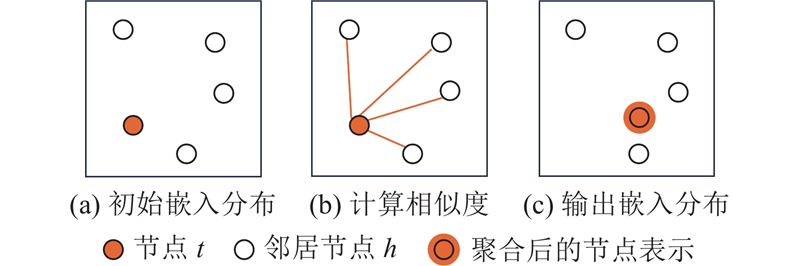
Fig.2 Core operation of local weighted smoothing in single iteration
名称用户数项目数交互数稠密度
ML-1M6 0403 629836 4780.038 16
Yelp45 47830 7091 777 7650.001 27
Books58 14558 0522 517 4370.000 75
Gowalla29 85940 9891 027 4640.000 84
Tab.1 Basic information about dataset
数据集模型Recall@10NDCG@10Recall@20NDCG@20Recall@50NDCG@50
ML-1MNGCF0.184 60.252 80.274 10.261 40.434 10.305 5
LightGCN0.187 60.251 40.279 60.262 00.446 90.309 1
SGL0.188 80.252 60.284 80.264 90.448 70.311 1
SimGCL0.205 20.272 60.298 80.281 50.451 50.328 2
NCL0.204 80.272 20.302 50.283 20.462 80.329 2
AdaGCL0.207 20.274 50.301 20.286 80.466 20.329 5
GraphAug0.206 00.273 20.303 40.284 30.468 60.330 0
GICL0.210 30.277 30.304 40.287 90.470 60.333 9
η/%+1.50+1.02+0.33+0.38+0.43+1.18
YelpNGCF0.063 00.044 60.102 60.056 70.186 40.078 4
LightGCN0.073 00.052 00.116 30.065 20.201 60.087 5
SGL0.083 30.060 10.128 80.073 90.214 00.096 4
SimGCL0.089 60.065 80.130 40.081 00.209 80.101 8
NCL0.091 20.066 20.132 60.081 30.224 70.104 8
AdaGCL0.090 20.067 30.131 20.082 20.221 30.102 5
GraphAug0.092 20.068 20.137 70.081 70.224 00.104 2
GICL0.095 80.070 40.143 40.084 20.233 20.107 4
η/%+3.90+3.23+4.14+2.43+3.78+2.48
BooksNGCF0.061 70.042 70.097 80.053 70.169 90.072 5
LightGCN0.079 70.056 50.120 60.068 90.201 20.089 9
SGL0.089 80.064 50.133 10.077 70.215 70.099 2
SimGCL0.092 40.065 60.133 80.082 00.215 80.100 9
NCL0.093 00.066 40.137 70.081 20.216 40.101 7
AdaGCL0.094 20.067 20.134 60.082 80.217 70.102 3
GraphAug0.093 70.068 20.138 10.081 50.217 00.103 2
GICL0.098 90.071 50.146 40.085 90.230 70.108 2
η/%+4.99+4.84+6.01+3.74+5.97+4.84
GowallaNGCF0.119 20.085 20.175 50.101 30.281 10.127 0
LightGCN0.136 20.087 60.197 60.115 20.304 40.141 4
SGL0.146 50.104 80.208 40.122 50.319 70.149 7
SimGCL0.147 20.105 20.200 50.123 20.319 80.150 8
NCL0.148 20.106 10.211 80.125 30.322 90.153 1
AdaGCL0.149 10.108 20.212 70.127 50.323 80.152 2
GraphAug0.151 20.107 30.213 20.126 50.325 40.154 1
GICL0.156 70.113 90.220 50.131 80.332 70.159 6
η/%+3.64+5.27+3.42+3.37+2.24+3.57
Tab.2 Performance comparison of different recommendation models on four public datasets
模型图卷积数据增强对比学习损失
GraphAug$ O\left(2M\left| E\right| Ld\right) $$ O\left(\left| E\right| {d}^{2}\right) $$ O\left(BSd\right) $
AdaGCL$ O\left(2\left| E\right| Ld\right) $$ O\left(\left| E\right| L{d}^{2}\right) $$ O\left(LBSd\right) $
NCL$ O\left(2\left| E\right| Ld\right) $$ O\left(B(S+{K}_{\text{m}})d\right) $
GICL$ O\left(2\left| E\right| Ld\right) $$ O\left(B(S+{K}_{\text{S}}+\overline{N}{L}_{\text{W}})d\right) $
Tab.3 Comparison of time complexity of different recommendation models
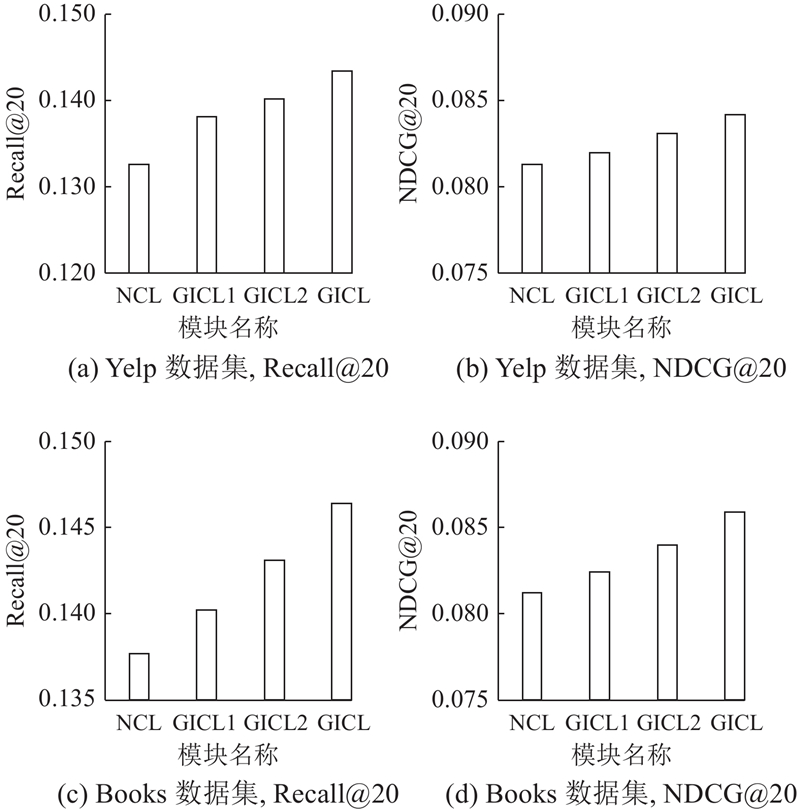
Fig.3 Performance comparison of recommendation model and its variants on two public datasets
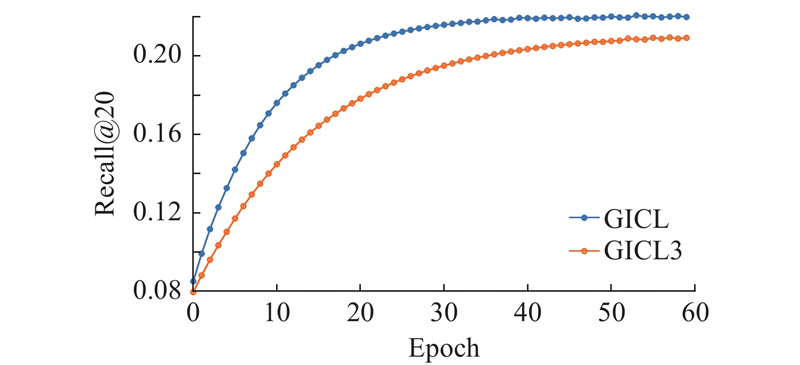
Fig.4 Ablation results of singular value decomposition module on Gowalla dataset
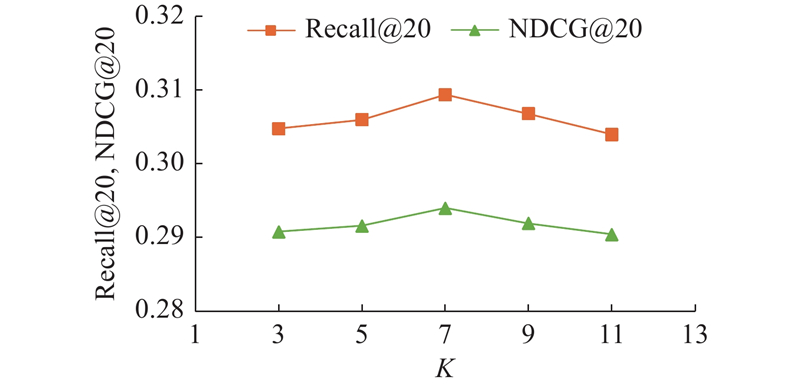
Fig.5 Effect of different number of subgraphs on recommendation model performance
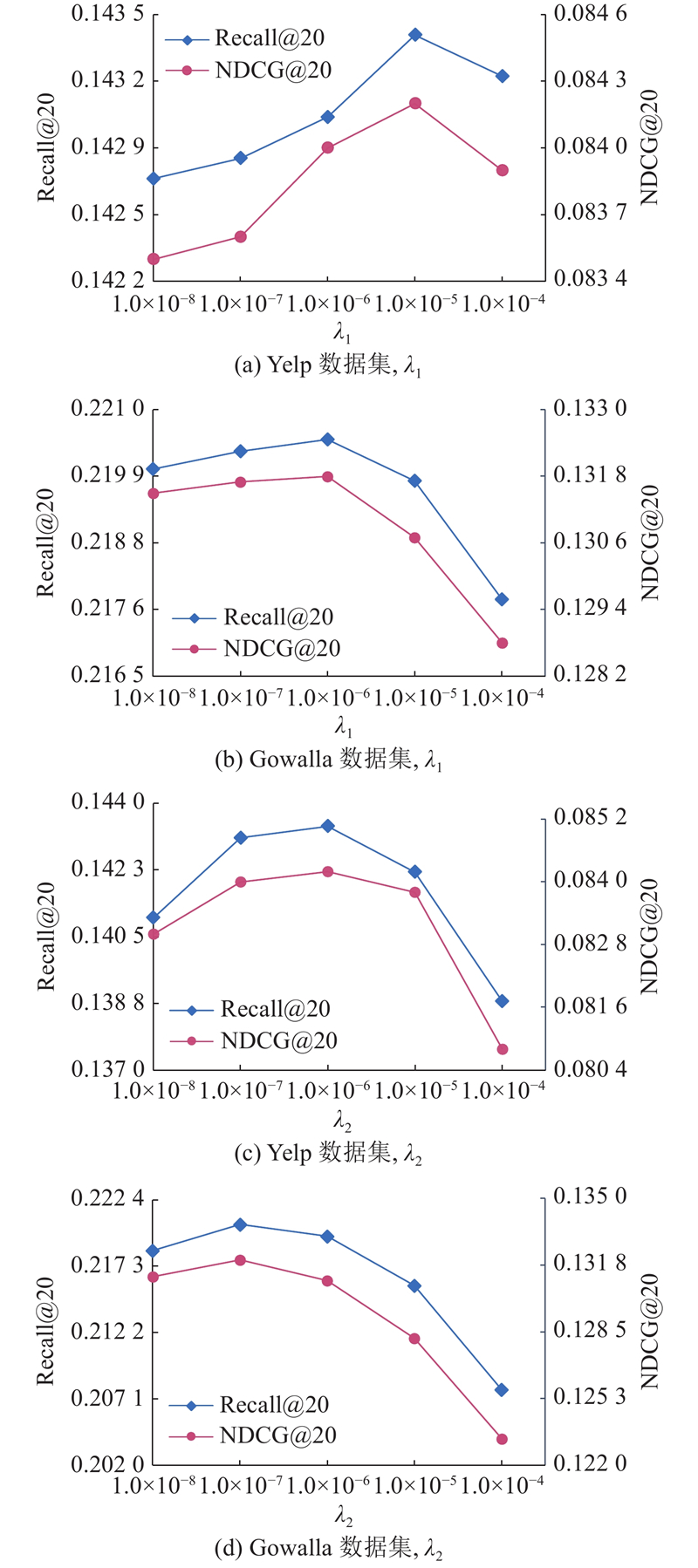
Fig.6 Effect of comparison task weights on recommendation model performance
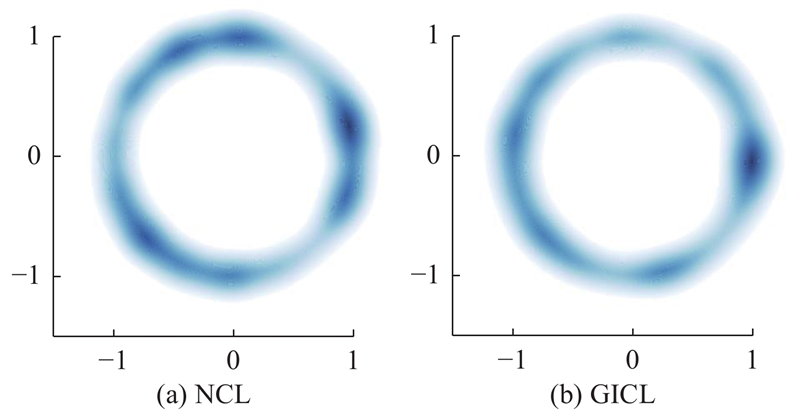
Fig.7 Visualization of item embedding distributions for different recommendation models
[1]   LI Y, LIU K, SATAPATHY R, et al Recent developments in recommender systems: a survey[J]. IEEE Computational Intelligence Magazine, 2024, 19 (2): 78- 95
[2]   ALJUNID M F, MANJAIAH D H, HOOSHMAND M K, et al A collaborative filtering recommender systems: survey[J]. Neurocomputing, 2025, 617: 128718
doi: 10.1016/j.neucom.2024.128718
[3]   KOREN Y, BELL R, VOLINSKY C Matrix factorization techniques for recommender systems[J]. Computer, 2009, 42 (8): 30- 37
[4]   WANG X, HE X, WANG M, et al. Neural graph collaborative filtering [C]// Proceedings of the 42nd International ACM SIGIR Conference on Research and Development in Information Retrieval. Paris: ACM, 2019: 165–174.
[5]   HE X, DENG K, WANG X, et al. LightGCN: simplifying and powering graph convolution network for recommendation [C]// Proceedings of the 43rd International ACM SIGIR Conference on Research and Development in Information Retrieval. [S.l.]: ACM, 2020: 639–648.
[6]   PENG S, SUGIYAMA K, MINE T. SVD-GCN: a simplified graph convolution paradigm for recommendation [C]// Proceedings of the 31st ACM International Conference on Information & Knowledge Management. Atlanta: ACM, 2022: 1625–1634.
[7]   SUN J, ZHANG Y, MA C, et al. Multi-graph convolution collaborative filtering [C]// Proceedings of the IEEE International Conference on Data Mining. Beijing: IEEE, 2020: 1306–1311.
[8]   WU J, WANG X, FENG F, et al. Self-supervised graph learning for recommendation [C]// Proceedings of the 44th International ACM SIGIR Conference on Research and Development in Information Retrieval. [S.l.]: ACM, 2021: 726–735.
[9]   YU J, YIN H, XIA X, et al. Are graph augmentations necessary? : simple graph contrastive learning for recommendation [C]// Proceedings of the 45th International ACM SIGIR Conference on Research and Development in Information Retrieval. Madrid: ACM, 2022: 1294–1303.
[10]   CHEN J, LI H, ZHANG X, et al SR-HetGNN: session-based recommendation with heterogeneous graph neural network[J]. Knowledge and Information Systems, 2024, 66 (2): 1111- 1134
doi: 10.1007/s10115-023-01986-4
[11]   LIN Z, TIAN C, HOU Y, et al. Improving graph collaborative filtering with neighborhood-enriched contrastive learning [C]// Proceedings of the ACM Web Conference 2022. [S.l.]: ACM, 2022: 2320–2329.
[12]   LI X, TIAN Y, DONG B, et al MD-GCCF: multi-view deep graph contrastive learning for collaborative filtering[J]. Neurocomputing, 2024, 590: 127756
doi: 10.1016/j.neucom.2024.127756
[13]   RENDLE S, FREUDENTHALER C, GANTNER Z, et al. BPR: Bayesian personalized ranking from implicit feedback [EB/OL]. (2012–05–09)[2025–02–14]. https://arxiv.org/pdf/1205.2618.
[14]   GUTMANN U M, HYVÄRINEN A. Noise-contrastive estimation: a new estimation principle for unnormalized statistical models [C]// Proceedings of the 13th International Conference on Artificial Intelligence and Statistics. Sardinia: [s.n.], 2010: 297–304.
[15]   LIN S, LIU C, ZHOU P, et al Prototypical graph contrastive learning[J]. IEEE Transactions on Neural Networks and Learning Systems, 2024, 35 (2): 2747- 2758
doi: 10.1109/TNNLS.2022.3191086
[16]   HARPER F M, KONSTAN J A The MovieLens datasets: history and context[J]. ACM Transactions on Interactive Intelligent Systems, 2015, 5 (4): 1- 19
[17]   CHEN J, GUAN H, LI H, et al. PACIFIC: enhancing sequential recommendation via preference-aware causal intervention and counterfactual data augmentation [C]// Proceedings of the 33rd ACM International Conference on Information and Knowledge Management. Boise: ACM, 2024: 249–258.
[18]   CHEN J, ZHANG F, LI H, et al EMPNet: an extract-map-predict neural network architecture for cross-domain recommendation[J]. World Wide Web, 2024, 27 (2): 12
doi: 10.1007/s11280-024-01240-z
[19]   LIU Y, XIA L, HUANG C. SelfGNN: self-supervised graph neural networks for sequential recommendation [C]// Proceedings of the 47th International ACM SIGIR Conference on Research and Development in Information Retrieval. Washington DC: ACM, 2024: 1609–1618.
[20]   JIANG Y, HUANG C, HUANG L. Adaptive graph contrastive learning for recommendation [C]// Proceedings of the 29th ACM SIGKDD Conference on Knowledge Discovery and Data Mining. Long Beach: ACM, 2023: 4252–4261.
[1] Tao XIE,Huili GE,Ning CHEN,Xiaofeng WANG,Yansong LI,Xiaofeng HUANG. Knowledge embedding-enhanced contrastive recommendation model[J]. Journal of ZheJiang University (Engineering Science), 2026, 60(1): 90-98.
[2] Wenhu HUANG,Xing ZHAO,Liang XIE,Haoran LIANG,Ronghua LIANG. Contrastive learning-based sound source localization-guided audio-visual segmentation model[J]. Journal of ZheJiang University (Engineering Science), 2025, 59(9): 1803-1813.
[3] Yue HOU,Qianhui LI,Peng YUAN,Xin ZHANG,Tiantian WANG,Ziwei HAO. Scalable traffic image auto-annotation method based on contrastive learning[J]. Journal of ZheJiang University (Engineering Science), 2025, 59(8): 1634-1643.
[4] Mingzhi HU,Jun SUN,Biao YANG,Kairong CHANG,Junlong YANG. Super-resolution reconstruction of remote sensing image based on CNN and Transformer aggregation[J]. Journal of ZheJiang University (Engineering Science), 2025, 59(5): 938-946.
[5] Ke CHEN,Wenhao ZHANG. Zero-shot object rumor detection based on contrastive learning[J]. Journal of ZheJiang University (Engineering Science), 2024, 58(9): 1790-1800.
[6] Longxue LIANG,Chenglong HE,Xiaosuo WU,Haowen YAN. Remote sensing image semantic segmentation network based on global information extraction and reconstruction[J]. Journal of ZheJiang University (Engineering Science), 2024, 58(11): 2270-2279.
[7] Hui-xin WANG,Xiang-rong TONG. Research progress of recommendation system based on knowledge graph[J]. Journal of ZheJiang University (Engineering Science), 2023, 57(8): 1527-1540.
[8] Jing-jing ZHANG,Zhao-gong ZHANG,Xin XU. Graph convolution collaborative filtering model combining graph enhancement and sampling strategies[J]. Journal of ZheJiang University (Engineering Science), 2023, 57(2): 243-251.
[9] Tian-qi ZHOU,Yan YANG,Ji-jie ZHANG,Shao-wei YIN,Zeng-qiang GUO. Graph contrastive learning based on negative-sample-free loss and adaptive augmentation[J]. Journal of ZheJiang University (Engineering Science), 2023, 57(2): 259-266.
[10] Huang-he ZHENG,Zhi-qiu HUANG,Wei-wei LI,Yao-shen YU,Yong-chao WANG. API recommendation method based on natural nearest neighbors and collaborative filtering[J]. Journal of ZheJiang University (Engineering Science), 2022, 56(3): 494-502.
[11] Jia-hui XU,Jing-chang WANG,Ling CHEN,Yong WU. Surface water quality prediction model based on graph neural network[J]. Journal of ZheJiang University (Engineering Science), 2021, 55(4): 601-607.
[12] Nuo LI,Bin GUO,Yan LIU,Yao JING,Zhi-wen YU. Intelligent commercial site recommendation with neural collaborative filtering[J]. Journal of ZheJiang University (Engineering Science), 2019, 53(9): 1788-1794.
[13] Li-yan DONG,Jia-huan JIN,Yuan-cheng FANG,Yue-qun WANG,Yong-li LI,Ming-hui SUN. Slope One algorithm based on nonnegative matrix factorization[J]. Journal of ZheJiang University (Engineering Science), 2019, 53(7): 1349-1353.
[14] Hong-xia WANG,Jian CHEN,Yan-fen CHENG. Improved collaborative filtering algorithm to revise users' rating by review mining[J]. Journal of ZheJiang University (Engineering Science), 2019, 53(3): 522-532.
[15] Xiao-jun LI,Hong LIU,Han-xiao SHI,Liu-qing ZHU,Ya-hui ZHANG. Deep learning based course recommendation model[J]. Journal of ZheJiang University (Engineering Science), 2019, 53(11): 2139-2145.