|
|
|
| Reparameterized aero-engine remaining useful life prediction based on channel decomposition and feature fusion |
Xingyu LI1( ),Hairui WANG1,*(),Guifu ZHU2,3 ),Hairui WANG1,*(),Guifu ZHU2,3 |
1. Faculty of Information Engineering and Automation , Kunming University of Science and Technology, Kunming 650500
2. Information Technology Construction Management Center, Kunming University of Science and Technology, Kunming 650500
3. Kunming University of Science and Technology - Dawn Information Industry Co. Ltd. AI Joint Research Center, Kunming University of Science and Technology, Kunming 650500 |
|
|
|
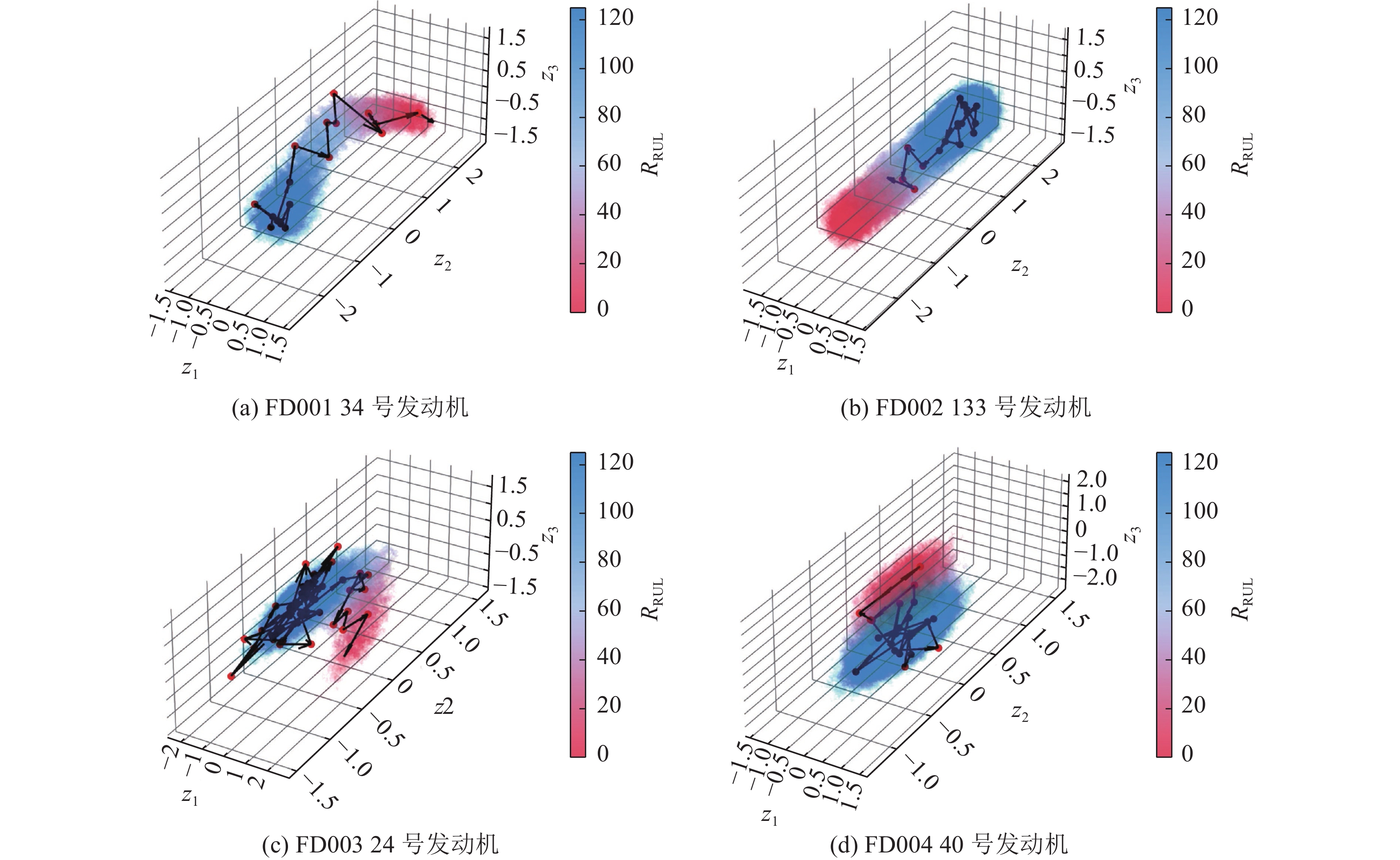
Abstract A reparameterization-based RUL prediction method that integrated channel decomposition and feature fusion was proposed to address the challenges in remaining useful life (RUL) prediction for aero-engines. Specifically, a channel decomposition and reconstruction module based on wavelet transform was designed to capture dependencies between time and channels while reducing redundancy. By fusing the raw input with the extracted feature information, the model enhanced the preservation of original information and mitigated the loss of critical information during deep network training. Furthermore, a frequency-enhanced channel attention mechanism was introduced to further suppress channel redundancy. A neural network was then employed to estimate the mean and variance of the features, and reparameterization was applied to map them into a Gaussian distribution for sampling-based prediction. In addition, the Whale optimization algorithm (WOA) was used to perform global optimization of key hyperparameters. Experimental validation on the C-MAPSS dataset from NASA demonstrated that the proposed method achieved an RMSE range of [11.58,13.72] and a Score range of [224.78,1025.29], with average decreases of 22.67% and 45.56%, respectively. Moreover, the constructed three-dimensional latent space supported the visualization of engine degradation processes.
|
|
Received: 07 May 2025
Published: 29 July 2026
|
|
|
| Fund: 国家自然科学基金资助项目(61863016). |
|
Corresponding Authors:
Hairui WANG
E-mail: 515927790@qq.com;hrwang88@163.com
|
基于信道分解与特征融合的重参数航空发动机寿命预测
为了应对航空发动机剩余使用寿命预测中的挑战,提出基于信道分解与特征融合的重参数航空发动机寿命预测方法. 通过构建基于小波变换的信道分解与重塑模块,学习时间和信道之间的依赖关系并减少冗余. 将原始信息与提取的特征信息混合,增强原始信息的保留,避免在深度网络学习过程中丢失关键信息. 引入频率增强通道注意力机制进一步减少信道冗余信息. 利用神经网络进行特征的均值和方差拟合,通过重参数化映射至高斯分布进行采样预测,并采用鲸鱼优化算法对模型关键超参数进行全局搜索优化. 使用NASA的C-MAPSS数据集进行验证,结果显示RMSE范围为[11.58,13.72],Score范围为[224.78,1025.29],4个数据子集的RMSE和Score平均降低了22.67%和45.56%. 所构建的三维潜在空间,为发动机退化过程的可视化提供了支持.
关键词:
信道分解,
特征融合,
寿命预测,
频率增强通道注意力,
重参数,
高斯分布,
鲸鱼优化算法
|
|
| [1] |
BOUKRA T, LEBAROUD A. Identifying new prognostic features for remaining useful life prediction [C]// 16th International Power Electronics and Motion Control Conference and Exposition. Antalya: IEEE, 2014: 1216–1221.
|
|
|
| [2] |
ZHOU S, XIAO M, BARTOS P, et al Remaining useful life prediction and fault diagnosis of rolling bearings based on short-time Fourier transform and convolutional neural network[J]. Shock and Vibration, 2020, (1): 8857307
|
|
|
| [3] |
ZHANG J, JIANG Y, WU S, et al Prediction of remaining useful life based on bidirectional gated recurrent unit with temporal self-attention mechanism[J]. Reliability Engineering and System Safety, 2022, 221: 108297
doi: 10.1016/j.ress.2021.108297
|
|
|
| [4] |
LIAO Y, ZHANG L, LIU C. Uncertainty prediction of remaining useful life using long short-term memory network based on bootstrap method [C]// IEEE International Conference on Prognostics and Health Management. Seattle: IEEE, 2018: 1–8.
|
|
|
| [5] |
SATEESH BABU G, ZHAO P, LI X L. Deep convolutional neural network based regression approach for estimation of remaining useful life [M]// Database systems for advanced applications. Cham: Springer, 2016: 214–228.
|
|
|
| [6] |
LIU J, LEI F, PAN C, et al Prediction of remaining useful life of multi-stage aero-engine based on clustering and LSTM fusion[J]. Reliability Engineering and System Safety, 2021, 214: 107807
doi: 10.1016/j.ress.2021.107807
|
|
|
| [7] |
ZHANG Y, SU C, WU J, et al Trend-augmented and temporal-featured Transformer network with multi-sensor signals for remaining useful life prediction[J]. Reliability Engineering and System Safety, 2024, 241: 109662
doi: 10.1016/j.ress.2023.109662
|
|
|
| [8] |
GUO J, LI D, DU B A stacked ensemble method based on TCN and convolutional bi-directional GRU with multiple time windows for remaining useful life estimation[J]. Applied Soft Computing, 2024, 150: 111071
doi: 10.1016/j.asoc.2023.111071
|
|
|
| [9] |
CHEN X A novel transformer-based DL model enhanced by position-sensitive attention and gated hierarchical LSTM for aero-engine RUL prediction[J]. Scientific Reports, 2024, 14: 10061
doi: 10.1038/s41598-024-59095-3
|
|
|
| [10] |
OUYANG M, SHEN P Prediction of remaining useful life of lithium batteries based on WOA-VMD and LSTM[J]. Energies, 2022, 15 (23): 8918
doi: 10.3390/en15238918
|
|
|
| [11] |
LI J, WEN Y, HE L. SCConv: spatial and channel reconstruction convolution for feature redundancy [C]// IEEE/CVF Conference on Computer Vision and Pattern Recognition. Vancouver: IEEE, 2023: 6153–6162.
|
|
|
| [12] |
ZHANG J, JIANG Y, WU S, et al Prediction of remaining useful life based on bidirectional gated recurrent unit with temporal self-attention mechanism[J]. Reliability Engineering and System Safety, 2022, 221: 108297
doi: 10.1016/j.ress.2021.108297
|
|
|
| [13] |
LI J, LI X, HE D. Domain adaptation remaining useful life prediction method based on AdaBN-DCNN [C]// Prognostics and System Health Management Conference. Qingdao: IEEE, 2019: 1–6.
|
|
|
| [14] |
FAN L, CHAI Y, CHEN X Trend attention fully convolutional network for remaining useful life estimation[J]. Reliability Engineering and System Safety, 2022, 225: 108590
doi: 10.1016/j.ress.2022.108590
|
|
|
| [15] |
LI Y, CHEN Y, HU Z, et al Remaining useful life prediction of aero-engine enabled by fusing knowledge and deep learning models[J]. Reliability Engineering and System Safety, 2023, 229: 108869
doi: 10.1016/j.ress.2022.108869
|
|
|
| [16] |
COSTA N, SÁNCHEZ L Variational encoding approach for interpretable assessment of remaining useful life estimation[J]. Reliability Engineering and System Safety, 2022, 222: 108353
doi: 10.1016/j.ress.2022.108353
|
|
|
|
Viewed |
|
|
|
Full text
|
|
|
|
|
Abstract
|
|
|
|
|
Cited |
|
|
|
|
| |
Shared |
|
|
|
|
| |
Discussed |
|
|
|
|