|
|
|
| Spatial-semantic hierarchical knowledge graph modeling for body-in-white datum design |
Hongsheng FU1,2,3( ),Yanlong CAO1,2,*(),Junding LUO3,Zongzheng ZHANG1,2,Tukun LI4,Fang HUANG1,2 ),Yanlong CAO1,2,*(),Junding LUO3,Zongzheng ZHANG1,2,Tukun LI4,Fang HUANG1,2 |
1. State Key Laboratory of Fluid Power and Mechatronic Systems, Zhejiang University, Hangzhou 310058, China
2. Zhejiang Key Laboratory of Advanced Equipment Manufacturing and Measurement Technology, Zhejiang University, Hangzhou 310058, China
3. NIO Automobile Technology (Anhui) Limited Company, Hefei 230061, China
4. School of Computing and Engineering, University of Huddersfield, West Yorkshire HD1 3DH, UK |
|
|
|
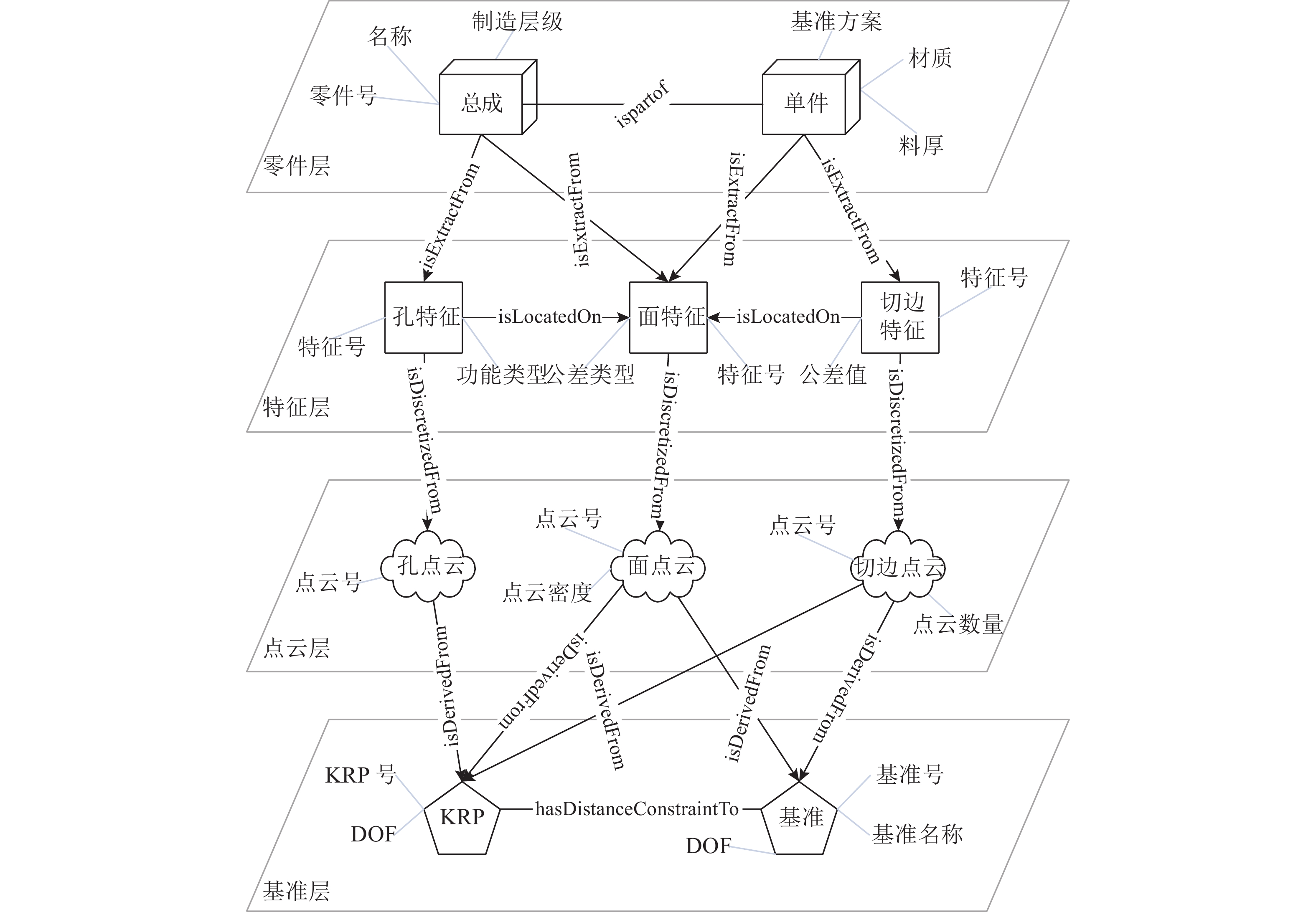
Abstract A spatial–semantic hierarchical knowledge graph (SSH-KG) modeling method was proposed in order to address the problem of dispersed design knowledge and difficulty in fusing with geometric models in body-in-white datum design, which leads to low automation. A four-layer ontology model, “component–feature–point cloud–datum”, was constructed. A unified representation framework integrating spatial geometry and semantics information was established. Automated mapping and reasoning from semantic rule to spatial entity were achieved through formal axiomatic definition. Experimental studies on a B-pillar reinforcement, an A-pillar reinforcement and a sill beam were conducted. Results showed that the average topological relation coverage (evaluating knowledge representation completeness) was increased from 49% to 97.4%, and the average spatial-semantic alignment rate (measuring compliance of geometric entities with semantic rules) was improved from 48.2% to 98.3% compared with conventional manual design. A closed-loop, automated workflow that transformed rule into scheme was realized. The average number of design iterations per scheme decreased from 3.5 to 1, with the total design time reduced by approximately 83%. Ablation experiments confirmed that the point cloud discretization mechanism was critical for enhancing reasoning robustness and computational efficiency.
|
|
Received: 07 December 2025
Published: 20 July 2026
|
|
|
| Fund: 国家自然科学基金资助项目(52175520);国家重点研发计划资助项目(2023YFB3307202);浙江省“高层次人才特殊支持计划”科技创新领军人才项目(2022R52053). |
|
Corresponding Authors:
Yanlong CAO
E-mail: hongsheng.fu@nio.com;sdcaoyl@zju.edu.cn
|
白车身基准设计空间-语义分层知识图谱建模
针对白车身基准设计知识分散、难以与几何模型融合导致自动化程度低的问题,提出空间-语义分层知识图谱(SSH-KG)建模方法. 该方法构建“零件–特征–点云–基准”四层本体模型,形成空间与语义相融合的统一表示框架,通过形式化公理实现语义规则到空间实体的自动映射与推理. 以某车型B柱加强板、A柱加强板及门槛梁为案例进行实验. 结果表明,与传统人工设计相比,所提方法将知识表示完整性(平均拓扑关联覆盖率)从49%提升至97.4%,空间-语义一致性(平均对齐率)从48.2%提升至98.3%,实现了从规则到方案的闭环自动执行. 基准方案的平均迭代次数由3.5次降至1次,设计总时间缩短约83%. 消融实验验证了点云离散化机制对提升推理鲁棒性与计算效率的关键作用.
关键词:
白车身,
基准设计,
知识图谱,
空间-语义融合,
点云,
自动推理
|
|
| [1] |
MASOUMI A, SHAHI V J Fixture layout optimization in multi-station sheet metal assembly considering assembly sequence and datum scheme[J]. The International Journal of Advanced Manufacturing Technology, 2018, 95 (9): 4629- 4643
|
|
|
| [2] |
SINGH K, BHISE A, KSHIRSAGAR S, et al Knowledge-based tool for assurance of car body dimensional quality in design[J]. SAE International Journal of Materials and Manufacturing, 2022, 15 (4): 421- 432
doi: 10.4271/05-15-04-0027
|
|
|
| [3] |
CAMELIO J A, HU S J, CEGLAREK D Impact of fixture design on sheet metal assembly variation[J]. Journal of Manufacturing Systems, 2004, 23 (3): 182- 193
doi: 10.1016/S0278-6125(05)00006-3
|
|
|
| [4] |
HUBHAM S, SAGAR L, RHUSHIKESH B, et al. Design, analysis and simulation of Body-in-White (BIW) fixture [J]. International Research Journal of Engineering and Technology, 2022, 1383-1391.
|
|
|
| [5] |
REZAEI A A, HALLMANN M, WÄRMEFJORD K, et al Integrated tolerance and fixture layout design for compliant sheet metal assemblies[J]. Applied Sciences, 2021, 11 (4): 1646
doi: 10.3390/app11041646
|
|
|
| [6] |
HALLMANN M, GOETZ S, SCHLEICH B Mapping of GD&T information and PMI between 3D product models in the STEP and STL format[J]. Computer-Aided Design, 2019, 115: 293- 306
doi: 10.1016/j.cad.2019.06.006
|
|
|
| [7] |
LI J, ZHOU G, ZHANG C A twin data and knowledge-driven intelligent process planning framework of aviation parts[J]. International Journal of Production Research, 2021, 60 (17): 5217- 5234
doi: 10.1080/00207543.2021.1951869
|
|
|
| [8] |
DENG T, WANG T, WANG J, et al. Knowledge graph construction for automated automotive welding processes [C]// Proceedings of the 3rd International Symposium on Artificial Intelligence and Intelligent Manufacturing. Chengdu: IEEE, 2024: 39–45.
|
|
|
| [9] |
PENG G, WANG H, ZHANG H, et al A collaborative system for capturing and reusing in-context design knowledge with an integrated representation model[J]. Advanced Engineering Informatics, 2017, 33: 314- 329
doi: 10.1016/j.aei.2016.12.007
|
|
|
| [10] |
JIA J, ZHANG Y, SAAD M Knowledge graph–enabled tolerancing experience acquisition and reuse for tolerance specification[J]. The International Journal of Advanced Manufacturing Technology, 2023, 129 (11): 5515- 5539
doi: 10.1007/s00170-023-12644-y
|
|
|
| [11] |
覃裕初. 基于本体的公差规范智能设计方法研究 [D]. 武汉: 华中科技大学, 2017.
QIN Yuchu. Towards intelligent design of tolerance specifications: an ontology-based methodology [D]. Wuhan: Huazhong University of Science and Technology, 2017.
|
|
|
| [12] |
黄劲, 黄美发, 江佳炜, 等 几何公差基准体系合理性检验的本体化方法研究[J]. 机械设计与制造, 2021, (9): 134- 139
HUANG Jing, HUANG Meifa, JIANG Jiawei, et al Study on ontology of rationality verification for geometric tolerance datum system[J]. Machinery Design and Manufacture, 2021, (9): 134- 139
|
|
|
| [13] |
SARIGECILI M I, ROY U, RACHURI S Interpreting the semantics of GD&T specifications of a product for tolerance analysis[J]. Computer-Aided Design, 2014, 47: 72- 84
doi: 10.1016/j.cad.2013.09.002
|
|
|
| [14] |
FU H, KONG C, CAO Y, et al A knowledge-graph based method for datum reference frame reasoning[J]. Procedia CIRP, 2024, 129: 7- 12
doi: 10.1016/j.procir.2024.10.003
|
|
|
| [15] |
裘科意. 基于STEP知识图谱的产品语义检索 [D]. 杭州: 浙江工业大学, 2020.
QIU Keyi. Product semantic retrieval based on STEP knowledge graph [D]. Hangzhou: Zhejiang University of Technology, 2020.
|
|
|
| [16] |
林崇. 基于STEP知识图谱的设计意图推理方法研究及应用 [D]. 杭州: 浙江工业大学, 2019.
LIN Chong. Research and application of design intention reasoning method based on STEP knowledge graph [D]. Hangzhou: Zhejiang University of Technology, 2019.
|
|
|
| [17] |
郭亮, 晏釜, 李湉, 等 基于知识图谱的工艺推理系统[J]. 现代制造工程, 2021, (10): 1- 10
GUO Liang, YAN Fu, LI Tian, et al Machining process reasoning system based on knowledge graph[J]. Modern Manufacturing Engineering, 2021, (10): 1- 10
|
|
|
| [18] |
高一聪, 吴栋, 密尚华, 等. 思维链增强的机电装备运维方案智能生成方法[J/OL]. 浙江大学学报: 工学版, 2026, 60(4): 1–13[2026-04-21]. https://kns.cnki.net/kcms/detail/33.1245.T.20260211.1500.008.html.
GAO Yicong, WU Dong, MI Shanghua, et al. Intelligent generation method for electromechanical equipment operation and maintenance plans enhanced by chain-of-thought [J/OL]. Journal of Zhejiang University: Engineering Science, 2026, 60(4): 1–13[2026-04-21]. https://kns.cnki.net/kcms/detail/33.1245.T.20260211.1500.008.html.
|
|
|
| [19] |
DING C, QIAO F, LIU J, et al Knowledge graph modeling method for product manufacturing process based on human–cyber–physical fusion[J]. Advanced Engineering Informatics, 2023, 58: 102183
doi: 10.1016/j.aei.2023.102183
|
|
|
| [20] |
LI Y, ZOU L. gBuilder: a scalable knowledge graph construction system for unstructured corpus [EB/OL]. [2025-11-20]. https://arxiv.org/abs/2208.09705.
|
|
|
| [21] |
冯超文, 耿程晨, 刘英莉 基于嵌入特征和稀疏矩阵的实体对齐方法[J]. 浙江大学学报: 工学版, 2026, 60 (2): 379- 387
FENG Chaowen, GENG Chengchen, LIU Yingli Entity alignment method based on embedding features and sparse matrices[J]. Journal of Zhejiang University: Engineering Science, 2026, 60 (2): 379- 387
|
|
|
| [22] |
SHI X, TIAN X, GU J, et al Knowledge graph-based assembly resource knowledge reuse towards complex product assembly process[J]. Sustainability, 2022, 14 (23): 15541
doi: 10.3390/su142315541
|
|
|
| [23] |
孙学民, 刘世民, 申兴旺, 等 数字孪生驱动的高精密产品智能化装配方法[J]. 计算机集成制造系统, 2022, 28 (6): 1704- 1716
SUN Xuemin, LIU Shimin, SHEN Xingwang, et al Digital twin-driven intelligent assembly method for high precision products[J]. Computer Integrated Manufacturing Systems, 2022, 28 (6): 1704- 1716
doi: 10.13196/j.cims.2022.06.010
|
|
|
| [24] |
PELLISSIER T T, STEPANOVA D, RAZNIEWSKI S, et al. Completeness-aware rule learning from knowledge graphs [M]//The semantic Web–ISWC 2017. Cham: Springer, 2017: 507–525.
|
|
|
| [25] |
HE L, WANG S, HU Q, et al GFOICP: geometric feature optimized iterative closest point for 3-D point cloud registration[J]. IEEE Transactions on Geoscience and Remote Sensing, 2023, 61: 5704217
doi: 10.1109/tgrs.2023.3317822
|
|
|
| [26] |
KIM E K, NAM Y J The comparative study on the methodologies of building ontology toward semantic web[J]. Journal of Information Management, 2004, 35 (2): 57- 85
doi: 10.1633/jim.2004.35.2.057
|
|
|
| [27] |
KONOPATSKIY E V, ROTKOV S I, LAGUNOVA M V, et al An approach to solid modeling of geometric objects in point calculus[J]. Ontology of Designing, 2025, 15 (1): 24- 33
doi: 10.18287/2223-9537-2025-15-1-24-33
|
|
|
|
Viewed |
|
|
|
Full text
|
|
|
|
|
Abstract
|
|
|
|
|
Cited |
|
|
|
|
| |
Shared |
|
|
|
|
| |
Discussed |
|
|
|
|