|
|
|
| Incremental update method for knowledge graphs based on core entities and local subgraphs |
Shanglian PENG1( ),Ying LOU2,Li FENG1 ),Ying LOU2,Li FENG1 |
1. School of Computer Science, Chengdu University of Information Technology, Chengdu 610225, China
2. School of International Business, Zhejiang International Studies University, Hangzhou 310012, China |
|
|
|
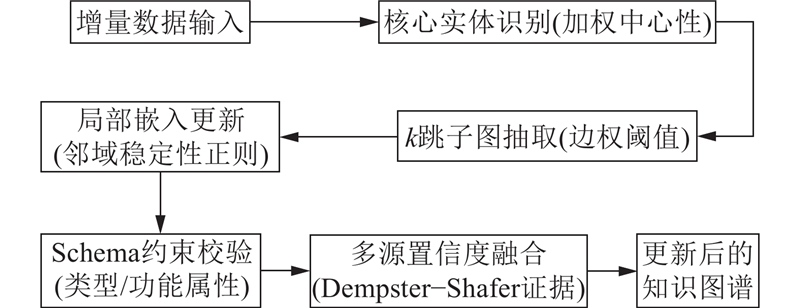
Abstract Existing knowledge graph update approaches often suffer from high computational cost, long update latency, and difficulties in maintaining consistency, which limit their applicability in large-scale dynamic environments. To address these issues, an incremental update method based on core entities and local subgraphs was proposed. A weighted centrality metric was constructed by integrating entity degree centrality with business access frequency, and the top-K entities with the highest scores were selected as core entities. In this way, the update process was focused on the entities that were most influential to downstream applications. Local subgraphs associated with the identified core entities were extracted through k-hop neighborhood expansion and edge-weight filtering, so that the update scope was restricted to semantically relevant structures and redundant computation was reduced. During model optimization, a local objective function was established for fine-tuning pre-trained knowledge graph embeddings. A neighborhood stability regularization term was introduced to suppress embedding drift caused by incremental updates. In addition, Schema constraints and multi-source confidence fusion were incorporated to ensure the consistency and reliability of the updated graph. Experiments were conducted on large-scale knowledge graph datasets. The results showed that, compared with full graph reconstruction and conventional fine-tuning methods, the proposed method reduced update latency by approximately 60%, improved triple insertion accuracy by approximately 8 percentage points, and decreased the consistency conflict rate by approximately 12 percentage points. These results indicate that the proposed method can effectively improve update efficiency while maintaining the structural and semantic quality of the knowledge graph.
|
|
Received: 28 July 2025
Published: 16 July 2026
|
|
|
| Fund: 国家社科基金资助项目(24XTQ005);四川省科技厅重点研发项目(2023YFG0144);成都信息工程大学创新创业训练计划项目(202410621153,X202510621154). |
基于核心实体与局部子图的知识图谱增量更新方法
现有知识图谱更新方法存在计算开销大、更新延迟高以及一致性难以保障等问题,限制了该方法在大规模动态场景下的应用,为此提出基于核心实体加局部子图概念的增量更新方法. 以实体的度中心性与业务访问频次加权融合设计加权中心指标,选取得分最高的前K个实体作为核心实体,使更新过程聚焦于对下游任务最具价值的节点. 通过k跳邻域扩展与边权阈值筛选,从原图谱中抽取与核心实体相关的局部子图,将更新范围限定于语义相关结构以降低冗余计算. 在模型优化阶段,构建结合预训练嵌入微调的局部优化损失函数,引入邻域稳定性正则项以有效抑制增量更新引起的嵌入漂移,结合 Schema 约束与多源置信度融合策略,确保更新结果的一致性与可靠性. 在大规模知识图谱数据集上的实验结果表明,与全图重构和常规模型微调方法相比,所提方法在更新延迟方面降低约60%,三元组插入精度提高约8个百分点,一致性冲突率降低约12个百分点,能够在保持知识图谱结构和语义质量的同时有效提升更新效率.
关键词:
知识图谱更新,
核心实体识别,
局部子图抽取,
加权中心指标,
嵌入微调,
一致性校验
|
|
| [1] |
官赛萍, 靳小龙, 贾岩涛, 等 面向知识图谱的知识推理研究进展[J]. 软件学报, 2018, 29 (10): 2966- 2994
GUAN Saiping, JIN Xiaolong, JIA Yantao, et al Knowledge reasoning over knowledge graph: a survey[J]. Journal of Software, 2018, 29 (10): 2966- 2994
doi: 10.13328/j.cnki.jos.005551
|
|
|
| [2] |
ZHONG L, WU J, LI Q, et al A comprehensive survey on automatic knowledge graph construction[J]. ACM Computing Surveys, 2024, 56 (4): 1- 62
doi: 10.1145/3618295
|
|
|
| [3] |
LIU J, KE W, WANG P, et al. Fast and continual knowledge graph embedding via incremental LoRA [C]// Proceedings of the International Joint Conference on Artificial Intelligence. Jeju: [s.n.], 2024: 2198–2206.
|
|
|
| [4] |
LIU J, KE W, WANG P, et al Towards continual knowledge graph embedding via incremental distillation[J]. Proceedings of the AAAI Conference on Artificial Intelligence, 2024, 38 (8): 8759- 8768
doi: 10.1609/aaai.v38i8.28722
|
|
|
| [5] |
LI Y, ZHANG L, YAN H, et al. SAGE: scale-aware gradual evolution for continual knowledge graph embedding [C]// Proceedings of the 31st ACM SIGKDD Conference on Knowledge Discovery and Data Mining V. 2. Toronto: ACM, 2025: 1600–1611.
|
|
|
| [6] |
LI L, JIN Z, HE Y, et al. Learning to evolve: Bayesian-guided continual knowledge graph embedding [EB/OL]. (2025–08–04)[2025–09–02]. https://arxiv.org/pdf/2508.02426.
|
|
|
| [7] |
PREMACHANDRA A M, TAYLOR K, RODRÍGUEZ-MÉNDEZ S. SPARQL-based relaxed rules for learning over knowledge graphs [C]// Joint Proceedings of the 1st Software Lifecycle Management for Knowledge Graphs Workshop and the 3rd International Workshop on Semantic Industrial Information Modelling. Baltimore: [s.n.], 2024: 1–13.
|
|
|
| [8] |
CHENG K, ALI M A, YANG S, et al. Leveraging logical rules in knowledge editing: a cherry on the top [EB/OL]. (2024–05–27)[2025–07–02]. https://arxiv.org/pdf/2405.15452.
|
|
|
| [9] |
HOFER M, OBRACZKA D, SAEEDI A, et al Construction of knowledge graphs: current state and challenges[J]. Information, 2024, 15 (8): 509
doi: 10.3390/info15080509
|
|
|
| [10] |
XU W, CURÉ O. ZodiacEdge: a datalog engine with incremental rule set maintenance [EB/OL]. (2023–12–22)[2025–07–02]. https://arxiv.org/pdf/2312.14530.
|
|
|
| [11] |
WANG Z, ZHANG J, FENG J, et al. Knowledge graph embedding by translating on hyperplanes [C]// Proceedings of the AAAI Conference on Artificial Intelligence. [S.l.]: AAAI Press, 2014: 1112–1119.
|
|
|
| [12] |
YANG B, YIH W T, HE X, et al. Embedding entities and relations for learning and inference in knowledge bases [EB/OL]. (2015–08–29)[2025–07–02]. https://arxiv.org/pdf/1412.6575.
|
|
|
| [13] |
DE SA C, RATNER A, RÉ C, et al Incremental knowledge base construction using DeepDive[J]. The VLDB Journal, 2017, 26 (1): 81- 105
doi: 10.1007/s00778-016-0437-2
|
|
|
| [14] |
饶官军, 古天龙, 常亮, 等 基于相似性负采样的知识图谱嵌入[J]. 智能系统学报, 2020, 15 (2): 218- 226
RAO Guanjun, GU Tianlong, CHANG Liang, et al Knowledge graph embedding based on similarity negative sampling[J]. CAAI Transactions on Intelligent Systems, 2020, 15 (2): 218- 226
doi: 10.11992/tis.201811022
|
|
|
| [15] |
HOU X, MA R, YAN L, et al T-GAE: a timespan-aware graph attention-based embedding model for temporal knowledge graph completion[J]. Information Sciences, 2023, 642: 119225
doi: 10.1016/j.ins.2023.119225
|
|
|
| [16] |
BAI L, MA X, MENG X, et al RoAN: a relation-oriented attention network for temporal knowledge graph completion[J]. Engineering Applications of Artificial Intelligence, 2023, 123: 106308
doi: 10.1016/j.engappai.2023.106308
|
|
|
| [17] |
ZHANG S, LIANG X, LI Z, et al. BiQCap: a biquaternion and Capsule network-based embedding model for Temporal knowledge graph completion [C]// Database Systems for Advanced Applications. [S.l.]: Springer, 2023: 673–688.
|
|
|
| [18] |
XIE R, RUAN K, HUANG B, et al TSA-Net: a temporal knowledge graph completion method with temporal-structural adaptation[J]. Applied Intelligence, 2024, 54 (21): 10320- 10332
doi: 10.1007/s10489-024-05734-1
|
|
|
| [19] |
TRIVEDI R, FARAJTABAR M, BISWAL P, et al. DyRep: learning representations over dynamic graphs [C]// International Conference on Learning Representations. New Orleans: [s.n.], 2019: 1–25.
|
|
|
| [20] |
WU D, LI Z, MITRA T. InkStream: real-time GNN inference on streaming graphs via incremental update [C]// 2025 IEEE International Parallel and Distributed Processing Symposium (IPDPS). Milan: IEEE, 2025: 1273–1285.
|
|
|
| [21] |
NAMAN P, SIMMHAN Y. Ripple: scalable incremental GNN inferencing on large streaming graphs [EB/OL]. (2025–05–17)[2025–07–02]. https://arxiv.org/pdf/2505.12112.
|
|
|
| [22] |
SHAFER G Dempster-shafer theory[J]. Encyclopedia of Artificial Intelligence, 1992, 1: 330- 331
|
|
|
| [23] |
WANG J, HALALINGAIAH S, CHEN W, et al. Probabilistic inference for datalog with correlated inputs [EB/OL]. (2025–08–21)[2026–02–02]. https://arxiv.org/pdf/2508.15166.
|
|
|
| [24] |
ZHOU D, ZHOU B, ZHENG Z, et al. ScheRe: schema reshaping for enhancing knowledge graph construction [C]// Proceedings of the 31st ACM International Conference on Information and Knowledge Management. Atlanta: ACM, 2022: 5074–5078.
|
|
|
| [25] |
WIKIMEDIA FOUNDATION. Wikidata database dump (English subset) [EB/OL]. (2025–05–19)[2026–02–02]. https://dumps.wikimedia.org/wikidatawiki/entities/20250519/all-truthy-en.ttl.bz2.
|
|
|
| [26] |
HOFFART J, SUCHANEK F M, BERBERICH K, et al YAGO2: a spatially and temporally enhanced knowledge base from Wikipedia[J]. Artificial Intelligence, 2013, 194: 28- 61
doi: 10.1016/j.artint.2012.06.001
|
|
|
| [27] |
TROUILLON T, WELBL J, RIEDEL S, et al. Complex embeddings for simple link prediction [EB/OL]. (2016–06–20)[2025–07–02]. https://arxiv.org/pdf/1606.06357.
|
|
|
| [28] |
SUN Z, DENG Z H, NIE J Y, et al. RotatE: knowledge graph embedding by relational rotation in complex space [EB/OL]. (2019–02–26)[2025–07–02]. https://arxiv.org/pdf/1902.10197.
|
|
|
|
Viewed |
|
|
|
Full text
|
|
|
|
|
Abstract
|
|
|
|
|
Cited |
|
|
|
|
| |
Shared |
|
|
|
|
| |
Discussed |
|
|
|
|