|
|
|
| 3D visual question answering guided by knowledge graph |
Aihua MAO( ),Siyu CHEN ),Siyu CHEN |
| School of Computer Science and Engineering, South China University of Technology, Guangzhou 511400, China |
|
|
|
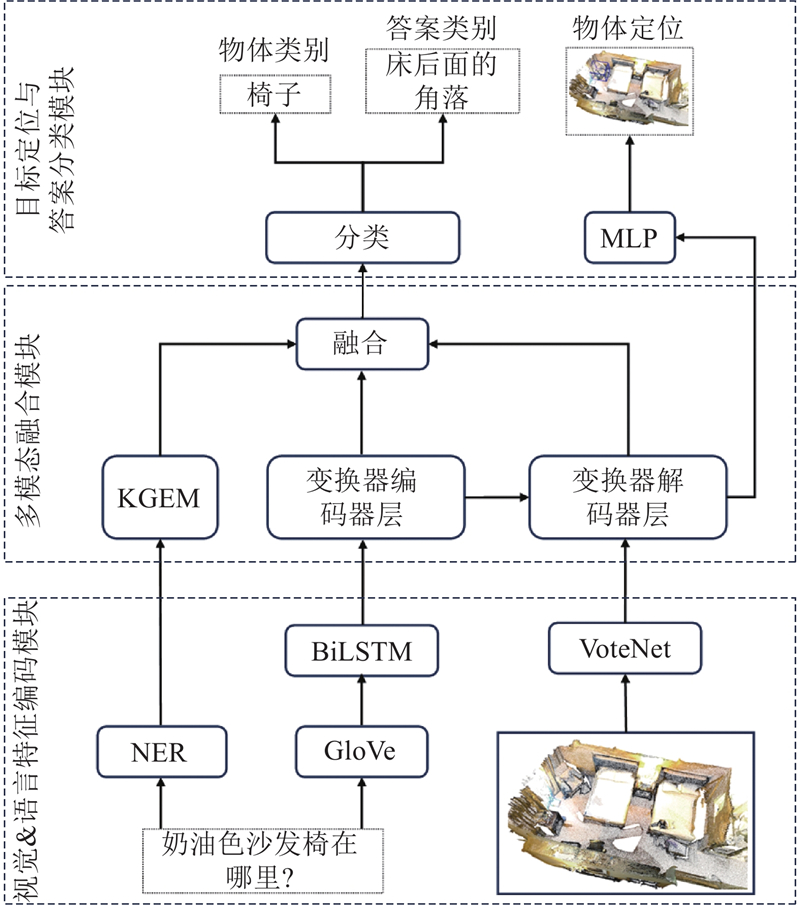
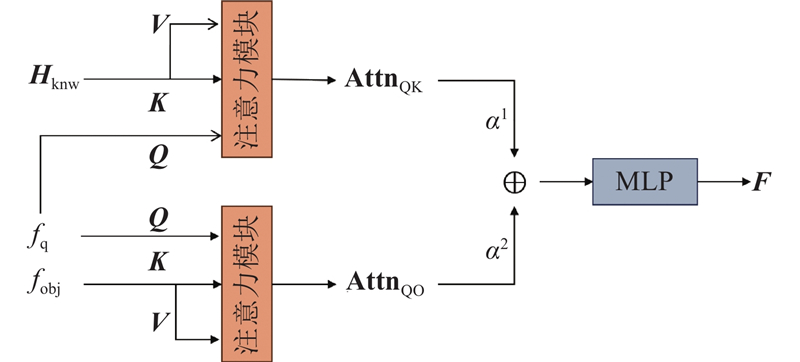
Abstract A knowledge graph-guided 3D visual question answering method was proposed to capture the implicit common-sense semantic relationships between objects in the scene. By introducing external structured knowledge, the model was effectively enhanced in both semantic understanding and reasoning ability. Specifically, key semantic entities were extracted from the question text, and a knowledge graph-guided feature enhancement module was designed to obtain knowledge features using these key semantic entities. The knowledge features were fused with visual features extracted both from the question representation and from the 3D object detection network for answer prediction. Experimental results on the ScanQA dataset showed that the proposed method outperforms existing baseline models on metrics such as EM@1 and BLEU-4.
|
|
Received: 10 July 2025
Published: 16 July 2026
|
|
|
| Fund: 广东省基础与应用基础研究基金资助项目(2024A1515012791). |
基于知识图谱引导的三维视觉问答
针对场景中物体之间潜在的常识性语义关系,提出基于知识图谱引导的三维视觉问答方法,通过引入外部结构化知识,有效增强模型的语义理解与推理能力. 从问题文本中提取关键语义实体,设计知识图谱引导的特征增强模块,利用关键语义实体获取知识特征. 将知识特征与由问题表示和三维目标检测网络提取的视觉特征进行融合,用于答案预测. 在ScanQA数据集上的实验证明,所提方法在评估指标EM@1与BLEU-4上均优于现有基线模型.
关键词:
三维视觉问答,
知识图谱,
特征增强,
多模态融合,
语义关系,
先验信息
|
|
| [1] |
AZUMA D, MIYANISHI T, KURITA S, et al. ScanQA: 3D question answering for spatial scene understanding [C]// Proceedings of the IEEE/CVF Conference on Computer Vision and Pattern Recognition. New Orleans: IEEE, 2022: 19107–19117.
|
|
|
| [2] |
DELITZAS A, PARELLI M, HARS N, et al. Multi-CLIP: contrastive vision-language pre-training for question answering tasks in 3D scenes [EB/OL]. (2023–06–04)[2025–07–02]. https://arxiv.org/pdf/2306.02329.
|
|
|
| [3] |
RADFORD A, KIM J W, HALLACY C, et al. Learning transferable visual models from natural language supervision [EB/OL]. (2021–02–26)[2025–07–02]. https://arxiv.org/pdf/2103.00020.
|
|
|
| [4] |
JIN Z, HAYAT M, YANG Y, et al. Context-aware alignment and mutual masking for 3D-language pre-training [C]// Proceedings of the IEEE/CVF Conference on Computer Vision and Pattern Recognition. Vancouver: IEEE, 2023: 10984–10994.
|
|
|
| [5] |
CHEN D Z, CHANG A X, NIEßNER M. ScanRefer: 3D object localization in RGB-D scans using natural language [C]// Computer Vision – ECCV 2020. [S.l.]: Springer International Publishing, 2020: 202–221.
|
|
|
| [6] |
HONG Y, ZHEN H, CHEN P, et al. 3D-LLM: injecting the 3D world into large language models [EB/OL]. (2023–07–24)[2025–07–02]. https://arxiv.org/pdf/2307.12981.
|
|
|
| [7] |
LI J, LI D, SAVARESE S, et al. BLIP-2: bootstrapping language-image pre-training with frozen image encoders and large language models [C]// Proceedings of the International Conference on Machine Learning. [S.l.]: PMLR, 2023: 19730-19742.
|
|
|
| [8] |
ALAYRAC J B, DONAHUE J, LUC P, et al. Flamingo: a visual language model for few-shot learning [EB/OL]. (2022–11–15)[2025–07–02]. https://arxiv.org/pdf/2204.14198.
|
|
|
| [9] |
PAPINENI K, ROUKOS S, WARD T, et al. BLEU: a method for automatic evaluation of machine translation [C]// Proceedings of the 40th Annual Meeting of the Association for Computational Linguistics. Philadelphia: Association for Computational Linguistics, 2002: 311–318.
|
|
|
| [10] |
VEDANTAM R, ZITNICK C L, PARIKH D. CIDEr: consensus-based image description evaluation [C]// Proceedings of the IEEE Conference on Computer Vision and Pattern Recognition. Boston: IEEE, 2015: 4566–4575.
|
|
|
| [11] |
ZHU Z, MA X, CHEN Y, et al. 3D-VisTA: pre-trained transformer for 3D vision and text alignment [C]// Proceedings of the IEEE/CVF International Conference on Computer Vision. Paris: IEEE, 2024: 2899–2909.
|
|
|
| [12] |
VO D M, CHEN H, SUGIMOTO A, et al. NOC-REK: novel object captioning with retrieved vocabulary from external knowledge [C]// Proceedings of the IEEE/CVF Conference on Computer Vision and Pattern Recognition. New Orleans: IEEE, 2022: 17979–17987.
|
|
|
| [13] |
SPEER R, CHIN J, HAVASI C ConceptNet 5.5: an open multilingual graph of general knowledge[J]. Proceedings of the AAAI Conference on Artificial Intelligence, 2017, 31 (1): 1
doi: 10.1609/aaai.v31i1.11164
|
|
|
| [14] |
DING Z, HAN X, NIETHAMMER M. VoteNet: a deep learning label fusion method for multi-atlas segmentation [C]// Medical Image Computing and Computer Assisted Intervention – MICCAI 2019. [S.l.]: Springer, 2019: 202–210.
|
|
|
| [15] |
PENNINGTON J, SOCHER R, MANNING C. GloVe: global vectors for word representation [C]// Proceedings of the 2014 Conference on Empirical Methods in Natural Language Processing. Doha: Association for Computational Linguistics, 2014: 1532–1543.
|
|
|
| [16] |
SCHUSTER M, PALIWAL K K Bidirectional recurrent neural networks[J]. IEEE Transactions on Signal Processing, 1997, 45 (11): 2673- 2681
doi: 10.1109/78.650093
|
|
|
| [17] |
KIPF T N, WELLING M. Semi-supervised classification with graph convolutional networks [EB/OL]. (2017–02–22)[2025–07–02]. https://arxiv.org/pdf/1609.02907.
|
|
|
| [18] |
RUMELHART D E, HINTON G E, WILLIAMS R J Learning representations by back-propagating errors[J]. Nature, 1986, 323 (6088): 533- 536
doi: 10.1038/323533a0
|
|
|
| [19] |
LIN C Y, HOVY E. Automatic evaluation of summaries using N-gram co-occurrence statistics [C]// Proceedings of the 2003 Conference of the North American Chapter of the Association for Computational Linguistics on Human Language Technology - NAACL '03. Edmonton: ACL, 2003: 71–78.
|
|
|
|
Viewed |
|
|
|
Full text
|
|
|
|
|
Abstract
|
|
|
|
|
Cited |
|
|
|
|
| |
Shared |
|
|
|
|
| |
Discussed |
|
|
|
|