|
|
|
| Reliability-enhanced task deployment method in mobile edge computing environments |
Shuxu ZHAO( ),Qi ZHU,Xiaolong WANG ),Qi ZHU,Xiaolong WANG |
| School of Electronic and Information Engineering, Lanzhou Jiaotong University, Lanzhou 730070, China |
|
|
|
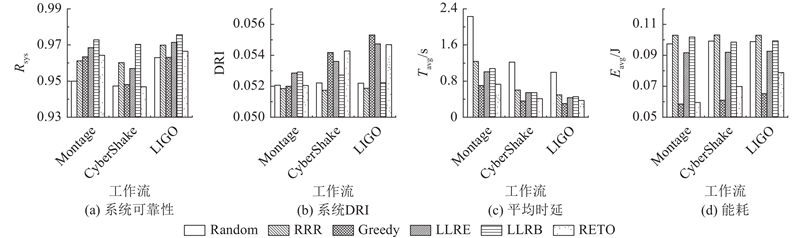
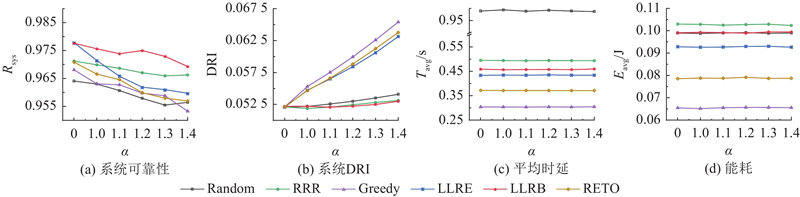
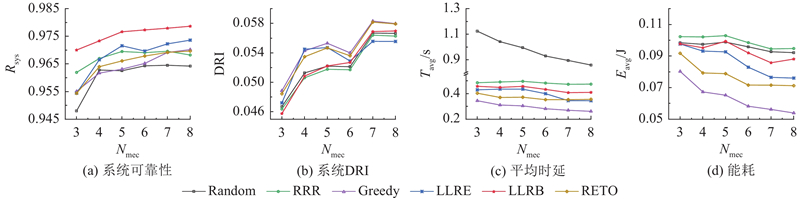
Abstract In the edge computing environment, risk factors such as edge server and virtual machine failures could lead to the degradation of system reliability and quality of service. Based on the principle of fault perception and reliability balancing, a task deployment strategy for delay-reliability collaborative optimization was proposed. First, a reliability-enhanced mobile edge computing (MEC) system model and a failure rate variation model based on server load perception were established. Then, by weighing the trade-off between reducing latency and improving the reliability level of the system, suitable computing nodes for task deployment were identified, and a low-latency and high-reliability deployment scheme was achieved under energy consumption constraints. Finally, in view of the change in server failure rate, the concept of reliability equilibrium was introduced, which ensured system reliability by limiting the maximum resource utilization of edge servers, and the degree of reliability imbalance (DRI) was employed to measure algorithm performance. Simulation results demonstrated that, compared with other related algorithms, the two proposed algorithms improved system reliability by 0.57% and 1.09%, and reduced latency by 30.06% and 16.86%, respectively, on average.
|
|
Received: 18 June 2025
Published: 16 July 2026
|
|
|
| Fund: 甘肃省重点研发计划基金资助项目(20YF8GA123). |
面向移动边缘计算的可靠性增强任务部署方法
边缘计算环境中存在如边缘服务器和虚拟机故障的风险因素,导致系统可靠性与服务质量降低,为此基于故障感知与可靠性均衡原理,提出时延-可靠性协同优化的任务部署策略. 建立可靠性增强移动边缘计算(MEC)系统模型以及基于服务器负载感知的故障率变化模型. 在减少时延与提高系统可靠性水平之间权衡,找到合适的计算节点部署任务,在能耗约束的条件下实现低时延、高可靠性的任务部署方案. 针对服务器故障率变化的情况,提出可靠性均衡的概念,通过限制边缘服务器的最大资源使用率来保证系统的可靠性,使用可靠性均衡评价指标(DRI)来衡量算法的性能. 仿真实验结果表明,与其他相关算法相比,2种所提算法在系统可靠性上分别平均提升了0.57%和1.09%,在时延上分别平均减少了30.06%和16.86%.
关键词:
移动边缘计算(MEC),
可靠性增强,
可靠性均衡,
时延,
任务卸载
|
|
| [1] |
谢人超, 廉晓飞, 贾庆民, 等 移动边缘计算卸载技术综述[J]. 通信学报, 2018, 39 (11): 138- 155
XIE Renchao, LIAN Xiaofei, JIA Qingmin, et al Survey on computation offloading in mobile edge computing[J]. Journal on Communications, 2018, 39 (11): 138- 155
doi: 10.11896/jsjkx.250100058
|
|
|
| [2] |
CHEN L, XU Y, LU Z, et al IoT microservice deployment in edge-cloud hybrid environment using reinforcement learning[J]. IEEE Internet of Things Journal, 2021, 8 (16): 12610- 12622
doi: 10.1109/JIOT.2020.3014970
|
|
|
| [3] |
MAZLAMI G, CITO J, LEITNER P. Extraction of microservices from monolithic software architectures [C]// Proceedings of the IEEE International Conference on Web Services. Honolulu: IEEE, 2017: 524–531.
|
|
|
| [4] |
ARAL A, BRANDIĆ I Learning spatiotemporal failure dependencies for resilient edge computing services[J]. IEEE Transactions on Parallel and Distributed Systems, 2021, 32 (7): 1578- 1590
doi: 10.1109/TPDS.2020.3046188
|
|
|
| [5] |
KUMARI P, KAUR P A survey of fault tolerance in cloud computing[J]. Journal of King Saud University: Computer and Information Sciences, 2021, 33 (10): 1159- 1176
doi: 10.1016/j.jksuci.2018.09.021
|
|
|
| [6] |
BIRKE R, GIURGIU I, CHEN L Y, et al. Failure analysis of virtual and physical machines: patterns, causes and characteristics [C]// Proceedings of the 44th Annual IEEE/IFIP International Conference on Dependable Systems and Networks. Atlanta: IEEE, 2014: 1–12.
|
|
|
| [7] |
RAY K, BANERJEE A Prioritized fault recovery strategies for multi-access edge computing using probabilistic model checking[J]. IEEE Transactions on Dependable and Secure Computing, 2023, 20 (1): 797- 812
doi: 10.1109/TDSC.2022.3143877
|
|
|
| [8] |
LONG T, MA Y, XIA Y, et al. A mobility-aware and fault-tolerant service offloading method in mobile edge computing [C]// Proceedings of the IEEE International Conference on Web Services. Barcelona: IEEE, 2022: 67–72.
|
|
|
| [9] |
LIU H, CAO L, PEI T, et al A fast algorithm for energy-saving offloading with reliability and latency requirements in multi-access edge computing[J]. IEEE Access, 2020, 8: 151- 161
doi: 10.1109/ACCESS.2019.2961453
|
|
|
| [10] |
LIU J, ZHOU A, LIU C, et al Reliability-enhanced task offloading in mobile edge computing environments[J]. IEEE Internet of Things Journal, 2022, 9 (13): 10382- 10396
doi: 10.1109/JIOT.2021.3115807
|
|
|
| [11] |
SAMANTA A, ESPOSITO F, NGUYEN T G Fault-tolerant mechanism for edge-based IoT networks with demand uncertainty[J]. IEEE Internet of Things Journal, 2021, 8 (23): 16963- 16971
doi: 10.1109/JIOT.2021.3075681
|
|
|
| [12] |
LIU J, ZHANG Q Offloading schemes in mobile edge computing for ultra-reliable low latency communications[J]. IEEE Access, 2018, 6: 12825- 12837
doi: 10.1109/ACCESS.2018.2800032
|
|
|
| [13] |
ZHAO H, DENG S, LIU Z, et al Distributed redundant placement for microservice-based applications at the edge[J]. IEEE Transactions on Services Computing, 2022, 15 (3): 1732- 1745
doi: 10.1109/TSC.2020.3013600
|
|
|
| [14] |
TULI S, CASALE G, JENNINGS N R. PreGAN: preemptive migration prediction network for proactive fault-tolerant edge computing [C]// Proceedings of the IEEE INFOCOM 2022 - IEEE Conference on Computer Communications. London: IEEE, 2022: 670–679.
|
|
|
| [15] |
LONG T, CHEN P, XIA Y, et al A deep deterministic policy gradient-based method for enforcing service fault-tolerance in MEC[J]. Chinese Journal of Electronics, 2024, 33 (4): 899- 909
doi: 10.23919/cje.2023.00.105
|
|
|
| [16] |
SONG L, SUN G, YU H. An approach for fault tolerance in multi-access edge computing [C]// Proceedings of the IEEE 2nd International Conference on Deep Learning and Computer Vision. Jinan: IEEE, 2025: 1–5.
|
|
|
| [17] |
PARK T, YOU M, KIM J, et al Fatriot: fault-tolerant MEC architecture for mission-critical systems using a SmartNIC[J]. Journal of Network and Computer Applications, 2024, 231: 103978
doi: 10.1016/j.jnca.2024.103978
|
|
|
| [18] |
International Organization for Standardization. Road vehicles - functional safety: ISO 26262 [S]. Geneva: International Organization for Standardization, 2017.
|
|
|
| [19] |
BARI M F, BOUTABA R, ESTEVES R, et al Data center network virtualization: a survey[J]. IEEE Communications Surveys and Tutorials, 2013, 15 (2): 909- 928
doi: 10.1109/SURV.2012.090512.00043
|
|
|
| [20] |
XIE G, ZENG G, CHEN Y, et al Minimizing redundancy to satisfy reliability requirement for a parallel application on heterogeneous service-oriented systems[J]. IEEE Transactions on Services Computing, 2020, 13 (5): 871- 886
doi: 10.1109/TSC.2017.2665552
|
|
|
| [21] |
BURKE E K, KENDALL G. Search methodologies: introductory tutorials in optimization and decision support techniques [M]. Boston: Springer, 2014: 273–316.
|
|
|
| [22] |
TONG Z, DENG X, CHEN H, et al DDMTS: a novel dynamic load balancing scheduling scheme under SLA constraints in cloud computing[J]. Journal of Parallel and Distributed Computing, 2021, 149: 138- 148
doi: 10.1016/j.jpdc.2020.11.007
|
|
|
| [23] |
GABI D, ISMAIL A S, ZAINAL A, et al Orthogonal Taguchi-based cat algorithm for solving task scheduling problem in cloud computing[J]. Neural Computing and Applications, 2018, 30 (6): 1845- 1863
doi: 10.1007/s00521-016-2816-4
|
|
|
| [24] |
KHATAVKAR B, BOOPATHY P. Efficient WMaxMin static algorithm for load balancing in cloud computation [C]// Proceedings of the Innovations in Power and Advanced Computing Technologies (i-PACT). Vellore: IEEE, 2018: 1–6.
|
|
|
| [25] |
邵苏杰, 吴磊, 钟成, 等 面向多工作流的基于容器的边缘微服务选择机制[J]. 电子与信息学报, 2022, 44 (11): 3748- 3756
SHAO Sujie, WU Lei, ZHONG Cheng, et al Container based microservice selection for multi-workflow in edge computing paradigm[J]. Journal of Electronics and Information Technology, 2022, 44 (11): 3748- 3756
doi: 10.11999/JEIT220267
|
|
|
|
Viewed |
|
|
|
Full text
|
|
|
|
|
Abstract
|
|
|
|
|
Cited |
|
|
|
|
| |
Shared |
|
|
|
|
| |
Discussed |
|
|
|
|