|
|
|
| Machine-learning based fractal derivative Maxwell concrete creep model |
Shengqi MEI1,2( ),Xufeng LI3,4,Xingju WANG2,*(),Xiaodong LIU4,Liming WU5,Xingyan LI4,Zhe LIU4 ),Xufeng LI3,4,Xingju WANG2,*(),Xiaodong LIU4,Liming WU5,Xingyan LI4,Zhe LIU4 |
1. State Key Laboratory of Mechanical Behavior and System Safety of Traffic Engineering Structures, Shijiazhuang Tiedao University, Shijiazhuang 050043, China
2. School of Traffic and Transportation, Shijiazhuang Tiedao University, Shijiazhuang 050043, China
3. Shanxi Transportation Logistics Group Limited Company, Taiyuan 030011, China
4. School of Civil Engineering, Shijiazhuang Tiedao University, Shijiazhuang 050043, China
5. School of Civil Engineering, Sichuan University of Science and Engineering, Zigong 643000, China |
|
|
|
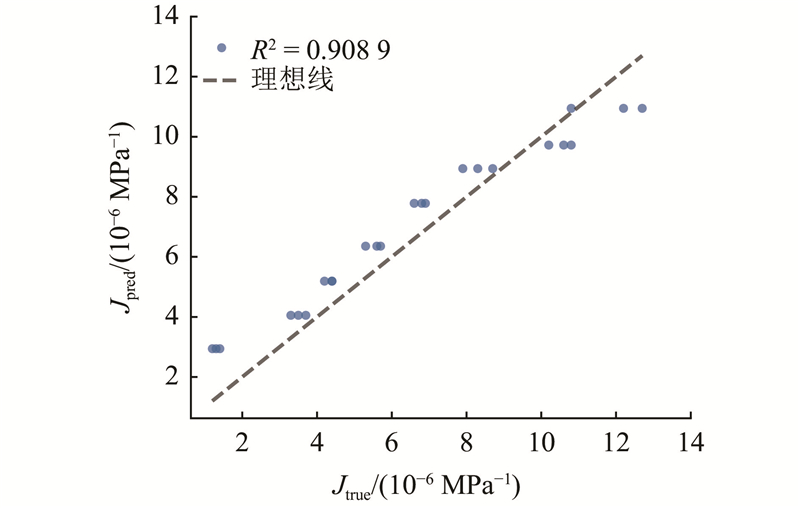
Abstract A predictable fractal derivative Maxwell concrete creep model was proposed to address the problems of complex calculations and limited prediction accuracy for multi-source dispersed data in existing concrete creep models. The fractal derivative theory was combined with the XGBoost machine learning algorithm through a physics-data fusion approach. A mapping relationship between concrete material characteristics, environmental conditions, and the key parameters of the fractal derivative Maxwell model (fractal order and viscosity coefficient) was established based on 746 sets of experimental data selected from the NU concrete creep database. Bayesian optimization was adopted to determine the optimal hyperparameters. The constructed model achieved coefficients of determination (R2) of 0.919 and 0.908 for the prediction of the fractal order and the viscosity coefficient on the test set, respectively. An R2 score of 0.909 was obtained on an independent validation set. These results demonstrate that the model has good fitting performance and generalization capability. The proposed physics-data fusion model improves overall prediction accuracy while retaining theoretical interpretability compared with existing models.
|
|
Received: 09 March 2025
Published: 04 February 2026
|
|
|
| Fund: 国家自然科学基金资助项目(52108161);河北省高等学校科学研究资助项目(BJK2024127);石家庄铁道大学土木工程学院自主科研课题(TMXN2201);石家庄铁道大学研究生创新资助项目(YC202407, YC202426). |
|
Corresponding Authors:
Xingju WANG
E-mail: cshqmei@stdu.edu.cn;wangxingju@stdu.edu.cn
|
基于机器学习的分形导数 Maxwell 混凝土徐变模型
为了解决现有混凝土徐变模型计算复杂且对多源分散数据预测精度有限的问题,通过物理模型与数据驱动融合的方式,结合具有物理意义的分形导数理论与XGBoost机器学习算法,提出可预测的分形导数 Maxwell混凝土徐变模型. 基于从NU混凝土徐变数据库中筛选出的746组试验数据,建立混凝土材料特性、环境条件与分形导数Maxwell模型关键参数(分形阶数和黏性系数)之间的映射关系,采用贝叶斯优化方法确定模型的最优超参数. 研究结果表明,所构建模型在测试集上对分形阶数和黏性系数的预测决定系数分别达到0.919和0.908,在独立的验证集上,预测决定系数的评分为0.909,展现出良好的拟合性能和泛化能力. 与既有模型相比,提出的物理-数据融合模型在保留理论解释性的同时,有效提高了整体的预测精度.
关键词:
混凝土徐变,
分形导数理论,
Maxwell模型,
机器学习算法,
预测模型
|
|
| [1] |
VOYIADJIS G Z. Handbook of damage mechanics: nano to macro scale for materials and structures [M]. New York: Springer, 2022.
|
|
|
| [2] |
VANDAMME M, ULM F J, BAŽANT Z P Nanogranular origin of concrete creep[J]. Proceedings of the National Academy of Sciences of the United States of America, 2009, 106 (26): 10552- 10557
|
|
|
| [3] |
LYSETT T. Decrease life cycle costs and cost-effective bridge maintenance [EB/OL]. (2019-01-30). https:// cor-tuf.com/decrease-lifecycle-costs-and-increase-longevity-with-cost-effective-bridge-maintenance.html.
|
|
|
| [4] |
ACI Committee 209. Prediction of creep, shrinkage, and temperature effects in concrete structures (reapproved 2008): ACI PRC-209-92 [S]. Farmington Hills: ACI, 2008.
|
|
|
| [5] |
Comité Euro-International du Béton. Fib model code for concrete structures 2010 [M]. Berlin: Ernst and Sohn, 2013.
|
|
|
| [6] |
RILEM draft recommendation: TC-242-MDC multi-decade creep and shrinkage of concrete: material model and structural analysis*: model B4 for creep, drying shrinkage and autogenous shrinkage of normal and high-strength concretes with multi-decade applicability [J]. Materials and Structures, 2015, 48(4): 753–770.
|
|
|
| [7] |
GARDNER N J, LOCKMAN M J Design provisions for drying shrinkage and creep of normal-strength concrete[J]. ACI Materials Journal, 2001, 98 (2): 159- 167
|
|
|
| [8] |
梅生启, 刘晓东, 王兴举, 等 基于参数相关性分析和机器学习算法的高强混凝土徐变预测[J]. 吉林大学学报: 工学版, 2025, 55 (5): 1595- 1603
MEI Shengqi, LIU Xiaodong, WANG Xingju, et al Prediction of high strength concrete creep based on parametric MIC analysis and machine learning algorithm[J]. Journal of Jilin University: Engineering and Technology Edition, 2025, 55 (5): 1595- 1603
doi: 10.13229/j.cnki.jdxbgxb.20230814
|
|
|
| [9] |
FENG J, ZHANG H, GAO K, et al A machine learning and game theory-based approach for predicting creep behavior of recycled aggregate concrete[J]. Case Studies in Construction Materials, 2022, 17: e01653
doi: 10.1016/j.cscm.2022.e01653
|
|
|
| [10] |
FENG J, ZHANG H, GAO K, et al Efficient creep prediction of recycled aggregate concrete via machine learning algorithms[J]. Construction and Building Materials, 2022, 360: 129497
doi: 10.1016/j.conbuildmat.2022.129497
|
|
|
| [11] |
SCHIESSEL H, METZLER R, BLUMEN A, et al Generalized viscoelastic models: their fractional equations with solutions[J]. Journal of Physics A: Mathematical and General, 1995, 28 (23): 6567
doi: 10.1088/0305-4470/28/23/012
|
|
|
| [12] |
刘喜, 李振军, 周剑, 等. 钢纤维地聚物轻骨料混凝土受弯构件裂缝特征与分析模型 [EB/OL]. (2025-05-07). https://link.cnki.net/doi/10.13801/j.cnki.fhclxb.20250506.005.
|
|
|
| [13] |
CAI W, CHEN W, XU W Characterizing the creep of viscoelastic materials by fractal derivative models[J]. International Journal of Non-Linear Mechanics, 2016, 87: 58- 63
doi: 10.1016/j.ijnonlinmec.2016.10.001
|
|
|
| [14] |
尹倩, 龚维明, 戴国亮, 等 分形导数西元流变模型及其工程应用[J]. 岩土工程学报, 2025, 47 (7): 1494- 1503
YIN Qian, GONG Weiming, DAI Guoliang, et al Fractal derivative Nishihara rheology model and its application[J]. Chinese Journal of Geotechnical Engineering, 2025, 47 (7): 1494- 1503
doi: 10.11779/CJGE20240193
|
|
|
| [15] |
苏祥龙, 许文祥, 陈文 基于分形导数对非牛顿流体层流的数值研究[J]. 力学学报, 2017, 49 (5): 1020- 1028
SU Xianglong, XU Wenxiang, CHEN Wen Numerical study for laminar flow of non-Newtonian fluid based on fractal derivative[J]. Chinese Journal of Theoretical and Applied Mechanics, 2017, 49 (5): 1020- 1028
doi: 10.6052/0459-1879-16-318
|
|
|
| [16] |
刘式达, 付遵涛, 刘式适 间歇湍流的分形特征: 分数维及分数阶导数的应用[J]. 地球物理学报, 2014, 57 (9): 2751- 2755
LIU Shida, FU Zuntao, LIU Shishi Fractal behaviors of intermittent turbulence: applications of fractional dimension and fractional derivatives[J]. Chinese Journal of Geophysics, 2014, 57 (9): 2751- 2755
|
|
|
| [17] |
FINDLEY W N, DAVIS F A. Creep and relaxation of nonlinear viscoelastic materials [M]. New York: Courier Corporation, 2013.
|
|
|
| [18] |
VANDAMME M, ULM F J Nanoindentation investigation of creep properties of calcium silicate hydrates[J]. Cement and Concrete Research, 2013, 52: 38- 52
doi: 10.1016/j.cemconres.2013.05.006
|
|
|
| [19] |
NEVILLE A M, DILGER W H, BROOKS J J. Creep of plain and structural concrete [M]. London: Construction Press, 1983.
|
|
|
| [20] |
KOELLER R C Applications of fractional calculus to the theory of viscoelasticity[J]. Journal of Applied Mechanics, 1984, 51 (2): 299- 307
doi: 10.1115/1.3167616
|
|
|
| [21] |
SCOTT BLAIR G W Analytical and integrative aspects of the stress-strain-time problem[J]. Journal of Scientific Instruments, 1944, 21 (5): 80
doi: 10.1088/0950-7671/21/5/302
|
|
|
| [22] |
MEI S, LI X, WANG X, et al Calculation of short-term creep of concrete using fractional viscoelastic model[J]. Materials, 2023, 16 (12): 4274
doi: 10.3390/ma16124274
|
|
|
| [23] |
CAO J, WANG D, ZOU Z, et al Fractional-order Burgers model for coral concrete creep[J]. Engineering Research Express, 2024, 6 (3): 035117
doi: 10.1088/2631-8695/ad777d
|
|
|
| [24] |
PODLUBNY I. Fractional differential equations: an introduction to fractional derivatives, fractional differential equations, to methods of their solution and some of their applications [M]. San Diego: Elsevier, 1998.
|
|
|
| [25] |
CHEN W Time–space fabric underlying anomalous diffusion[J]. Chaos, Solitons and Fractals, 2006, 28 (4): 923- 929
doi: 10.1016/j.chaos.2005.08.199
|
|
|
| [26] |
CHEN W, SUN H, ZHANG X, et al Anomalous diffusion modeling by fractal and fractional derivatives[J]. Computers and Mathematics with Applications, 2010, 59 (5): 1754- 1758
doi: 10.1016/j.camwa.2009.08.020
|
|
|
| [27] |
SUN H, MEERSCHAERT M M, ZHANG Y, et al A fractal Richards’ equation to capture the non-Boltzmann scaling of water transport in unsaturated media[J]. Advances in Water Resources, 2013, 52: 292- 295
doi: 10.1016/j.advwatres.2012.11.005
|
|
|
| [28] |
CHEN T, GUESTRIN C. XGBoost: a scalable tree boosting system [C]//Proceedings of the 22nd ACM SIGKDD International Conference on Knowledge Discovery and Data Mining. San Francisco: ACM, 2016: 785–794.
|
|
|
| [29] |
SHAHRIARI B, SWERSKY K, WANG Z, et al Taking the human out of the loop: a review of Bayesian optimization[J]. Proceedings of the IEEE, 2016, 104 (1): 148- 175
doi: 10.1109/JPROC.2015.2494218
|
|
|
| [30] |
宁成晋. 高强高性能机制砂混凝土关键技术研究 [D]. 广州: 广州大学, 2016.
NING Chengjin. A study of key technology of high performance concrete sand [D]. Guangzhou: Guangzhou University, 2016.
|
|
|
|
Viewed |
|
|
|
Full text
|
|
|
|
|
Abstract
|
|
|
|
|
Cited |
|
|
|
|
| |
Shared |
|
|
|
|
| |
Discussed |
|
|
|
|