|
|
|
| Prescribed-time disturbance rejection and learning control for quadrotor aircraft attitude |
Rui HU1,2( ),Xiaoyu YANG1,2,Qianru JIANG1,2,*(),Shuzong XIE3,Qiang CHEN1,2 ),Xiaoyu YANG1,2,Qianru JIANG1,2,*(),Shuzong XIE3,Qiang CHEN1,2 |
1. College of Information Engineering, Zhejiang University of Technology, Hangzhou 310023, China
2. Zhejiang Key Laboratory of Intelligent Perception and Control for Complex Systems, Zhejiang University of Technology, Hangzhou 310023, China
3. School of Automation and Electrical Engineering, Zhejiang University of Science and Technology, Hangzhou 310023, China |
|
|
|
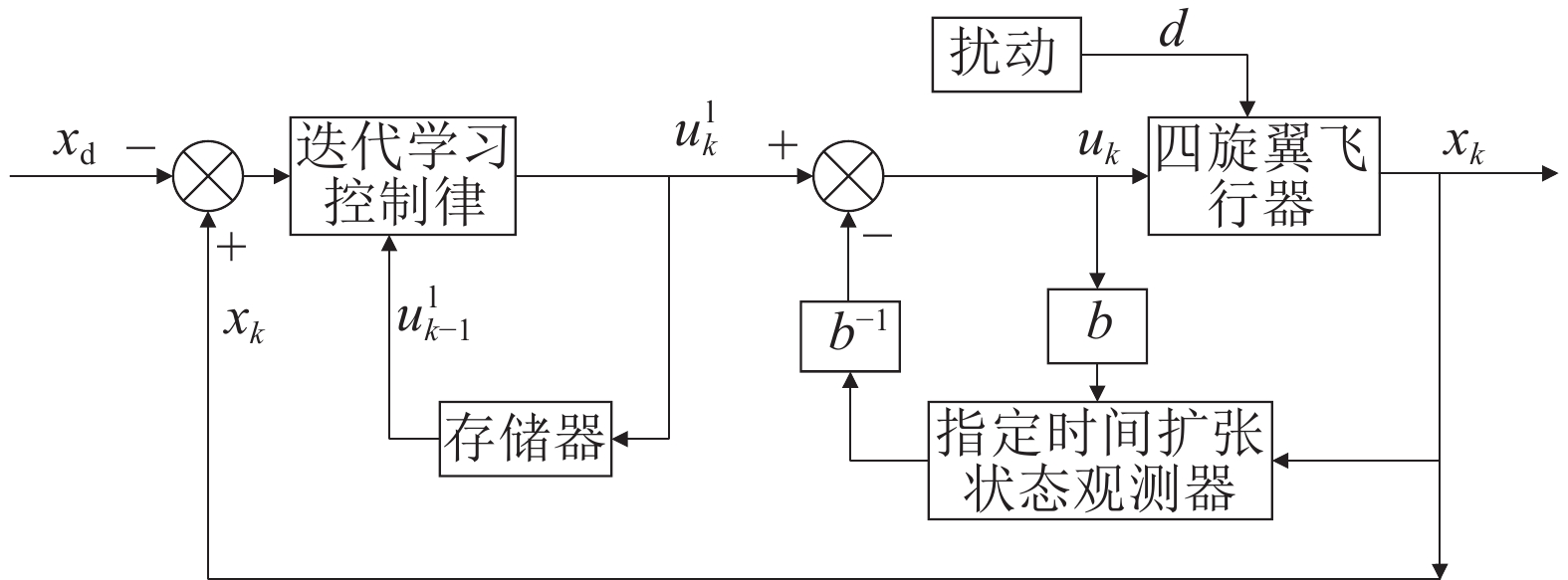
Abstract A prescribed-time disturbance-rejection learning control method was proposed for the attitude system of quadrotor aircraft performing repetitive task. A prescribed-time extended state observer was designed by introducing time-scale transformation that mapped a finite prescribed-time interval onto an infinite time interval. Then the system states and uncertain disturbances were rapidly estimated within the prescribed time. A monotonically increasing, continuous, and bounded time-scale function was developed to ensure that the observer remained effective over the entire operating interval, thereby avoiding estimate chattering caused by observer switching. A fully saturated sliding-mode iterative learning controller was constructed to estimate the desired control input in order to improve the attitude tracking accuracy and system robustness. The stability of the closed-loop system was proved, and the convergence of the tracking error was analyzed based on the Lyapunov method. Numerical simulations and experimental results showed that the proposed prescribed-time disturbance-rejection learning control method achieved better disturbance-rejection performance, faster response speed and higher tracking accuracy compared with the sliding-mode iterative learning control method and the fixed-time extended state observer (ESO)-based iterative learning control method.
|
|
Received: 24 December 2025
Published: 20 July 2026
|
|
|
| Fund: 国家自然科学基金资助项目(U25A20452, 62222315, 62203384, 62503430);浙江省自然科学基金重点资助项目(LZ26F030004);浙江省属高校基本科研业务费专业资金资助项目(RF-C2024001). |
|
Corresponding Authors:
Qianru JIANG
E-mail: 19150663287@163.com;qianrujiang@zjut.edu.cn
|
四旋翼飞行器姿态指定时间抗扰学习控制
针对执行重复任务的四旋翼飞行器姿态系统,提出指定时间抗扰学习控制方法. 设计指定时间扩张状态观测器,引入时间尺度变换将有限指定时间范围映射到无限时间范围,使得观测器在指定时间快速估计系统状态和不确定性扰动. 设计单调递增且连续有界的时间尺度函数,确保观测器在整个时间区间内有效,避免因切换观测器引起估计值抖振的问题. 构造全限幅滑模迭代学习控制器,估计期望控制输入,以提高姿态跟踪精度和系统鲁棒性. 基于李雅普诺夫定理,证明闭环系统稳定性和分析跟踪误差收敛性. 数值仿真和实验结果表明,与滑模迭代学习控制及基于固定时间扩张状态观测器的迭代学习控制方法相比,提出的指定时间抗扰学习控制方法具有更好的抗扰性能、更快的响应速度以及更高的跟踪精度.
关键词:
四旋翼飞行器,
姿态控制,
指定时间扩张状态观测器,
迭代学习控制,
类李雅普诺夫方法
|
|
| [1] |
CHEN Q, TAO M, HE X, et al Fuzzy adaptive nonsingular fixed-time attitude tracking control of quadrotor UAVs[J]. IEEE Transactions on Aerospace and Electronic Systems, 2021, 57 (5): 2864- 2877
doi: 10.1109/TAES.2021.3067610
|
|
|
| [2] |
ABRO G E M, ALI Z A, MASOOD R J Synergistic UAV motion: a comprehensive review on advancing multi-agent coordination[J]. ICCK Transactions on Sensing, Communication, and Control, 2024, 1 (2): 72- 88
doi: 10.62762/TSCC.2024.211408
|
|
|
| [3] |
王日俊, 白越, 续志军, 等 基于扰动观测器的多旋翼无人机机载云台模糊自适应跟踪控制[J]. 浙江大学学报: 工学版, 2015, 49 (10): 2005- 2012
WANG Rijun, BAI Yue, XU Zhijun, et al Fuzzy self-adjusting tracking control based on disturbance observer for airborne platform mounted on multi-rotor unmanned aerial vehicle[J]. Journal of Zhejiang University: Engineering Science, 2015, 49 (10): 2005- 2012
|
|
|
| [4] |
HUANG T P, LI T S, CHEN C, et al Attitude stabilization for a quadrotor using adaptive control algorithm[J]. IEEE Transactions on Aerospace and Electronic Systems, 2024, 60 (1): 334- 347
doi: 10.1109/TAES.2023.3323633
|
|
|
| [5] |
LIAN S K, MENG W, LIN Z M, et al Adaptive attitude control of a quadrotor using fast nonsingular terminal sliding mode[J]. IEEE Transactions on Industrial Electronics, 2022, 69 (2): 1597- 1607
doi: 10.1109/TIE.2021.3057015
|
|
|
| [6] |
TAO M L, CHEN Q, HE X X, et al Fixed-time filtered adaptive parameter estimation and attitude control for quadrotor UAVs[J]. IEEE Transactions on Aerospace and Electronic Systems, 2022, 58 (5): 4135- 4146
doi: 10.1109/TAES.2022.3159770
|
|
|
| [7] |
WEI Z B, QUAN Q, CAI K Y Output feedback ILC for a class of nonminimum phase nonlinear systems with input saturation: an additive-state-decomposition-based method[J]. IEEE Transactions on Automatic Control, 2017, 62 (1): 502- 508
doi: 10.1109/TAC.2016.2555081
|
|
|
| [8] |
ZHANG Z H, XIE S Z, CHEN Q Disturbance observer-based singularity-free predefined-time attitude tracking control of quadrotors: theory and experiments[J]. IEEE Transactions on Aerospace and Electronic Systems, 2025, 61 (1): 314- 324
doi: 10.1109/TAES.2024.3446754
|
|
|
| [9] |
XU F, TAN J B, WANG X Q, et al Mixed active/passive robust fault detection and isolation using set-theoretic unknown input observers[J]. IEEE Transactions on Automation Science and Engineering, 2018, 15 (2): 863- 871
doi: 10.1109/TASE.2017.2776998
|
|
|
| [10] |
YUE X H, SHAO X L, ZHANG W D Elliptical encircling of quadrotors for a dynamic target subject to aperiodic signals updating[J]. IEEE Transactions on Intelligent Transportation Systems, 2022, 23 (9): 14375- 14388
doi: 10.1109/TITS.2021.3127722
|
|
|
| [11] |
CAO H Z, LI Y Q, LIU C J, et al ESO-based robust and high-precision tracking control for aerial manipulation[J]. IEEE Transactions on Automation Science and Engineering, 2024, 21 (2): 2139- 2155
doi: 10.1109/TASE.2023.3260874
|
|
|
| [12] |
HAN J Q From PID to active disturbance rejection control[J]. IEEE Transactions on Industrial Electronics, 2009, 56 (3): 900- 906
doi: 10.1109/TIE.2008.2011621
|
|
|
| [13] |
LIU K, WANG X X, WANG R G, et al Antisaturation finite-time attitude tracking control based observer for a quadrotor[J]. IEEE Transactions on Circuits and Systems II: Express Briefs, 2021, 68 (6): 2047- 2051
|
|
|
| [14] |
WANG T Q, XIA Y Q, ZHAO K, et al Fixed-time disturbance rejection control scheme for quadrotor trajectory tracking[J]. IEEE Transactions on Industrial Electronics, 2025, 72 (11): 11671- 11681
doi: 10.1109/TIE.2025.3531489
|
|
|
| [15] |
LI D Y, WU Z G, ZHANG F. Distributed predefined time sliding mode 3D formation control of UAVs [C]//Proceedings of the 37th Chinese Control and Decision Conference. Xiamen: IEEE, 2025: 2222–2226.
|
|
|
| [16] |
WANG H A, SHAO S K, ZHAO Y J. Prescribed-time attitude tracking control of UAV based on prescribed-time extended state observer [C]//Proceedings of the China Automation Congress. Qingdao: IEEE, 2024: 5727–5732.
|
|
|
| [17] |
BAI H, MEI S, DONG J Hierarchical temporal sequence convergence in prescribed-time control for quadrotor UAVs under unknown dynamic disturbances[J]. Aerospace Science and Technology, 2024, 148: 109094
doi: 10.1016/j.ast.2024.109094
|
|
|
| [18] |
李沈崇, 曾新华, 林传渠 基于轴向注意力的多任务自动驾驶环境感知算法[J]. 浙江大学学报: 工学版, 2025, 59 (4): 769- 777
LI Shenchong, ZENG Xinhua, LIN Chuanqu Multi-task environment perception algorithm for autonomous driving based on axial attention[J]. Journal of Zhejiang University: Engineering Science, 2025, 59 (4): 769- 777
doi: 10.3785/j.issn.1008-973X.2025.04.012
|
|
|
| [19] |
ARIMOTO S, KAWAMURA S, MIYAZAKI F Bettering operation of robots by learning[J]. Journal of Robotic Systems, 1984, 1 (2): 123- 140
doi: 10.1002/rob.4620010203
|
|
|
| [20] |
SHI H H, CHEN Q, HONG Y H, et al Adaptive fuzzy iterative learning control of constrained systems with arbitrary initial state errors and unknown control gain[J]. IEEE Transactions on Automation Science and Engineering, 2025, 22 (8): 6439- 6450
doi: 10.1109/tase.2024.3445670
|
|
|
| [21] |
XU J, XU J J Iterative learning control for output-constrained systems with both parametric and nonparametric uncertainties[J]. Automatica, 2013, 49 (8): 2508- 2516
doi: 10.1016/j.automatica.2013.04.039
|
|
|
| [22] |
施卉辉, 陈强 一类不确定系统的自适应滑模迭代学习控制[J]. 控制理论与应用, 2023, 40 (7): 1162- 1171
SHI Huihui, CHEN Qiang Adaptive sliding-mode iterative learning control for a class of uncertain systems[J]. Control Theory and Applications, 2023, 40 (7): 1162- 1171
doi: 10.7641/CTA.2022.20474
|
|
|
| [23] |
王术波, 韩宇, 陈建, 等 基于ADRC迭代学习控制的四旋翼无人机姿态控制[J]. 航空学报, 2020, 41 (12): 313- 325
WANG Shubo, HAN Yu, CHEN Jian, et al Active disturbance rejection control (ADRC) of UAV attitude based on iterative learning control[J]. Acta Aeronautica et Astronautica Sinica, 2020, 41 (12): 313- 325
|
|
|
| [24] |
LIANG C, YANG K J, OUYANG L C. Event-triggered iterative learning for constrained UAV attitude control [C]//Proceedings of the China Automation Congress. Chongqing: IEEE, 2024: 1258–1263.
|
|
|
| [25] |
QIAN S Y, XU J, NIU Y G, et al Iterative learning cascade trajectory tracking control for quadrotor-UAVs with finite-frequency disturbances[J]. IEEE Transactions on Vehicular Technology, 2025, 74 (4): 5624- 5636
doi: 10.1109/TVT.2024.3517579
|
|
|
| [26] |
SUN M X A barbalat-like lemma with its application to learning control[J]. IEEE Transactions on Automatic Control, 2009, 54 (9): 2222- 2225
doi: 10.1109/TAC.2009.2026849
|
|
|
| [27] |
POLYCARPOU M M Stable adaptive neural control scheme for nonlinear systems[J]. IEEE Transactions on Automatic Control, 1996, 41 (3): 447- 451
doi: 10.1109/9.486648
|
|
|
| [28] |
朱胜, 孙明轩, 何熊熊 严格反馈非线性时变系统的迭代学习控制[J]. 自动化学报, 2010, 36 (3): 454- 458
ZHU Sheng, SUN Mingxuan, HE Xiongxiong Iterative learning control of strict-feedback nonlinear time-varying systems[J]. Acta Automatica Sinica, 2010, 36 (3): 454- 458
doi: 10.3724/SP.J.1004.2010.00454
|
|
|
|
Viewed |
|
|
|
Full text
|
|
|
|
|
Abstract
|
|
|
|
|
Cited |
|
|
|
|
| |
Shared |
|
|
|
|
| |
Discussed |
|
|
|
|