|
|
|
| Semi-supervised multi-view similarity and discriminative representation joint learning |
Yaru HAO1( ),Yuangao AI1,Peng ZHANG1,Wei WU2,*() ),Yuangao AI1,Peng ZHANG1,Wei WU2,*() |
1. Three Gorges Hydropower Plant, China Yangtze Power Limited Company, Yichang 443134, China
2. Hainan Institute, Zhejiang University, Sanya 572025, China |
|
|
|
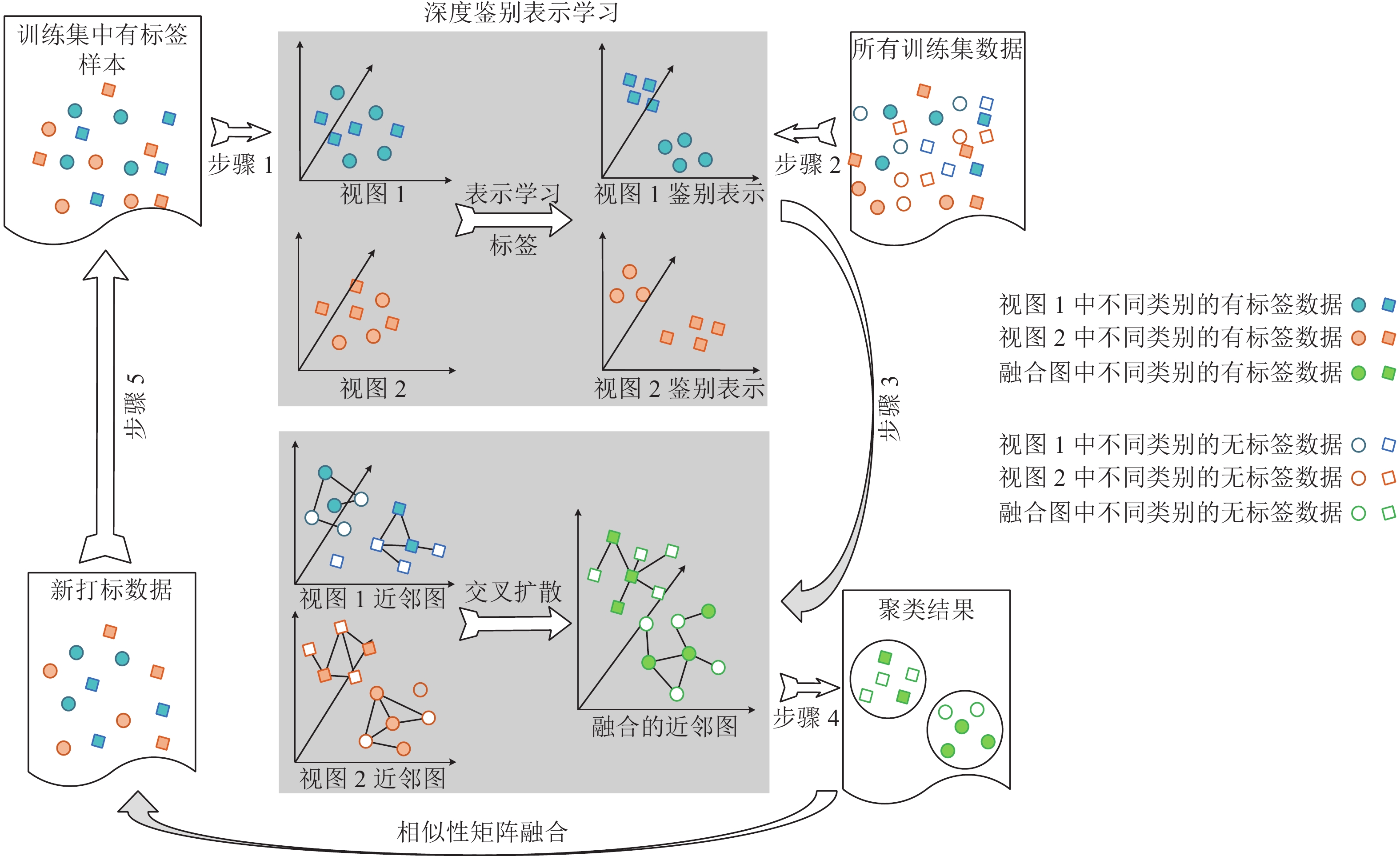
Abstract A semi-supervised multi-view similarity and discriminative representation joint learning method (SMLSDR) was proposed aiming at the problem that existing semi-supervised multi-view learning methods fail to fully mine complementary information among different views. In the labeled space, a deep view-specific representation learning network was constructed to fully explore and utilize complementary information across views. In the unlabeled space, a local structure-based cross fusion strategy of similarity matrices was adopted to fully excavate and use inter-view complementary information. Spectral clustering was employed to design a label propagation strategy in order to realize semi-supervised learning. Extensive experiments were conducted on five multi-view datasets in the field of machine learning to verify the effectiveness of SMLSDR. The experimental results demonstrated that the proposed SMLSDR outperformed baseline methods. Further ablation experiments prove that both deep discriminative representation learning in labeled space and similarity matrix fusion in unlabeled space contribute positively to semi-supervised classification.
|
|
Received: 24 September 2025
Published: 20 July 2026
|
|
|
| Fund: 国家自然科学基金资助项目(62561057,62566020);浙江大学自主部署启动项目(6602-A12202). |
|
Corresponding Authors:
Wei WU
E-mail: hyr2018@whu.edu.cn;wuweiux@zju.edu.cn
|
半监督多视图相似性和鉴别表示联合学习
针对现有半监督多视图学习方法视图间互补信息挖掘不充分的问题,提出半监督多视图相似性和鉴别表示联合学习方法(SMLSDR). 在标签空间,通过构建各视图深度特定表示学习网络来充分挖掘和利用视图间的互补信息.在无标签空间,采用基于局部结构的相似矩阵交叉融合策略来充分挖掘和利用视图间的互补信息. 利用谱聚类设计标签传播策略,实现半监督学习. 在机器学习领域5个多视图数据上进行大量的实验,验证SMLSDR的有效性. 实验结果表明,所提方法SMLSDR的性能优于基线方法.进一步的消融实验证明,标签空间的深度鉴别表示学习和无标签空间的相似矩阵融合都对半监督分类有一定的贡献.
关键词:
多视图表示学习,
半监督学习,
鉴别信息,
结构信息,
谱聚类
|
|
| [1] |
GUO T, WANG D, JIANG Z, et al. An enhanced deep convolutional neural network for person re-identification [C]//Proceedings of the IEEE International Conference on Multimedia and Expo Workshops. San Diego: IEEE, 2018: 1–6.
|
|
|
| [2] |
CAI J, DAN W, ZHANG X ℓ0-based sparse canonical correlation analysis with application to cross-language document retrieval[J]. Neurocomputing, 2019, 329: 32- 45
doi: 10.1016/j.neucom.2018.09.089
|
|
|
| [3] |
YU B X B, LIU Y, ZHANG X, et al MMNet: a model-based multimodal network for human action recognition in RGB-D videos[J]. IEEE Transactions on Pattern Analysis and Machine Intelligence, 2023, 45 (3): 3522- 3538
doi: 10.1109/TPAMI.2022.3177813
|
|
|
| [4] |
LI Y, FAUTEUX F, ZOU J, et al Personalized prediction of genes with tumor-causing somatic mutations based on multi-modal deep Boltzmann machine[J]. Neurocomputing, 2019, 324: 51- 62
doi: 10.1016/j.neucom.2018.02.096
|
|
|
| [5] |
DUTTA P, MISHRA P, SAHA S Incomplete multi-view gene clustering with data regeneration using Shape Boltzmann machine[J]. Computers in Biology and Medicine, 2020, 125: 103965
doi: 10.1016/j.compbiomed.2020.103965
|
|
|
| [6] |
WANG M, SHAO W, HAO X, et al Identify consistent cross-modality imaging genetic patterns via discriminant sparse canonical correlation analysis[J]. IEEE/ACM Transactions on Computational Biology and Bioinformatics, 2021, 18 (4): 1549- 1561
doi: 10.1109/TCBB.2019.2944825
|
|
|
| [7] |
TRIVEDI A, RAI P, DUVALL S L, et al. Exploiting tag and word correlations for improved webpage clustering [C]//Proceedings of the 2nd International Workshop on Search and Mining User-Generated Contents. Toronto: ACM, 2010: 3-12.
|
|
|
| [8] |
LIU Y, LI Y, YUAN Y H, et al. Supervised deep canonical correlation analysis for multiview feature learning [C]//Neural Information Processing. Cham: Springer, 2017: 575–582.
|
|
|
| [9] |
QIU J L, LIU W, LU B L. Multi-view emotion recognition using deep canonical correlation analysis [C]//Neural Information Processing. Cham: Springer, 2018: 221–231.
|
|
|
| [10] |
ZHOU R, SHEN Y D. End-to-end adversarial-attention network for multi-modal clustering [C]//Proceedings of the IEEE/CVF Conference on Computer Vision and Pattern Recognition. Seattle: IEEE, 2020: 14607–14616.
|
|
|
| [11] |
TROSTEN D J, LØKSE S, JENSSEN R, et al. Reconsidering representation alignment for multi-view clustering [C]//Proceedings of the IEEE/CVF Conference on Computer Vision and Pattern Recognition. Nashville: IEEE, 2021: 1255–1265.
|
|
|
| [12] |
LIANG B, ZHENG L Specificity and latent correlation learning for action recognition using synthetic multi-view data from depth maps[J]. IEEE Transactions on Image Processing, 2017, 26 (12): 5560- 5574
doi: 10.1109/TIP.2017.2740122
|
|
|
| [13] |
LUO S, ZHANG C, ZHANG W, et al. Consistent and specific multi-view subspace clustering [C]// AAAI Conference on Artificial Intelligence. Palo Alto: AAAI, 2018: 3730-3737.
|
|
|
| [14] |
HU J, LU J, TAN Y P Sharable and individual multi-view metric learning[J]. IEEE Transactions on Pattern Analysis and Machine Intelligence, 2018, 40 (9): 2281- 2288
doi: 10.1109/TPAMI.2017.2749576
|
|
|
| [15] |
ZHOU T, ZHANG C, GONG C, et al Multiview latent space learning with feature redundancy minimization[J]. IEEE Transactions on Cybernetics, 2020, 50 (4): 1655- 1668
doi: 10.1109/TCYB.2018.2883673
|
|
|
| [16] |
LI Y, ZHU X, LI J, et al A curriculum-based pseudo-labeling method with attention-based fusion for semi-supervised multi-view learning[J]. Information Fusion, 2024, 103: 102128
|
|
|
| [17] |
HU P, PENG J, LI X, et al Rethinking consistency regularization for semi-supervised learning[J]. IEEE Transactions on Neural Networks and Learning Systems, 2025, 36 (1): 1182- 1196
|
|
|
| [18] |
KARASUYAMA M, MAMITSUKA H Multiple graph label propagation by sparse integration[J]. IEEE Transactions on Neural Networks and Learning Systems, 2013, 24 (12): 1999- 2012
doi: 10.1109/TNNLS.2013.2271327
|
|
|
| [19] |
BO X, KANG Z, ZHAO Z, et al. Latent multi-view semi-supervised classification [C]//Asian Conference on Machine Learning. Berlin: Springer, 2019: 348–362.
|
|
|
| [20] |
LIANG N, YANG Z, LI Z, et al Semi-supervised multi-view learning by using label propagation based non-negative matrix factorization[J]. Knowledge-Based Systems, 2021, 228: 107244
doi: 10.1016/j.knosys.2021.107244
|
|
|
| [21] |
BAHRAMI S, DORNAIKA F, BOSAGHZADEH A Joint auto-weighted graph fusion and scalable semi-supervised learning[J]. Information Fusion, 2021, 66: 213- 228
doi: 10.1016/j.inffus.2020.09.007
|
|
|
| [22] |
NIE F, CAI G, LI J, et al Auto-weighted multi-view learning for image clustering and semi-supervised classification[J]. IEEE Transactions on Image Processing, 2018, 27 (3): 1501- 1511
doi: 10.1109/TIP.2017.2754939
|
|
|
| [23] |
KANG Z, LU X, YI J, et al. Self-weighted multiple kernel learning for graph-based clustering and semi-supervised classification [C]//Proceedings of the 27th International Joint Conference on Artificial Intelligence. Palo Alto: AAAI, 2018: 2312-2318.
|
|
|
| [24] |
XUE Z, DU J, DU D, et al Deep constrained low-rank subspace learning for multi-view semi-supervised classification[J]. IEEE Signal Processing Letters, 2019, 26 (8): 1177- 1181
doi: 10.1109/LSP.2019.2923857
|
|
|
| [25] |
XIE Y, ZHANG W, QU Y, et al Hyper-Laplacian regularized multilinear multiview self-representations for clustering and semisupervised learning[J]. IEEE Transactions on Cybernetics, 2020, 50 (2): 572- 586
doi: 10.1109/TCYB.2018.2869789
|
|
|
| [26] |
NIE F, TIAN L, WANG R, et al Multiview semi-supervised learning model for image classification[J]. IEEE Transactions on Knowledge and Data Engineering, 2020, 32 (12): 2389- 2400
doi: 10.1109/TKDE.2019.2920985
|
|
|
| [27] |
ZHAO C, LI Y, ZHANG X, et al Generative-contrastive collaborative learning for semi-supervised multi-view classification[J]. IEEE Transactions on Multimedia, 2024, 26: 6800- 6813
|
|
|
| [28] |
HUANG A, CHEN W, ZHAO T, et al Joint learning of latent similarity and local embedding for multi-view clustering[J]. IEEE Transactions on Image Processing, 2021, 30: 6772- 6784
doi: 10.1109/TIP.2021.3096086
|
|
|
| [29] |
WANG B, JIANG J, WANG W, et al. Unsupervised metric fusion by cross diffusion [C]//Proceedings of the IEEE Conference on Computer Vision and Pattern Recognition. New York: IEEE, 2012: 2997–3004.
|
|
|
| [30] |
WU F, JING X, WEI P, et al Semi-supervised multi-view graph convolutional networks with application to webpage classification[J]. Information Sciences, 2022, 591: 142- 154
doi: 10.1016/j.ins.2022.01.013
|
|
|
| [31] |
CHUA T S, TANG J, HONG R, et al. NUS-WIDE: a real-world web image database from National University of Singapore [C]//Proceedings of the ACM International Conference on Image and Video Retrieval. New York: ACM, 2009: 1-9.
|
|
|
| [32] |
LIU Y, WANG L, BAI Y, et al. Generative view-correlation adaptation for semi-supervised multi-view learning [C]// European Conference on Computer Vision. Heidelberg: Springer, 2020: 318–334.
|
|
|
| [33] |
JIA X, JING X Y, ZHU X, et al Semi-supervised multi-view deep discriminant representation learning[J]. IEEE Transactions on Pattern Analysis and Machine Intelligence, 2021, 43 (7): 2496- 2509
doi: 10.1109/TPAMI.2020.2973634
|
|
|
| [34] |
WANG X, FU L, ZHANG Y, et al MMatch: semi-supervised discriminative representation learning for multi-view classification[J]. IEEE Transactions on Circuits and Systems for Video Technology, 2022, 32 (9): 6425- 6436
doi: 10.1109/TCSVT.2022.3159371
|
|
|
| [35] |
JIA X, JING X, ZHU X, et al Co-embedding: a semi-supervised multi-view representation learning approach[J]. Neural Computing and Applications, 2022, 34 (6): 4437- 4457
doi: 10.1007/s00521-021-06599-y
|
|
|
| [36] |
GUO W, WANG Z, DU W Robust semi-supervised multi-view graph learning with sharable and individual structure[J]. Pattern Recognition, 2023, 140: 109565
doi: 10.1016/j.patcog.2023.109565
|
|
|
|
Viewed |
|
|
|
Full text
|
|
|
|
|
Abstract
|
|
|
|
|
Cited |
|
|
|
|
| |
Shared |
|
|
|
|
| |
Discussed |
|
|
|
|