|
|
|
| Large language model framework for event extraction based on staged semantic perception |
Yansong LI1( ),Ning CHEN2,Fengguang LIU2,Pan CHEN2,Xiaofeng HUANG1,Huili GE2,*() ),Ning CHEN2,Fengguang LIU2,Pan CHEN2,Xiaofeng HUANG1,Huili GE2,*() |
1. School of Communication Engineering, Hangzhou Dianzi University, Hangzhou 310018, China
2. Department of Science and Technology of Zhejiang Province, Hangzhou 310006, China |
|
|
|
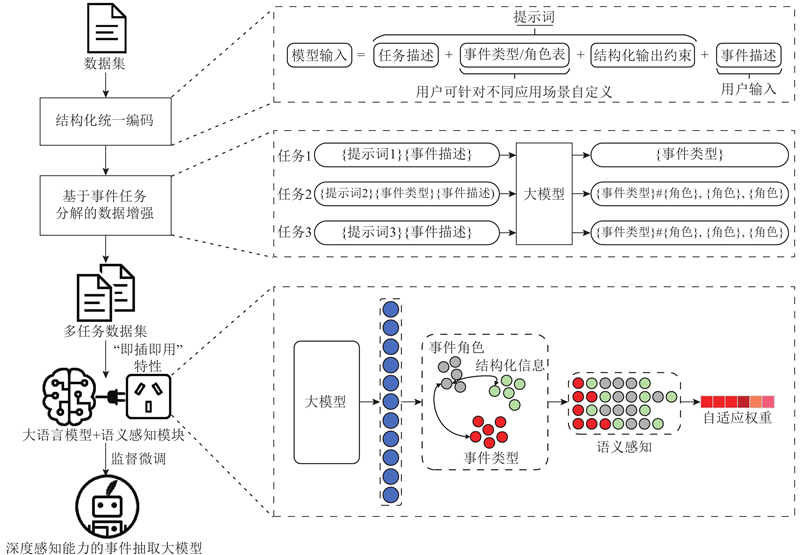
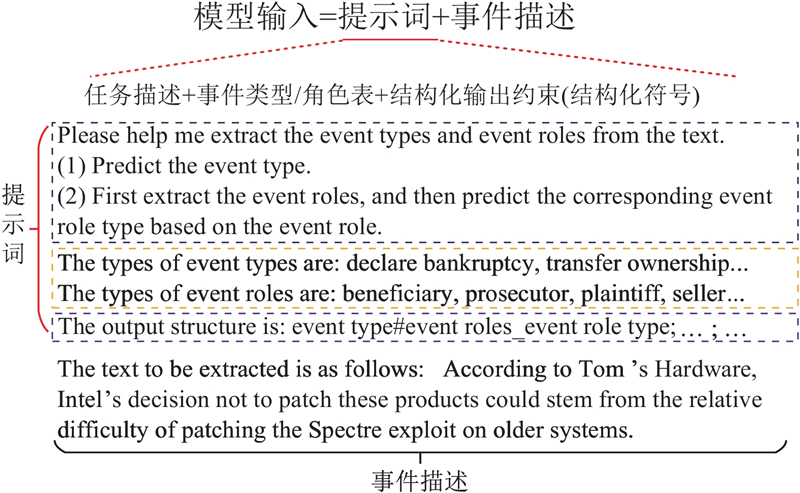
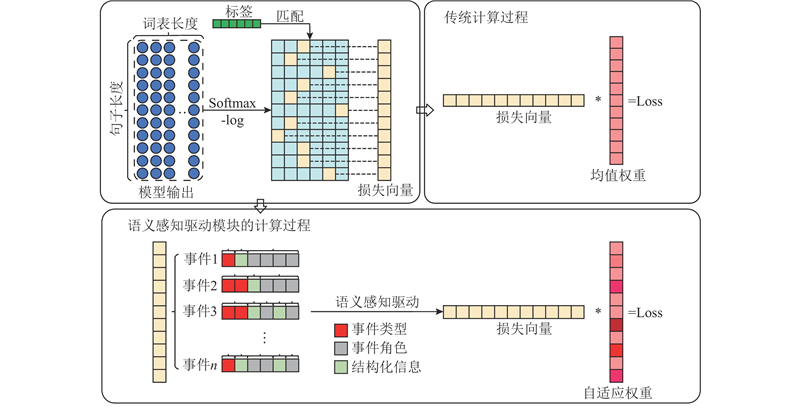
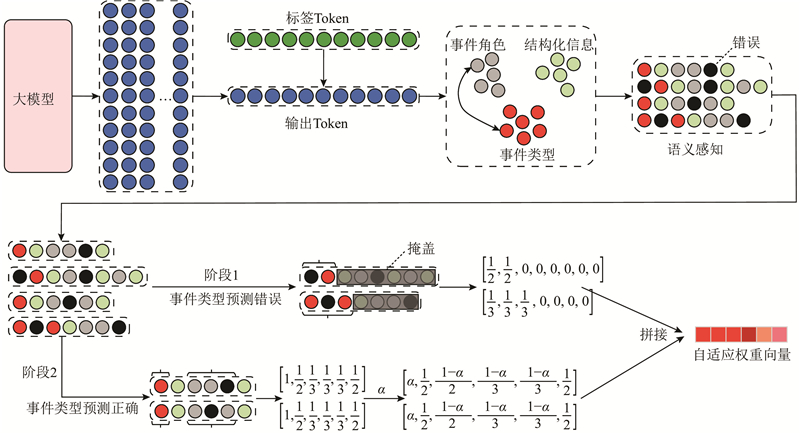
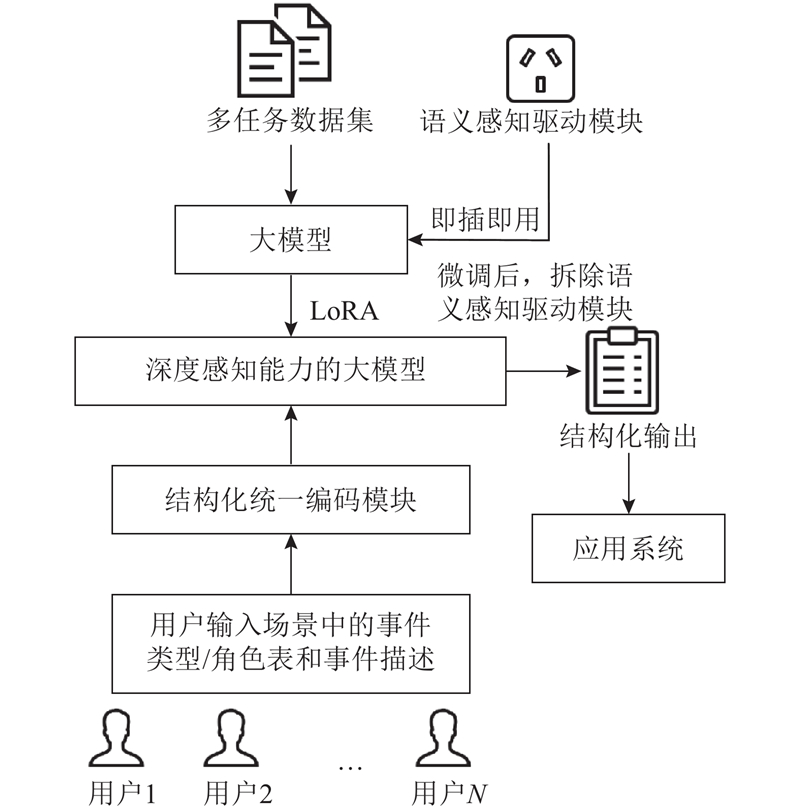
Abstract A large language model framework for event extraction based on staged semantic perception was proposed aiming at the difficulty in modeling the hierarchical semantics of events, which simulated the human cognitive mechanism of ‘recognizing the whole first and then learning the details’. The structured unified coding ensured consistency of prompts across different domains. The plug-and-play semantic perception driver unit supported staged learning for event-type prediction and argument extraction. The model focused on fine-grained semantic information by leveraging an adaptive weight mechanism. Data augmentation based on event decomposition was proposed to enrich the training data in order to enhance the generalization ability of the model. The experimental results on the CASIE and ACE2005 datasets demonstrated that our method significantly improved the performance of models in the event extraction.
|
|
Received: 11 March 2025
Published: 04 February 2026
|
|
|
| Fund: 国家重点研发计划资助项目(2024YFB3312600);浙江省“领雁”研发攻关计划资助项目(2024C01107). |
|
Corresponding Authors:
Huili GE
E-mail: yansongli@hdu.edu.cn;429362862@qq.com
|
基于分阶段语义感知的事件抽取大语言模型框架
针对大语言模型难以对事件中层级化语义建模的问题,提出基于分阶段语义感知的事件抽取大模型框架,整个框架模拟了人类“先识整体、再学细节”的认知机理. 结构化统一编码设计了不同领域的统一的提示词. 即插即用的语义感知驱动单元支持事件类型预测和论元提取的分阶段学习,通过自适应权重分配机制使大模型关注细颗粒度的语义信息. 为了提升模型的泛化能力,提出基于事件分解的数据增强来丰富训练数据. 在CASIE和ACE2005数据集上进行的实验结果表明,该方法在事件抽取中的性能取得显著提升.
关键词:
自然语言处理,
事件抽取,
大语言模型,
监督微调,
数据增强
|
|
| [13] |
NGUYEN T H, GRISHMAN R. Event detection and domain adaptation with convolutional neural networks [C]//Proceedings of the 53rd Annual Meeting of the Association for Computational Linguistics and the 7th International Joint Conference on Natural Language Processing. Beijing: ACL, 2015: 365–371.
|
|
|
| [14] |
YAO L, MAO C, LUO Y. Graph convolutional networks for text classification [C]//Proceedings of the AAAI Conference on Artificial Intelligence. Honolulu: AAAI, 2019: 7370-7377.
|
|
|
| [15] |
ZHU M, ZENG K, JIBINGWU J, et al. LC4EE: LLMs as good corrector for event extraction [C]//Proceedings of the Findings of the Association for Computational Linguistics. St. Julian's, Malta: ACL, 2024: 12028–12038.
|
|
|
| [16] |
TSUJIMURA T, YAMADA K, IDA R, et al Contextualized medication event extraction with striding NER and multi-turn QA[J]. Journal of Biomedical Informatics, 2023, 144: 104416
doi: 10.1016/j.jbi.2023.104416
|
|
|
| [17] |
LU Y, LIU Q, DAI D, et al. Unified structure generation for universal information extraction [C]//Proceedings of the 60th Annual Meeting of the Association for Computational Linguistics. Dublin: ACL, 2022: 5755–5772.
|
|
|
| [18] |
WANG X, ZHOU W, ZU C, et al. Instructuie: multi-task instruction tuning for unified information extraction [EB/OL]. (2023-04-17) [2024-12-20]. https://arxiv.org/abs/2304.08085.
|
|
|
| [19] |
GAO J, ZHAO H, YU C, et al. Exploring the feasibility of chatgpt for event extraction [EB/OL]. (2023-03-09) [2024-12-20]. https://arxiv.org/abs/2303.03836.
|
|
|
| [20] |
BONISOLI G, VILARES D, ROLLO F, et al Document-level event extraction from Italian crime news using minimal data[J]. Knowledge-Based Systems, 2025, 317: 113386
doi: 10.1016/j.knosys.2025.113386
|
|
|
| [21] |
LI Z, ZENG Y, ZUO Y, et al. KnowCoder: coding structured knowledge into LLMs for universal information extraction [C]//Proceedings of the 62nd Annual Meeting of the Association for Computational Linguistics. Vancouver: ACL, 2024: 8758–8779.
|
|
|
| [22] |
LOU J, LU Y, DAI D, et al. Universal information extraction as unified semantic matching [C]// Proceedings of the AAAI Conference on Artificial Intelligence. [S. l. ]: AAAI, 2023: 13318–13326.
|
|
|
| [23] |
HU E J, SHEN Y, WALLIS P, et al. Lora: low-rank adaptation of large language models [EB/OL]. [2025-02-25]. https://arxiv.org/abs/2106.09685.
|
|
|
| [24] |
LIU S, LI Y, ZHANG F, et al. Event detection without triggers [C]//Proceedings of the 2019 Conference of the North. Minneapolis: ACL, 2019: 735–744.
|
|
|
| [25] |
DEVLIN J, CHANG M W, LEE K, et al. Bert: pre-training of deep bidirectional transformers for language understanding [C]// Proceedings of the 2019 Conference of the North American Chapter of the Association for Computational Linguistics. Minneapolis: ACL, 2019: 4171–4186.
|
|
|
| [1] |
AHN D. The stages of event extraction [C]//Proceedings of the Workshop on Annotating and Reasoning about Time and Events. Sydney: ACL, 2006: 1–8.
|
|
|
| [2] |
DODDINGTON G R, MITCHELL A, PRZYBOCKI M A, et al. The automatic content extraction (ACE) program: tasks, data, and evaluation [C]//Proceedings of the International Conference on Language Resources and Evaluation. Lisbon: ELRA, 2004: 837–840.
|
|
|
| [3] |
ZHANG W, ZHAO X, ZHAO L, et al. DRL4IR: 2nd workshop on deep reinforcement learning for information retrieval [C]//Proceedings of the 44th International ACM SIGIR Conference on Research and Development in Information Retrieval. [S. l. ]: ACM, 2021: 2681–2684.
|
|
|
| [4] |
BOSSELUT A, LE BRAS R, CHOI Y. Dynamic neuro-symbolic knowledge graph construction for zero-shot commonsense question answering [C]// Proceedings of the AAAI Conference on Artificial Intelligence. [S. l. ]: AAAI, 2021: 4923–4931.
|
|
|
| [5] |
CAO Q, TRIVEDI H, BALASUBRAMANIAN A, et al. DeFormer: decomposing pre-trained Transformers for faster question answering [C]//Proceedings of the 58th Annual Meeting of the Association for Computational Linguistics. Seattle: ACL, 2020: 4487–4497.
|
|
|
| [6] |
蒋倩, 唐昊冶, 涂勇辉, 等 大型仪器设备分层化与特征化运行管理探索[J]. 实验技术与管理, 2024, 41 (10): 266- 270
JIANG Qian, TANG Haoye, TU Yonghui, et al Exploration of hierarchical and characteristic operation modes for large instruments and equipment[J]. Experimental Technology and Management, 2024, 41 (10): 266- 270
|
|
|
| [7] |
张可, 万红, 张肖笑, 等 省属高校分析测试中心大型仪器设备开放运行管理探讨[J]. 实验与分析, 2024, (4): 87- 90
ZHANG Ke, WAN Hong, ZHANG Xiaoxiao, et al Discussion on the open operation management of large instruments in the analysis and testing center of provincial universities[J]. Labor Praxis, 2024, (4): 87- 90
doi: 10.20175/j.syyfx.20240414
|
|
|
| [8] |
CHEN Y, XU L, LIU K, et al. Event extraction via dynamic multi-pooling convolutional neural networks [C]//Proceedings of the 53rd Annual Meeting of the Association for Computational Linguistics and the 7th International Joint Conference on Natural Language Processing. Beijing: ACL, 2015: 167–176.
|
|
|
| [9] |
SUBBURATHINAM A, LU D, JI H, et al. Cross-lingual structure transfer for relation and event extraction [C]//Proceedings of the 2019 Conference on Empirical Methods in Natural Language Processing and the 9th International Joint Conference on Natural Language Processing. Hong Kong: ACL, 2019: 313–325.
|
|
|
| [10] |
ZHANG J, QIN Y, ZHANG Y, et al. Extracting entities and events as a single task using a transition-based neural model [C]// 28th International Joint Conference on Artificial Intelligence. Macau: MKP, 2019: 5422–5428.
|
|
|
| [11] |
LI Q, LI J, SHENG J, et al A survey on deep learning event extraction: Approaches and applications[J]. IEEE Transactions on Neural Networks and Learning Systems, 2022, 35 (5): 6301- 6321
|
|
|
| [12] |
项威, 王邦 中文事件抽取研究综述[J]. 计算机技术与发展, 2020, 30 (2): 1- 6
XIANG Wei, WANG Bang Survey of chinese event extraction research[J]. Computer Technology and Development, 2020, 30 (2): 1- 6
doi: 10.3778/j.issn.1002-8331.2203-0453
|
|
|
| [26] |
DU X, CARDIE C. Event extraction by answering (almost) natural questions [C]// Proceedings of the 2020 Conference on Empirical Methods in Natural Language Processing. Punta Cana: ACL, 2020: 671–683.
|
|
|
| [27] |
SHIRI F, MOGHIMIFAR F, HAFFARI R, et al. Decompose, enrich, and extract! schema-aware event extraction using LLMs [C]//27th International Conference on Information Fusion. Florence: IEEE, 2024: 1–8.
|
|
|
| [28] |
WANG S, HUANG L. Targeted augmentation for low-resource event extraction [C]// Findings of the Association for Computational Linguistics: NAACL 2024. Mexico City: ACL, 2024: 4414–4428.
|
|
|
|
Viewed |
|
|
|
Full text
|
|
|
|
|
Abstract
|
|
|
|
|
Cited |
|
|
|
|
| |
Shared |
|
|
|
|
| |
Discussed |
|
|
|
|