Please wait a minute...
浙江大学学报(工学版)  2026, Vol. 60 Issue (10): 2299-2309    DOI: 10.3785/j.issn.1008-973X.2026.10.021
机械工程、能源工程     
基于信道分解与特征融合的重参数航空发动机寿命预测
李兴羽1(),王海瑞1,*(),朱贵富2,3
1. 昆明理工大学 信息工程与自动化学院,云南 昆明 650500
2. 昆明理工大学 信息建设管理中心,云南 昆明 650500
3. 昆明理工大学曙光信息产业股份有限公司AI联合研究中心,云南 昆明 650500
Reparameterized aero-engine remaining useful life prediction based on channel decomposition and feature fusion
Xingyu LI1(),Hairui WANG1,*(),Guifu ZHU2,3
1. Faculty of Information Engineering and Automation , Kunming University of Science and Technology, Kunming 650500
2. Information Technology Construction Management Center, Kunming University of Science and Technology, Kunming 650500
3. Kunming University of Science and Technology - Dawn Information Industry Co. Ltd. AI Joint Research Center, Kunming University of Science and Technology, Kunming 650500
 全文: PDF(8813 KB)   HTML
摘要:

为了应对航空发动机剩余使用寿命预测中的挑战,提出基于信道分解与特征融合的重参数航空发动机寿命预测方法. 通过构建基于小波变换的信道分解与重塑模块,学习时间和信道之间的依赖关系并减少冗余. 将原始信息与提取的特征信息混合,增强原始信息的保留,避免在深度网络学习过程中丢失关键信息. 引入频率增强通道注意力机制进一步减少信道冗余信息. 利用神经网络进行特征的均值和方差拟合,通过重参数化映射至高斯分布进行采样预测,并采用鲸鱼优化算法对模型关键超参数进行全局搜索优化. 使用NASA的C-MAPSS数据集进行验证,结果显示RMSE范围为[11.58,13.72],Score范围为[224.78,1025.29],4个数据子集的RMSE和Score平均降低了22.67%和45.56%. 所构建的三维潜在空间,为发动机退化过程的可视化提供了支持.

关键词: 信道分解特征融合寿命预测频率增强通道注意力重参数高斯分布鲸鱼优化算法    
Abstract:

A reparameterization-based RUL prediction method that integrated channel decomposition and feature fusion was proposed to address the challenges in remaining useful life (RUL) prediction for aero-engines. Specifically, a channel decomposition and reconstruction module based on wavelet transform was designed to capture dependencies between time and channels while reducing redundancy. By fusing the raw input with the extracted feature information, the model enhanced the preservation of original information and mitigated the loss of critical information during deep network training. Furthermore, a frequency-enhanced channel attention mechanism was introduced to further suppress channel redundancy. A neural network was then employed to estimate the mean and variance of the features, and reparameterization was applied to map them into a Gaussian distribution for sampling-based prediction. In addition, the Whale optimization algorithm (WOA) was used to perform global optimization of key hyperparameters. Experimental validation on the C-MAPSS dataset from NASA demonstrated that the proposed method achieved an RMSE range of [11.58,13.72] and a Score range of [224.78,1025.29], with average decreases of 22.67% and 45.56%, respectively. Moreover, the constructed three-dimensional latent space supported the visualization of engine degradation processes.

Key words: channel decomposition    feature fusion    remaining useful life prediction    frequency-enhanced channel attention    reparameterization    Gaussian distribution    Whale optimization algorithm
收稿日期: 2025-05-07 出版日期: 2026-07-29
CLC:  V 263.6  
基金资助: 国家自然科学基金资助项目(61863016).
通讯作者: 王海瑞     E-mail: 515927790@qq.com;hrwang88@163.com
作者简介: 李兴羽(1999—),男,硕士生,从事寿命预测研究. orcid.org/0009-0007-9416-4434. E-mail:515927790@qq.com
服务  
把本文推荐给朋友
加入引用管理器
E-mail Alert
作者相关文章  
李兴羽
王海瑞
朱贵富

引用本文:

李兴羽,王海瑞,朱贵富. 基于信道分解与特征融合的重参数航空发动机寿命预测[J]. 浙江大学学报(工学版), 2026, 60(10): 2299-2309.

Xingyu LI,Hairui WANG,Guifu ZHU. Reparameterized aero-engine remaining useful life prediction based on channel decomposition and feature fusion. Journal of ZheJiang University (Engineering Science), 2026, 60(10): 2299-2309.

链接本文:

https://www.zjujournals.com/eng/CN/10.3785/j.issn.1008-973X.2026.10.021        https://www.zjujournals.com/eng/CN/Y2026/V60/I10/2299

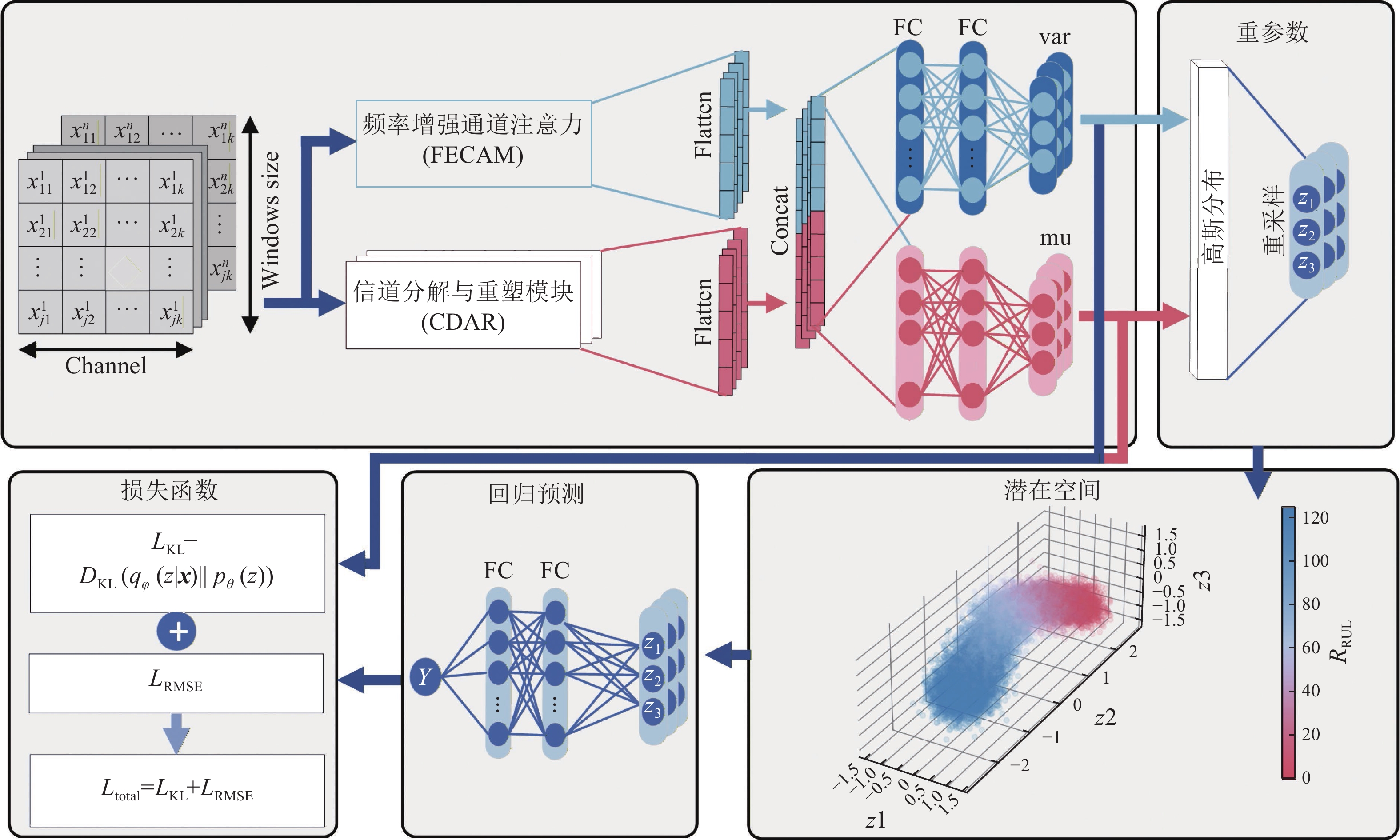
图 1  RUL预测模型流程图
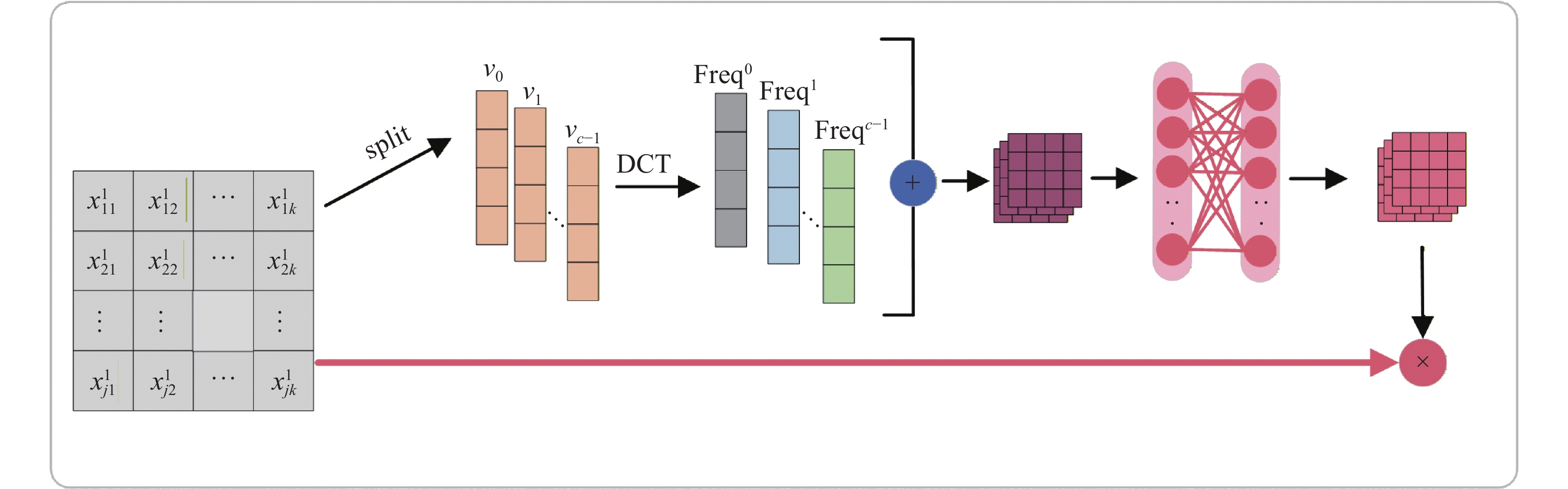
图 2  信道分解与重塑模块结构图
图 3  FECAM结构图
名称DtrainDtestOFTtrainTtest
FD001100100112063113096
FD002260259615375933991
FD003100100122471916595
FD004249248626124941214
表 1  C-MAPSS数据集信息
参数数值
时间窗长度30
批大小128
学习率0.005
可变学习策略Epochs/times: 10/0.1
早停机制/耐心值True/20
L2正则化0.01
特征融合短连接 (FD001,FD002)
长连接 (FD003,FD004)
Dropout0.5
表 2  RUL预测模型参数设置
方法C-MAPSS
FD001FD002FD003FD004
ERMSEKScoreERMSEKScoreERMSEKScoreERMSEKScore
BiGRU-TSAM[12]12.56213.3518.942264.1312.45232.8620.473610.34
AdaBN-DCNN[13]13.17279.0020.862020.0014.97817.0024.573690.00
TaFCN[14]13.99336.0019.592650.0019.161727.0022.152910.00
KGHM[15]13.18250.9913.251131.0313.54333.4419.963356.10
RVE[16]13.42323.8214.921379.1711.67241.8916.371845.99
TATFA-Transformer[17]12.21261.5015.071369.7011.23210.2118.812506.35
上述方法平均值13.08277.4417.1051802.3313.95593.7320.392986.46
所提方法11.58224.7811.99815.1712.05315.7813.721025.29
平均降低/%11.4718.9829.9054.7713.6246.8132.7165.67
表 3  RUL预测性能比较
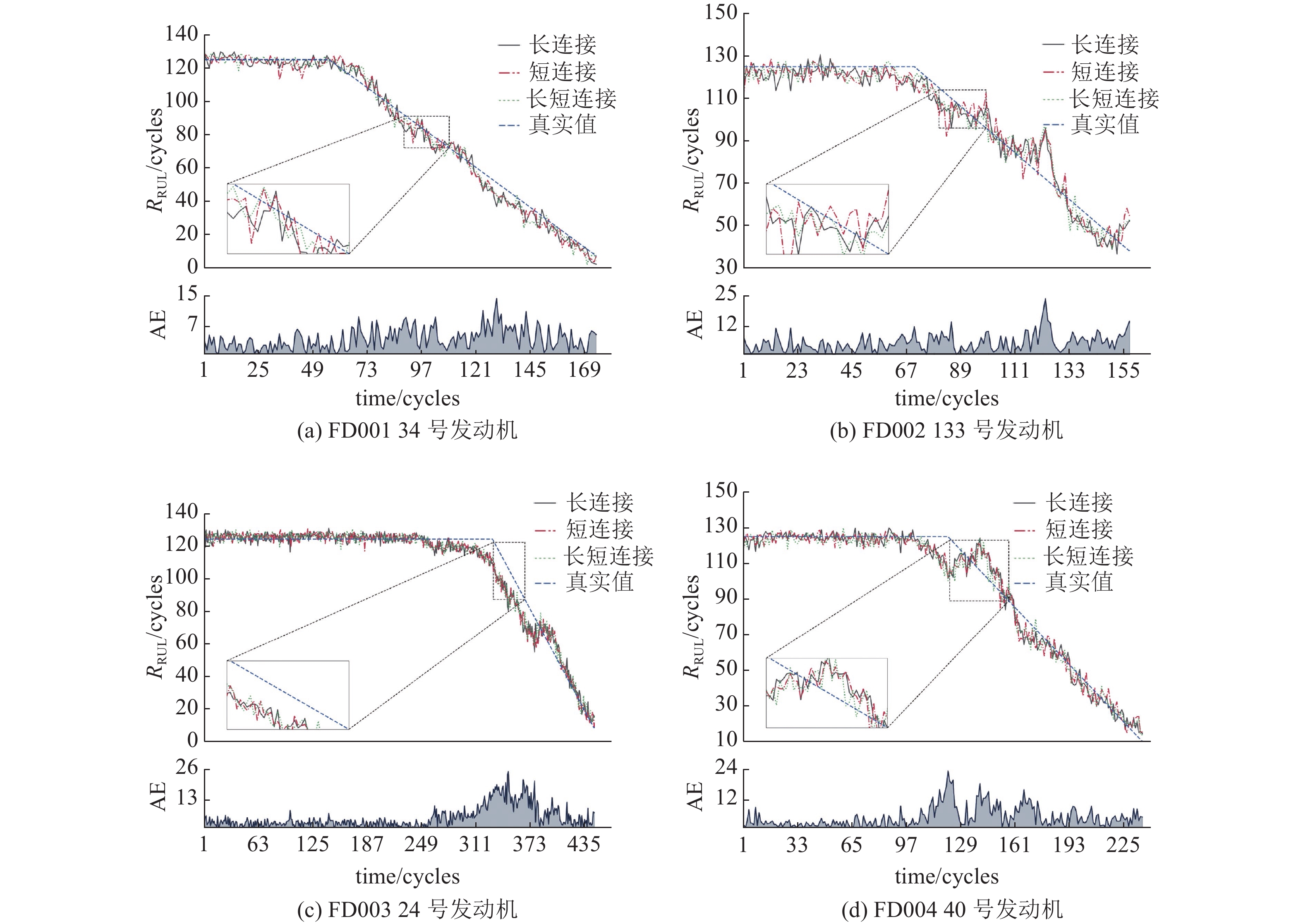
图 4  发动机剩余使用寿命真实值与预测值可视化
方法C-MAPSS
FD001FD002FD003FD004
ERMSEKScoreERMSEKScoreERMSEKScoreERMSEKScore
长连接12.30264.5212.64854.9912.05315.7813.721025.29
短连接11.58224.7811.99815.1712.33311.4114.251185.21
长短链接11.68243.9912.40773.2312.76352.9413.811610.93
表 4  长短连接实验
图 5  测试集中抽取的单台发动机寿命预测可视化及误差
图 6  三维潜在空间表示
图 7  不确定性量化图
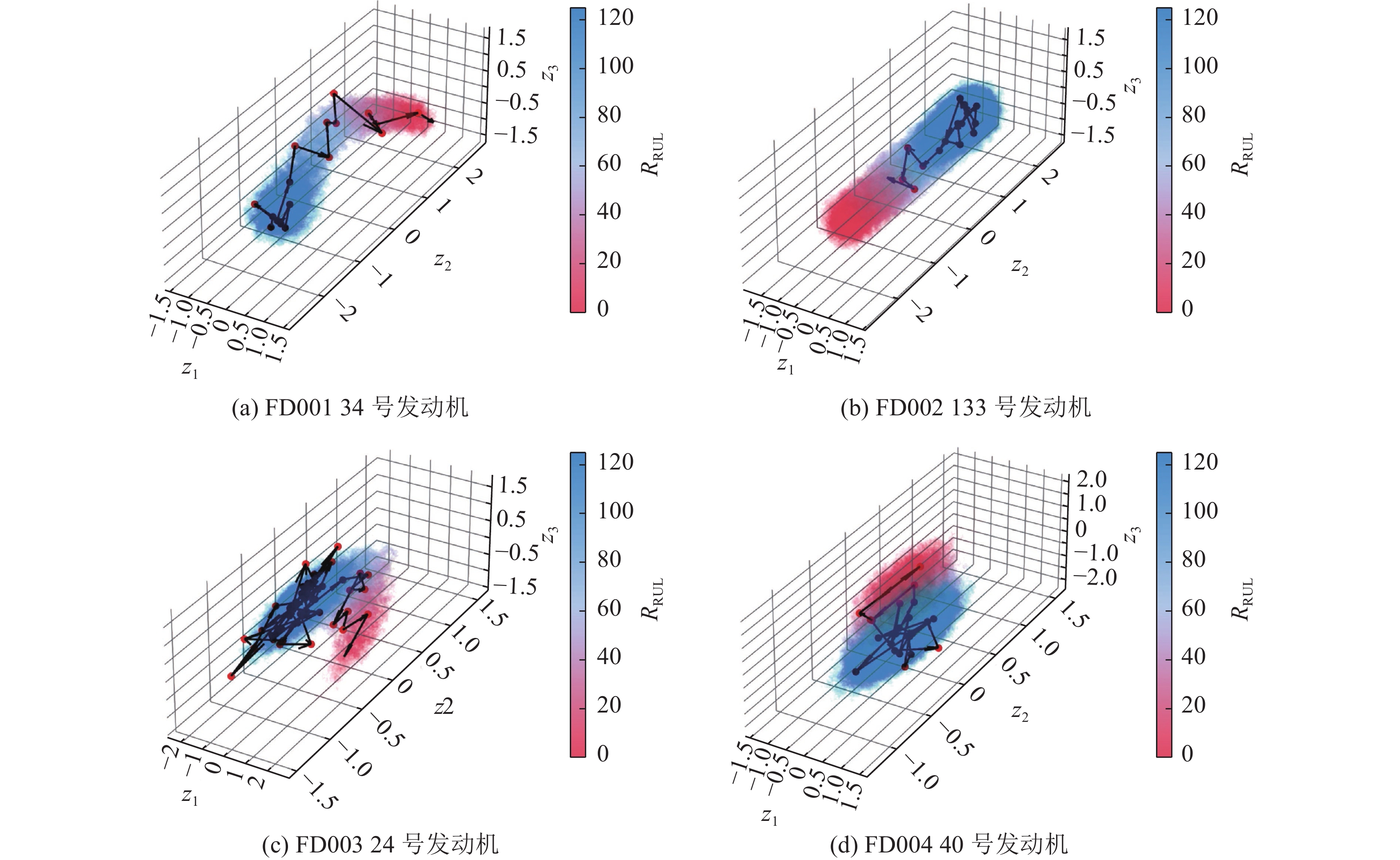
图 8  发动机RUL在三维潜在空间中的退化路径
实验方法FD001FD002FD003FD004
ERMSEKScoreERMSEKScoreERMSEKScoreERMSEKScore
1CRU-SRU11.81258.6712.02911.7413.14377.9115.171383.56
2仅SRU12.56379.4712.37999.9713.23387.5014.341173.80
3仅CRU12.65305.6212.12939.1315.01381.4113.27943.44
4去除DCT18.34761.3018.052766.9622.302356.7318.012293.95
5去除CDAR18.941055.8416.953232.6612.62409.5820.033001.96
6去除FECAM12.73352.0611.58586.0912.64427.7619.802590.85
7去除CDAR、FECAM17.811001.5317.482364.6021.311770.8819.432714.51
8标准高斯分布11.64244.7412.061255.0914.82586.4713.931107.47
9本研究方法11.58224.7811.99815.1712.05315.7813.721025.29
表 5  本研究方法的各模块消融实验
1 BOUKRA T, LEBAROUD A. Identifying new prognostic features for remaining useful life prediction [C]// 16th International Power Electronics and Motion Control Conference and Exposition. Antalya: IEEE, 2014: 1216–1221.
2 ZHOU S, XIAO M, BARTOS P, et al Remaining useful life prediction and fault diagnosis of rolling bearings based on short-time Fourier transform and convolutional neural network[J]. Shock and Vibration, 2020, (1): 8857307
3 ZHANG J, JIANG Y, WU S, et al Prediction of remaining useful life based on bidirectional gated recurrent unit with temporal self-attention mechanism[J]. Reliability Engineering and System Safety, 2022, 221: 108297
doi: 10.1016/j.ress.2021.108297
4 LIAO Y, ZHANG L, LIU C. Uncertainty prediction of remaining useful life using long short-term memory network based on bootstrap method [C]// IEEE International Conference on Prognostics and Health Management. Seattle: IEEE, 2018: 1–8.
5 SATEESH BABU G, ZHAO P, LI X L. Deep convolutional neural network based regression approach for estimation of remaining useful life [M]// Database systems for advanced applications. Cham: Springer, 2016: 214–228.
6 LIU J, LEI F, PAN C, et al Prediction of remaining useful life of multi-stage aero-engine based on clustering and LSTM fusion[J]. Reliability Engineering and System Safety, 2021, 214: 107807
doi: 10.1016/j.ress.2021.107807
7 ZHANG Y, SU C, WU J, et al Trend-augmented and temporal-featured Transformer network with multi-sensor signals for remaining useful life prediction[J]. Reliability Engineering and System Safety, 2024, 241: 109662
doi: 10.1016/j.ress.2023.109662
8 GUO J, LI D, DU B A stacked ensemble method based on TCN and convolutional bi-directional GRU with multiple time windows for remaining useful life estimation[J]. Applied Soft Computing, 2024, 150: 111071
doi: 10.1016/j.asoc.2023.111071
9 CHEN X A novel transformer-based DL model enhanced by position-sensitive attention and gated hierarchical LSTM for aero-engine RUL prediction[J]. Scientific Reports, 2024, 14: 10061
doi: 10.1038/s41598-024-59095-3
10 OUYANG M, SHEN P Prediction of remaining useful life of lithium batteries based on WOA-VMD and LSTM[J]. Energies, 2022, 15 (23): 8918
doi: 10.3390/en15238918
11 LI J, WEN Y, HE L. SCConv: spatial and channel reconstruction convolution for feature redundancy [C]// IEEE/CVF Conference on Computer Vision and Pattern Recognition. Vancouver: IEEE, 2023: 6153–6162.
12 ZHANG J, JIANG Y, WU S, et al Prediction of remaining useful life based on bidirectional gated recurrent unit with temporal self-attention mechanism[J]. Reliability Engineering and System Safety, 2022, 221: 108297
doi: 10.1016/j.ress.2021.108297
13 LI J, LI X, HE D. Domain adaptation remaining useful life prediction method based on AdaBN-DCNN [C]// Prognostics and System Health Management Conference. Qingdao: IEEE, 2019: 1–6.
14 FAN L, CHAI Y, CHEN X Trend attention fully convolutional network for remaining useful life estimation[J]. Reliability Engineering and System Safety, 2022, 225: 108590
doi: 10.1016/j.ress.2022.108590
15 LI Y, CHEN Y, HU Z, et al Remaining useful life prediction of aero-engine enabled by fusing knowledge and deep learning models[J]. Reliability Engineering and System Safety, 2023, 229: 108869
doi: 10.1016/j.ress.2022.108869
16 COSTA N, SÁNCHEZ L Variational encoding approach for interpretable assessment of remaining useful life estimation[J]. Reliability Engineering and System Safety, 2022, 222: 108353
doi: 10.1016/j.ress.2022.108353
[1] 邬开俊,郑云琦,魏鼎,袁海翔. 基于YOLOv8s的轻量化航拍图像小目标检测算法[J]. 浙江大学学报(工学版), 2026, 60(9): 1912-1923.
[2] 汤毅杰,钟铭恩,袁彬淦,范康,谭佳威,林志强. 联合正交特征融合与大核可分离注意力的道路分割算法[J]. 浙江大学学报(工学版), 2026, 60(9): 1942-1952.
[3] 常天根,田国富,唐媛媛,曹明学. 考虑主客观因素的自动驾驶模型预测控制参数优化[J]. 浙江大学学报(工学版), 2026, 60(8): 1638-1649.
[4] 陈广秋,任天蓉,段锦,黄丹丹. 结合边缘辅助与多级特征融合的跨模态语义分割算法[J]. 浙江大学学报(工学版), 2026, 60(8): 1782-1791.
[5] 王铮,张梦君,姜楠,王万良,屠杭垚. 基于多特征融合和牛顿-拉夫逊优化算法的LSTM日径流预测[J]. 浙江大学学报(工学版), 2026, 60(7): 1567-1576.
[6] 张乃洲,赵云超,曹薇,张啸剑. 基于多视图跨模态特征融合的图像描述生成[J]. 浙江大学学报(工学版), 2026, 60(6): 1205-1212.
[7] 董博,吕东澔,喻大华,杜晓炜. 融合多域特征的VAE模型在肌肉疲劳分析中的应用[J]. 浙江大学学报(工学版), 2026, 60(6): 1317-1328.
[8] 李国燕,于威,梅玉鹏,张明辉,王新强. 全局局部特征融合的遥感图像建筑物提取[J]. 浙江大学学报(工学版), 2026, 60(5): 1100-1108.
[9] 王孝龙,陶吉利,朱想先,梁建伟,陈岱岱,刘之涛. 基于卷积长短期记忆网络的锂电池寿命预测及动态建模[J]. 浙江大学学报(工学版), 2026, 60(5): 1027-1036.
[10] 于天河,王文龙,刘镛,杨壮壮,侯善冲. 改进的有雾图像中被遮挡车辆及行人识别算法[J]. 浙江大学学报(工学版), 2026, 60(4): 738-750.
[11] 马龙,候永琪,吴佰靖,高丽,邓建伟,闫光辉. 多尺度图卷积下的水漂垃圾轨迹预测模型[J]. 浙江大学学报(工学版), 2026, 60(4): 751-762.
[12] 李国燕,李鹏辉,刘榕,梅玉鹏,张明辉. 融合多尺度分辨率和带状特征的遥感道路提取[J]. 浙江大学学报(工学版), 2026, 60(3): 585-593.
[13] 包晓安,陈恩琳,张娜,涂小妹,吴彪,张庆琪. 基于多尺度编码器融合的三维人体姿态估计算法[J]. 浙江大学学报(工学版), 2026, 60(3): 565-573.
[14] 张建刚,李肖,冯丹丹. 基于动态核感知的无人机视角路面病害检测方法[J]. 浙江大学学报(工学版), 2026, 60(10): 2141-2152.
[15] 牛宏侠,冯鼎超,侯涛. 基于改进RT-DETR的复杂天气下铁路异物实时检测算法[J]. 浙江大学学报(工学版), 2026, 60(10): 2165-2175.