| Theory and Method of Mechanical Design |
|

|
|
|
| Research on twin modeling for vibration prediction of transmission system of helicopter's main gearbox |
Long CHEN1( ),Jiezhou LIU2,Zhao XIAO1(),Lifeng CHEN1,Han DING3,Jinyuan TANG3,Yi TIAN3 ),Jiezhou LIU2,Zhao XIAO1(),Lifeng CHEN1,Han DING3,Jinyuan TANG3,Yi TIAN3 |
1.School of Mechanical Engineering, Hunan University of Science and Technology, Xiangtan 411201, China
2.Hunan Aviation Powerplant Research Institute, Aero Engine Corporation of China, Zhuzhou 4120021, China
3.State Key Laboratory of High Performance Complex Manufacturing, Central South University, Changsha 410083, China |
|
|
|
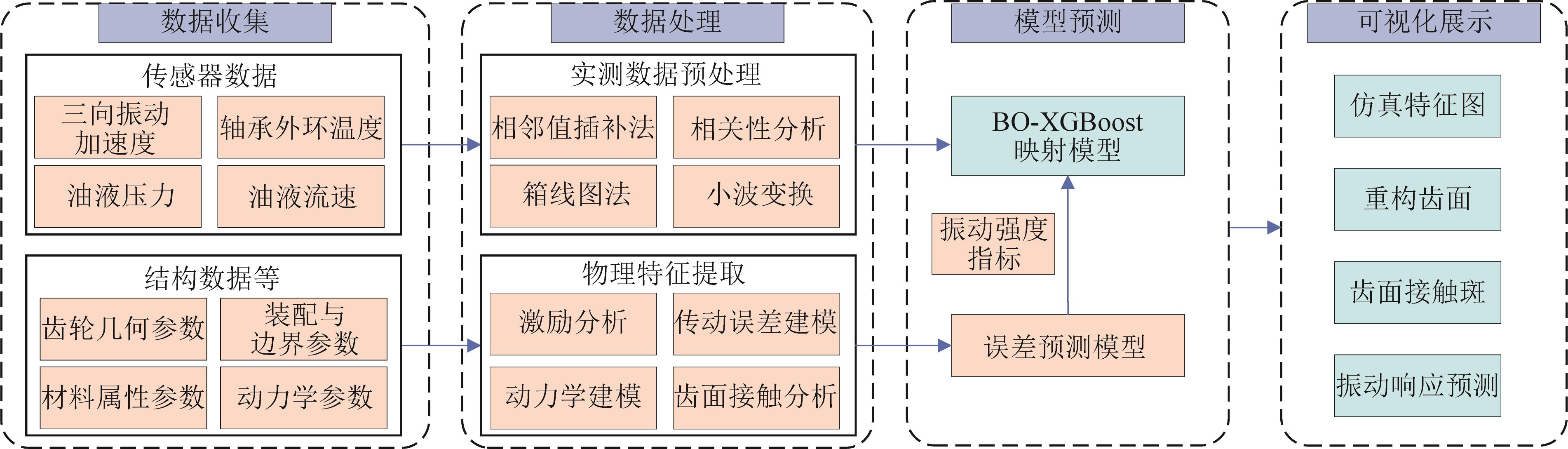
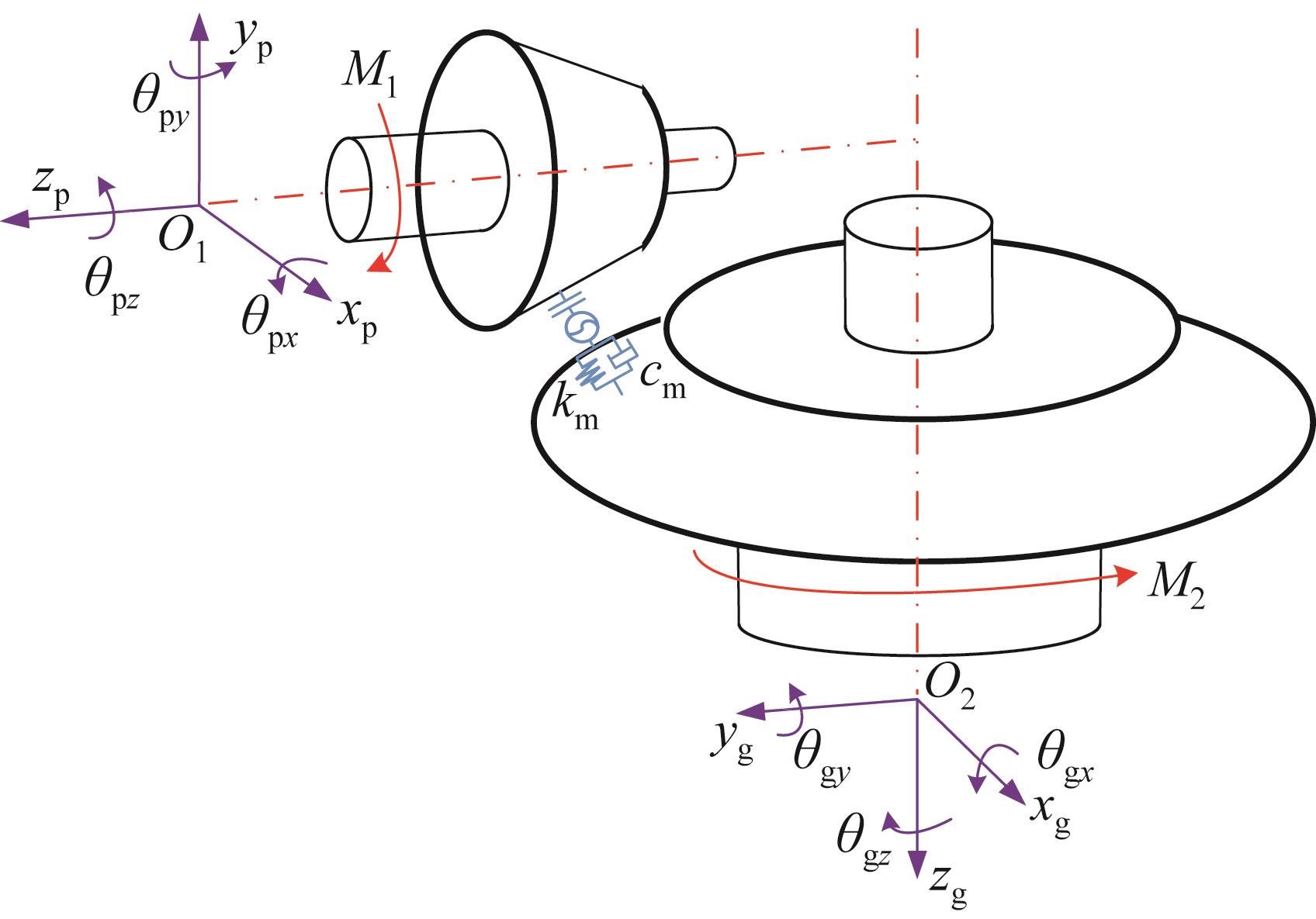
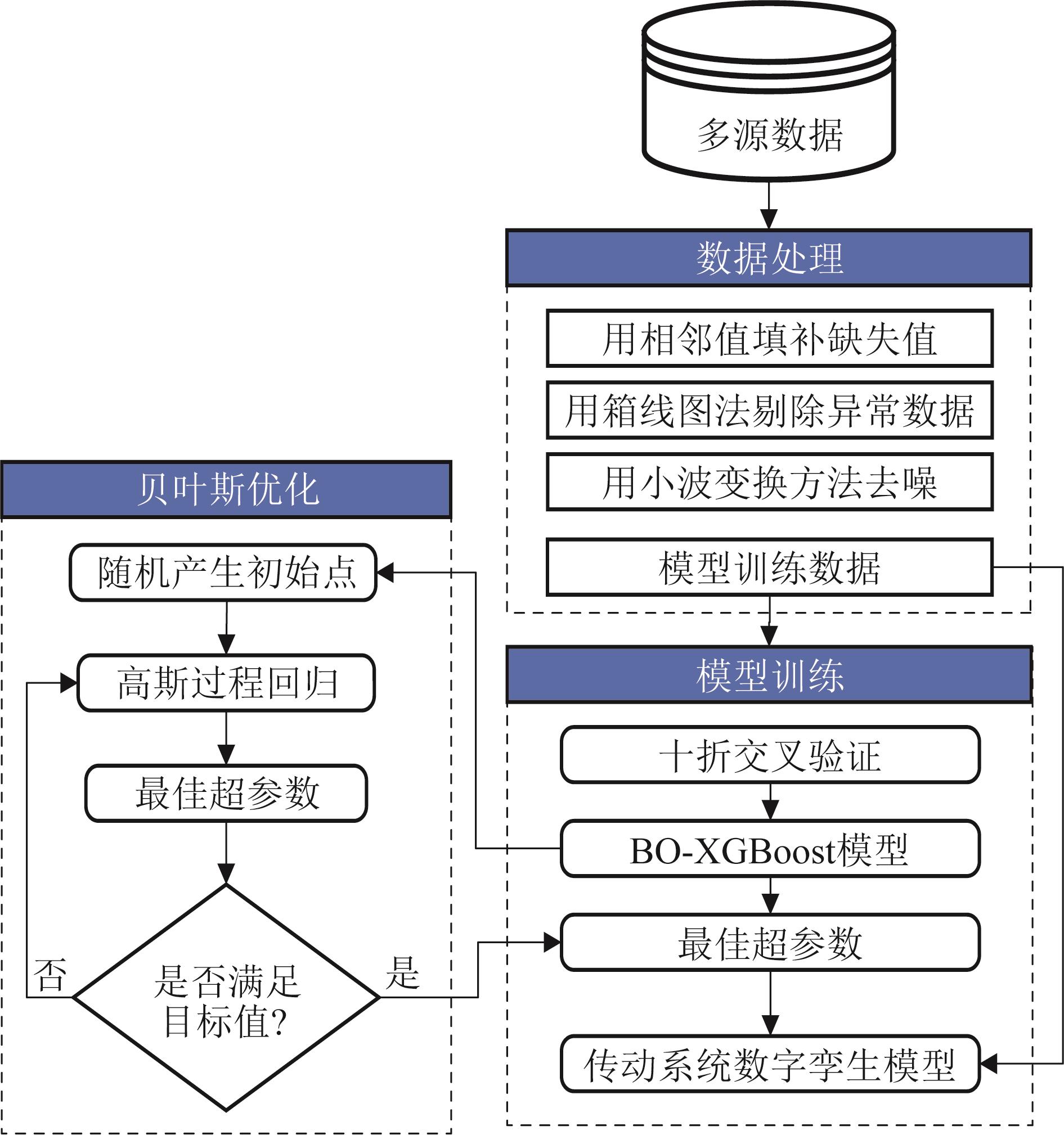
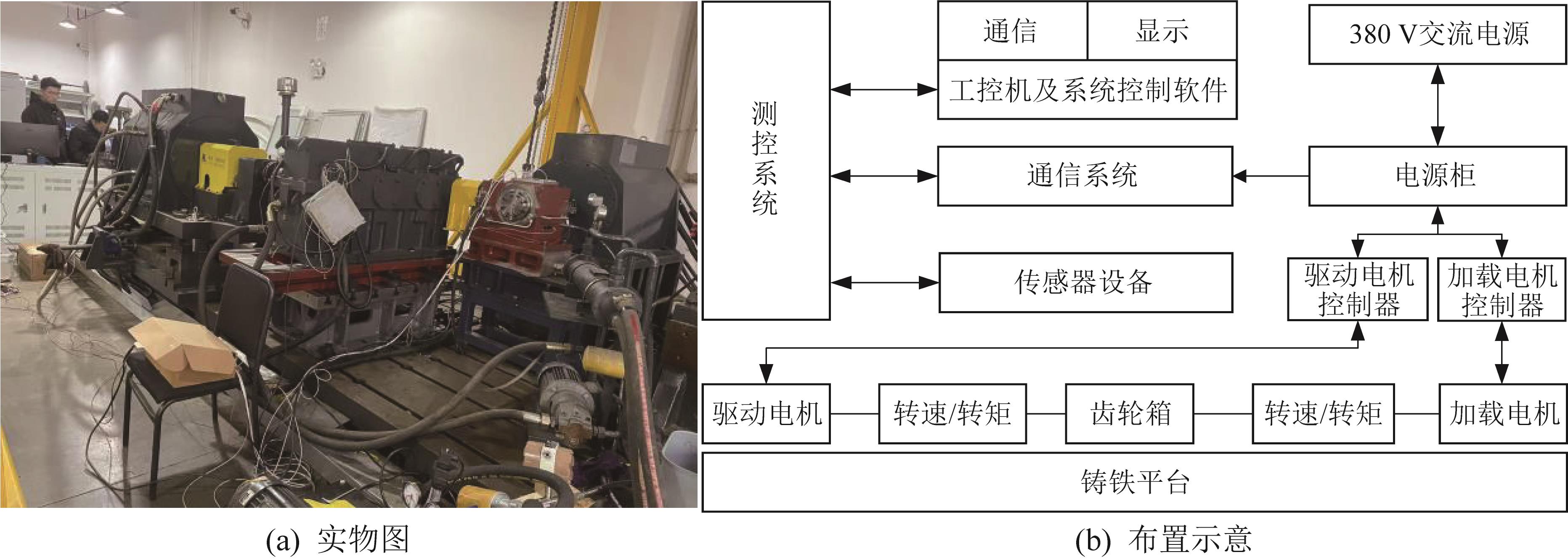
Abstract Spiral bevel gears in the helicopter's main gearbox exhibit pronounced spatial meshing characteristics. Under the combined effects of complex loads as well as manufacturing and assembly errors, the key excitations such as mesh stiffness and transmission error are difficult to obtain online, which limits the high-accuracy prediction of vibration responses. To address this issue, a digital twin method for vibration prediction was proposed by integrating tooth surface contact analysis with mechanism-guided data-driven modeling. The proposed method adopted collaborative modeling along physical and data paths. On the physical path, a tooth surface with geometric errors was constructed based on the three-coordinate measurement data, and the tooth surface contact analysis was carried out to extract time-varying mesh stiffness and composite transmission error. A condition-related vibration intensity index was then obtained through torsional dynamics analysis and used as an interpretable mechanism-informed feature. On the data path, a Bayesian-optimized XGBoost (eXtreme Gradient Boosting) mapping model BO-XGBoost was constructed to fuse the measured operating parameters with the mechanism features for nonlinear prediction of three-dimensional vibration of the output-shaft. The verification results based on the test-rig data of the transmission system of the main gearbox demonstrated that the model had a higher prediction accuracy for the three-dimensional vibration of the output-shaft, with the determination coefficient R2 being higher than 0.97. Compared with baseline models such as BO-XGBoost, SVR (support vector regression), LSTM (long short-term memory), and GRU (gated recurrent unit), its prediction accuracy was the highest. The research results provide a physically interpretable modeling approach for vibration monitoring and performance evaluation of the transmission system of the helicopter's main gearbox.
|
|
Received: 30 November 2025
Published: 28 April 2026
|
|
|
|
Corresponding Authors:
Zhao XIAO
E-mail: 18911282502@163.com;xnxzh501@hnust.edu.cn
|
直升机主减速器传动系统振动预测孪生建模技术研究
直升机主减速器弧齿锥齿轮系统的空间啮合特性显著,在复杂工况载荷与制造及装配误差的共同作用下,其啮合刚度和传动误差等关键激励难以在线获取,限制了振动响应的高精度预测。针对上述问题,提出了一种融合齿面接触分析与机理引导-数据驱动建模的振动预测数字孪生方法。采用物理路径与数据路径协同建模方式:在物理路径上,基于三坐标测量数据构建了含几何误差的齿面并开展齿面接触分析,提取时变啮合刚度和综合传动误差,并结合扭转动力学分析得到与工况相关的振动强度指标,将它作为可解释的机理先验特征;在数据路径上,构建了贝叶斯优化XGBoost(eXtreme Gradient Boosting,极限梯度提升)映射模型BO-XGBoost,将实测工况参数与机理特征融合,实现输出轴三向振动非线性预测。基于主减速器传动系统台架试验数据的验证结果表明,所提出的模型对输出轴三向振动的预测精度较高,决定系数R2均高于0.97。与BO-XGBoost、SVR(support vector regression,支持向量回归)、LSTM(long short-term memory,长短期记忆)、GRU(gated recurrent unit,门控循环单元)等基线模型相比,其预测精度最高。研究结果为直升机主减速器传动系统振动监测与性能评估提供了具有物理可解释性的建模方法。
关键词:
数字孪生,
齿面接触分析,
贝叶斯优化,
XGBoost,
振动预测
|
|
| [[1]] |
SEO M K, YUN W Y. Gearbox condition monitoring and diagnosis of unlabeled vibration signals using a supervised learning classifier[J]. Machines, 2024, 12(2): 134.
|
|
|
| [[2]] |
ELASHA F, GREAVES M, MBA D. Planetary bearing defect detection in a commercial helicopter main gearbox with vibration and acoustic emission[J]. Structural Health Monitoring, 2018, 17(5): 1192-1212.
|
|
|
| [[3]] |
王轩, 王细洋. 面向故障诊断的行星齿轮扭振信号测量与分析[J]. 中国机械工程, 2018, 29(1): 49-56. doi:10.3969/j.issn.1004-132X.2018.01.008
WANG X, WANG X Y. Measurement and analysis of torsional vibration signals for diagnosing planetary gearbox faults[J]. China Mechanical Engineering, 2018, 29(1): 49-56.
doi: 10.3969/j.issn.1004-132X.2018.01.008
|
|
|
| [[4]] |
ELASHA F, GREAVES M, MBA D. Diagnostics of a defective bearing within a planetary gearbox with vibration and acoustic emission[M]//Advances in Condition Monitoring of Machinery in Non-Stationary Operations. Cham: Springer International Publishing, 2015: 399-412.
|
|
|
| [[5]] |
ZHOU L H, DUAN F, CORSAR M, et al. A study on helicopter main gearbox planetary bearing fault diagnosis[J]. Applied Acoustics, 2019, 147: 4-14.
|
|
|
| [[6]] |
许华超, 朱豪杰, 韩振华, 等. 基于代理模型和敏感度分析的直升机主减速器减振优化[J]. 航空动力学报, 2024, 39(11): 20220884.
XU H C, ZHU H J, HAN Z H, et al. Vibration reduction optimization for helicopter’s main gearbox based on surrogate model and sensitivity analysis[J]. Journal of Aerospace Power, 2024, 39(11): 20220884.
|
|
|
| [[7]] |
INTURI V, GHOSH B, RAJASEKHARAN S G, et al. A review of digital twinning for rotating machinery[J]. Sensors, 2024, 24(15): 5514.
|
|
|
| [[8]] |
ZHONG D, XIA Z L, ZHU Y A, et al. Overview of predictive maintenance based on digital twin technology[J]. Heliyon, 2023, 9(4): e14534.
|
|
|
| [[9]] |
HU W F, ZHANG T Z, DENG X Y, et al. Digital twin: a state-of-the-art review of its enabling technologies, applications and challenges[J]. Journal of Intelligent Manufacturing and Special Equipment, 2021, 2(1): 1-34.
|
|
|
| [[10]] |
LU Y Q, LIU C, WANG K I, et al. Digital twin-driven smart manufacturing: connotation, reference model, applications and research issues[J]. Robotics and Computer-Integrated Manufacturing, 2020, 61: 101837.
|
|
|
| [[11]] |
CUI Z X, YANG X L, YUE J G, et al. A review of digital twin technology for electromechanical products: evolution focus throughout key lifecycle phases[J]. Journal of Manufacturing Systems, 2023, 70: 264-287.
|
|
|
| [[12]] |
WANG J J, YE L K, GAO R X, et al. Digital twin for rotating machinery fault diagnosis in smart manufacturing[J]. International Journal of Production Research, 2019, 57(12): 3920-3934.
|
|
|
| [[13]] |
陶飞, 张辰源, 戚庆林, 等. 数字孪生成熟度模型[J]. 计算机集成制造系统, 2022, 28(5): 1267-1281. doi:10.13196/j.cims.2022.05.001
TAO F, ZHANG C Y, QI Q L, et al. Digital twin maturity model[J]. Computer Integrated Manufacturing Systems, 2022, 28(5): 1267-1281.
doi: 10.13196/j.cims.2022.05.001
|
|
|
| [[14]] |
陶飞, 刘蔚然, 张萌, 等. 数字孪生五维模型及十大领域应用[J]. 计算机集成制造系统, 2019, 25(1): 1-18.
TAO F, LIU W R, ZHANG M, et al. Five-dimension digital twin model and its ten applications[J]. Computer Integrated Manufacturing Systems, 2019, 25(1): 1-18.
|
|
|
| [[15]] |
胡伟飞, 方健豪, 刘飞香, 等. 基于数字孪生的掘锚一体机实时状态映射[J]. 湖南大学学报(自然科学版), 2022, 49(2): 1-12. doi:10.16339/j.cnki.hdxbzkb.2022151
HU W F, FANG J H, LIU F X, et al. Real-time state mirror-mapping for driving and bolting integration equipment based on digital twin[J]. Journal of Hunan University (Natural Sciences), 2022, 49(2): 1-12.
doi: 10.16339/j.cnki.hdxbzkb.2022151
|
|
|
| [[16]] |
LIU W M, HAN B, ZHENG A Y, et al. Fault diagnosis for reducers based on a digital twin[J]. Sensors, 2024, 24(8): 2345.
|
|
|
| [[17]] |
MATANIA O, BECHHOEFER E, BORTMAN J. Digital twin of a gear root crack prognosis[J]. Sensors, 2023, 23(24): 9883.
|
|
|
| [[18]] |
ZHOU X, HE S X, DONG L T, et al. Real-time prediction of probabilistic crack growth with a helicopter component digital twin[EB/OL]. 2021: arXiv: 2105. 03668.
|
|
|
| [[19]] |
HUANG Y F, TAO J, SUN G, et al. A novel digital twin approach based on deep multimodal information fusion for aero-engine fault diagnosis[J]. Energy, 2023, 270: 126894.
|
|
|
| [[20]] |
MOGHADAM F K, NEJAD A R. Online condition monitoring of floating wind turbines drivetrain by means of digital twin[J]. Mechanical Systems and Signal Processing, 2022, 162: 108087.
|
|
|
| [[21]] |
MATANIA O, REINICKE C, GAHR C. A digital twin for crack propagation in gears[J]. Mechanics & Industry, 2023, 24(5): 499-507.
|
|
|
| [[22]] |
宋仁旺, 张岩, 石慧. 基于Copula函数的齿轮箱剩余寿命预测方法[J]. 系统工程理论与实践, 2020, 40(9): 2466-2474. doi:10.12011/1000-6788-2019-0307-09
SONG R W, ZHANG Y, SHI H. Prediction method for the remaining useful life of gearbox based on copula function[J]. Systems Engineering: Theory & Practice, 2020, 40(9): 2466-2474.
doi: 10.12011/1000-6788-2019-0307-09
|
|
|
| [[23]] |
郭飞燕, 刘检华, 邹方, 等. 数字孪生驱动的装配工艺设计现状及关键实现技术研究[J]. 机械工程学报, 2019, 55(17): 110-132. doi:10.3901/JME.2019.17.110
GUO F Y, LIU J H, ZOU F, et al. Research on the state-of-art, connotation and key implementation technology of assembly process planning with digital twin[J]. Journal of Mechanical Engineering, 2019, 55(17): 110-132.
doi: 10.3901/JME.2019.17.110
|
|
|
| [[24]] |
LI J B, WANG S L, YANG J J, et al. A digital twin-based state monitoring method of gear test bench[J]. Applied Sciences, 2023, 13(5): 3291.
|
|
|
| [[25]] |
ZHANG Q, WU Z, AN B S, et al. Digital twin-based technical research on comprehensive gear fault diagnosis and structural performance evaluation[J]. Sensors, 2025, 25(9): 2775.
|
|
|
| [[26]] |
HE H, SONG Q, LI J. Digital twin-driven predictive maintenance method for gearboxes considering fatigue damage and uncertainty[J]. Mechanical Systems and Signal Processing, 2023, 200: 110579.
|
|
|
| [[27]] |
KHAZRI M. Implementation of digital twins for gearboxes using a coupled torsional dynamic model and experimental validation[J]. IEEE Transactions on Industrial Informatics, 2021, 17(10): 6852-6863.
|
|
|
| [[28]] |
宋学官, 来孝楠, 何西旺, 等. 重大装备形性一体化数字孪生关键技术[J]. 机械工程学报, 2022, 58(10): 298-325. doi:10.3901/JME.2022.10.298
SONG X G, LAI X N, HE X W, et al. Key technologies of shape-performance integrated digital twin for major equipment[J]. Journal of Mechanical Engineering, 2022, 58(10): 298-325.
doi: 10.3901/JME.2022.10.298
|
|
|
| [[29]] |
KAPTEYN M G, WILLCOX K E. From physics-based models to physics-informed learning: a data-driven digital twin framework[J]. Journal of Computational Physics, 2020, 418: 109622.
|
|
|
| [[30]] |
XIAO B, ZHONG J S, BAO X Y, et al. Digital twin-driven prognostics and health management for industrial assets[J]. Scientific Reports, 2024, 14: 13443.
|
|
|
| [[31]] |
TAO F, ZHANG H, ZHANG C Y. Advancements and challenges of digital twins in industry[J]. Nature Computational Science, 2024, 4(3): 169-177.
|
|
|
| [[32]] |
KONG T X, HU T L, ZHOU T T, et al. Data construction method for the applications of workshop digital twin system[J]. Journal of Manufacturing Systems, 2021, 58: 323-328.
|
|
|
| [[33]] |
尹凤, 杜文龙, 丁撼, 等. 航空锥齿轮加载齿面接触分析的半解析计算方法[J]. 中南大学学报(自然科学版), 2025, 56(4): 1331-1342. doi:10.11817/j.issn.1672-7207.2025.04.007
YIN F, DU W L, DING H, et al. Semi-analytical calculation for loaded tooth contact analysis of aerospace spiral bevel gears[J]. Journal of Central South University (Science and Technology), 2025, 56(4): 1331-1342.
doi: 10.11817/j.issn.1672-7207.2025.04.007
|
|
|
| [[34]] |
王煜石, 容凯彬, 丁撼, 等. 弧齿锥齿轮TCA接触印痕与传动误差协同求解方法研究[J]. 机械科学与技术, 2024, 43(9): 1559-1568.
WANG Y S, RONG K B, DING H, et al. TCA collaborative solution considering both contact pattern and transmission error for spiral bevel gears[J]. Mechanical Science and Technology for Aerospace Engineering, 2024, 43(9): 1559-1568.
|
|
|
| [[35]] |
宋碧芸, 唐进元, 容铠彬, 等. 减小螺旋锥齿轮齿面加工误差的参数修正方法[J]. 西安交通大学学报, 2022, 56(2): 101-109. doi:10.7652/xjtuxb202202011
SONG B Y, TANG J Y, RONG K B, et al. A machine-settings compensation method for reducing machining error of spiral bevel gear tooth flank[J]. Journal of Xi’an Jiaotong University, 2022, 56(2): 101-109.
doi: 10.7652/xjtuxb202202011
|
|
|
| [[36]] |
QIN Y, LIU H Y, MAO Y F. Faulty rolling bearing digital twin model and its application in fault diagnosis with imbalanced samples[J]. Advanced Engineering Informatics, 2024, 61: 102513.
|
|
|
| [[37]] |
QUINTANILHA I M, ELIAS V R M, SILVA F B DA, et al. A fault detector/classifier for closed-ring power generators using machine learning[J]. Reliability Engineering & System Safety, 2021, 212: 107614.
|
|
|
| [[38]] |
陈亮, 顾宇轩, 林可欣, 等. 基于飞参数据的结构关键部位载荷孪生技术研究[J/OL]. 航空学报, 1-10. (2024-12-25) [2026-01-10]. .
CHEN L, GU Y X, LIN K X, et al. Research on load twin technology for critical structural parts based on flight parameter data[J/OL]. Acta Aeronautica et Astronautica Sinica, 1-10. (2024-12-25) [2026-01-10]. .
|
|
|
| [[39]] |
GRAJA K, ZRIBI M, BOUAZIZ A. Machine learning-based vibration response reconstruction for planetary gear fault diagnosis[J]. Journal of the Brazilian Society of Mechanical Sciences and Engineering, 2025, 47(3): 146.
|
|
|
|
Viewed |
|
|
|
Full text
|
|
|
|
|
Abstract
|
|
|
|
|
Cited |
|
|
|
|
| |
Shared |
|
|
|
|
| |
Discussed |
|
|
|
|