|
|
|
| Lane-changing intention prediction based on spatiotemporal feature and interaction modeling |
Shuaishuai GAO1( ),Cheng WEI1,*(),Fei HUI1,Jingcheng ZHANG1,Hanchen SONG2 ),Cheng WEI1,*(),Fei HUI1,Jingcheng ZHANG1,Hanchen SONG2 |
1. School of Electronics and Control Engineering, Chang’an University, Xi’an 710064, China
2. Xi’an Mainfunc Intelligent Technology Limited Company, Xi’an 712039, China |
|
|
|
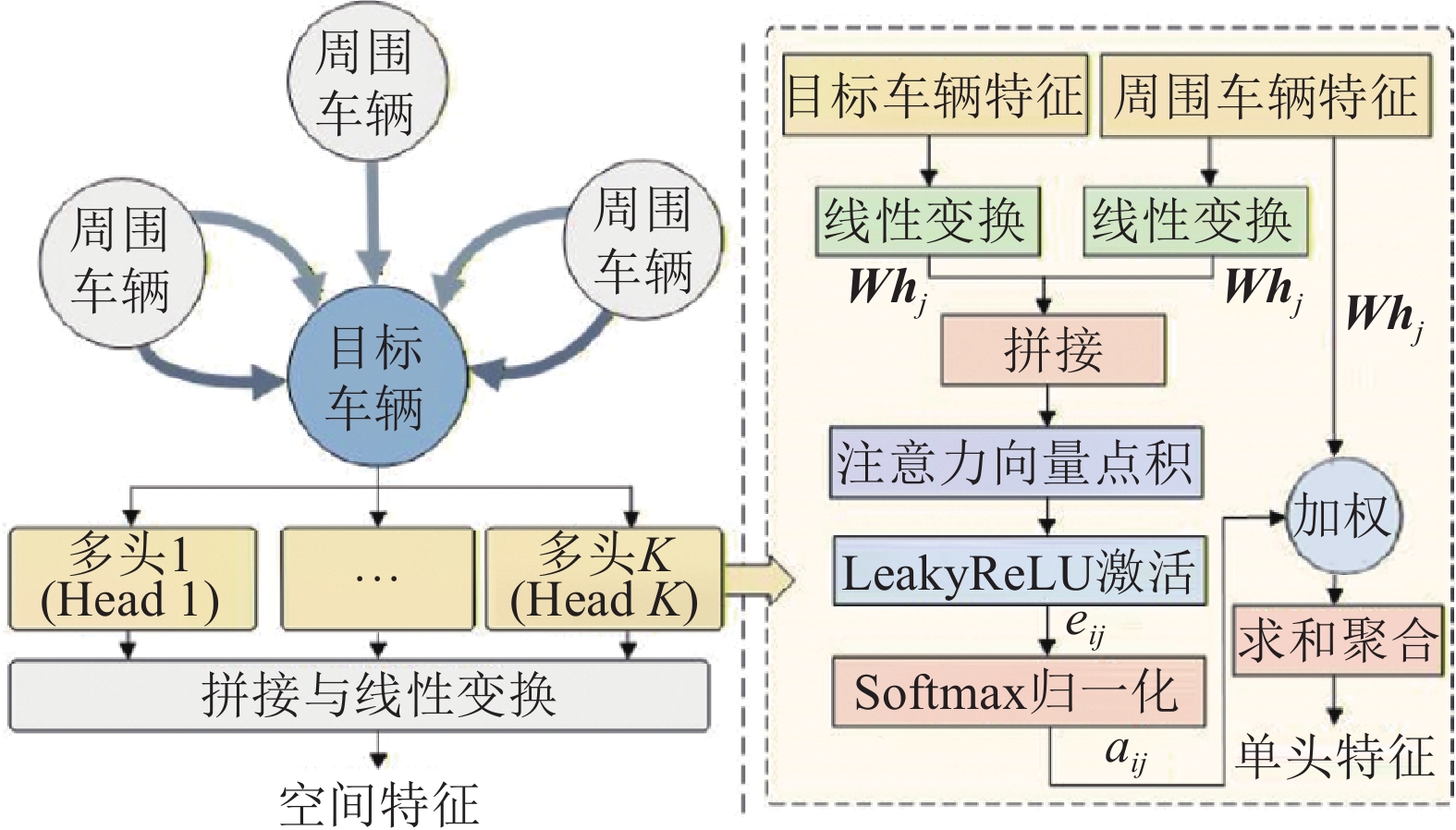
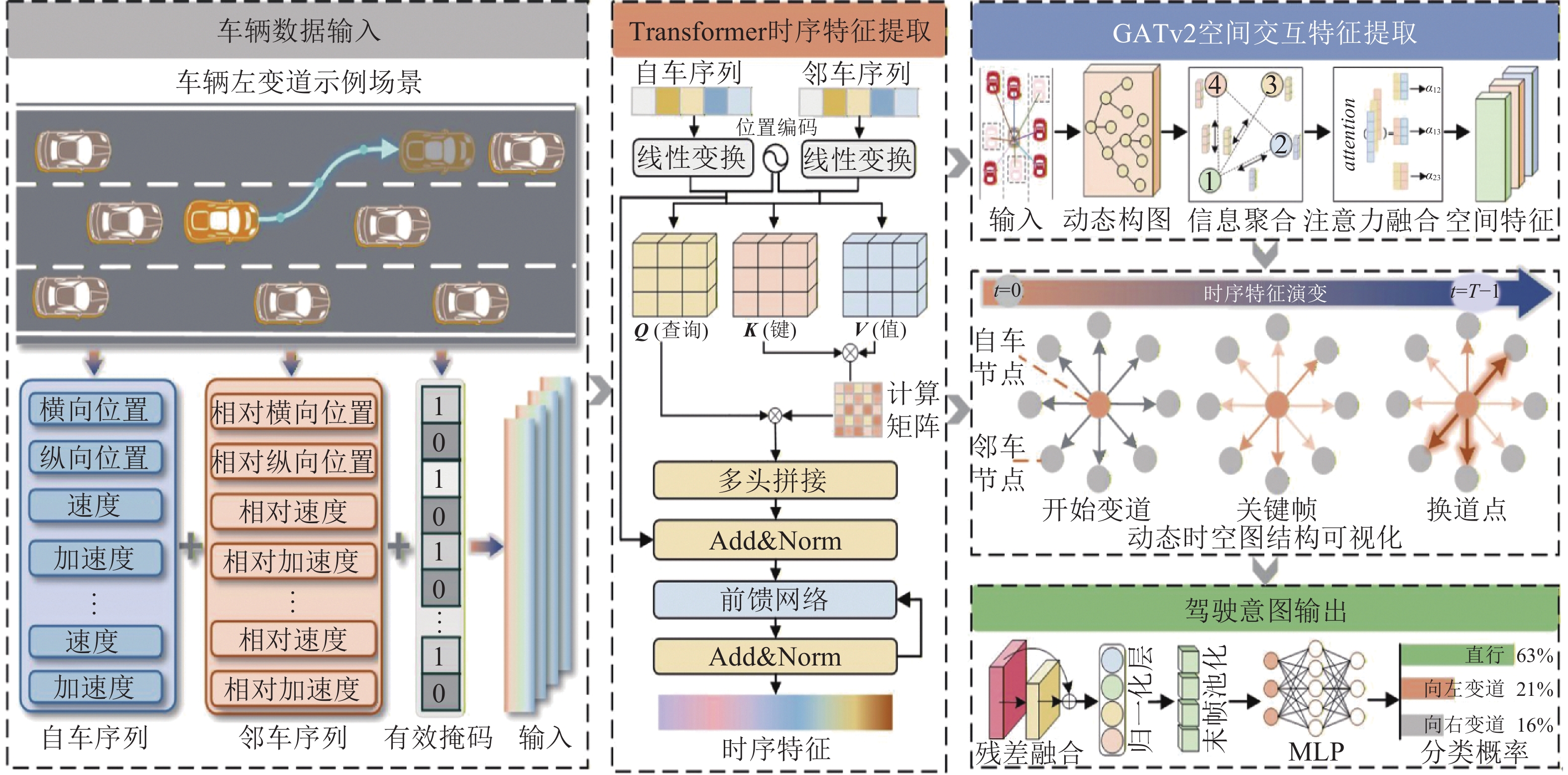
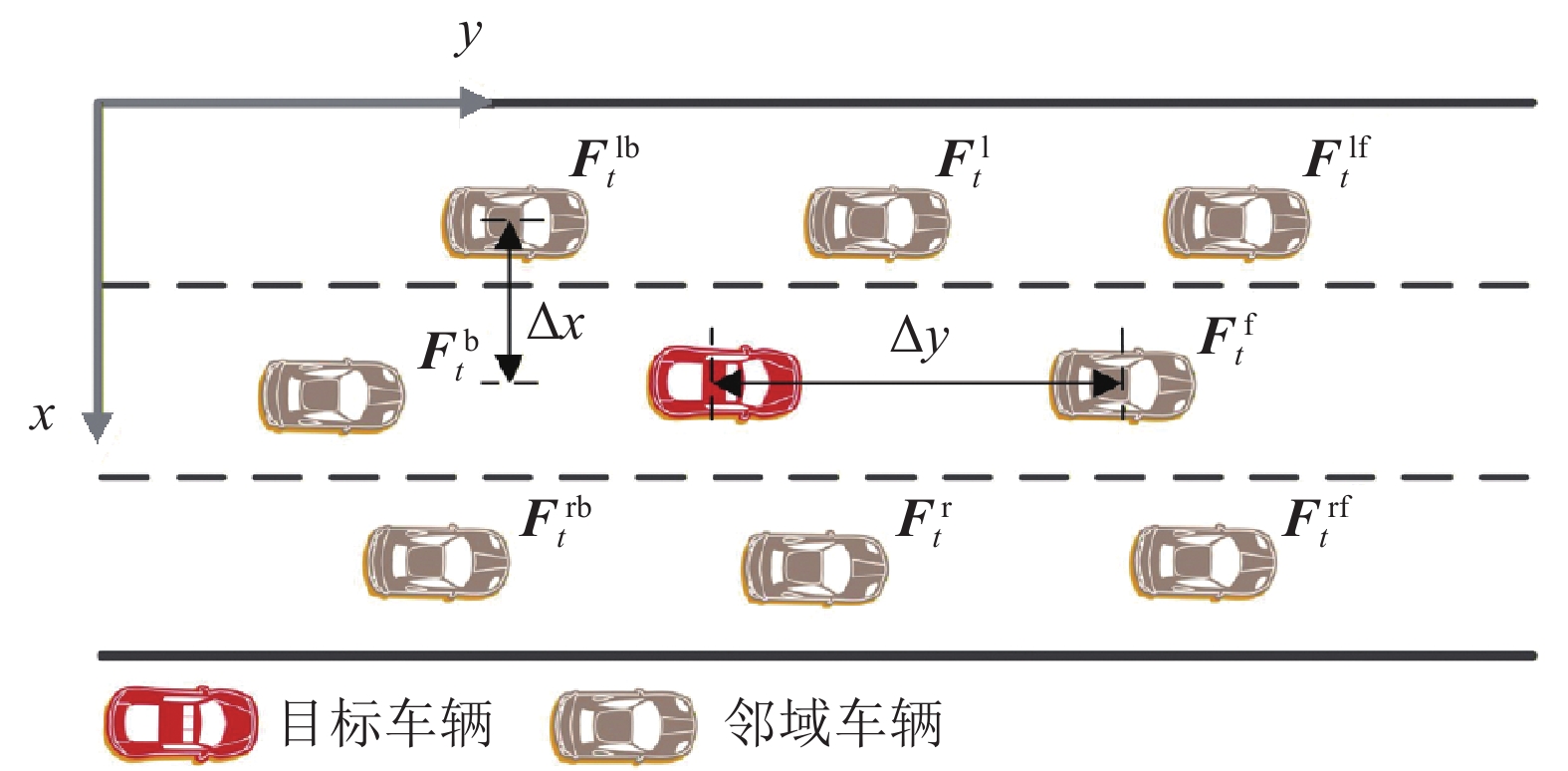
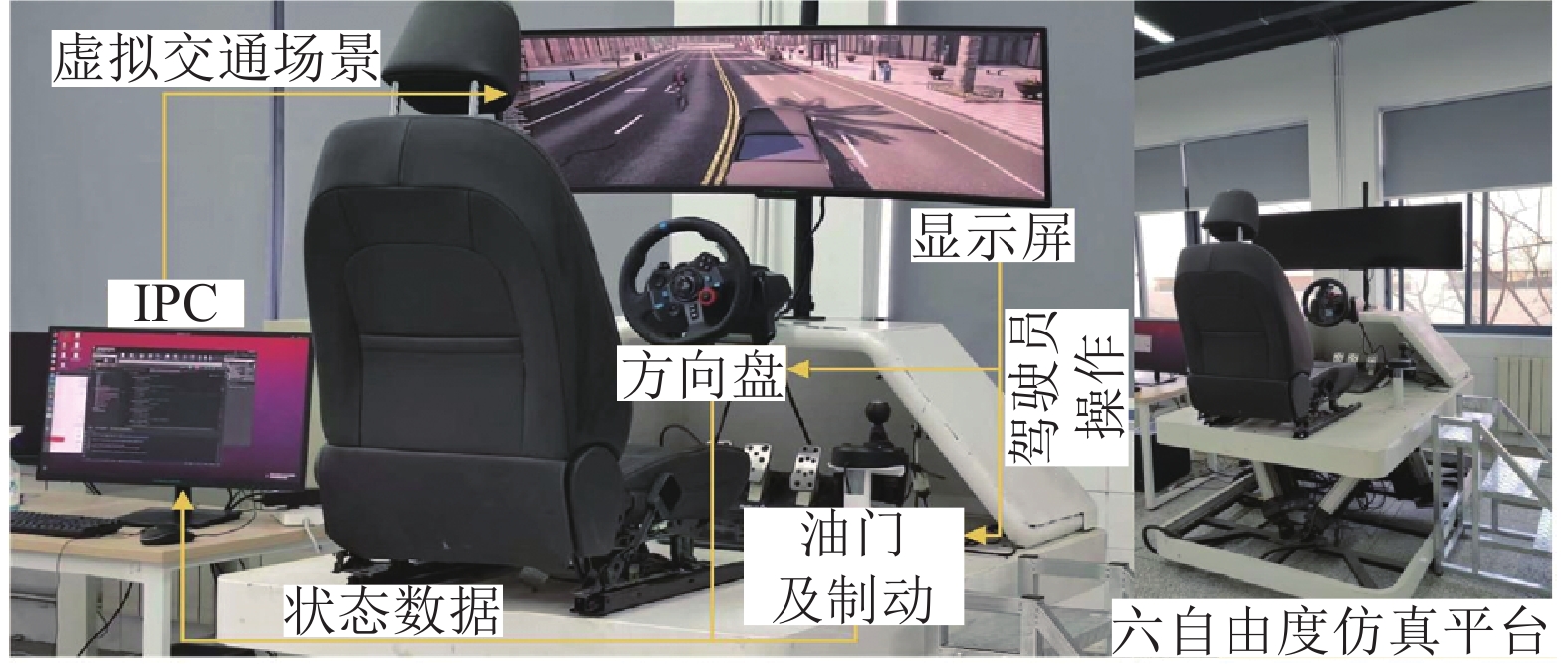
Abstract A spatiotemporal joint lane-change intention prediction model based on Transformer and graph attention neural network (GATv2) was proposed in order to accurately predict lane-changing intention of surrounding vehicles and improve the safety and reliability of autonomous vehicles. Symmetric exponential average filtering was applied to smooth the raw NGSIM data. Then velocity and acceleration were recalculated by using the difference method, and outliers were removed. The data of the target vehicle and its surrounding vehicles were unified by establishing an eight-neighborhood for each vehicle, providing a foundation for model training and validation. Transformer multi-head attention was used to mine temporal dependency, while GATv2 was employed to quantify the interaction relationship between vehicles at each time step. Then a Transformer-GATv2 lane-changing prediction model based on spatiotemporal feature and multi-vehicle interaction was constructed. The experimental results showed that the proposed model significantly outperformed other baseline models in accuracy, recall, F1-score, and other metrics. A prediction accuracy of 98.04% was achieved, which demonstrated superior lane-changing intention prediction performance and strong early prediction capability. The model was deployed on a six-degree-of-freedom driving simulator integrated with the CARLA co-simulation platform for model-in-the-loop testing, verifying the usability of the model in real-world scenario.
|
|
Received: 27 January 2026
Published: 20 July 2026
|
|
|
| Fund: 陕西省重点研发计划资助项目(2025PT-ZCK-71, 2024CY-JJQ-55);陕西省博士后科研资助项目(2025BSHSDZZ261). |
|
Corresponding Authors:
Cheng WEI
E-mail: gaoshuaishuai@chd.edu.cn;chengwei@chd.edu.cn
|
基于时空特征与交互关系建模的换道意图预测
为了准确预测周围车辆的换道意图,提高自动驾驶车辆的安全性与可靠性,提出基于Transformer和图注意力神经网络(GATv2)的时空联合换道意图预测模型. 采用对称指数平均滤波对NGSIM原始数据进行平滑处理,利用差分方法重新计算速度和加速度并去除异常值,通过建立车辆八邻域,对目标车辆及周围车辆的数据进行统一化处理,为模型训练验证提供基础. 使用Transformer多头注意力挖掘时序依赖关系,利用GATv2进行每个时间步车辆间的交互关系量化,构建基于时空特征与多车交互关系的Transformer-GATv2换道预测模型. 实验表明,相较于其他基准模型,所提出的模型在准确率、召回率和F1分数等指标上均具有明显优势,达到98.04%的预测精度,证明模型具有较好的换道意图预测精度和提前预测能力. 将该模型部署于六自由度驾驶模拟器与CARLA联合仿真平台,开展模型在环测试,验证了模型在实际场景下的可用性.
关键词:
交通工程,
换道意图预测,
自动驾驶,
Transformer,
图神经网络
|
|
| [1] |
WEI C, HUI F, YANG Z, et al Fine-grained highway autonomous vehicle lane-changing trajectory prediction based on a heuristic attention-aided encoder-decoder model[J]. Transportation Research Part C: Emerging Technologies, 2022, 140: 103706
doi: 10.1016/j.trc.2022.103706
|
|
|
| [2] |
YANG Z, QI Y, JI X Research on the transition marking between the broken line and solid line of expressway[J]. Transportation Research Part F: Traffic Psychology and Behaviour, 2022, 89: 437- 455
doi: 10.1016/j.trf.2022.07.011
|
|
|
| [3] |
PENG M, GUO X, CHEN X, et al LC-LLM: explainable lane-change intention and trajectory predictions with large language models[J]. Communications in Transportation Research, 2025, 5 (2): 100170
doi: 10.1016/j.commtr.2025.100170
|
|
|
| [4] |
方华珍, 刘立, 顾青, 等 自动驾驶车辆换道意图识别研究现状[J]. 工程科学学报, 2024, 46 (10): 1845- 1855
FANG Huazhen, LIU Li, GU Qing, et al Current status of lane change intention recognition for autonomous vehicles[J]. Chinese Journal of Engineering, 2024, 46 (10): 1845- 1855
|
|
|
| [5] |
任立海, 康鈺泽, 刘煜, 等 融合逻辑判断机制的CNN-GRU换道意图识别方法[J]. 湖南大学学报: 自然科学版, 2025, 52 (6): 69- 77
REN Lihai, KANG Yuze, LIU Yu, et al Recognition method of lane change intention based on CNN-GRU integrated with logic judgment mechanism[J]. Journal of Hunan University: Natural Sciences, 2025, 52 (6): 69- 77
|
|
|
| [6] |
LIU Q, XU S, LU C, et al Early recognition of driving intention for lane change based on recurrent hidden semi-Markov model[J]. IEEE Transactions on Vehicular Technology, 2020, 69 (10): 10545- 10557
doi: 10.1109/TVT.2020.3011672
|
|
|
| [7] |
LI X, WANG W, ROETTING M Estimating driver’s lane-change intent considering driving style and contextual traffic[J]. IEEE Transactions on Intelligent Transportation Systems, 2018, 20 (9): 3258- 3271
doi: 10.1109/tits.2018.2873595
|
|
|
| [8] |
LI L, ZHAO W, XU C, et al Lane-change intention inference based on RNN for autonomous driving on highways[J]. IEEE Transactions on Vehicular Technology, 2021, 70 (6): 5499- 5510
doi: 10.1109/TVT.2021.3079263
|
|
|
| [9] |
LU Y, ZHANG Z, BAI R, et al. Dual-view interaction-aware lane change prediction for autonomous driving [C]//Proceedings of the AAAI Conference on Artificial Intelligence. Philadelphia: AAAI Press, 2025: 28222–28230.
|
|
|
| [10] |
MIRZABAGHERI A, MOZAFFARI S, ALIREZAEE S Enhancing vehicle lane change prediction via transfer learning infused with social interaction dynamics[J]. Robotics and Autonomous Systems, 2026, 196: 105261
doi: 10.1016/j.robot.2025.105261
|
|
|
| [11] |
BYEON H, AL-KUBAISI M, QURAISHI A, et al Reinforcement learning for dynamic optimization of lane change intention recognition for transportation networks[J]. IEEE Transactions on Intelligent Transportation Systems, 2026, 27 (2): 2695- 2705
doi: 10.1109/TITS.2025.3529299
|
|
|
| [12] |
高凯, 李勋豪, 胡林, 等 基于多头注意力的CNN-LSTM的换道意图预测[J]. 机械工程学报, 2022, 58 (22): 369- 378
GAO Kai, LI Xunhao, HU Lin, et al Lane change intention prediction of CNN-LSTM based on multi-head attention[J]. Journal of Mechanical Engineering, 2022, 58 (22): 369- 378
|
|
|
| [13] |
GUO H, KEYVAN-EKBATANI M, XIE K Lane change detection and prediction using real-world connected vehicle data[J]. Transportation Research Part C: Emerging Technologies, 2022, 142: 103785
doi: 10.1016/j.trc.2022.103785
|
|
|
| [14] |
GAO K, LI X, CHEN B, et al Dual transformer based prediction for lane change intentions and trajectories in mixed traffic environment[J]. IEEE Transactions on Intelligent Transportation Systems, 2023, 24 (6): 6203- 6216
doi: 10.1109/TITS.2023.3248842
|
|
|
| [15] |
ZHANG Y, CHEN Y, LI Y, et al Lane-changing intention recognition based on multivehicle interaction dynamic graph modeling in a connected environment[J]. Journal of Transportation Engineering, Part A: Systems, 2024, 150 (6): 04024022
doi: 10.1061/JTEPBS.TEENG-8272
|
|
|
| [16] |
陈文强, 王东丹, 朱文英, 等 基于时空图注意力网络的车辆多模态轨迹预测模型[J]. 浙江大学学报: 工学版, 2025, 59 (3): 443- 450
CHEN Wenqiang, WANG Dongdan, ZHU Wenying, et al Vehicle multimodal trajectory prediction model based on spatio-temporal graph attention network[J]. Journal of Zhejiang University: Engineering Science, 2025, 59 (3): 443- 450
|
|
|
| [17] |
李颂元, 朱祥维, 李玺 基座模型技术背景下的具身智能体综述[J]. 浙江大学学报: 工学版, 2025, 59 (2): 213- 226
LI Songyuan, ZHU Xiangwei, LI Xi Survey of embodied agent in context of foundation model[J]. Journal of Zhejiang University: Engineering Science, 2025, 59 (2): 213- 226
|
|
|
| [18] |
LIU H, WANG H, CHI M, et al An active safety framework for intelligent vehicles considering lane-change intention recognition and risk prediction in oncoming traffic[J]. International Journal of Intelligent Transportation Systems Research, 2025, 23 (3): 1924- 1948
doi: 10.1007/s13177-025-00552-2
|
|
|
| [19] |
XU D, LYU N, YANG L A proactive risk prediction framework for cut-In maneuvers incorporating inherent driving styles[J]. IEEE Transactions on Intelligent Transportation Systems, 2025, 26 (12): 23084- 23099
doi: 10.1109/TITS.2025.3607860
|
|
|
| [20] |
LYU N, FENG S, WAN H A perspective from competitive-cooperative driving modes: identification of vehicle merging behavior models and crash risk factors in merge zone[J]. Accident Analysis and Prevention, 2025, 220: 108153
doi: 10.1016/j.aap.2025.108153
|
|
|
| [21] |
肖刚, 卢大鹏, 郑文博, 等 基于时空图注意力网络的多变量时序数据异常检测方法[J]. 浙江大学学报: 工学版, 2025, 59 (10): 2134- 2143
XIAO Gang, LU Dapeng, ZHENG Wenbo, et al Multivariable time series data anomaly detection method based on spatiotemporal graph attention network[J]. Journal of Zhejiang University: Engineering Science, 2025, 59 (10): 2134- 2143
|
|
|
| [22] |
BRODY S, ALON U, YAHAV E. How attentive are graph attention networks [EB/OL]. (2021-05-30)[2026-01-20]. https://arxiv.org/abs/2105.14491.
|
|
|
| [23] |
CHEN X, GU G, NING X GMS: graph-guided multi-modal spatio-temporal fusion model for trajectory prediction in autonomous driving[J]. Neurocomputing, 2026, 661: 132010
doi: 10.1016/j.neucom.2025.132010
|
|
|
| [24] |
徐兵, 刘潇, 汪子扬, 等 采用梯度提升决策树的车辆换道融合决策模型[J]. 浙江大学学报: 工学版, 2019, 53 (6): 1171- 1181
XU Bing, LIU Xiao, WANG Ziyang, et al Fusion decision model for vehicle lane change with gradient boosting decision tree[J]. Journal of Zhejiang University: Engineering Science, 2019, 53 (6): 1171- 1181
|
|
|
| [25] |
ALEXIADIS V, COLYAR J, HALKIAS J, et al The next generation simulation program[J]. ITE Journal, 2004, 74 (8): 22- 26
|
|
|
| [26] |
LU Y, ZHANG Z, WANG W, et al Knowledge-driven lane change prediction for secure and reliable Internet of vehicles[J]. IEEE Transactions on Intelligent Transportation Systems, 2025, 26 (9): 14120- 14131
doi: 10.1109/TITS.2025.3526341
|
|
|
| [27] |
THIEMANN C, TREIBER M, KESTING A Estimating acceleration and lane-changing dynamics from next generation simulation trajectory data[J]. Transportation Research Record, 2008, 2088 (1): 90- 101
doi: 10.3141/2088-10
|
|
|
| [28] |
曹弋, 卜祥尊 考虑换道意图的卷积双向注意力网络高速公路车辆轨迹预测[J]. 中国公路学报, 2025, 38 (6): 324- 339
CAO Yi, BU Xiangzun Trajectory prediction for freeway vehicles using convolutional bidirectional attention networks considering lane-change intentions[J]. China Journal of Highway and Transport, 2025, 38 (6): 324- 339
|
|
|
| [29] |
何仁, 赵晓聪, 杨奕彬, 等 基于驾驶人风险响应机制的人机共驾模型[J]. 吉林大学学报: 工学版, 2021, 51 (3): 799- 809
HE Ren, ZHAO Xiaocong, YANG Yibin, et al Man-machine shared driving model using risk-response mechanism of human driver[J]. Journal of Jilin University: Engineering and Technology Edition, 2021, 51 (3): 799- 809
|
|
|
|
Viewed |
|
|
|
Full text
|
|
|
|
|
Abstract
|
|
|
|
|
Cited |
|
|
|
|
| |
Shared |
|
|
|
|
| |
Discussed |
|
|
|
|