|
|
|
| Physics-informed multi-stage surrogate model for urban flooding |
Ting SU1( ),Yueping XU1,*(),Quanjun WANG2,Hua ZHONG3,Jianqun JIANG1 ),Yueping XU1,*(),Quanjun WANG2,Hua ZHONG3,Jianqun JIANG1 |
1. College of Civil Engineering and Architecture, Zhejiang University, Hangzhou 310058, China
2. Faculty of Engineering and Information Technology, University of Melbourne, Melbourne 3052, Australia
3. Nanjing Hydraulic Research Institute, Nanjing 210029, China |
|
|
|
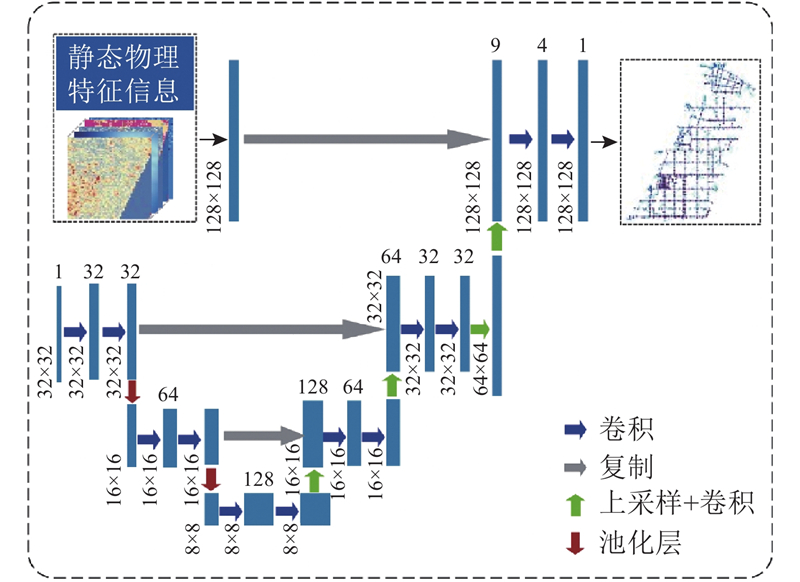
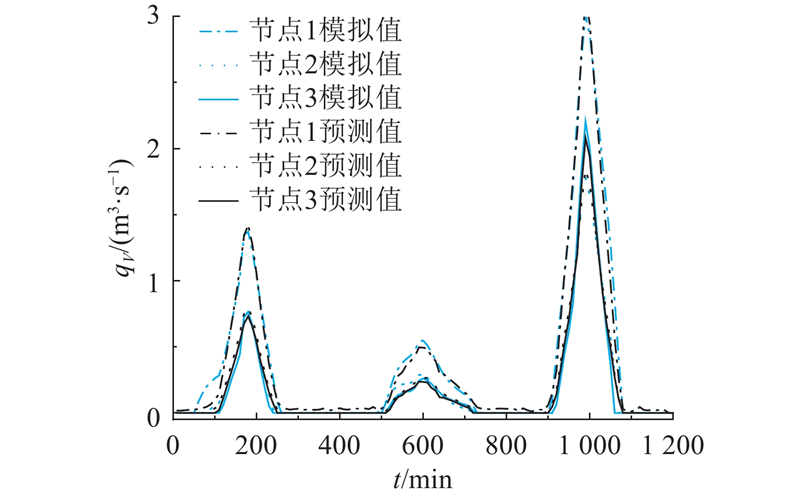
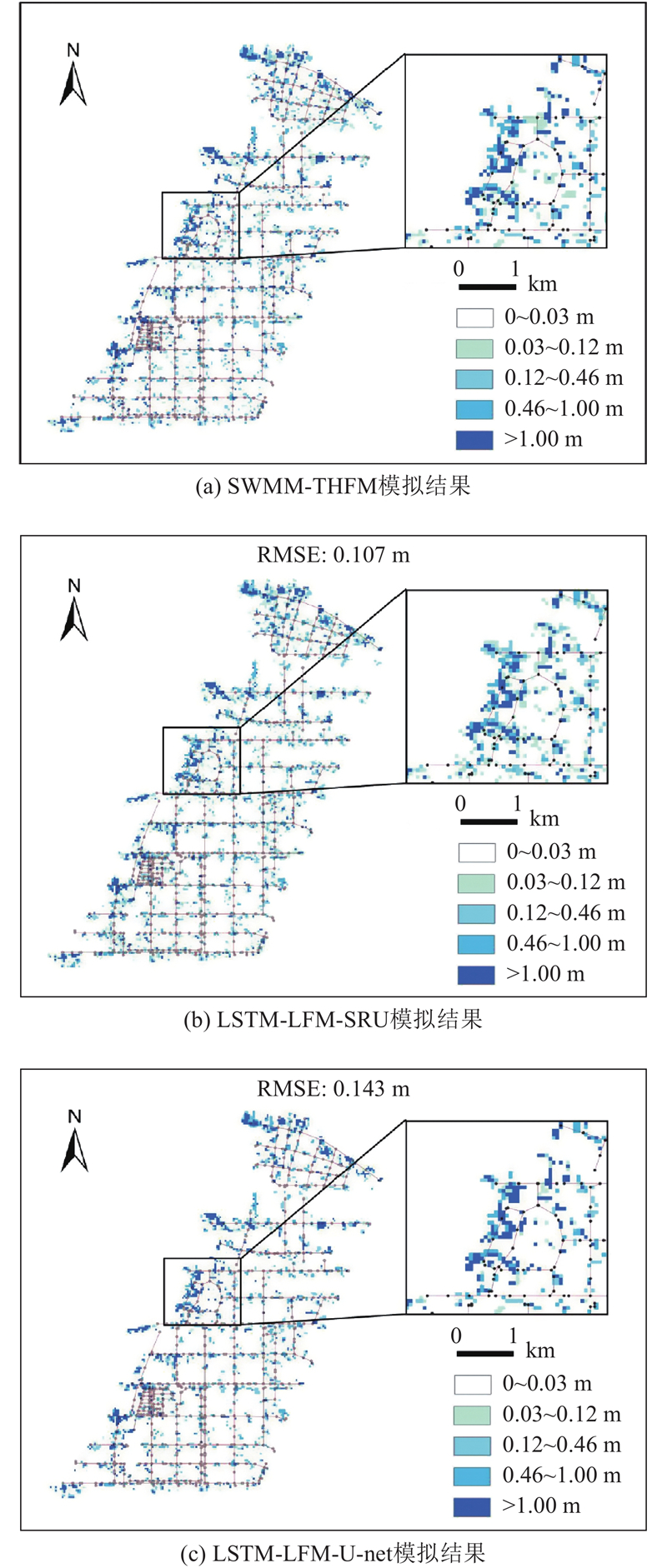
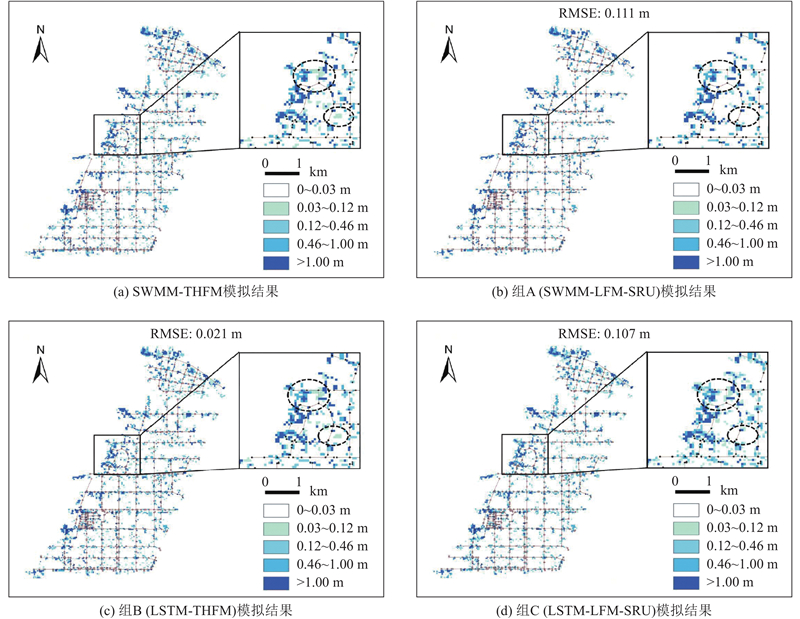
Abstract A multi-stage surrogate model named LSTM-LFM-SRU was developed to address the high computational cost and limited real-time capability of traditional hydrodynamic models. The urban flood process was divided into two stages: one-dimensional drainage through pipe networks and two-dimensional surface inundation. Long short-term memory (LSTM) networks and a combination of a low-fidelity physical model (LFM) with a super-resolution U-shaped convolutional neural network (SRU) were adopted to replace the corresponding stages. A flood prediction framework was constructed by combining data-driven methods with physical information. The multi-stage surrogate model was applied to a case study in the Xiasha area of Hangzhou. A 20-hour intense rainfall-induced inundation event was simulated within 5.31, with its computational efficiency reaching 12.7 times that of the high-precision hydrodynamic models. The one-dimensional LSTM-based surrogate achieved an average Nash-Sutcliffe Efficiency value of 0.94, while the two-dimensional LFM-SRU model reduced the Root Mean Square Error by 17.2% compared with the LFM-U-net model.
|
|
Received: 17 April 2025
Published: 23 May 2026
|
|
|
| Fund: 国家自然科学基金资助项目(52309038);浙江省重点研发计划资助项目(2021C03017). |
|
Corresponding Authors:
Yueping XU
E-mail: 22312105@zju.edu.cn;yuepingxu@zju.edu.cn
|
基于物理信息的城市洪涝多阶段替代模型
针对传统水力学模型计算量大且难以满足实时预测需求的问题,研发融合长短期记忆网络(LSTM)、低精度物理模型(LFM)与基于超分辨率技术的U形卷积神经网络(SRU)的多阶段替代模型LSTM-LFM-SRU. 模型将洪涝过程划分为一维管网排水与二维地表淹没2个阶段,分别采用LSTM与LFM-SRU进行替代建模,构建数据驱动与物理信息融合的内涝预测框架. 在杭州下沙的应用结果表明,本研究中所构建的多阶段替代模型能在5.31 s内完成一场20 h强降雨引发的城市淹没过程模拟,计算效率提升至高精度的水动力学模型的12.7倍,其中一维替代模型LSTM的平均纳什效率系数达到0.94,二维替代模型LFM-SRU相比于LFM-U-net模型在均方根误差上下降了17.2%.
关键词:
城市洪涝,
多阶段,
替代模型,
长短期记忆网络(LSTM),
低精度物理模型(LFM),
基于超分辨率技术的U形卷积神经网络(SRU)
|
|
| [1] |
新华社. 河南郑州 “7· 20” 特大暴雨灾害调查报告公布[EB/OL]. (2022−11−26). https://www.gov.cn/xinwen/2022-01/21/content_5669723.htm.
|
|
|
| [2] |
宋晓猛, 张建云, 占车生, 等 气候变化和人类活动对水文循环影响研究进展[J]. 水利学报, 2013, 44 (7): 779- 790
SONG Xiaomeng, ZHANG Jianyun, ZHAN Chesheng, et al Review for impacts of climate change and human activities on water cycle[J]. Journal of Hydraulic Engineering, 2013, 44 (7): 779- 790
|
|
|
| [3] |
张建云, 王银堂, 贺瑞敏, 等 中国城市洪涝问题及成因分析[J]. 水科学进展, 2016, 27 (4): 485- 491
ZHANG Jianyun, WANG Yintang, HE Ruimin, et al Discussion on the urban flood and waterlogging and causes analysis in China[J]. Advances in Water Science, 2016, 27 (4): 485- 491
doi: 10.14042/j.cnki.32.1309.2016.04.001
|
|
|
| [4] |
徐宗学, 叶陈雷 城市暴雨洪涝模拟: 原理、模型与展望[J]. 水利学报, 2021, 52 (4): 381- 392
XU Zongxue, YE Chenlei Simulation of urban flooding/waterlogging processes: principle, models and prospects[J]. Journal of Hydraulic Engineering, 2021, 52 (4): 381- 392
doi: 10.13243/j.cnki.slxb.20200515
|
|
|
| [5] |
张建云, 王银堂, 刘翠善, 等 中国城市洪涝及防治标准讨论[J]. 水力发电学报, 2017, 36 (1): 1- 6
ZHANG Jianyun, WANG Yintang, LIU Cuishan, et al Discussion on the standards of urban flood and waterlogging prevention in China[J]. Journal of Hydroelectric Engineering, 2017, 36 (1): 1- 6
|
|
|
| [6] |
黄国如, 陈文杰, 喻海军 城市洪涝水文水动力耦合模型构建与评估[J]. 水科学进展, 2021, 32 (3): 334- 344
HUANG Guoru, CHEN Wenjie, YU Haijun Construction and evaluation of an integrated hydrological and hydrodynamics urban flood model[J]. Advances in Water Science, 2021, 32 (3): 334- 344
doi: 10.14042/j.cnki.32.1309.2021.03.002
|
|
|
| [7] |
白冰, 董飞, 李传奇, 等 基于元胞自动机和深度学习的城市洪涝预报[J]. 水利水电技术, 2024, 55 (12): 17- 28
BAI Bing, DONG Fei, LI Chuanqi, et al Rapid urban flood forecasting based on cellular automata and deep learning[J]. Water Resources and Hydropower Engineering, 2024, 55 (12): 17- 28
|
|
|
| [8] |
南统超, 施睿, 于春水 基于国产CPU/GPU平台的水动力模型异构并行计算[J]. 水利学报, 2025, 56 (6): 771- 779
NAN Tongchao, SHI Rui, YU Chunshui Hydrodynamic modeling via heterogeneous parallel computing on domestic CPU/GPU platform[J]. Journal of Hydraulic Engineering, 2025, 56 (6): 771- 779
doi: 10.13243/j.cnki.slxb.20240326
|
|
|
| [9] |
MORALES-HERNÁNDEZ M, SHARIF M B, KALYANAPU A, et al TRITON: a Multi-GPU open source 2D hydrodynamic flood model[J]. Environmental Modelling and Software, 2021, 141: 105034
doi: 10.1016/j.envsoft.2021.105034
|
|
|
| [10] |
刘媛媛, 刘业森, 郑敬伟, 等 BP神经网络和数值模型相结合的城市内涝预测方法研究[J]. 水利学报, 2022, 53 (3): 284- 295
LIU Yuanyuan, LIU Yesen, ZHENG Jingwei, et al Intelligent rapid prediction method of urban flooding based on BP neural network and numerical simulation model[J]. Journal of Hydraulic Engineering, 2022, 53 (3): 284- 295
doi: 10.13243/j.cnki.slxb.20210611
|
|
|
| [11] |
FRAEHR N, WANG Q J, WU W, et al Supercharging hydrodynamic inundation models for instant flood insight[J]. Nature Water, 2023, 1 (10): 835- 843
doi: 10.1038/s44221-023-00132-2
|
|
|
| [12] |
FRAEHR N, WANG Q J, WU W, et al Assessment of surrogate models for flood inundation: the physics-guided LSG model vs. state-of-the-art machine learning models[J]. Water Research, 2024, 252: 121202
doi: 10.1016/j.watres.2024.121202
|
|
|
| [13] |
刘樱, 杨明, 徐集云 杭州市城市暴雨雨型分析研究[J]. 科技通报, 2021, 37 (4): 15- 22
LIU Ying, YANG Ming, XU Jiyun Analysis and study of rainstorm pattern in Hangzhou[J]. Bulletin of Science and Technology, 2021, 37 (4): 15- 22
doi: 10.13774/j.cnki.kjtb.2021.04.004
|
|
|
| [14] |
CHANG L C, LIOU J Y, CHANG F J Spatial-temporal flood inundation nowcasts by fusing machine learning methods and principal component analysis[J]. Journal of Hydrology, 2022, 612: 128086
doi: 10.1016/j.jhydrol.2022.128086
|
|
|
| [15] |
SCHAEFER J T The critical success index as an indicator of warning skill[J]. Weather and Forecasting, 1990, 5 (4): 570- 575
doi: 10.1175/1520-0434(1990)005<0570:TCSIAA>2.0.CO;2
|
|
|
| [16] |
ZENG Z, WANG Z, LAI C Simulation performance evaluation and uncertainty analysis on a coupled inundation model combining SWMM and WCA2D[J]. International Journal of Disaster Risk Science, 2022, 13 (3): 448- 464
doi: 10.1007/s13753-022-00416-3
|
|
|
| [17] |
WU X, WANG Z, GUO S, et al Scenario-based projections of future urban inundation within a coupled hydrodynamic model framework: a case study in Dongguan City, China[J]. Journal of Hydrology, 2017, 547: 428- 442
doi: 10.1016/j.jhydrol.2017.02.020
|
|
|
| [18] |
ECHEVERRIBAR I, MORALES-HERNÁNDEZ M, BRUFAU P, et al Use of internal boundary conditions for levees representation: application to river flood management[J]. Environmental Fluid Mechanics, 2019, 19 (5): 1253- 1271
doi: 10.1007/s10652-018-09658-6
|
|
|
| [19] |
XIA X, LIANG Q A new efficient implicit scheme for discretising the stiff friction terms in the shallow water equations[J]. Advances in Water Resources, 2018, 117: 87- 97
doi: 10.1016/j.advwatres.2018.05.004
|
|
|
| [20] |
周云峰, 周永潮, 郑春华, 等 采用Sobol方法的暴雨径流管理模型参数灵敏度分析[J]. 浙江大学学报: 工学版, 2019, 53 (2): 347- 354
ZHOU Yunfeng, ZHOU Yongchao, ZHENG Chunhua, et al Sensitivity analysis of parameters of storm water management model with Sobol method[J]. Journal of Zhejiang University: Engineering Science, 2019, 53 (2): 347- 354
|
|
|
| [21] |
SALGUEIRO ROMERO L, MARCELLO J, VILAPLANA V Super-resolution of sentinel-2 imagery using generative adversarial networks[J]. Remote Sensing, 2020, 12 (15): 2424
doi: 10.3390/rs12152424
|
|
|
| [22] |
ABADAL S, SALGUEIRO L, MARCELLO J, et al A dual network for super-resolution and semantic segmentation of sentinel-2 imagery[J]. Remote Sensing, 2021, 13 (22): 4547
doi: 10.3390/rs13224547
|
|
|
|
Viewed |
|
|
|
Full text
|
|
|
|
|
Abstract
|
|
|
|
|
Cited |
|
|
|
|
| |
Shared |
|
|
|
|
| |
Discussed |
|
|
|
|