|
|
|
| Cooling load prediction model for commercial buildings based on improved LSTM |
Fangnan DONG1( ),Qiang WU1,Jiayao LIU1,Junqi YU2 ),Qiang WU1,Jiayao LIU1,Junqi YU2 |
1. College of Digital Intelligence City, Xianyang Key Laboratory of Building Health Monitoring and Green Reinforcement, Shaanxi Polytechnic University, Xianyang 712000, China
2. College of Information and Control Engineering, Xi'an University of Architecture and Technology, Xi'an 710311, China |
|
|
|
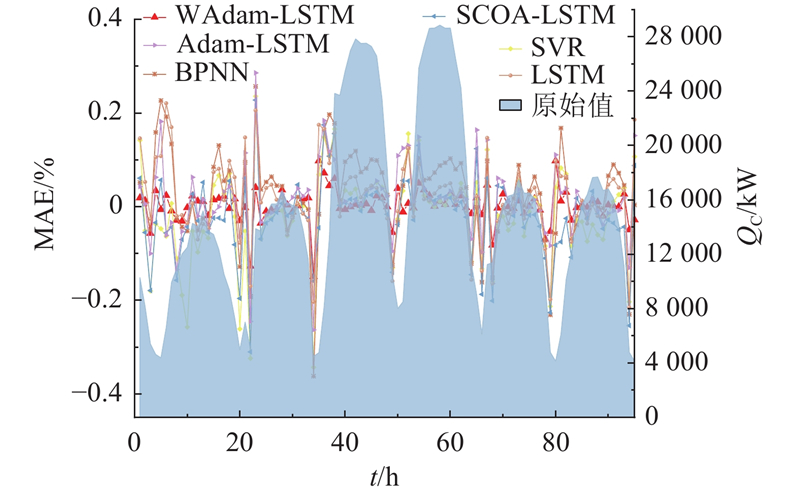
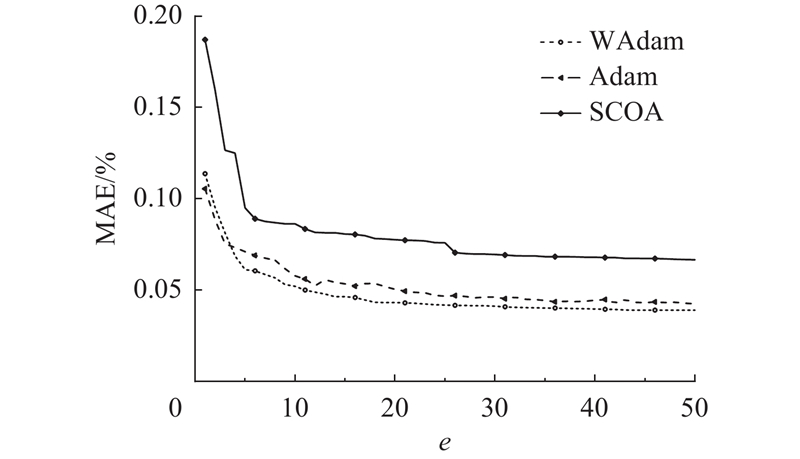
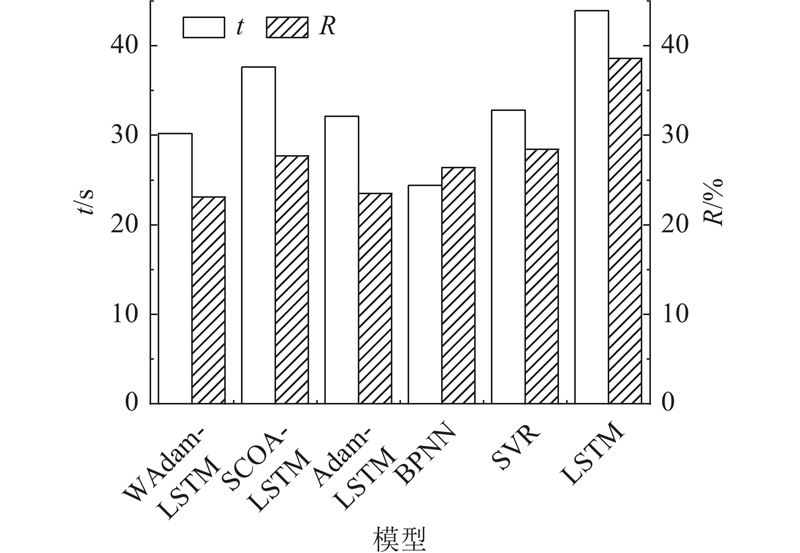
Abstract Traditional cooling load prediction methods often neglect temporal factors, leading to poor prediction performance and low generalization ability. To address these issues, a long short-term memory (LSTM) neural network prediction model optimized by the weight decay adaptive moment estimation algorithm (WAdam-LSTM) was proposed for high-precision building cooling load prediction. The cross-correlation function was employed to identify optimal feature variables as model inputs. WAdam-LSTM was constructed by introducing a weight decay term during the update of LSTM variable parameters. Hourly cooling load data from two representative large commercial buildings were used to evaluate and compare model prediction performance. Results show that the incorporation of the decoupled weight decay term enhances the stability and convergence of the optimization algorithm, making it suitable for LSTM network parameter optimization. WAdam-LSTM demonstrates superior prediction accuracy compared to SVR, SCOA-LSTM, and Adam-LSTM, with mean square error reductions of 83%, 66%, and 30%, respectively. WAdam-LSTM exhibits stronger generalization ability than single models (LSTM, SVR, and BPNN) and hybrid prediction models (SCOA-LSTM and Adam-LSTM), enabling precise cooling load predictions for different commercial buildings across varying months.
|
|
Received: 10 June 2025
Published: 06 May 2026
|
|
|
| Fund: 陕西工业职业技术大学科研计划项目(2024YKYB-021);国家重点研发计划项目(2022YFC3802700). |
基于改进LSTM的商业建筑冷负荷预测模型
传统冷负荷预测多未考虑时间因素,导致预测效果差和泛化能力低,为此提出基于权重衰减适应性矩估计优化算法的长短期记忆(LSTM)神经网络预测模型(WAdam-LSTM),用于建筑的高精度冷负荷预测. 采用交叉相关函数得到变量最佳特征作为输入变量,更新LSTM变量参数时引入权重衰减项,构建WAdam-LSTM. 以2个典型大型商业建筑逐时冷负荷数据为样本开展模型预测性能对比实验. 结果表明:解耦权重衰减项的引入提高了优化算法的稳定性和收敛性,适用于LSTM网络的参数优化;WAdam-LSTM比SVR、SCOA-LSTM和Adam-LSTM的预测效果更准确,均方误差分别下降了83%、66%和30%;WAdam-LSTM具有比单一模型(LSTM、SVR和BPNN)和混合预测模型(SCOA-LSTM和Adam-LSTM)更强的泛化能力,能对不同商业建筑不同月份的冷负荷进行精确预测.
关键词:
商业建筑,
冷负荷,
长短期记忆(LSTM),
Adam算法,
预测性能
|
|
| [13] |
于军琪, 杨思远, 赵安军, 等 基于神经网络的建筑能耗混合预测模型[J]. 浙江大学学报: 工学版, 2022, 56 (6): 1220- 1231
YU Junqi, YANG Siyuan, ZHAO Anjun, et al Hybrid prediction model of building energy consumption based on neural network[J]. Journal of Zhejiang University: Engineering Science, 2022, 56 (6): 1220- 1231
|
|
|
| [14] |
董彦军, 王晓甜, 马红明, 等 基于随机森林与长短期记忆网络的电力负荷预测方法[J]. 全球能源互联网, 2022, 5 (2): 147- 156
DONG Yanjun, WANG Xiaotian, MA Hongming, et al Power load forecasting method based on random forest and long short-term memory[J]. Journal of Global Energy Interconnection, 2022, 5 (2): 147- 156
|
|
|
| [15] |
KINGMA D P, BA J. Adam: a method for stochastic optimization [EB/OL]. (2017−01−30)[2025−06−02]. https://arxiv.org/pdf/1412.6980.
|
|
|
| [16] |
CHANG Z, ZHANG Y, CHEN W Electricity price prediction based on hybrid model of Adam optimized LSTM neural network and wavelet transform[J]. Energy, 2019, 187: 115804
doi: 10.1016/j.energy.2019.07.134
|
|
|
| [17] |
马杰. 基于季节指数与Adam优化的LSTM短期电力负荷预测研究 [D]. 北京: 北京工业大学, 2020.
MA Jie. Study on short-term power load forecasting of LSTM based on seasonal index and Adam optimization [D]. Beijing: Beijing University of technology, 2020.
|
|
|
| [1] |
GAO L, LIU T, CAO T, et al Comparing deep learning models for multi energy vectors prediction on multiple types of building[J]. Applied Energy, 2021, 301: 117486
doi: 10.1016/j.apenergy.2021.117486
|
|
|
| [2] |
SOMU N, RAMAN G M R, RAMAMRITHAM K A hybrid model for building energy consumption forecasting using long short term memory networks[J]. Applied Energy, 2020, 261: 114131
doi: 10.1016/j.apenergy.2019.114131
|
|
|
| [18] |
SRIVASTAVA S, LESSMANN S A comparative study of LSTM neural networks in forecasting day-ahead global horizontal irradiance with satellite data[J]. Solar Energy, 2018, 162: 232- 247
doi: 10.1016/j.solener.2018.01.005
|
|
|
| [19] |
RUIZ L G B, RUEDA R, CUÉLLAR M P, et al Energy consumption forecasting based on Elman neural networks with evolutive optimization[J]. Expert Systems with Applications, 2018, 92: 380- 389
doi: 10.1016/j.eswa.2017.09.059
|
|
|
| [3] |
KIM Y, SON H G, KIM S Short term electricity load forecasting for institutional buildings[J]. Energy Reports, 2019, 5: 1270- 1280
doi: 10.1016/j.egyr.2019.08.086
|
|
|
| [4] |
HOU Z, LIAN Z, YAO Y, et al Cooling-load prediction by the combination of rough set theory and an artificial neural-network based on data-fusion technique[J]. Applied Energy, 2006, 83 (9): 1033- 1046
doi: 10.1016/j.apenergy.2005.08.006
|
|
|
| [5] |
WANG H J, JIN T, WANG H, et al Application of IEHO–BP neural network in forecasting building cooling and heating load[J]. Energy Reports, 2022, 8: 455- 465
doi: 10.1016/j.egyr.2022.01.216
|
|
|
| [6] |
贾鹏, 杨炼鑫, 唐一鸣, 等 基于SVM算法在电力负荷预测中的研究[J]. 科技视界, 2020, 10 (31): 14- 16
JIA Peng, YANG Lianxin, TANG Yiming, et al Research on power load forecasting based on SVM algorithm[J]. Science and Technology Vision, 2020, 10 (31): 14- 16
doi: 10.19694/j.cnki.issn2095-2457.2020.31.05
|
|
|
| [7] |
MOHANDES M Support vector machines for short-term electrical load forecasting[J]. International Journal of Energy Research, 2002, 26 (4): 335- 345
doi: 10.1002/er.787
|
|
|
| [8] |
DE OLIVEIRA E M, CYRINO OLIVEIRA F L Forecasting mid-long term electric energy consumption through bagging ARIMA and exponential smoothing methods[J]. Energy, 2018, 144: 776- 788
doi: 10.1016/j.energy.2017.12.049
|
|
|
| [9] |
ZHOU C, FANG Z, XU X, et al Using long short-term memory networks to predict energy consumption of air-conditioning systems[J]. Sustainable Cities and Society, 2020, 55: 102000
doi: 10.1016/j.scs.2019.102000
|
|
|
| [10] |
WANG Z, HONG T, PIETTE M A Data fusion in predicting internal heat gains for office buildings through a deep learning approach[J]. Applied Energy, 2019, 240: 386- 398
doi: 10.1016/j.apenergy.2019.02.066
|
|
|
| [11] |
ZHAO L, MO C, MA J, et al LSTM-MFCN: a time series classifier based on multi-scale spatial-temporal features[J]. Computer Communications, 2022, 182: 52- 59
doi: 10.1016/j.comcom.2021.10.036
|
|
|
| [12] |
姜春晓, 张正贺, 段华 基于改进的LSTM模型的建筑能耗预测[J]. 数学建模及其应用, 2023, 12 (1): 16- 24
JIANG Chunxiao, ZHANG Zhenghe, DUAN Hua Prediction of building energy consumption based on improved LSTM model[J]. Mathematical Modeling and Its Applications, 2023, 12 (1): 16- 24
|
|
|
| [20] |
GAO Y, RUAN Y Interpretable deep learning model for building energy consumption prediction based on attention mechanism[J]. Energy and Buildings, 2021, 252: 111379
doi: 10.1016/j.enbuild.2021.111379
|
|
|
|
Viewed |
|
|
|
Full text
|
|
|
|
|
Abstract
|
|
|
|
|
Cited |
|
|
|
|
| |
Shared |
|
|
|
|
| |
Discussed |
|
|
|
|