|
|
|
| Knowledge embedding-enhanced contrastive recommendation model |
Tao XIE1( ),Huili GE2,*(),Ning CHEN2,Xiaofeng WANG1,Yansong LI3,Xiaofeng HUANG3 ),Huili GE2,*(),Ning CHEN2,Xiaofeng WANG1,Yansong LI3,Xiaofeng HUANG3 |
1. College of Information Engineering, China Jiliang University, Hangzhou 310018, China
2. Zhejiang Science and Technology Project Management Service Center, Hangzhou 310006, China
3. School of Communication Engineering, Hangzhou Dianzi University, Hangzhou 310018, China |
|
|
|
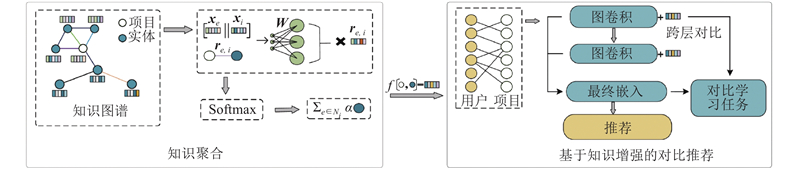
Abstract A new contrastive recommendation model was proposed to alleviate the performance degradation caused by the excessive reliance on structural perturbations for data augmentation. The embedding representations of knowledge graphs were leveraged to guide the contrastive learning process for highly effective item recommendation. A relation-aware knowledge aggregation module was designed to capture heterogeneous relational information from the knowledge graphs, thereby obtaining knowledge embeddings. A graph neural network encoder was utilized to learn entity representations from the user-item interaction graphs. The knowledge embeddings were incorporated into the representation learning through a knowledge-enhanced contrastive recommendation module, to enhance the user and item embeddings and improve the recommendation accuracy. Extensive experiments were conducted on three datasets of enterprise services, books, and news. The results demonstrated that the proposed model had significant advantages in handling sparse datasets. Compared with the baseline models KGAT and CKAN, the proposed model achieved average improvements of over 20% on the Recall and NDCG metrics. Compared with the state-of-the-art contrastive learning models such as KGIN, KGCL and MGDCF, an average performance gain of 10% was realized. These results demonstrate that the proposed method has comprehensive performance advantages.
|
|
Received: 04 March 2025
Published: 15 December 2025
|
|
|
| Fund: 国家重点研发计划资助项目(2024YFB3312600);浙江省“领雁”研发攻关计划资助项目(2024C01107). |
|
Corresponding Authors:
Huili GE
E-mail: taoxie@cjlu.edu.cn;429362862@qq.com
|
知识嵌入增强的对比推荐模型
为了缓解对比推荐模型因过度依赖结构扰动进行数据增强而导致性能下降的问题,提出知识嵌入增强的对比推荐模型,利用知识图谱的嵌入表征来引导对比学习过程,从而实现高效的物品推荐. 通过关系感知的知识聚合模块捕获知识图谱中的异质性关系信息以获得知识嵌入,利用图神经网络编码器从用户-项目交互图中获取实体表征;通过基于知识增强的对比推荐模块将知识嵌入融入用户交互图的表征学习中,强化用户和项目嵌入表示,从而提升推荐精度. 在企业服务、书籍和新闻3个数据集上进行大量实验,结果表明,所提模型在处理稀疏数据集时具有明显优势. 相较于基线模型KGAT、CKAN,所提模型在Recall和NDCG指标上的平均提升幅度超过20%;与性能优越的KGIN、KGCL、MGDCF等对比学习模型相比,实现了平均10%的性能增益,说明所提方法具有全面的性能优势.
关键词:
推荐系统,
知识图谱,
对比学习,
数据增强,
数据稀疏
|
|
| [1] |
KO H, LEE S, PARK Y, et al A survey of recommendation systems: recommendation models, techniques, and application fields[J]. Electronics, 2022, 11 (1): 141
doi: 10.3390/electronics11010141
|
|
|
| [2] |
秦川, 祝恒书, 庄福振, 等 基于知识图谱的推荐系统研究综述[J]. 中国科学: 信息科学, 2020, 50(7): 937–956.
QIN Chuan, ZHU Hengshu, ZHUANG Fuzhen, et al. A survey on knowledge graph-based recommender systems [J]. Scientia Sinica: Informationis, 2020, 50(7): 937–956.
|
|
|
| [3] |
ABDUL HUSSIEN F T, RAHMA A M S, ABDUL WAHAB H B Recommendation systems for E-commerce systems an overview[J]. Journal of Physics: Conference Series, 2021, 1897 (1): 12024
doi: 10.1088/1742-6596/1897/1/012024
|
|
|
| [4] |
DELDJOO Y, SCHEDL M, CREMONESI P, et al Recommender systems leveraging multimedia content[J]. ACM Computing Surveys, 2021, 53 (5): 1- 38
|
|
|
| [5] |
郭向星, 周魏, 杨正益, 等 基于自监督图卷积和注意力机制实现隐式反馈降噪的社交推荐[J]. 电子学报, 2025, 53 (1): 151- 162
GUO Xiangxing, ZHOU Wei, YANG Zhengyi, et al Denoising implicit feedback with self-supervised graph convolution network and attention mechanism for social recommendation[J]. Acta Electronica Sinica, 2025, 53 (1): 151- 162
|
|
|
| [6] |
王文虎, 张德祥, 李晓鹏 基于移动互联网的大型仪器设备推荐系统的研究[J]. 信息与电脑: 理论版, 2021, 33 (20): 128- 132
WANG Wenhu, ZHANG Dexiang, LI Xiaopeng Research on large-scale instrument and equipment recommendation system based on mobile Internet[J]. China Computer & Communication, 2021, 33 (20): 128- 132
|
|
|
| [7] |
PERIFANIS V, EFRAIMIDIS P S Federated neural collaborative filtering[J]. Knowledge-Based Systems, 2022, 242: 108441
doi: 10.1016/j.knosys.2022.108441
|
|
|
| [8] |
SEDHAIN S, MENON A K, SANNER S, et al. AutoRec: autoencoders meet collaborative filtering [C]// Proceedings of the 24th International Conference on World Wide Web. Florence: ACM, 2015: 111–112.
|
|
|
| [9] |
CHEN J, ZHANG H, HE X, et al. Attentive collaborative filtering: multimedia recommendation with item-and component-level attention [C]// Proceedings of the 40th International ACM SIGIR Conference on Research and Development in Information Retrieval. Tokyo: ACM, 2017: 335–344.
|
|
|
| [10] |
HE X, DENG K, WANG X, et al. LightGCN: simplifying and powering graph convolution network for recommendation [C]// Proceedings of the 43rd International ACM SIGIR Conference on Research and Development in Information Retrieval. [S.l.]: ACM, 2020: 639–648.
|
|
|
| [11] |
WU L, HE X, WANG X, et al A survey on accuracy-oriented neural recommendation: from collaborative filtering to information-rich recommendation[J]. IEEE Transactions on Knowledge and Data Engineering, 2023, 35 (5): 4425- 4445
|
|
|
| [12] |
HUANG C, XU H, XU Y, et al. Knowledge-aware coupled graph neural network for social recommendation [C]// Proceedings of the 35th AAAI Conference on Artificial Intelligence. [S.l.]: AAAI Press, 2021: 4115–4122.
|
|
|
| [13] |
赵晔辉, 柳林, 王海龙, 等 知识图谱推荐系统研究综述[J]. 计算机科学与探索, 2023, 17 (4): 771- 791
ZHAO Yehui, LIU Lin, WANG Hailong, et al Survey of knowledge graph recommendation system research[J]. Journal of Frontiers of Computer Science and Technology, 2023, 17 (4): 771- 791
doi: 10.3778/j.issn.1673-9418.2205052
|
|
|
| [14] |
SANG L, XU M, QIAN S, et al Knowledge graph enhanced neural collaborative recommendation[J]. Expert Systems with Applications, 2021, 164: 113992
doi: 10.1016/j.eswa.2020.113992
|
|
|
| [15] |
BORDES A, USUNIER N, GARCIA-DURÁN A, et al. Translating embeddings for modeling multi-relational data [C]// Proceedings of the 27th International Conference on Neural Information Processing Systems. Lake Tahoe: Curran Associates Inc, 2013: 2787–2795.
|
|
|
| [16] |
YU X, REN X, SUN Y, et al. Personalized entity recommendation: a heterogeneous information network approach [C]// Proceedings of the 7th ACM International Conference on Web Search and Data Mining. New York: ACM, 2014: 283–292.
|
|
|
| [17] |
HU B, SHI C, ZHAO W X, et al. Leveraging meta-path based context for top-N recommendation with a neural co-attention model [C]// Proceedings of the 24th ACM SIGKDD International Conference on Knowledge Discovery & Data Mining. London: ACM, 2018: 1531–1540.
|
|
|
| [18] |
ZHAO H, YAO Q, LI J, et al. Meta-graph based recommendation fusion over heterogeneous information networks [C]// Proceedings of the 23rd ACM SIGKDD International Conference on Knowledge Discovery and Data Mining. Halifax: ACM, 2017: 635–644.
|
|
|
| [19] |
HUANG L, GUAN C R, HUANG Z W, et al Broad recommender system: an efficient nonlinear collaborative filtering approach[J]. IEEE Transactions on Emerging Topics in Computational Intelligence, 2024, 8 (4): 2843- 2857
doi: 10.1109/TETCI.2024.3378599
|
|
|
| [20] |
YANG D, GUO Z, WANG Z, et al. A knowledge-enhanced deep recommendation framework incorporating GAN-based models [C]// Proceedings of the IEEE International Conference on Data Mining. Singapore: IEEE, 2018: 1368–1373.
|
|
|
| [21] |
DONG Y, CHAWLA N V, SWAMI A. Metapath2vec: scalable representation learning for heterogeneous networks [C]// Proceedings of the 23rd ACM SIGKDD International Conference on Knowledge Discovery and Data Mining. Halifax: ACM, 2017: 135–144.
|
|
|
| [22] |
WANG H, ZHANG F, WANG J, et al. RippleNet: propagating user preferences on the knowledge graph for recommender systems [C]// Proceedings of the 27th ACM International Conference on Information and Knowledge Management. Torino: ACM, 2018: 417–426.
|
|
|
| [23] |
MA W, ZHANG M, CAO Y, et al. Jointly learning explainable rules for recommendation with knowledge graph [C]// Proceedings of the World Wide Web Conference. San Francisco: ACM, 2019: 1210–1221.
|
|
|
| [24] |
GAO C, ZHENG Y, LI N, et al A survey of graph neural networks for recommender systems: challenges, methods, and directions[J]. ACM Transactions on Recommender Systems, 2023, 1 (1): 1- 51
|
|
|
| [25] |
WANG H, ZHAO M, XIE X, et al. Knowledge graph convolutional networks for recommender systems [C]// Proceedings of the World Wide Web Conference. San Francisco: ACM, 2019: 3307–3313.
|
|
|
| [26] |
WANG X, HE X, CAO Y, et al. KGAT: knowledge graph attention network for recommendation [C]// Proceedings of the 25th ACM SIGKDD International Conference on Knowledge Discovery & Data Mining. Anchorage: ACM, 2019: 950–958.
|
|
|
| [27] |
WANG X, HUANG T, WANG D, et al. Learning intents behind interactions with knowledge graph for recommendation [C]// Proceedings of the Web Conference 2021. Ljubljana: ACM, 2021: 878–887.
|
|
|
| [28] |
WANG Z, LIN G, TAN H, et al. CKAN: collaborative knowledge-aware attentive network for recommender systems [C]// Proceedings of the 43rd International ACM SIGIR Conference on Research and Development in Information Retrieval. [S.l.]: ACM, 2020: 219–228.
|
|
|
| [29] |
HU J, HOOI B, QIAN S, et al MGDCF: distance learning via Markov graph diffusion for neural collaborative filtering[J]. IEEE Transactions on Knowledge and Data Engineering, 2024, 36 (7): 3281- 3296
doi: 10.1109/TKDE.2023.3348537
|
|
|
| [30] |
MA T, HUANG L, LU Q, et al KR-GCN: knowledge-aware reasoning with graph convolution network for explainable recommendation[J]. ACM Transactions on Information Systems, 2023, 41 (1): 1- 27
|
|
|
| [31] |
YU J, YIN H, XIA X, et al Self-supervised learning for recommender systems: a survey[J]. IEEE Transactions on Knowledge and Data Engineering, 2024, 36 (1): 335- 355
doi: 10.1109/TKDE.2023.3282907
|
|
|
| [32] |
YANG Y, HUANG C, XIA L, et al. Knowledge graph contrastive learning for recommendation [C]// Proceedings of the 45th International ACM SIGIR Conference on Research and Development in Information Retrieval. Madrid: ACM, 2022: 1434–1443.
|
|
|
| [33] |
WU J, WANG X, FENG F, et al. Self-supervised graph learning for recommendation [C]// Proceedings of the 44th International ACM SIGIR Conference on Research and Development in Information Retrieval. [S.l.]: ACM, 2021: 726–735.
|
|
|
| [34] |
XIE X, SUN F, LIU Z, et al. Contrastive learning for sequential recommendation [C]// Proceedings of the IEEE 38th International Conference on Data Engineering. Kuala Lumpur: IEEE, 2022: 1259–1273.
|
|
|
| [35] |
XIA L, HUANG C, XU Y, et al. Hypergraph contrastive collaborative filtering [C]// Proceedings of the 45th International ACM SIGIR Conference on Research and Development in Information Retrieval. Madrid: ACM, 2022: 70–79.
|
|
|
| [36] |
LIN Z, TIAN C, HOU Y, et al. Improving graph collaborative filtering with neighborhood-enriched contrastive learning [C]// Proceedings of the ACM Web Conference. Lyon: ACM, 2022: 2320–2329.
|
|
|
|
Viewed |
|
|
|
Full text
|
|
|
|
|
Abstract
|
|
|
|
|
Cited |
|
|
|
|
| |
Shared |
|
|
|
|
| |
Discussed |
|
|
|
|