|
|
|
| Zero-shot object rumor detection based on contrastive learning |
Ke CHEN1( ),Wenhao ZHANG2 ),Wenhao ZHANG2 |
1. School of Computer, Guangdong University of Petrochemical Technology, Maoming 525000, China
2. School of Electronic and Information Engineering, Guangdong University of Petrochemical Technology, Maoming 525000, China |
|
|
|
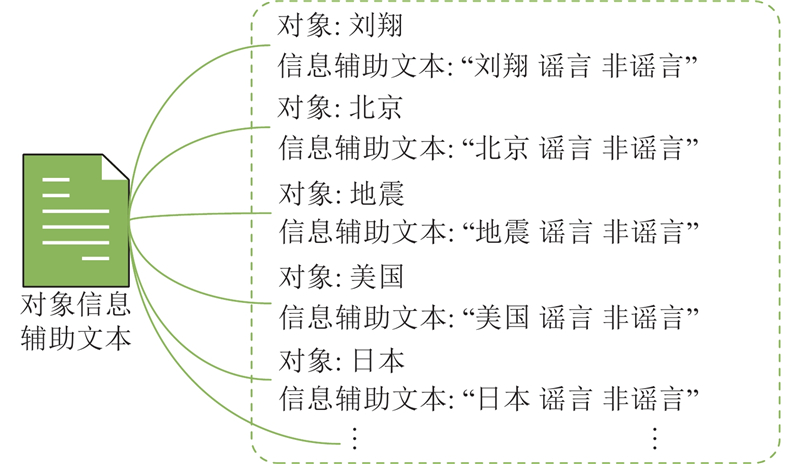
Abstract Existing rumor detection models often rely on large-scale manually annotated rumor datasets, which are costly and limited in their ability to detect unknown rumors due to the reliance on features derived from debunked rumors. To address this limitation, an approach for rumor detection targeted at different objects was proposed. Leveraging the zero-shot learning, the rumor dataset was divided into multiple datasets with non-overlapping samples and contents based on different objects, enabling the zero-shot object-oriented rumor detection task. Correspondingly, a universal mask feature was constructed to represent the relationship between objects, and a proxy task was designed to differentiate the universal mask feature. Additionally, object-oriented information-assisted text was introduced to reduce noise caused by data augmentation and was linearly transformed with the original vector semantics. Then, a proxy task-based hierarchical contrastive learning model (ZPTHCL) was presented for zero-shot object-oriented rumor detection, which leveraged transfer learning for rumor detection. Finally, experiments were conducted on a zero-shot rumor dataset based on objects and four publicly available datasets, Ma-Weibo, Weibo20, Twitter15 and Twitter16, demonstrating superior performance of the proposed contrastive learning zero-shot object-oriented rumor detection model.
|
|
Received: 20 May 2023
Published: 30 August 2024
|
|
|
| Fund: 国家自然科学基金资助项目(61172145);广东省自然科学基金资助项目(2018A030307032);广东省普通高校重点科研平台和项目(2020ZDZX3038). |
基于对比学习的零样本对象谣言检测
现有的谣言检测模型通常依赖大规模人工标注的谣言数据集,标注成本高且谣言特征来源于已被辟谣的谣言. 为了提高模型对未知谣言的检测能力,提出面向不同对象的谣言检测方法. 基于零样本学习,将谣言数据集按照不同的对象划分为样本与内容互不重叠的多个数据集,从而实现零样本对象谣言检测任务;为了表征对象之间的关系构建通义掩码特征,从而设计区分通义掩码特征的代理任务;为了减少数据增强带来的噪声,引入面向对象的信息辅助文本作为特征,并将其与原语义向量进行线性变换. 在此基础上,提出面向零样本对象谣言检测的基于代理任务的分层对比学习模型(ZPTHCL),可以通过迁移学习进行谣言检测. 在一个基于对象的零样本谣言数据集和Ma-Weibo、Weibo20、Twitter15、Twitter16这4个公开数据集上进行实验,结果表明所提出的对比学习零样本对象谣言检测模型性能更优.
关键词:
谣言检测,
零样本学习,
迁移学习,
代理任务,
对比学习
|
|
| [1] |
KANTAR M. Social Media Trends [R]. London: Kantar Media, 2019.
|
|
|
| [2] |
KAPFERER J. Rumeurs-Le plus vieux média du monde [M]// Pari: Editions du Seuil, 1987: 31−33.
|
|
|
| [3] |
LAROCHELLE H, ERHAN D, BENGIO Y. Zero-data learning of new tasks [C]// Proceedings of the 23rd AAAI Conference on Artificial Intelligence . Chicago: AAAI Press, 2008: 646−651 .
|
|
|
| [4] |
CHANG M W, RATINOV L, ROTH D, et al. Importance of semantic representation: dataless classification [C]// Proceedings of the 23rd AAAI Conference on Artificial Intelligence. Chicago: AAAI Press, 2008: 830−835.
|
|
|
| [5] |
LIN H, YI P, MA J, et al. Zero-shot rumor detection with propagation structure via prompt learning [C]// Proceedings of the AAAI Conference on Artificial Intelligence . Washington: AAAI Press, 2023: 5213−5221.
|
|
|
| [6] |
SONG Y, UPADHYAY S, PENG H, et al Toward any-language zero-shot topic classification of textual documents[J]. Artificial Intelligence, 2019, 274 (C): 133- 150
|
|
|
| [7] |
SONG Y, UPADHYAY S, PENG H, et al. Cross-lingual dataless classification for many languages [C]// Proceedings of the 25th International Joint Conference on Artificial Intelligence . New York: AAAI Press, 2016: 2901−2907.
|
|
|
| [8] |
GOODFELLOW I, POUGET-ABADIE J, MIRZA M, et al Generative adversarial networks[J]. Communications of the ACM, 2020, 63 (11): 139- 44
doi: 10.1145/3422622
|
|
|
| [9] |
KINGMA D P, WELLING M. Auto-encoding variational bayes [C]// Proceedings of the International Conference on Learning Representations . Ithaca: ArXiv, 2014: 14−16.
|
|
|
| [10] |
CHEN T, KORNBLITH S, NOROUZI M, et al. A simple framework for contrastive learning of visual representations [C]// Proceedings of the International Conference on Machine Learning . [s. l. ]: PMLR, 2020: 1597−1607.
|
|
|
| [11] |
HE K, FAN H, WU Y, et al. Momentum contrast for unsupervised visual representation learning [C]// Proceedings of the IEEE/CVF Conference on Computer Vision and Pattern Recognition . Seattle: IEEE, 2020: 9726−9735.
|
|
|
| [12] |
LIANG B, CHEN Z X, GUI L, et al. Zero-shot stance detection via contrastive learning [C]// Proceedings of the ACM Web Conference. Lyon: ACM, 2022: 2738−2747.
|
|
|
| [13] |
VICARIO M D, QUATTROCIOCCHI W, SCALA A, et al Polarization and fake news: early warning of potential misinformation targets[J]. ACM Transactions on the Web, 2019, 13 (2): 1- 22
|
|
|
| [14] |
MEEL P, VISHWAKARMA D K Fake news, rumor, information pollution in social media and web: a contemporary survey of state-of-the-arts, challenges and opportunities[J]. Expert Systems with Applications, 2020, 153 (1): 112986
|
|
|
| [15] |
WANG Z, GUO Y Rumor events detection enhanced by encoding sentimental information into time series division and word representations[J]. Neurocomputing, 2020, 397 (2): 224- 243
|
|
|
| [16] |
KUMAR S, CARLEY K M. Tree LSTMs with convolution units to predict stance and rumor veracity in social media conversations [C]// Proceedings of the 57th annual meeting of the association for computational linguistics . Florence: ACL, 2019: 5047−5058.
|
|
|
| [17] |
BIAN T, XIAO X, XU T, et al. Rumor detection on social media with bi-directional graph convolutional networks [C]// Proceedings of the AAAI Conference on Artificial Intelligence . New York: AAAI Press, 2020: 546−556.
|
|
|
| [18] |
ZHANG Q, LIPANI A, LIANG S, et al. Reply-aided detection of misinformation via bayesian deep learning [C]// Proceedings of the World Wide Web Conference . San Francisco: ACM, 2019: 2333−2343.
|
|
|
| [19] |
RIEDEL B, AUGENSTEIN I, SPITHOURAKIS G P, et al. A simple but tough-to-beat baseline for the fake news challenge stance detection task [EB/OL]. (2018−05−21). https://doi.org/10.48550/arXiv.1707.03264.
|
|
|
| [20] |
LU Y J, LI C T. GCAN: graph-aware co-attention networks for explainable fake news detection on social media [C]// Proceedings of the 58th Annual Meeting of the Association for Computational Linguistics . [s. l. ]: ACL, 2020: 505−514.
|
|
|
| [21] |
RAO D, MIAO X, JIANG Z, et al. STANKER: stacking network based on level-grained attention-masked BERT for rumor detection on social media [C]// Proceedings of the 2021 Conference on Empirical Methods in Natural Language Processing . Online and Punta Cana: ACL, 2021: 3347−3363.
|
|
|
| [22] |
CHEN X, ZHOU F, TRAJCEVSKI G, et al Multi-view learning with distinguishable feature fusion for rumor detection[J]. Knowledge-Based Systems, 2022, 240 (8): 108085
|
|
|
| [23] |
XU Y, GUO J, QIU W, et al. "Comments matter and the more the better!": improving rumor detection with user comments [C]// International Conference on Trust, Security and Privacy in Computing and Communications . Wuhan: IEEE, 2022: 383−390.
|
|
|
| [24] |
PUSHP P K, SRIVASTAVA M M. Train once, test anywhere: zero-shot learning for text classification [EB/OL]. (2017−12−23). https://doi.org/10.48550/arXiv.1 712.05972.
|
|
|
| [25] |
陆恒杨, 范晨悠, 吴小俊. 面向网络社交媒体的少样本新 冠谣言检测 [J]. 中文信息学报, 2022, 36(1): 135−144.
LU Hengyang, FAN Chenyou, WU Xiaojun. Few-shot COVID-19 rumor detection for online social media [J]. Journal of Chinese Information Processing . 2022, 36(1): 135−144.
|
|
|
| [26] |
ZHOU H, MA T, RONG H, et al MDMN: multi-task and domain adaptation based multi-modal network for early rumor detection[J]. Expert Systems with Applications, 2022, 195 (3): 116517
|
|
|
| [27] |
RAN H, JIA C. Unsupervised cross-domain rumor detection with contrastive learning and cross-attention [C]// Proceedings of the AAAI Conference on Artificial Intelligence . Washington: AAAI Press, 2023: 13510−13518.
|
|
|
| [28] |
MA J, GAO W, MITRA P, et al. Detecting rumors from microblogs with recurrent neural networks [C]// Proceedings of the 25th International Joint Conference on Artificial Intelligence . New York: AAAI Press, 2016: 3818−3824.
|
|
|
| [29] |
DEVLIN J, CHANG M, LEE K, et al. BERT: pre-training of deep bidirectional transformers for language understanding [C]// Proceedings of the 2019 Conference of the North American Chapter of the Association for Computational Linguistics . Minneapolis: ACL, 2019: 4171−4186.
|
|
|
| [30] |
BLEI D M, NG A Y, JORDAN M I Latent dirichlet allocation[J]. Journal of Machine Learning Research, 2003, 3 (1): 993- 1022
|
|
|
| [31] |
MA J, GAO W, WEI Z, et al. Detect rumors using time series of social context information on microblogging websites [C]// Proceedings of the 24th ACM International on Conference on Information and Knowledge Management . Melbourne : ACM , 2015: 1751−1754.
|
|
|
| [32] |
MA J, GAO W, WONG K F. Detect rumors in microblog posts using propagation structure via kernel learning [C]// Proceedings of the 55th Annual Meeting of the Association for Computational Linguistics . Vancouver: ACL, 2017: 708−717.
|
|
|
| [33] |
LIU Z, WEI Z, ZHANG R Rumor detection based on convolutional neural network[J]. Journal of Computer Applications, 2017, 37 (11): 3053
|
|
|
| [34] |
SUJANA Y, LI J, KAO H Y. Rumor detection on twitter using multiloss hierarchical bilstm with an attenuation factor [C]// Asian Chapter of the Association for Computational Linguistics . [s. l. ]: ACL, 2020: 18−26.
|
|
|
| [35] |
RANI N, DAS P, BHARDWAJ A K. A hybrid deep learning model based on CNN-BiLSTM for rumor detection [C]// Proceedings of the 2021 6th International Conference on Communication and Electronics Systems . Coimbatre: IEEE, 2021: 1423−1427.
|
|
|
| [36] |
MA J, GAO W, JOTY S, et al An attention-based rumor detection model with tree-structured recursive neural networks[J]. ACM Transactions on Intelligent Systems and Technology, 2020, 11 (4): 1- 28
|
|
|
| [37] |
TU K, CHEN C, HOU C, et al Rumor2vec: a rumor detection framework with joint text and propagation structure representation learning[J]. Information Sciences, 2021, 560 (1): 137- 151
|
|
|
| [38] |
LIU Y, OTT M, GOYAL N, et al. Roberta: a robustly optimized Bert pretraining approach [C]// Proceedings of the 20th Chinese National Conference on Computational Linguistics . Huhhot: Chinese Information Processing Society of China, 2021: 1218−1227.
|
|
|
| [39] |
BELTAGY I, PETERS M E, COHAN A. Longformer: the long-document transformer [EB/OL]. [2020-12-02]. https://doi.org/10.48550/arXiv.2004.05150.
|
|
|
| [40] |
KHOO L M S, CHIEU H L, QIAN Z, et al. Interpretable rumor detection in microblogs by attending to user interactions [C]// Proceedings of the AAAI Conference on Artificial Intelligence . California: AAAI Press, 2020: 8783-8790.
|
|
|
| [41] |
WU Y, ZENG Y, YANG J, et al Weibo rumor recognition based on communication and stacking ensemble learning[J]. Discrete Dynamics in Nature and Society, 2020, 2020: 1- 12
|
|
|
| [42] |
RISCH J, KRESTEL R. Bagging bert models for robust aggression identification [C]// Proceedings of the Second Workshop on Trolling, Aggression and Cyberbullying . Marseille: ELRA, 2020: 55−61.
|
|
|
| [43] |
GENG Y, LIN Z, FU P, et al. Rumor detection on social media: a multi-view model using self-attention mechanism [C]// Proceedings of the Computational Science-ICCS 2019: 19th International Conference . Faro: Springer-Verlag, 2019: 339−352.
|
|
|
|
Viewed |
|
|
|
Full text
|
|
|
|
|
Abstract
|
|
|
|
|
Cited |
|
|
|
|
| |
Shared |
|
|
|
|
| |
Discussed |
|
|
|
|