|
|
|
| Hierarchical classification method for machining process texts integrating multi-channel features and word-weighted clustering |
Aolong TAN( ),Wenjie FU,Ao SHEN,Zhaowei XIANG,Jinghua MA,Qin YIN*() |
| College of Mechanical Engineering, Chongqing University of Technology, Chongqing, 400054, China |
|
|
|
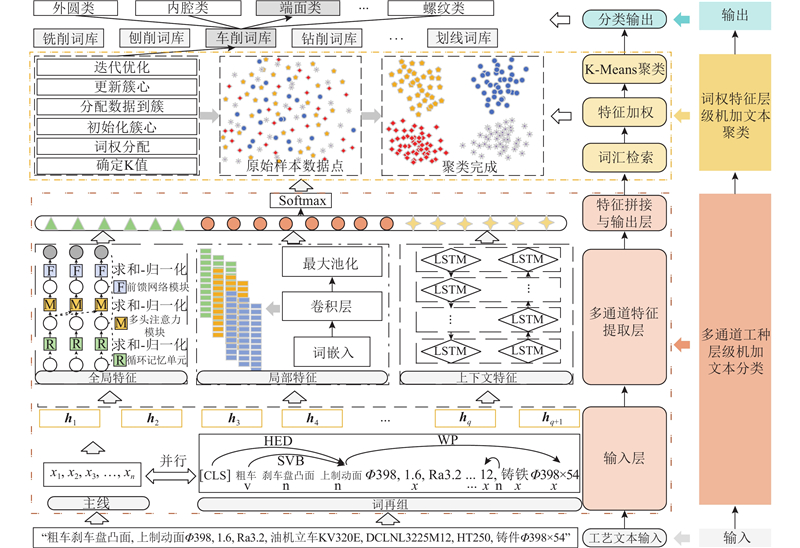
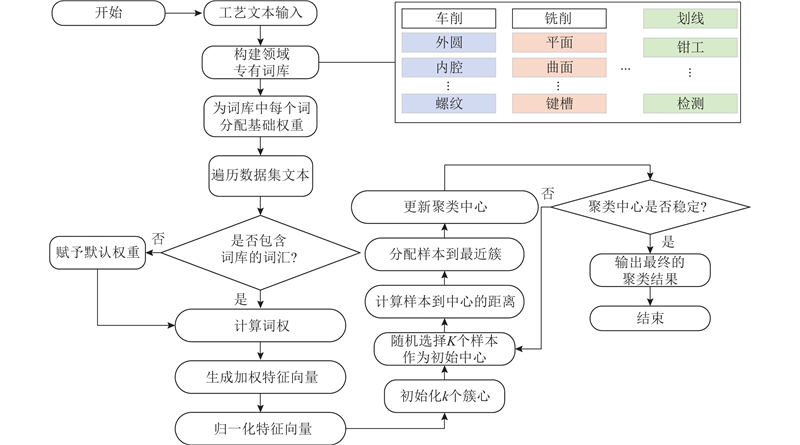
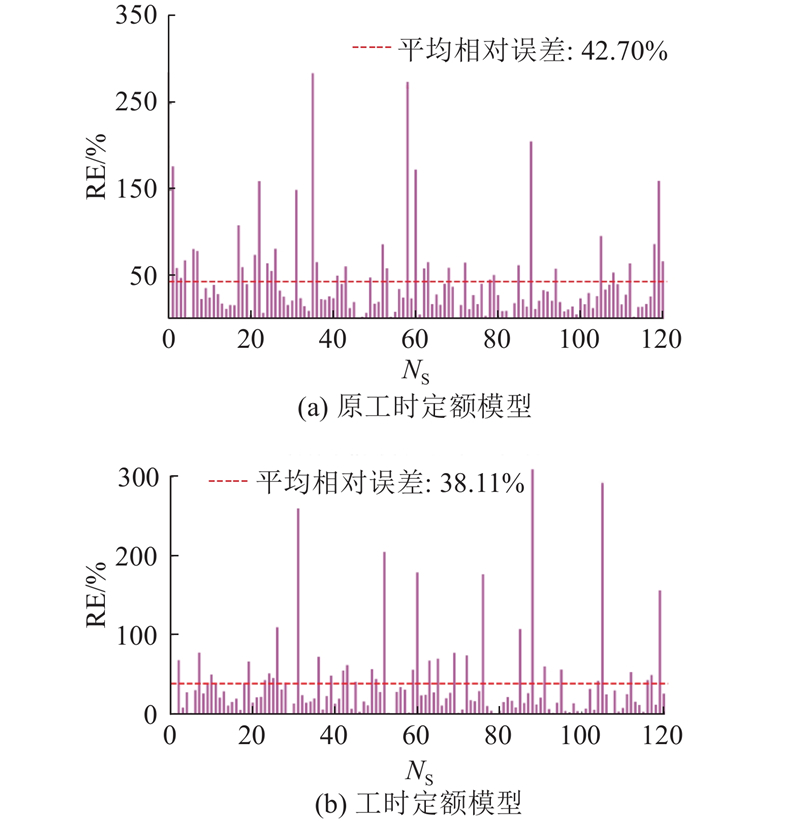
Abstract In man-hour prediction, machining process texts with similar semantics but distinct processing logic make it difficult to effectively distinguish working hours using differentiating features. This leads to ineffective matching of man-hour features. A two-level classification method integrating multi-channel features and word-weighted clustering was proposed to address this problem. A hierarchical framework for process categories and features was constructed. At the process category level, based on BERT word embeddings, a “verb+noun” recombination channel was designed to enhance key information, and CNN, BiLSTM, and R-Transformer were fused to capture local, contextual, and global features. At the feature level, relying on the classification results at the process category level, a K-Means algorithm combined with a domain lexicon weighting mechanism was adopted to perform unsupervised clustering based on geometric features, thereby establishing a fine-grained classification system for machining process categories and geometric features. Experimental results demonstrate that the classification model for process categories outperforms the single-trained BERT model by 4.21, 4.49, and 4.40 percentage points in accuracy, recall, and F1-score, respectively. Compared with traditional K-Means, the feature-level clustering model improves the silhouette coefficient and CH score by factors of 1.02 and 4.86, respectively, and the mean relative error of final man-hour prediction decreases by 4.59 percentage points. Experimental results validate the effectiveness of the two-level framework in fine-grained classification and provide correctly matchable structured input for man-hour quota models.
|
|
Received: 17 September 2025
Published: 16 October 2026
|
|
|
| Fund: 国家自然科学基金资助项目(52105245,52305148,52205144);重庆市教委科学技术研究项目(KJQN202601165). |
|
Corresponding Authors:
Qin YIN
E-mail: 1798254751@qq.com;yinqin@cqut.edu.cn
|
融合多通道特征与词权聚类的机加工艺文本层级分类方法
在工时预测中,机加工艺文本语义相似但加工逻辑不同,同时差异化特征未有效区分工时,导致工时特征难以匹配. 为此,提出融合多通道特征与词权聚类的双层级分类方法. 构建面向工种-特征的层级框架:工种层级以BERT词向量为基础,设计“动词+名词”重组通道强化关键信息,融合CNN、BiLSTM和R-Transformer捕捉局部、上下文与全局特征;特征层级基于工种层级分类结果,结合领域词库加权机制的K-Means算法,依据几何特征进行无监督聚类,构建面向机加工种-几何特征的细粒度分类体系. 实验表明,工种层级分类模型的准确率、召回率和 F1值较单一训练模型BERT的对应指标分别提升了4.21个百分点、4.49个百分点与4.40个百分点;相比传统K-Means,特征层级聚类模型轮廓分数和Calinski-Harabasz 分数分别提升1.02倍和4.86倍;最终工时预测平均相对误差降低了4.59个百分点. 实验结果验证了双层级框架在细粒度分类中的有效性,能够为工时定额模型提供可正确匹配的结构化输入.
关键词:
机加工艺文本,
多通道特征,
词权聚类,
层级框架,
数据增强,
细粒度文本分类,
工时预测
|
|
| [1] |
王婷, 朱小飞, 唐顾 基于知识增强的图卷积神经网络的文本分类[J]. 浙江大学学报: 工学版, 2022, 56 (2): 322- 328
WANG Ting, ZHU Xiaofei, TANG Gu Knowledge-enhanced graph convolutional neural networks for text classification[J]. Journal of Zhejiang University: Engineering Science, 2022, 56 (2): 322- 328
|
|
|
| [2] |
刘娟, 刘检华, 庄存波, 等 基于特征聚类的结构件数控加工工时预测方法[J]. 机械工程学报, 2023, 59 (15): 232- 246
LIU Juan, LIU Jianhua, ZHUANG Cunbo, et al Working-hours prediction method of CNC machining of structural parts based on feature clustering[J]. Journal of Mechanical Engineering, 2023, 59 (15): 232- 246
doi: 10.3901/JME.2023.15.232
|
|
|
| [3] |
刘子文, 刘检华, 程益, 等 基于文本挖掘与神经网络的复杂产品装配工时估算方法[J]. 机械工程学报, 2021, 57 (15): 199- 210
LIU Ziwen, LIU Jianhua, CHENG Yi, et al Assembly time estimation method for complex products based on text mining and neural network[J]. Journal of Mechanical Engineering, 2021, 57 (15): 199- 210
doi: 10.3901/JME.2021.15.199
|
|
|
| [4] |
赵文浩, 邢香园, 王治, 等 基于知识挖掘的航天产品装配工时定额和管理系统[J]. 计算机集成制造系统, 2021, 27 (6): 1594- 1604
ZHAO Wenhao, XING Xiangyuan, WANG Zhi, et al Man-hour quota and management system of aerospace product assembly process based on knowledge mining[J]. Computer Integrated Manufacturing Systems, 2021, 27 (6): 1594- 1604
doi: 10.13196/j.cims.2021.06.006
|
|
|
| [5] |
VERELST T, RUBENSTEIN P K, EICHNER M, et al. Spatial consistency loss for training multi-label classifiers from single-label annotations [C]// Proceedings of the IEEE/CVF Winter Conference on Applications of Computer Vision. Waikoloa: IEEE, 2023: 3868–3878.
|
|
|
| [6] |
ZHANG Y, XIA G, LI X, et al A multi-label text classifier at publication level based on “PubMedBERT+TextRNN” for cancer literature[J]. Studies in Health Technology and Informatics, 2024, 316: 374- 375
|
|
|
| [7] |
YANG D, LIU P Utilizing AI to manage rapport: ERNIE Bot’s interpersonal strategies to respond to negative hotel reviews[J]. Lingua, 2025, 315: 103874
doi: 10.1016/j.lingua.2024.103874
|
|
|
| [8] |
臧洁, 鲁锦涛, 王妍, 等 融合双通道特征的中文短文本情感分类模型[J]. 计算机工程与应用, 2024, 60 (21): 116- 126
ZANG Jie, LU Jintao, WANG Yan, et al Chinese short text sentiment classification model integrating dual-channel features[J]. Computer Engineering and Applications, 2024, 60 (21): 116- 126
doi: 10.3778/j.issn.1002-8331.2310-0020
|
|
|
| [9] |
刘孝保, 陆宏彪, 阴艳超, 等 基于多元神经网络融合的分布式资源空间文本分类研究[J]. 计算机集成制造系统, 2020, 26 (1): 161- 170
LIU Xiaobao, LU Hongbiao, YIN Yanchao, et al Distributed resource spatial text classification based on multivariate neural network fusion[J]. Computer Integrated Manufacturing Systems, 2020, 26 (1): 161- 170
doi: 10.13196/j.cims.2020.01.017
|
|
|
| [10] |
李嘉欣, 莫思特 基于MiniRBT-LSTM-GAT与标签平滑的台区电力工单分类[J]. 计算机应用, 2025, 45 (4): 1356- 1362
LI Jiaxin, MO Site Power work order classification in substation area based on MiniRBT-LSTM-GAT and label smoothing[J]. Journal of Computer Applications, 2025, 45 (4): 1356- 1362
doi: 10.11772/j.issn.1001-9081.2024040533
|
|
|
| [11] |
SUNAGAR P, SOWMYA B J, PRUTHVIRAJA D, et al Hybrid RNN based text classification model for unstructured data[J]. SN Computer Science, 2024, 5 (6): 726
doi: 10.1007/s42979-024-03091-x
|
|
|
| [12] |
余明峰, 秦永彬, 黄瑞章, 等 基于对比学习增强双注意力机制的多标签文本分类方法[J]. 计算机应用, 2025, 45 (6): 1732- 1740
YU Mingfeng, QIN Yongbin, HUANG Ruizhang, et al Multi-label text classification method based on contrastive learning enhanced dual-attention mechanism[J]. Journal of Computer Applications, 2025, 45 (6): 1732- 1740
doi: 10.11772/j.issn.1001-9081.2024070909
|
|
|
| [13] |
陆佳丽 基于Bert-TextCNN的开源威胁情报文本的多标签分类方法[J]. 信息安全研究, 2024, 10 (8): 760- 768
LU Jiali Multi-label classification method of open source threat intelligence text based on Bert-TextCNN[J]. Journal of Information Security Research, 2024, 10 (8): 760- 768
doi: 10.12379/j.issn.2096-1057.2024.08.10
|
|
|
| [14] |
LIU N, WANG Q, REN J Label-embedding bi-directional attentive model for multi-label text classification[J]. Neural Processing Letters, 2021, 53 (1): 375- 389
doi: 10.1007/s11063-020-10411-8
|
|
|
| [15] |
董含笑, 李豫虎, 乔立红, 等 面向机加工艺规程文本的实体识别模型[J]. 计算机辅助设计与图形学学报, 2024, 36 (2): 313- 320
DONG Hanxiao, LI Yuhu, QIAO Lihong, et al Named entity recognition method for process planning text[J]. Journal of Computer-Aided Design and Computer Graphics, 2024, 36 (2): 313- 320
doi: 10.3724/SP.J.1089.2024.19732
|
|
|
| [16] |
马长林, 黄浩 基于多粒度通道和双重强化的文本分类[J]. 华中科技大学学报: 自然科学版, 2024, 52 (11): 133- 139
MA Changlin, HUANG Hao Text classification based on multi-granularity channels and double reinforcement[J]. Journal of Huazhong University of Science and Technology: Nature Science Edition, 2024, 52 (11): 133- 139
doi: 10.13245/j.hust.240402
|
|
|
| [17] |
黄靖, 陶竹林, 杜晓宇, 等 基于特征融合动态图网络的多标签文本分类算法[J]. 软件学报, 2025, 36 (7): 3239- 3252
HUANG Jing, TAO Zhulin, DU Xiaoyu, et al Multi-label text classification algorithm based on feature-fused dynamic graph network[J]. Journal of Software, 2025, 36 (7): 3239- 3252
doi: 10.13328/j.cnki.jos.007229
|
|
|
| [18] |
LAGUTINA N S, LAGUTINA K V, BREDERMAN A M, et al Text classification by CEFR levels using machine learning methods and the BERT language model[J]. Automatic Control and Computer Sciences, 2024, 58 (7): 869- 878
doi: 10.3103/S0146411624700329
|
|
|
| [19] |
XIONG Y, CHEN G, CAO J Research on public service request text classification based on BERT-BiLSTM-CNN feature fusion[J]. Applied Sciences, 2024, 14 (14): 6282
doi: 10.3390/app14146282
|
|
|
| [20] |
BOUCHIHA D, BOUZIANE A, DOUMI N, et al Hierarchical text classification: fine-tuned GPT-2 vs BERT-BiLSTM[J]. Applied Computer Systems, 2025, 30 (1): 40- 46
doi: 10.2478/acss-2025-0005
|
|
|
| [21] |
张彦楠, 黄小红, 马严, 等 基于深度学习的录音文本分类方法[J]. 浙江大学学报: 工学版, 2020, 54 (7): 1264- 1271
ZHANG Yannan, HUANG Xiaohong, MA Yan, et al Method with recording text classification based on deep learning[J]. Journal of Zhejiang University: Engineering Science, 2020, 54 (7): 1264- 1271
|
|
|
| [22] |
CHENG X, ZHANG C, LI Q Improved Chinese short text classification method based on ERNIE_BiGRU model[J]. Journal of Physics: Conference Series, 2021, 1993 (1): 012038
doi: 10.1088/1742-6596/1993/1/012038
|
|
|
| [23] |
WANG Y, ZHOU Y, QI H, et al A complex history browsing text categorization method with improved BERT embedding layer[J]. Applied Intelligence, 2025, 55 (6): 398
doi: 10.1007/s10489-025-06298-4
|
|
|
| [24] |
HAO M, XU B, LIANG J Y, et al Chinese short text classification with mutual-attention convolutional neural networks[J]. ACM Transactions on Asian and Low-Resource Language Information Processing, 2020, 19 (5): 1- 13
|
|
|
|
Viewed |
|
|
|
Full text
|
|
|
|
|
Abstract
|
|
|
|
|
Cited |
|
|
|
|
| |
Shared |
|
|
|
|
| |
Discussed |
|
|
|
|