|
|
|
| Resilience assessment of urban agglomeration passenger transport network under dynamic redistribution |
Fei MA( ),Yuanyuan XUE,Qipeng SUN*(),Qing LIU,Zhong MA,Zhijie YANG ),Yuanyuan XUE,Qipeng SUN*(),Qing LIU,Zhong MA,Zhijie YANG |
| School of Economics and Management, Chang’an University, Xi’an 710064, China |
|
|
|
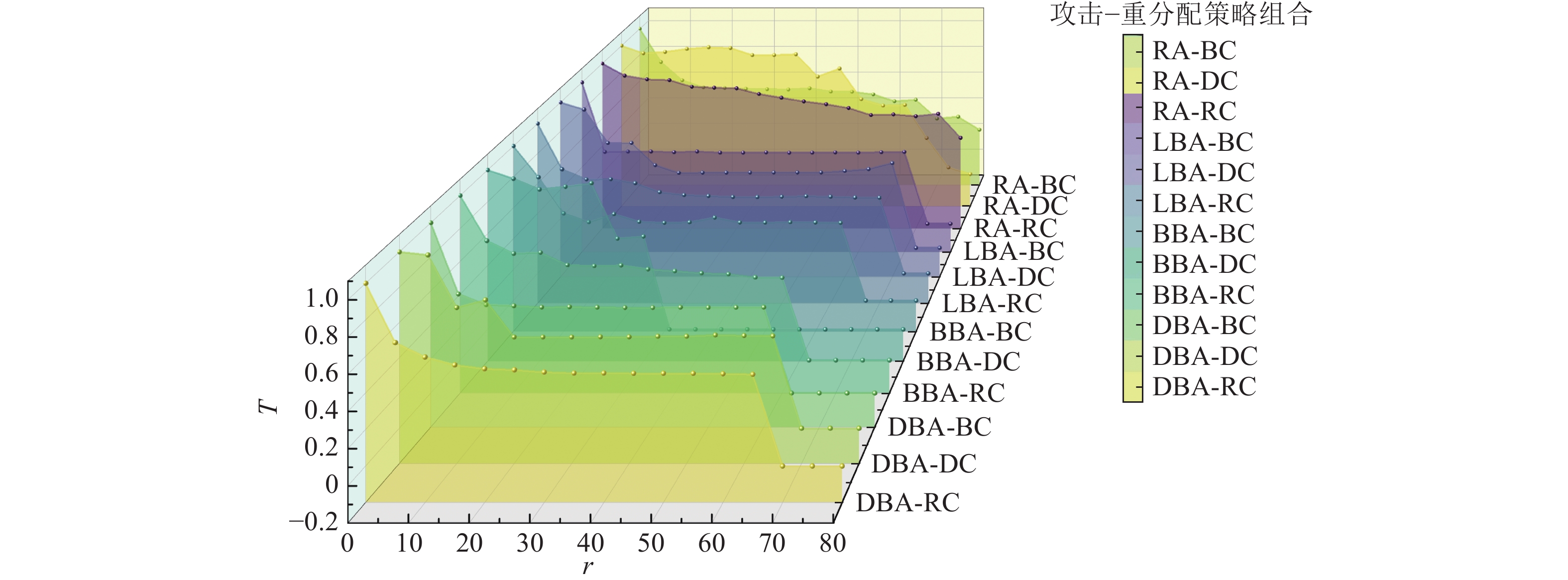
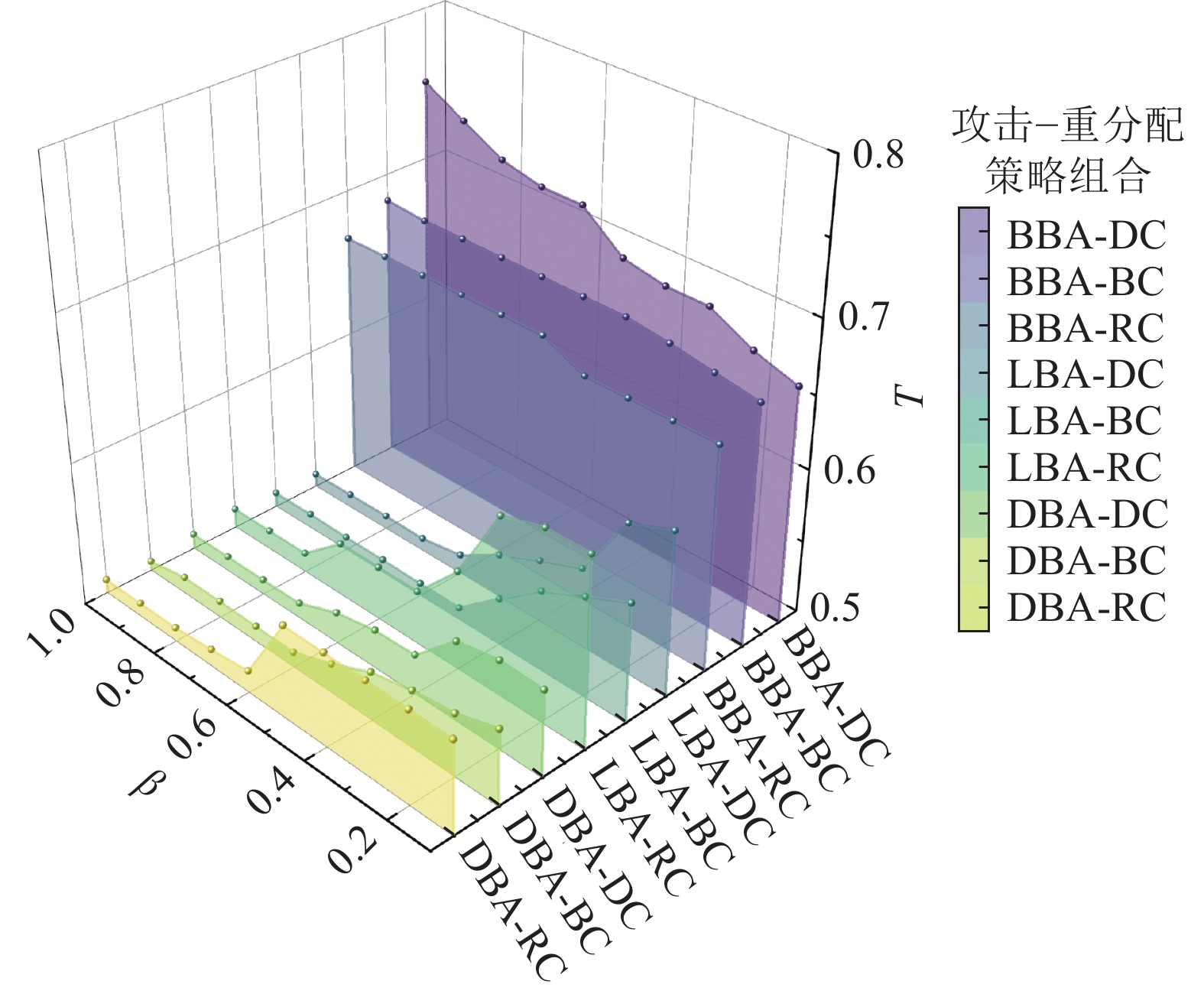
Abstract A network model was constructed based on the Space-P method from the perspective of dynamic passenger flow redistribution in order to effectively evaluate the resilience of multi-modal passenger transport network in urban agglomeration under emergency. A comprehensive resilience evaluation index was established to consider both network structural robustness and passenger accessibility. A dynamic passenger flow redistribution strategy based on residual capacity was proposed. Passenger transfer willingness and capacity adjustment coefficient were introduced to modify the redistribution weight. The improvement of network resilience by the dynamic strategy was analyzed through a comparison with a static strategy. Key nodes within the network were identified. An empirical case study was conducted on the urban agglomeration in the middle reaches of the Yangtze River. Results showed that the degradation of passenger transport network service performance was significantly accelerated by the failure of key nodes. The degradation of network function was effectively delayed by the dynamic strategy under any failure scenario. The overall service performance of the passenger transport network was maintained above 0.6. Superior network resilience was exhibited when the passenger transfer willingness was greater than or equal to 0.4 and the capacity adjustment coefficient was less than or equal to 0.4.
|
|
Received: 23 September 2025
Published: 20 July 2026
|
|
|
| Fund: 国家社科基金重点资助项目(25AGL034);国家自然科学基金资助项目(72104034,72104037);陕西省自然科学基础研究计划资助项目(2024-JC-YBMS-359,2023-JC-QN-0793);陕西省社会科学基金资助项目(2024R009);长安大学中央高校基本科研业务费专项资金资助项目(300102235625). |
|
Corresponding Authors:
Qipeng SUN
E-mail: mafeixa@chd.edu.cn;sunqip@chd.edu.cn
|
动态重分配下城市群客运网络抗毁性评估
为了有效评估突发事件下城市群多模式客运网络的抗毁性,从动态客流重分配视角,基于Space-P方法构建城市群多模式客运网络模型,建立兼顾网络结构稳健性与旅客可达性的综合抗毁性评估指标. 提出基于剩余容量的动态客流重分配策略,引入旅客换乘意愿与容量调节系数修正客流重分配权重,对比静态策略,分析动态策略对网络抗毁性的提升程度并识别关键节点. 以长江中游城市群为例进行实例研究,结果表明,关键节点失效显著加速客运网络服务效能的衰减. 无论何种失效情景,动态策略均能够有效延缓网络功能的退化,客运网络服务效能整体维持在0.6以上. 当旅客换乘意愿大于等于0.4,容量调节系数小于等于0.4时,网络表现出更优的抗毁性.
关键词:
动态客流,
客流重分配策略,
抗毁性评估,
城市群,
多模式客运网络
|
|
| [1] |
侯越, 谢金龙, 张琳栋, 等 异质性解耦与特征分层建模驱动的交通流预测[J]. 浙江大学学报: 工学版, 2026, 60 (6): 1362- 1372
HOU Yue, XIE Jinlong, ZHANG Lindong, et al Traffic flow prediction driven by heterogeneity decoupling and feature layered modeling[J]. Journal of Zhejiang University: Engineering Science, 2026, 60 (6): 1362- 1372
|
|
|
| [2] |
孙健, 万高乐, 康鹏灏, 等 大型综合交通枢纽系统运营韧性评价及障碍因素分析[J]. 安全与环境学报, 2025, 25 (7): 2473- 2483
SUN Jian, WAN Gaole, KANG Penghao, et al Evaluation of operational resilience in comprehensive transportation hub systems: an analysis of obstacle factors[J]. Journal of Safety and Environment, 2025, 25 (7): 2473- 2483
|
|
|
| [3] |
MA W, LIN S, CI Y, et al Resilience evaluation and improvement of post-disaster multimodal transportation networks[J]. Transportation Research Part A: Policy and Practice, 2024, 189: 104243
doi: 10.1016/j.tra.2024.104243
|
|
|
| [4] |
ZHANG J, WANG Z, WANG S, et al Vulnerability assessments of weighted urban rail transit networks with integrated coupled map lattices[J]. Reliability Engineering and System Safety, 2021, 214: 107707
doi: 10.1016/j.ress.2021.107707
|
|
|
| [5] |
JIN Z, DUAN D, WANG N Cascading failure of complex networks based on load redistribution and epidemic process[J]. Physica A: Statistical Mechanics and Its Applications, 2022, 606: 128041
doi: 10.1016/j.physa.2022.128041
|
|
|
| [6] |
高彦丽, 陈光明, 陈世明 基于负载重分配的边相依加权网络鲁棒性研究[J]. 复杂系统与复杂性科学, 2024, 21 (1): 1- 8
GAO Yanli, CHEN Guangming, CHEN Shiming Robustness of edge-dependent weighted networks based on load redistribution[J]. Complex Systems and Complexity Science, 2024, 21 (1): 1- 8
|
|
|
| [7] |
GKIOTSALITIS K, CATS O Public transport planning adaption under the COVID-19 pandemic crisis: literature review of research needs and directions[J]. Transport Reviews, 2021, 41 (3): 374- 392
doi: 10.1080/01441647.2020.1857886
|
|
|
| [8] |
LENG N, CORMAN F The role of information availability to passengers in public transport disruptions: an agent-based simulation approach[J]. Transportation Research Part A: Policy and Practice, 2020, 133: 214- 236
doi: 10.1016/j.tra.2020.01.007
|
|
|
| [9] |
SAHIN B, HASENBEIN J, KUTANOGLU E Value of considering extreme weather resilience in grid capacity expansion planning[J]. Reliability Engineering and System Safety, 2025, 259: 110892
doi: 10.1016/j.ress.2025.110892
|
|
|
| [10] |
郑义彬, 蔡航鹏, 赖伟伟, 等 基于复杂网络的湖北省高速公路网特性分析[J]. 重庆交通大学学报: 自然科学版, 2021, 40 (5): 31- 37
ZHENG Yibin, CAI Hangpeng, LAI Weiwei, et al Characteristics analysis of Hubei expressway network based on complex network[J]. Journal of Chongqing Jiaotong University: Natural Sciences, 2021, 40 (5): 31- 37
doi: 10.3969/j.issn.1674-0696.2021.05.06
|
|
|
| [11] |
SHI J, WEN S, ZHAO X, et al Sustainable development of urban rail transit networks: a vulnerability perspective[J]. Sustainability, 2019, 11 (5): 1335
doi: 10.3390/su11051335
|
|
|
| [12] |
SUN D, ZHAO Y, LU Q C Vulnerability analysis of urban rail transit networks: a case study of Shanghai, China[J]. Sustainability, 2015, 7 (6): 6919- 6936
doi: 10.3390/su7066919
|
|
|
| [13] |
侯本伟, 游丹, 范世杰, 等 基于网络效率的城市轨道交通网络抗震韧性评估[J]. 清华大学学报: 自然科学版, 2024, 64 (3): 509- 519
HOU Benwei, YOU Dan, FAN Shijie, et al Seismic resilience evaluation of urban rail transit network based on network efficiency[J]. Journal of Tsinghua University: Science and Technology, 2024, 64 (3): 509- 519
doi: 10.16511/j.cnki.qhdxxb.2023.26.058
|
|
|
| [14] |
LI T, RONG L Spatiotemporally complementary effect of high-speed rail network on robustness of aviation network[J]. Transportation Research Part A: Policy and Practice, 2022, 155: 95- 114
doi: 10.1016/j.tra.2021.10.020
|
|
|
| [15] |
XU Z, CHOPRA S S Interconnectedness enhances network resilience of multimodal public transportation systems for safe-to-fail urban mobility[J]. Nature Communications, 2023, 14: 4291
doi: 10.1038/s41467-023-39999-w
|
|
|
| [16] |
刘志勇, 李文帅, 李思奇, 等 基于层间关联性的复合公共交通网络布局优化策略[J]. 北京交通大学学报, 2024, 48 (3): 83- 91
LIU Zhiyong, LI Wenshuai, LI Siqi, et al Composite public transport network layout optimization strategy based on interlayer correlation[J]. Journal of Beijing Jiaotong University, 2024, 48 (3): 83- 91
|
|
|
| [17] |
MOTTER A E, LAI Y C Cascade-based attacks on complex networks[J]. Physical Review E, 2002, 66 (6): 065102
doi: 10.1103/PhysRevE.66.065102
|
|
|
| [18] |
马敏, 胡大伟, 刘杰, 等 基于客流加权的城市轨道交通网络抗毁性分析[J]. 中国安全科学学报, 2022, 32 (12): 141- 149
MA Min, HU Dawei, LIU Jie, et al Invulnerability analysis of urban rail transit network based on weighted passenger flow[J]. China Safety Science Journal, 2022, 32 (12): 141- 149
doi: 10.16265/j.cnki.issn1003-3033.2022.12.0203
|
|
|
| [19] |
王永岗, 王龙健, 刘志岗, 等 多模式复合交通网脆弱性测度[J]. 交通运输工程学报, 2023, 23 (1): 195- 207
WANG Yonggang, WANG Longjian, LIU Zhigang, et al Vulnerability metrics of multimodal composite transportation network[J]. Journal of Traffic and Transportation Engineering, 2023, 23 (1): 195- 207
|
|
|
| [20] |
牛路明, 马壮林, 邵逸恒, 等 级联失效下多层地铁网络抗毁性分析[J]. 中国安全科学学报, 2025, 35 (6): 181- 190
NIU Luming, MA Zhuanglin, SHAO Yiheng, et al Invulnerability analysis of multi-layer metro network under cascading failure[J]. China Safety Science Journal, 2025, 35 (6): 181- 190
|
|
|
| [21] |
王立夫, 李欢, 赵国涛 基于节点最大剩余容量的改进负荷再分配策略[J]. 东北大学学报: 自然科学版, 2020, 41 (9): 1223- 1230
WANG Lifu, LI Huan, ZHAO Guotao Improved load re-allocation strategy based on maximum residual capacity of node[J]. Journal of Northeastern University: Natural Science, 2020, 41 (9): 1223- 1230
doi: 10.12068/j.issn.1005-3026.2020.09.002
|
|
|
|
Viewed |
|
|
|
Full text
|
|
|
|
|
Abstract
|
|
|
|
|
Cited |
|
|
|
|
| |
Shared |
|
|
|
|
| |
Discussed |
|
|
|
|