|
|
|
| Thermal-humidity and fresh air dual-layer operation optimization for airport terminal air conditioning systems considering spatiotemporal passenger flow distribution |
Wenbi LIAO1( ),Menglian ZHENG2,*(),Zitao YU2 ),Menglian ZHENG2,*(),Zitao YU2 |
1. Polytechnic Institute, Zhejiang University, Hangzhou 310015, China
2. College of Energy Engineering, Zhejiang University, Hangzhou 310027, China |
|
|
|
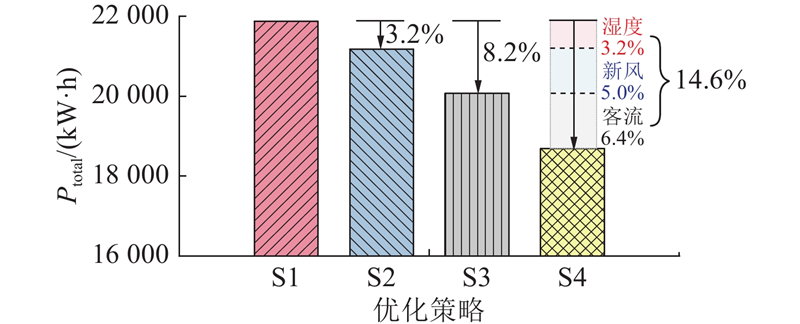
Abstract To address the issues of energy waste in air conditioning systems and reduced passenger comfort caused by load variations and uneven spatiotemporal distribution of passenger flow in multifunctional zones of airport terminals, a spatiotemporal distribution model of passenger flow that integrates dwell and movement behaviors was constructed. Furthermore, a dual-layer operation optimization strategy for air conditioning systems was proposed, jointly considering thermal-humidity comfort and indoor air quality. A model predictive control algorithm was employed in the strategy, where the upper thermal-humidity optimization layer dynamically adjusts air supply parameters, while the lower fresh air optimization layer dynamically regulates the fresh air ratio, achieving rolling-horizon optimization. Simulation results indicate that, compared to the baseline strategy relying solely on temperature control, the proposed strategy synergistically incorporates thermal-humidity regulation, fresh air optimization and passenger flow responsiveness. Under the premise of ensuring zonal thermal-humidity comfort and air quality, this strategy achieves a 14.6% reduction in air conditioning energy consumption.
|
|
Received: 16 June 2025
Published: 06 May 2026
|
|
|
| Fund: 中央高校基本科研业务费专项资金资助项目(2022ZFJH04). |
|
Corresponding Authors:
Menglian ZHENG
E-mail: 22360185@zju.edu.cn;menglian_zheng@zju.edu.cn
|
考虑客流时空分布的航站楼空调系统热湿-新风双层运行优化
针对机场航站楼多功能区域负荷差异及客流时空分布不均导致的空调系统能耗浪费与乘客舒适性较低问题,构建融合乘客停留模型和移动模型的客流时空分布模型,提出兼顾热湿舒适性与空气质量的空调系统双层运行优化策略. 采用模型预测控制算法,通过上层热湿优化层动态调节送风参数,下层新风优化层动态调节新风比,实现滚动时域优化. 仿真结果表明,相较于传统温度调控的基线策略,所提策略协同考虑热湿调控、新风优化、客流响应等因素,在保证区域热湿舒适性和空气质量的前提下,空调系统能耗降低了14.6%.
关键词:
航站楼暖通空调系统,
客流时空分布,
热湿环境,
空气质量,
运行优化
|
|
| [1] |
余娟, 林波荣, 黄彦祥, 等 我国航站楼用能和室内环境质量调研与实测分析[J]. 清华大学学报: 自然科学版, 2020, 60 (12): 977- 984
YU Juan, LIN Borong, HUANG Yenhsiang, et al Investigation and analysis of the energy use and indoor air quality of Chinese airport terminals[J]. Journal of Tsinghua University: Science and Technology, 2020, 60 (12): 977- 984
|
|
|
| [2] |
LIN L, LIU X, ZHANG T, et al Energy consumption index and evaluation method of public traffic buildings in China[J]. Sustainable Cities and Society, 2020, 57: 102132
doi: 10.1016/j.scs.2020.102132
|
|
|
| [3] |
ORTEGA ALBA S, MANANA M Energy research in airports: a review[J]. Energies, 2016, 9 (5): 349
doi: 10.3390/en9050349
|
|
|
| [4] |
王佳丽. 某航站楼冷负荷分区预测及中央空调系统末端优化控制研究 [D]. 西安: 西安建筑科技大学, 2021.
WANG Jiali. Research on cooling load zoning prediction and air conditioning system terminal optimization control of a terminal building [D]. Xi’an: Xi’an University of Architecture and Technology, 2021.
|
|
|
| [5] |
MA K, WANG D, SUN Y, et al Model predictive control for thermal comfort and energy optimization of an air handling unit system in airport terminals using occupant feedback[J]. Sustainable Energy Technologies and Assessments, 2024, 65: 103790
doi: 10.1016/j.seta.2024.103790
|
|
|
| [6] |
TANG H, YU J, GENG Y, et al Unlocking ventilation flexibility of large airport terminals through an optimal CO2-based demand-controlled ventilation strategy[J]. Building and Environment, 2023, 244: 110808
doi: 10.1016/j.buildenv.2023.110808
|
|
|
| [7] |
TANG H, YU J, GENG Y, et al Enhancing occupant-centric ventilation control in airport terminals: a predictive optimization framework integrating agent-based simulation[J]. Building and Environment, 2025, 276: 112829
doi: 10.1016/j.buildenv.2025.112829
|
|
|
| [8] |
LIN L, LIU X, LIU X, et al A prediction model to forecast passenger flow based on flight arrangement in airport terminals[J]. Energy and Built Environment, 2023, 4 (6): 680- 688
doi: 10.1016/j.enbenv.2022.06.006
|
|
|
| [9] |
唐浩, 余娟, 张仲宸, 等 大型航站楼室内物理环境质量实测与时空特征分析研究[J]. 建筑科学, 2023, 39 (10): 9- 14
TANG Hao, YU Juan, ZHANG Zhongchen, et al Analysis of spatiotemporal characteristics of indoor physical environmental quality in large terminal buildings based on field measurement[J]. Building Science, 2023, 39 (10): 9- 14
|
|
|
| [10] |
谷现良, 谢静超, 刘加平 大型机场航站楼冷热负荷时空分布影响因素分析[J]. 建筑科学, 2022, 38 (12): 215- 224
GU Xianliang, XIE Jingchao, LIU Jiaping Analysis of influencing factors of the spatiotemporal distribution of cooling and heating load in large airport terminal[J]. Building Science, 2022, 38 (12): 215- 224
doi: 10.13614/j.cnki.11-1962/tu.2022.12.26
|
|
|
| [11] |
张仲宸, 洪家杰, 朱嘉俊, 等 基于需求导向的航站楼空调及新风控制策略探讨[J]. 建筑节能(中英文), 2021, 49 (6): 61- 66
ZHANG Zhongchen, HONG Jiajie, ZHU Jiajun, et al Demand-oriented terminal air conditioning and fresh air control strategies[J]. Building Energy Efficiency, 2021, 49 (6): 61- 66
doi: 10.3969/j.issn.2096-9422.2021.06.010
|
|
|
| [12] |
REN Z, KIM J I, KIM J Assessment methodology for dynamic occupancy adaptive HVAC control in subway stations integrating passenger flow simulation into building energy modeling[J]. Energy and Buildings, 2023, 300: 113667
doi: 10.1016/j.enbuild.2023.113667
|
|
|
| [13] |
YUAN J, XIAO Z, CHEN X, et al A temperature & humidity setback demand response strategy for HVAC systems[J]. Sustainable Cities and Society, 2021, 75: 103393
doi: 10.1016/j.scs.2021.103393
|
|
|
| [14] |
SINHA K, ALI N, RAJASEKAR E Evaluating the dynamics of occupancy heat gains in a mid-sized airport terminal through agent-based modelling[J]. Building and Environment, 2021, 204: 108147
doi: 10.1016/j.buildenv.2021.108147
|
|
|
| [15] |
KRAMER R P, VAN SCHIJNDEL A W M, SCHELLEN H L The importance of integrally simulating the building, HVAC and control systems, and occupants’ impact for energy predictions of buildings including temperature and humidity control: validated case study museum Hermitage Amsterdam[J]. Journal of Building Performance Simulation, 2017, 10 (3): 272- 293
doi: 10.1080/19401493.2016.1221996
|
|
|
| [16] |
LU X, PANG Z, FU Y, et al The nexus of the indoor CO2 concentration and ventilation demands underlying CO2-based demand-controlled ventilation in commercial buildings: a critical review[J]. Building and Environment, 2022, 218: 109116
doi: 10.1016/j.buildenv.2022.109116
|
|
|
| [17] |
朱颖心, 魏庆芃, 林波荣, 等. 航站楼高大空间节能设计和运行应用指南[M]. 北京: 中国建筑工业出版社, 2012.
|
|
|
| [18] |
LIU X, LI L, LIU X, et al Field investigation on characteristics of passenger flow in a Chinese hub airport terminal[J]. Building and Environment, 2018, 133: 51- 61
|
|
|
| [19] |
GU X, XIE J, HUANG C, et al Prediction of the spatiotemporal passenger distribution of a large airport terminal and its impact on energy simulation[J]. Sustainable Cities and Society, 2022, 78: 103619
doi: 10.1016/j.scs.2021.103619
|
|
|
| [20] |
KIM W, PARK Y, KIM B J Estimating hourly variations in passenger volume at airports using dwelling time distributions[J]. Journal of Air Transport Management, 2004, 10 (6): 395- 400
doi: 10.1016/j.jairtraman.2004.06.009
|
|
|
| [21] |
中华人民共和国国家卫生健康委员会. 室内空气质量标准: GB/T 18883—2002 [S]. 北京: 中国标准出版社, 2003.
|
|
|
| [22] |
YANG Y, SRINIVASAN S, HU G, et al Distributed control of multizone HVAC systems considering indoor air quality[J]. IEEE Transactions on Control Systems Technology, 2021, 29 (6): 2586- 2597
doi: 10.1109/TCST.2020.3047407
|
|
|
| [23] |
YU L, XIE D, JIANG T, et al Distributed real-time HVAC control for cost-efficient commercial buildings under smart grid environment[J]. IEEE Internet of Things Journal, 2018, 5 (1): 44- 55
doi: 10.1109/JIOT.2017.2765359
|
|
|
| [24] |
董俐言, 杨彩青, 张杰, 等 航站楼建筑空调负荷特征及影响因素分析[J]. 暖通空调, 2021, 51 (6): 13- 20
DONG Liyan, YANG Caiqing, ZHANG Jie, et al Analysis of air conditioning load characteristics and influencing factors in terminal buildings[J]. Heating Ventilating and Air Conditioning, 2021, 51 (6): 13- 20
|
|
|
| [25] |
叶翠, 李哲青, 温嘉权, 等 机场航站楼空调系统负荷精算方法研究: 以我国夏热冬暖地区枢纽机场航站楼为例[J]. 暖通空调, 2023, 53 (4): 20- 26
YE Cui, LI Zheqing, WEN Jiaquan, et al Research on HVAC cooling load calculation method of airport terminals: a case study of hub airport terminal in hot summer and warm winter zone of China[J]. Heating Ventilating and Air Conditioning, 2023, 53 (4): 20- 26
doi: 10.19991/j.hvac1971.2023.04.03
|
|
|
| [26] |
LI Z, ZHANG J, GUAN H Passenger spatiotemporal distribution prediction in airport terminals based on physics-guided spatio-temporal graph convolutional network and its effect on indoor environment prediction[J]. Sustainable Cities and Society, 2024, 106: 105375
doi: 10.1016/j.scs.2024.105375
|
|
|
| [27] |
贾俊华. 大面积航班延误下机场应急疏散研究 [D]. 南京: 南京航空航天大学, 2018.
JIA Junhua. Research on the emergency evacuation of passengers in the large-area flight delay situation [D]. Nanjing: Nanjing University of Aeronautics and Astronautics, 2018.
|
|
|
|
Viewed |
|
|
|
Full text
|
|
|
|
|
Abstract
|
|
|
|
|
Cited |
|
|
|
|
| |
Shared |
|
|
|
|
| |
Discussed |
|
|
|
|