



目前,对于湿冷高背压机组运行特性的研究尚不充分,仅有少数文献从机组性能的角度探讨了热网侧运行参数带来的影响. 有学者通过改变进汽质量流量和抽汽质量流量,获得了湿冷高背压机组发电功率和供热功率之间的线性强耦合关系[14-15]. 吕凯等[16-17]在对330、200 MW湿冷机组的Ebsilon变工况仿真中发现,循环水回水温度变化,或循环水质量流量改变,会对机组的热力特性带来影响. 考虑到热网调节方式包括质调节、量调节和质-量并调[18]多种情况,即循环水质量流量和循环水入口温度均可能发生改变,此时湿冷机组是否还会保持电-热之间的线性强耦合关系,电热运行区间是否随之动态变化,进而影响供热机组厂级优化,尚无定量研究.
本研究以东北某热电厂350 MW湿冷高背压机组为研究对象,构建其Ebsilon仿真模型. 在热网质-量并调方式下,量化分析主蒸汽质量流量、抽汽质量流量/压力、循环水质量流量、循环水入口温度等参数变化对机组电热运行特性的影响,建立湿冷高背压机组的动态电热特性模型,并将之应用于热电厂厂内优化运行. 通过电厂运行数据校验该模型的准确性,并量化分析动态电热特性在厂级负荷分配中的节煤效果.
1. 高背压机组建模及典型工况
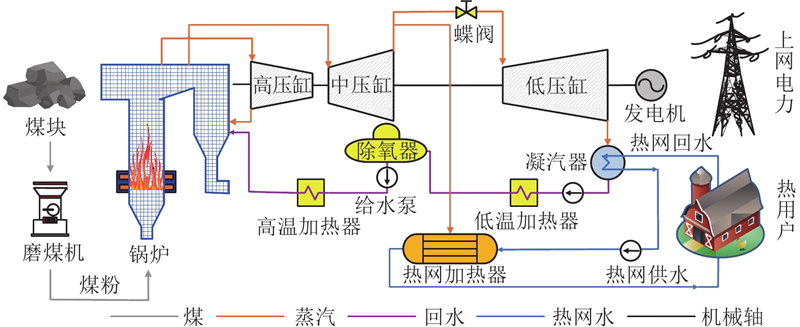
高背压供热改造方案旨在解决传统抽凝机组的低压缸排汽余热损失问题. 它通过提高机组的凝汽器背压以及更换低压转子的方式,提高排汽压力和温度,从而提高通过凝汽器的热网循环水温度,达到直接供热或者经采暖抽汽二次加热后供热的目的. 如图1所示.
图 1
1.1. 高背压机组建模
图 2
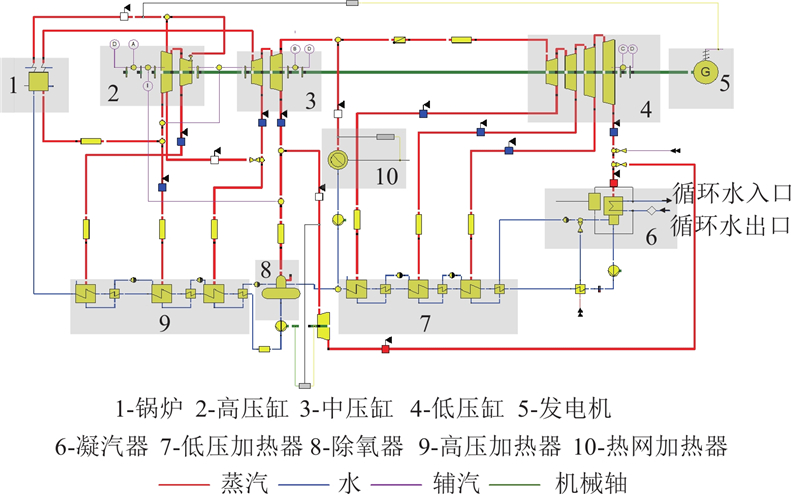
图 2 高背压机组Ebsilon仿真计算模型
Fig.2 Ebsilon simulation calculation model for high back-pressure unit
高背压机组总供热功率
式中:
热网采用质-量并调的方式,循环水质量流量在一定范围内波动,循环水入口温度在一定范围内变化.
1.2. 高背压改造机组的典型工况
高背压机组根据供热方式不同可分为纯背压(无抽汽)工况与抽背(纯背压+抽汽)工况. 其中主蒸汽质量流量和抽汽质量流量是影响高背压机组的电-热关系的主要因素[21].
1) 纯背压工况. 此时机组供热功率完全来自高中低压缸做功后的排汽余热. 显然随着主蒸汽质量流量增大,供热功率将随发电功率
图 3
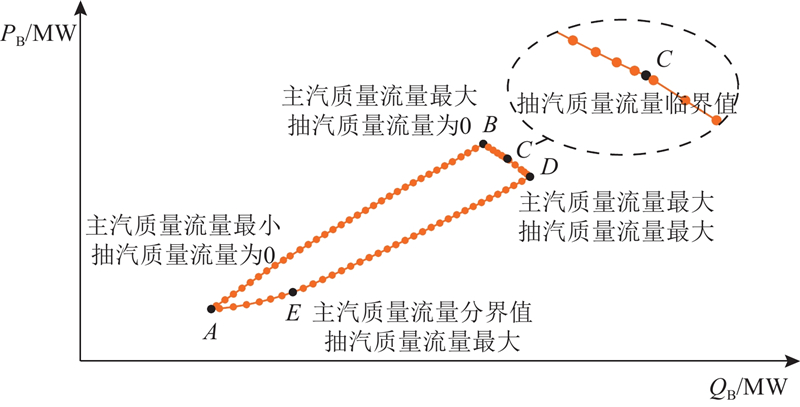
2) 抽背工况. 此时机组在保持余热供热的基础上,于中低压缸进行采暖抽汽,以对热网循环水进行二次加热. 原本经由低压缸做功发电、排汽供热的部分蒸汽,被完全用于供热,显然供热功率增加,发电功率降低,仿真可得电-热关系,如图3中
(a) 最大抽汽工况. 此时机组的发电功率和供热功率均随主蒸汽质量流量单调增加,但并不呈线性关系:在负荷过低即主蒸汽质量流量较小时,低压缸排汽温度上升[22],为了保证足够的低压缸质量流量以防止温度超限,抽汽质量流量将减小,因此供热功率减小. 仿真所得机组在最大抽汽工况下的电热关系曲线如AED段所示.
2. 机组纯背压工况下的动态特性
在热网质-量并调运行时,机组循环水质量流量和循环水入口温度都会发生变化,从而影响高背压机组的电-热关系. 考虑到实际运行时,热电厂内的高背压机组只工作于纯背压工况(
2.1. 质量并调时的机组电热特性
图 4
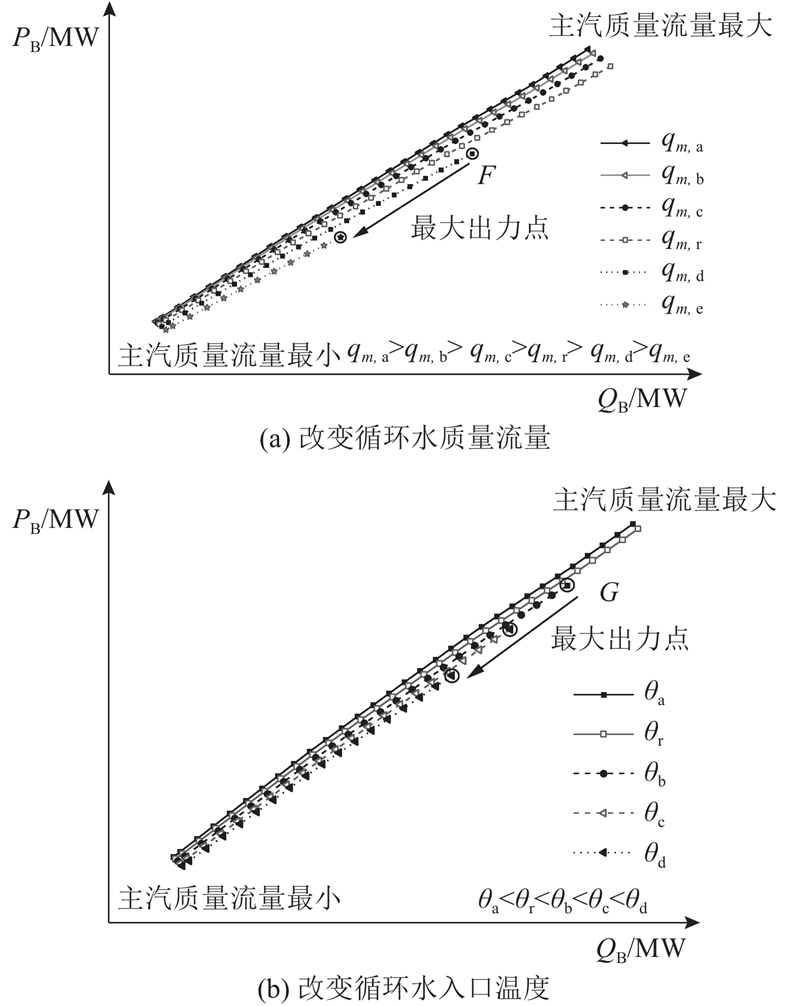
图 4 纯背压工况(非抽汽)工况下的电-热关系
Fig.4 Electric-thermal relationship in pure back-pressure (non-vaporized) conditions
值得注意的是,当循环水质量流量较小(
2.2. 动态电热关系建模
综合考虑主蒸汽质量流量、循环水质量流量和循环水入口温度对高背压机组电-热关系的影响,建立动态电热可行域模型,机组发电功率
式中:斜率
1)线性参数.
将式(1)代入式(2),可知发电功率
其中,
根据Ebsilon仿真拟合可得两者与
图 5
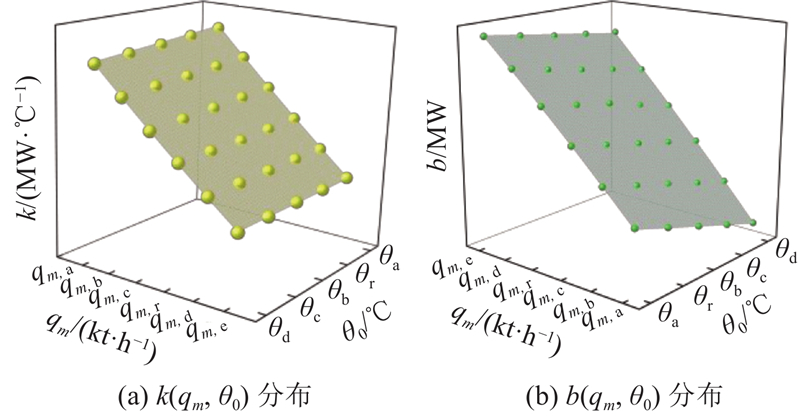
图 5 发电功率与循环水出口温度线性关系的斜率与截距
Fig.5 Slope and intercept of linear relationship between power generation power and outlet temperature of circulating water
将
2)供热边界.
由式(1)可知,在循环水质量流量
式中:
利用Ebsilon仿真得到的循环水出口温度极值变化如图6所示. 图中,灰球曲面、黑球曲面分别表示
图 6
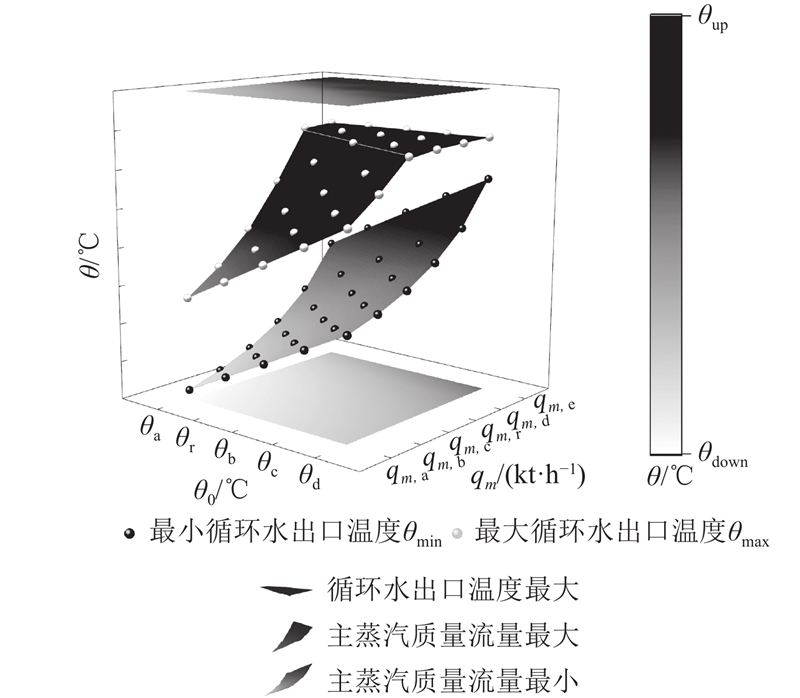
图 6 循环水出口温度的最大值和最小值
Fig.6 Maximum and minimum values of outlet temperature of circulating water
3. 厂级实时负荷分配策略
3.1. 目标函数
针对高背压供机组与抽凝机组协同运行情况,从热电厂经济运行角度出发,以厂内机组的总煤耗最低作为设备调度策略的目标函数:
式中:
式中:
3.2. 约束条件
1)高背压机组约束.
高背压机组的动态可行域约束、爬坡率约束表达式如下:
式中:
2) 抽凝机组约束.
抽凝机组的可行域约束、爬坡率约束表达式如下:
式中:
3) 电热平衡约束.
式中:
以上模型采用Matlab+Yalmip+Cplex进行求解.
4. 算例分析
以东北某热电厂为例,对比高背压机组传统线性模型(模型1)与动态可行域模型(模型2)对厂级负荷分配的影响.
该电厂有4台350 MW燃煤发电机组,其中1号机组为湿冷高背压供热机组,2、3、4号机组为抽凝供热机组,机组煤耗系数如表1所示.
表 1 机组煤耗系数
Tab.1
| 序号 | a/(t·(MW2·h)−1) | b/(t·(MW·h)−1) | c/(t·h−1) | cm | cv |
| 1 | 0.000 098 | 0.299 6 | 11.807 | — | — |
| 2~4 | 0.000 077 | 0.238 9 | 11.616 | 0.419 6 | 0.248 |
通过Ebsilon仿真对1号高背压机组的2种可行域模型分别进行仿真,其中,关于高背压机组的仿真参数以及准确性校验,具体说明如下.
表 2 高背压机组额定参数
Tab.2
| 参数 | 数值 |
| 机组额定出力/MW | 350 |
| 额定主蒸汽压力/MPa | 16.67 |
| 额定主蒸汽温度/℃ | 538.0 |
| 额定蒸汽质量流量/(t·h–1) | 1 043.320 |
| 额定热再热蒸汽温度/℃ | 538.0 |
| 额定给水温度/℃ | 273.9 |
| 额定背压/kPa | 纯凝工况:4.9 高背压工况:54.0 |
| 抽汽压力/MPa | 0.35 |
各机组运行参数如表4所示.
表 4 机组运行参数
Tab.4
| 序号 | |||||
| 1(模型1) | 295.8 | 117.9 | 469.7 | 205.3 | — |
| 2~4 | 350.0 | 140.0 | 359.2 | 0 | 110.2 |
1号高背压机组在模型1中的K和B分别为
表 3 高背压机组设计值和仿真结果比较
Tab.3
| 机组工况 | qm/(t·h−1) | e1/% | θ/℃ | e2/% | ||
| 试验值 | 仿真值 | 试验值 | 仿真值 | |||
| 240 MW 高背压工况 | 877.451 | 862.022 | −1.76 | 74.9 | 74.708 | 0.03 |
| 165 MW 高背压工况 | 597.345 | 595.417 | −0.32 | 68.0 | 67.939 | −0.27 |
| 110 MW 高背压工况 | 400.641 | 394.697 | −1.48 | 61.8 | 61.768 | −0.20 |
图 7
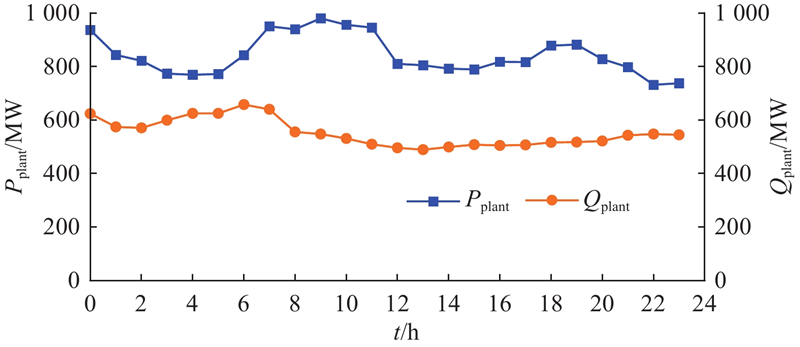
图 8
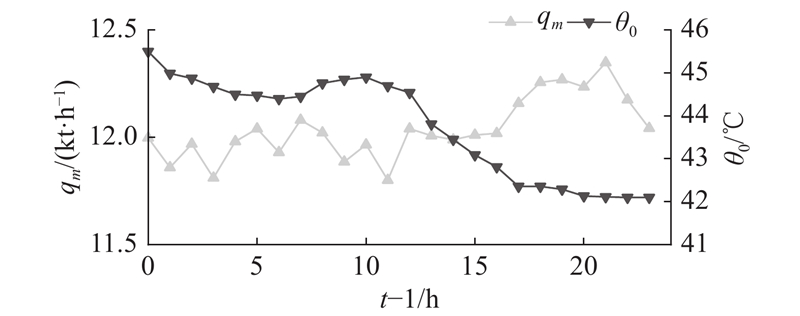
图 8 日内各时段循环水质量流量与循环水入口温度
Fig.8 Hourly variations in circulating water mass flow rate and inlet temperature throughout day
4.1. 动态特性校验
为了验证高背压机组可行域模型在考虑动态特性后更为精准,选取某日高背压机组的实际历史数据进行电热关系的准确度校验. 以5 min为单位时间,将高背压机组各时间段的循环水质量流量、循环水入口温度和供热功率分别输入模型1和模型2中进行滚动计算,输出模型1和模型2的发电功率,并与机组的实际运行的发电功率进行对比,如图9所示. 图中,R1、R2分别为传统线性模型结果与实际发电功率之间的误差、动态可行域模型结果与实际发电功率之间的误差. 从相对误差绝对值的比较结果可见,模型2的计算结果普遍优于模型1的,模型2可以更准确地反映机组实际的发电功率. 这同时说明,相较于传统可行域模型,动态可行域模型能更准确地反映电厂实际高背压机组热网质-量并调时电热关系斜率与截距的动态变化特性,结合图4可以看出,考虑动态特性时高背压机组的电热关系斜率变化范围为0.2%~0.7%,这使得相同供热功率下,发电功率的变化范围扩大2.37~4.24 MW.
图 9
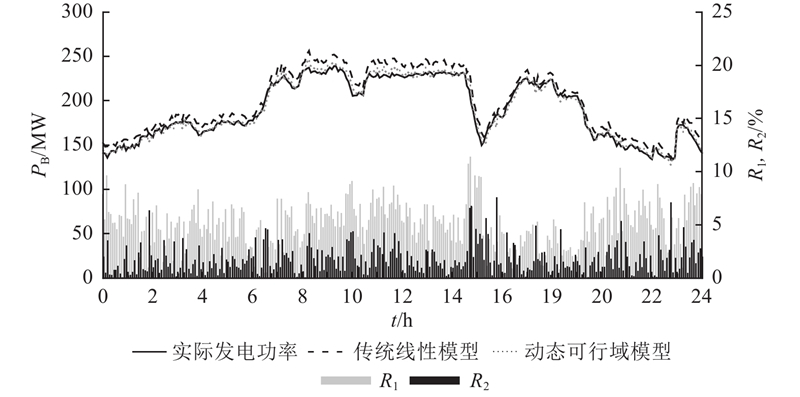
图 9 模型1、2与实际发电功率比较
Fig.9 Comparison of model 1 and model 2 with actual power generation capacity
4.2. 考虑机组动态特性的负荷分配
图 10

图 11
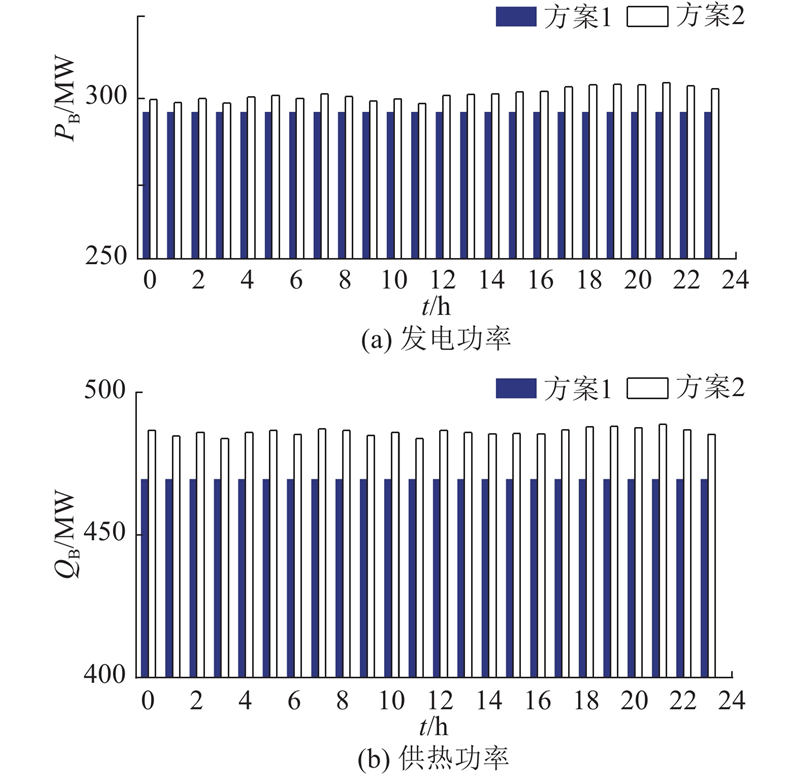
图 11 2种方案下高背压机组电热功率对比
Fig.11 Comparison of electric and heat power of high back-pressure unit under two schemes
在此情况下,进一步探究2种负荷分配方案对煤耗的影响,如图12所示. 可以看出,全时段内考虑机组动态特性的分配方案2均较方案1更节煤,厂内日节煤总量约为29.62 t.
图 12
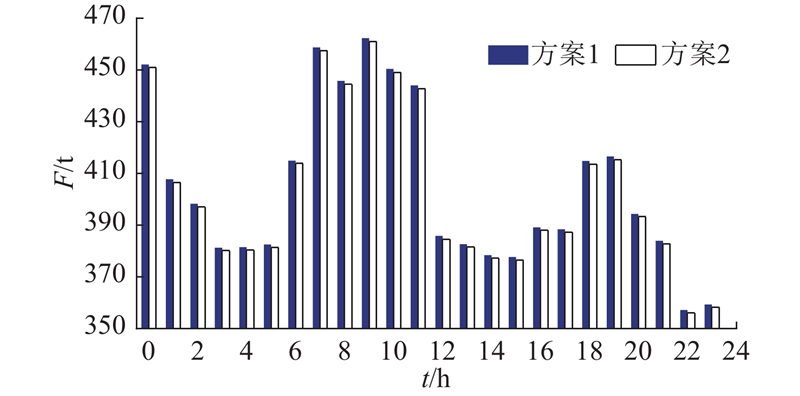
图 12 各时段2种方案下厂总煤耗量
Fig.12 Total coal consumption of plant at different time periods under two schemes
图 13
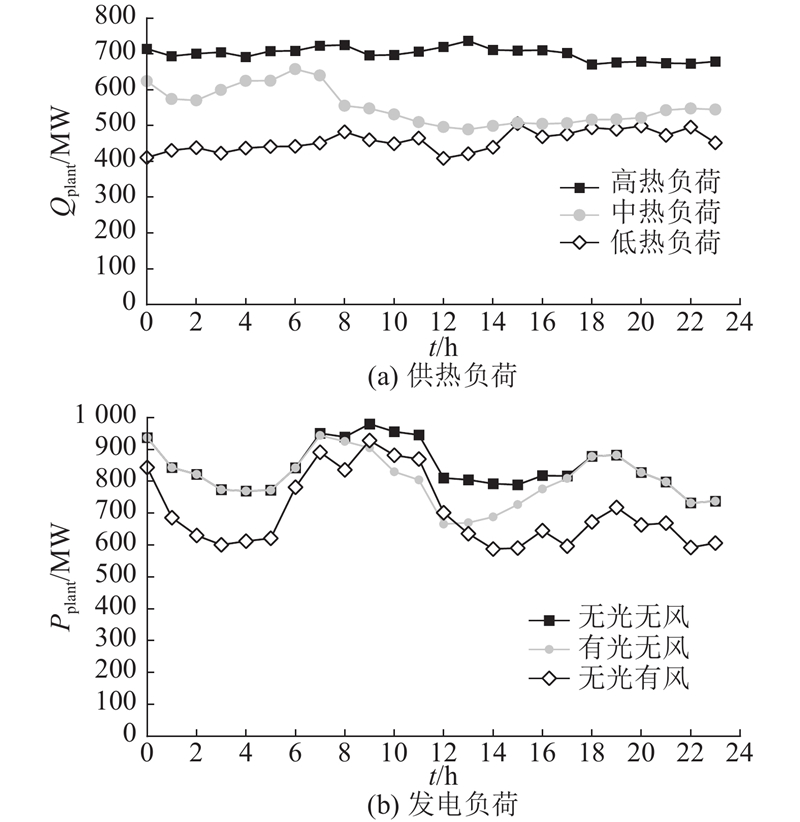
图 14
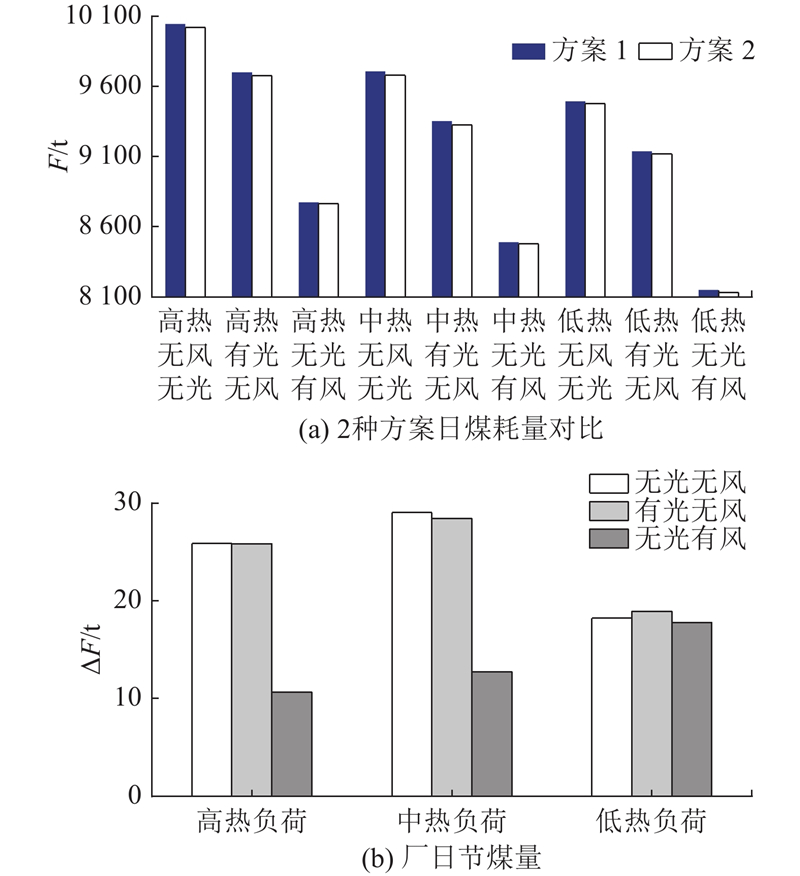
图 15
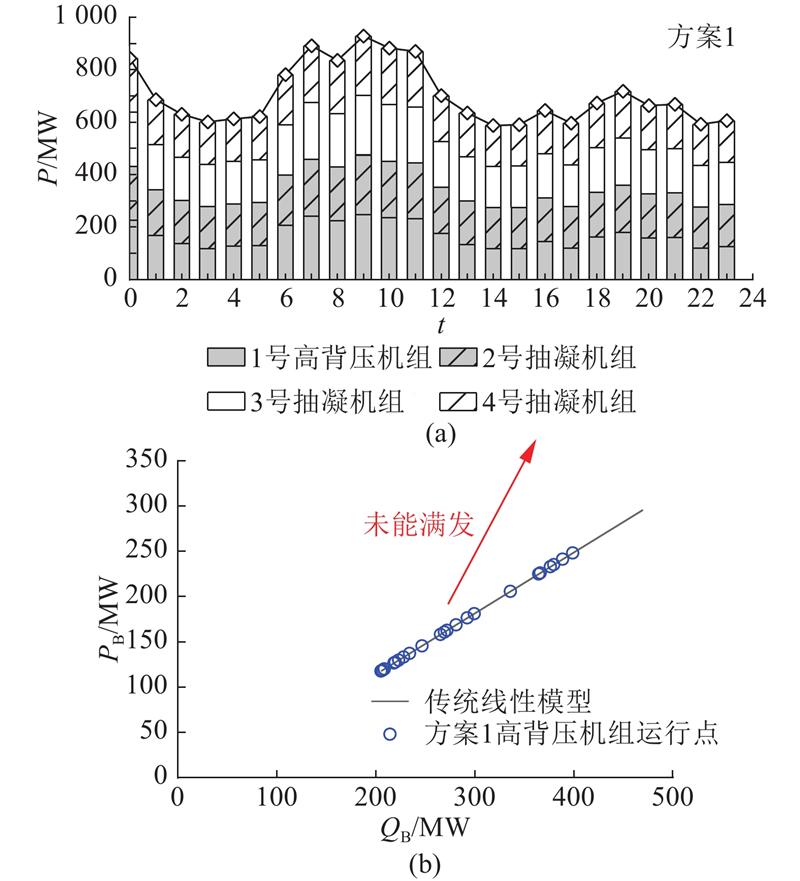
图 15 高热负荷、无光有风场景下高背压机组运行点
Fig.15 Operating point of unit with high back-pressure under high heat load and no light and no wind
5. 结 语
围绕湿冷高背压机组,利用Ebsilon软件对机组进行仿真建模及变工况计算,定性定量分析了主蒸汽质量流量、循环水质量流量和循环水入口温度等动态指标对电热特性的影响,建立了考虑可行域动态特性的厂级负荷分配方案. 实际运行数据验证该模型能更好地反映机组实际的电热关系,并在多场景下对比动态可行域模型的节煤效果.
在纯背压工况下,高背压机组的电热线性关系斜率随循环水质量流量增加而微增,随循环水入口温度增加而微减. 机组的电热运行范围不仅与主蒸汽质量流量有关还受到循环水质量流量、循环水入口温度的影响,当循环水质量流量与入口温度一定时,供热功率边界与循环水出口温度极值直接相关.
在湿冷高背压机组协同抽凝机组共同参与厂级负荷分配时,考虑动态特性的可行域模型相比于传统线性模型,不仅能够更准确地映射实际机组的电热关系,同时还扩大了机组的电热运行范围,350 MW机组在相同供热功率下,发电功率的变化范围扩大约2.37~4.24 MW,使负荷分配结果的经济性更优. 尤其在电、热负荷较高的场景下,高背压机组因得以充分利用,节煤效果更为显著.
本研究仅针对湿冷高背压机组提出动态特性下的厂级负荷分配策略,其他类型机组(如低压缸可灵活切除的抽凝改造机组、复杂双抽供热机组等)在各自动态特性方面对厂级负荷分配的影响,还有待进一步研究,以构建更加全面、细致的厂级负荷分配策略.
参考文献
面向碳达峰碳中和目标的我国电力系统发展研判
[J].
Analysis and reflection on the development of power system towards the goal of carbon emission peak and carbon neutrality
[J].
大规模风电接入电网的相关问题及措施
[J].
Problems and measures of power grid accommodating large scale wind power
[J].
风热冲突下热电厂供热问题研究
[J].
Heat-supply of thermal power plant in wind-heat conflict
[J].
面向提高风电接纳能力的多区域热-电联合调度模型
[J].
Research on heat and electricity coordinated dispatch model of multi-area for improving wind power accommodation ability
[J].
计及灵活性提升的热电厂日前市场竞价策略
[J].
Bidding strategy of day-ahead market for combined heat and power plant considering flexibility improvement
[J].
A novel inlet air cooling system based on liquefied natural gas cold energy utilization for improving power plant performance
[J].DOI:10.1016/j.enconman.2019.03.015 [本文引用: 1]
A review on the performance evaluation of natural draft dry cooling towers and possible improvements via inlet air spray cooling
[J].DOI:10.1016/j.rser.2017.05.151 [本文引用: 1]
大型汽轮机组高背压供热改造适用性分析
[J].
Applicability analysis of high back-pressure heating retrofit for large-scale steam turbine unit
[J].
直接空冷高背压供热机组的梯级供热特性与冷端变工况协同优化
[J].
Cascade heating characteristics and off-design collaborative optimization of direct air-cooled high pressure heat supply power units
[J].
质-量并行调节下直接空冷高背压供热机组弹性运行与优化
[J].
Flexible operation and optimization of direct air-cooled high pressure heat supply power units in quality-volume regulation
[J].
空冷机组高背压供热与抽汽供热的热经济性比较
[J].DOI:10.11930/j.issn.1004-9649.2016.09.104.05 [本文引用: 1]
Thermal economics comparison between high back-pressure heating and extraction heating for a direct air-cooled power unit
[J].DOI:10.11930/j.issn.1004-9649.2016.09.104.05 [本文引用: 1]
干湿联合冷却系统技术发展现状及展望
[J].
Development status and prospect of dry and wet combined cooling system technology
[J].
集成蒸汽引射器热电联产余热供热系统全工况性能分析
[J].
Performance analysis of the congeneration waste heat heating system intergrated with a steam ejector under full conditions
[J].
330 MW高背压供热机组热力特性研究
[J].DOI:10.3969/j.issn.1001-5884.2019.01.017 [本文引用: 1]
Thermodynamic characteristics of a 330 MW unit with high back-pressure circulating water heating
[J].DOI:10.3969/j.issn.1001-5884.2019.01.017 [本文引用: 1]
200MW高背压循环水供热机组热力特性研究
[J].DOI:10.3969/j.issn.1002-3364.2015.04.017 [本文引用: 1]
Thermodynamic characteristics of a 200 MW unit with high back pressure circulating water heating
[J].DOI:10.3969/j.issn.1002-3364.2015.04.017 [本文引用: 1]
城市集中供热系统一次网运行优化及算法
[J].
Primary network operational optimization and algorithm of a district heating system
[J].
Thermodynamic, operational, and techno-economic analysis of the cascade heating system with a double-unit
[J].DOI:10.1016/j.enconman.2020.113558 [本文引用: 1]
Optimal dispatch of the cascade heating CHP plants integrating with the high back-pressure technology
[J].DOI:10.1016/j.csite.2022.102330 [本文引用: 1]
高背压-抽凝机组耦合运行优化技术对深度调峰性能影响及经济性分析
[J].DOI:10.3969/j.issn.1001-5884.2020.04.017 [本文引用: 1]
Effect of coupling operation optimization technology of high back pressure-condensing cogeneration unit on peak regulation performance and economic analysis
[J].DOI:10.3969/j.issn.1001-5884.2020.04.017 [本文引用: 1]
深度调峰工况下600MW汽轮机低压缸流场数值计算与分析
[J].DOI:10.3969/j.issn.1001-5884.2020.03.002 [本文引用: 1]
Numerical calculation and analysis of flow field of low pressure cylinder of 600MW steam turbine in depth peak load conditions
[J].DOI:10.3969/j.issn.1001-5884.2020.03.002 [本文引用: 1]
330 MW机组采暖抽汽对发电热经济性的影响分析
[J].
Analysis of the influence of heating steam extraction of 330 MW unit on the economy of electric generation
[J].
高背压供热机组全厂负荷优化调度的试验研究
[J].
Experimental research on load optimal scheduling of high back pressure heating steam turbine units
[J].
发电机组凝汽器背压的优化计算
[J].
Optimization calculation of condenser backpressure in a generator unit
[J].
全国产分散控制系统开发与应用
[J].
Development and application of fully domestic distributed control system
[J].
国产分散控制系统主要性能测试对比
[J].
Comparisive test of main performance of domestic distributed control system
[J].
300 MW热电机组凝汽器变工况运行的热经济性模拟研究
[J].DOI:10.3969/j.issn.1001-5884.2023.05.017 [本文引用: 1]
Thermal economy simulation study on the variable condition operation of a 300 MW thermoelectric unit’s condenser
[J].DOI:10.3969/j.issn.1001-5884.2023.05.017 [本文引用: 1]


