|
|
|
| Multi-droplet parallel actuation for pin-constrained digital microfluidic system |
Ming CAO( ),Zuwei HUANG,Huihong LIANG,Wufeng DUAN,Sujie YUAN,Zhenmin XU,Kui ZHOU |
| School of Advanced Manufacturing, Nanchang University, Nanchang 330031, China |
|
|
|
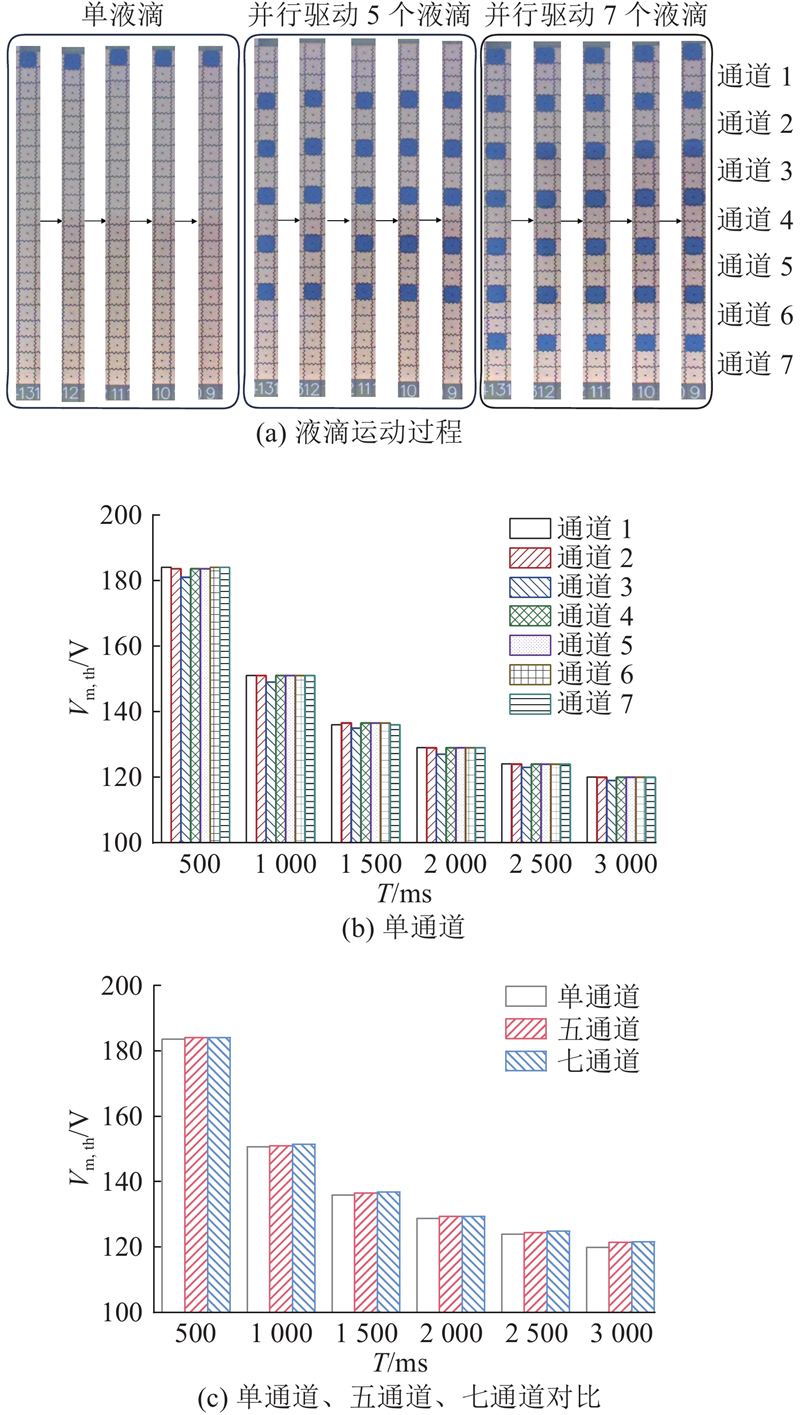
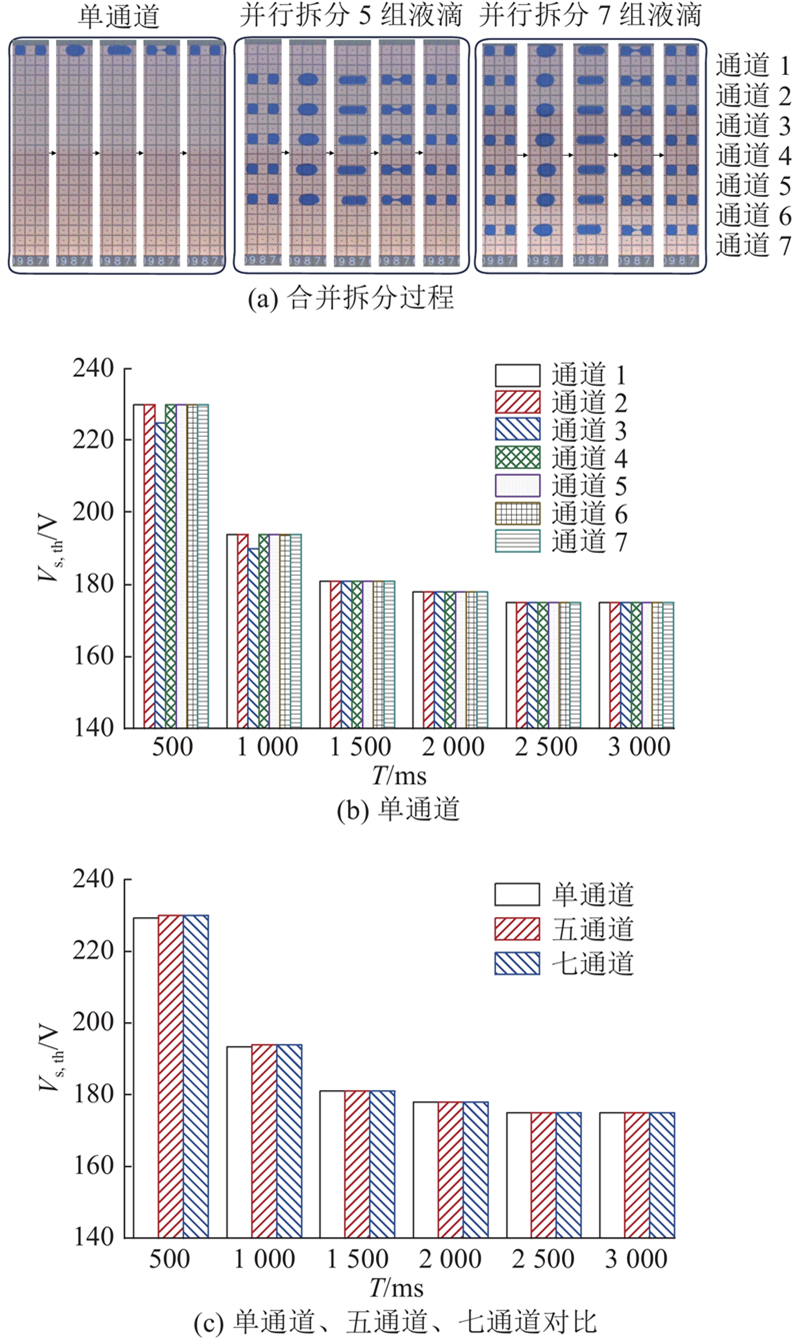
Abstract A pin-limited digital microfluidic system was designed and implemented in order to address the limitation of system throughput imposed by the number of control pins in the digital microfluidic system. A modular design was adopted to decouple the control circuitry from the electrode array, enabling configurable expansion of the number of parallel channels. The similarities and differences between single-droplet actuation and parallel multi-droplet actuation were analyzed based on the fundamental principle of electrowetting on dielectric. The effect of reservoir structure on droplet generation performance was evaluated on the developed platform, and the influence of the number of parallel droplets on droplet actuation performance was analyzed. The experimental results demonstrated that the TC reservoir effectively reduced the minimum driving voltage required for droplet generation, with a maximum reduction of 14.70%, while the coefficient of variation of droplet volume decreased from 1.32% to 0.57%. Variations in the minimum driving voltage required for droplet transport and splitting, compared with the single-droplet case, remained within 1.5%, and the coefficient of variation of droplet volume after splitting consistently remained below 3% under conditions of up to seven parallel droplet groups.
|
|
Received: 27 October 2025
Published: 21 October 2026
|
|
|
| Fund: 江西省重点研发计划资助项目(20232BBE50017);江西省自然科技基金资助项目(20232BAB215016);江西省自然科学基金资助项目(20242BAB25358);江西省研究生创新专项资助项目(YC2025-S349). |
引脚受限数字微流控系统的多液滴并行驱动
针对数字微流控系统中通量受引脚数量制约的问题,设计并实现了引脚数量受限的数字微流控系统. 该系统使用模块化设计解耦控制回路与电极阵列,实现并行通道数量的可配置扩展. 基于介电润湿基本原理,分析单液滴与多液滴并行驱动机理的异同,并在本平台上考察储液槽对液滴生成性能的影响,以及并行液滴数量对液滴驱动性能的影响. 实验结果表明,TC储液槽可以有效降低液滴生成的最小驱动电压,最大降幅为14.70%;液滴体积变异系数由1.32%降低至0.57%. 当并行驱动最多7组液滴时,液滴运动与拆分所需的最小驱动电压相对于单液滴情况变化均不超过1.5%,拆分后液滴体积变异系数始终小于3%.
关键词:
数字微流控,
介电润湿,
液滴等效电路,
液滴生成,
并行液滴驱动,
边缘检测
|
|
| [1] |
Thai D A, Liu Y Nucleic acid amplification tests in digital microfluidics: the promise of next-generation point-of-care diagnostics[J]. Microsystems and Nanoengineering, 2025, 11 (1): 155
doi: 10.1038/s41378-025-00977-5
|
|
|
| [2] |
Gumuscu B Mammalian cell culture and analysis in digital microfluidic platforms[J]. Lab on a Chip, 2025, 25 (9): 3297- 3313
doi: 10.1039/d5lc00250h
|
|
|
| [3] |
Dong W, Fu R, Zhang N, et al Digital microfluidics with integrated Raman sensor for high-sensitivity in-situ bioanalysis[J]. Biosensors and Bioelectronics, 2025, 271: 117036
doi: 10.1016/j.bios.2024.117036
|
|
|
| [4] |
Papamatthaiou S, Menelaou P, Oussallam B, et al Recent advances in bio-microsystem integration and Lab-on-PCB technology[J]. Microsystems and Nanoengineering, 2025, 11 (1): 78
doi: 10.1038/s41378-025-00940-4
|
|
|
| [5] |
Han C, Zhang R, He X, et al A digital manufactured microfluidic platform for flexible construction of 3D co-culture tumor model with spatiotemporal resolution[J]. Biofabrication, 2025, 17 (1): 015029
doi: 10.1088/1758-5090/ad9636
|
|
|
| [6] |
Fan W, Li D, Ding J, et al Reimagining point-of-care assays: automated digital microfluidics for multiplex in vitro diagnostics[J]. Talanta, 2025, 294: 128270
|
|
|
| [7] |
Liu Z, Wang S, Wang K, et al Digital microfluidic-based fluorescence methods for the automated determination of copper ions in wine[J]. Microchimica Acta, 2025, 192 (3): 157
doi: 10.1007/s00604-025-07019-x
|
|
|
| [8] |
Ruan Q, Shi C, Lin X, et al Dynamic whole genome amplification using digital microfluidics for single-cell sequencing[J]. Chemical Engineering Journal, 2025, 511: 162099
doi: 10.1016/j.cej.2025.162099
|
|
|
| [9] |
Jin K, Ding F, Liu X, et al CAB-DMF: enhanced precision in trace-level omics analysis with a capillary action-based digital microfluidic sampling method[J]. Sensors and Actuators B: Chemical, 2026, 450: 139213
doi: 10.1016/j.snb.2025.139213
|
|
|
| [10] |
Xie Y, Chen Z, Cai D, et al Rapid detection of uropathogens using an integrated multiplex digital nucleic acid detection assay powered by a digital-to-droplet microfluidic device[J]. Analytical Chemistry, 2024, 96 (30): 12561- 12569
doi: 10.1021/acs.analchem.4c02578.s001
|
|
|
| [11] |
Bai H, Hu J, Liu T, et al A sample-to-answer digital microfluidic multiplexed PCR system for syndromic pathogen detection in respiratory tract infection[J]. Lab on a Chip, 2025, 25 (6): 1552- 1564
doi: 10.1039/D4LC00704B
|
|
|
| [12] |
Zhai J, Liu Y, Ji W, et al Drug screening on digital microfluidics for cancer precision medicine[J]. Nature Communications, 2024, 15 (1): 4363
doi: 10.1038/s41467-024-48616-3
|
|
|
| [13] |
Yoon S, You D K, Jeong U, et al Microfluidics in high-throughput drug screening: organ-on-a-chip and C. Elegans-based innovations[J]. Biosensors, 2024, 14 (1): 55
doi: 10.3390/bios14010055
|
|
|
| [14] |
Xing Y, Liu Y, Chen R, et al A robust and scalable active-matrix driven digital microfluidic platform based on printed-circuit board technology[J]. Lab on a Chip, 2021, 21 (10): 1886- 1896
doi: 10.1039/D1LC00101A
|
|
|
| [15] |
Roy S, Mitra D, Bhattacharya B B, et al. Pin-constrained designs of digital microfluidic biochips for high-throughput bioassays [C]// 2010 International Symposium on Electronic System Design. Bhubaneswar: IEEE, 2010: 4-9.
|
|
|
| [16] |
Ly K, Pathan A, Rackus D G A review of electrochemical sensing in droplet systems: droplet and digital microfluidics[J]. Analytica Chimica Acta, 2025, 1347: 343744
doi: 10.1016/j.aca.2025.343744
|
|
|
| [17] |
Mugele F, Baret J C Electrowetting: from basics to applications[J]. Journal of Physics: Condensed Matter, 2005, 17 (28): R705
doi: 10.1088/0953-8984/17/28/R01
|
|
|
| [18] |
Millefiorini S, Tkaczyk A H, Sedev R, et al Electrowetting of ionic liquids[J]. Journal of the American Chemical Society, 2006, 128 (9): 3098- 3101
doi: 10.1021/ja057606d
|
|
|
| [19] |
Nanayakkara Y S, Moon H, Payagala T, et al A fundamental study on electrowetting by traditional and multifunctional ionic liquids: possible use in electrowetting on dielectric-based microfluidic applications[J]. Analytical Chemistry, 2008, 80 (20): 7690- 7698
doi: 10.1021/ac8009802
|
|
|
| [20] |
Gong J All-electronic droplet generation on-chip with real-time feedback control for EWOD digital microfluidics[J]. Lab on a Chip, 2008, 8 (6): 898- 906
doi: 10.1039/b717417a
|
|
|
| [21] |
Li Y J, Cahill B P Frequency dependence of low-voltage electrowetting investigated by impedance spectroscopy[J]. Langmuir, 2017, 33 (45): 13139- 13147
doi: 10.1021/acs.langmuir.7b03049
|
|
|
| [22] |
Guan Y, Tong A Y, Nikapitiya N Y J B, et al Numerical modeling of microscale droplet dispensing in parallel-plate electrowetting-on-dielectric (EWOD) devices with various reservoir designs[J]. Microfluidics and Nanofluidics, 2016, 20 (2): 39
doi: 10.1007/s10404-016-1703-8
|
|
|
|
Viewed |
|
|
|
Full text
|
|
|
|
|
Abstract
|
|
|
|
|
Cited |
|
|
|
|
| |
Shared |
|
|
|
|
| |
Discussed |
|
|
|
|