|
|
|
| Interaction between horseshoe vortex and free surface at different Weber numbers |
Weiyuan ZENG( ),Shiying XIONG*() ),Shiying XIONG*() |
| School of Aeronautics and Astronautics, Zhejiang University, Hangzhou 310027, China |
|
|
|
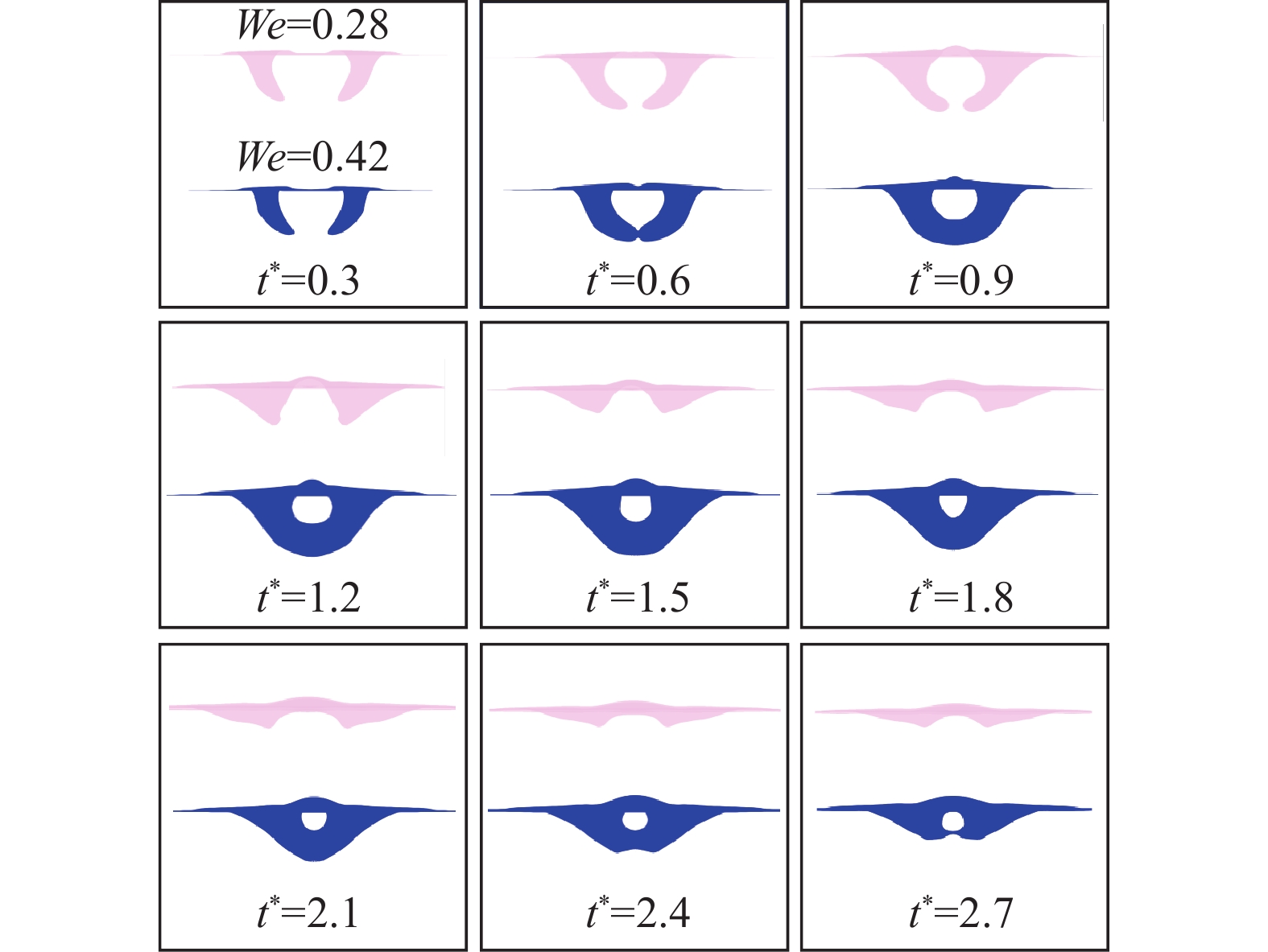
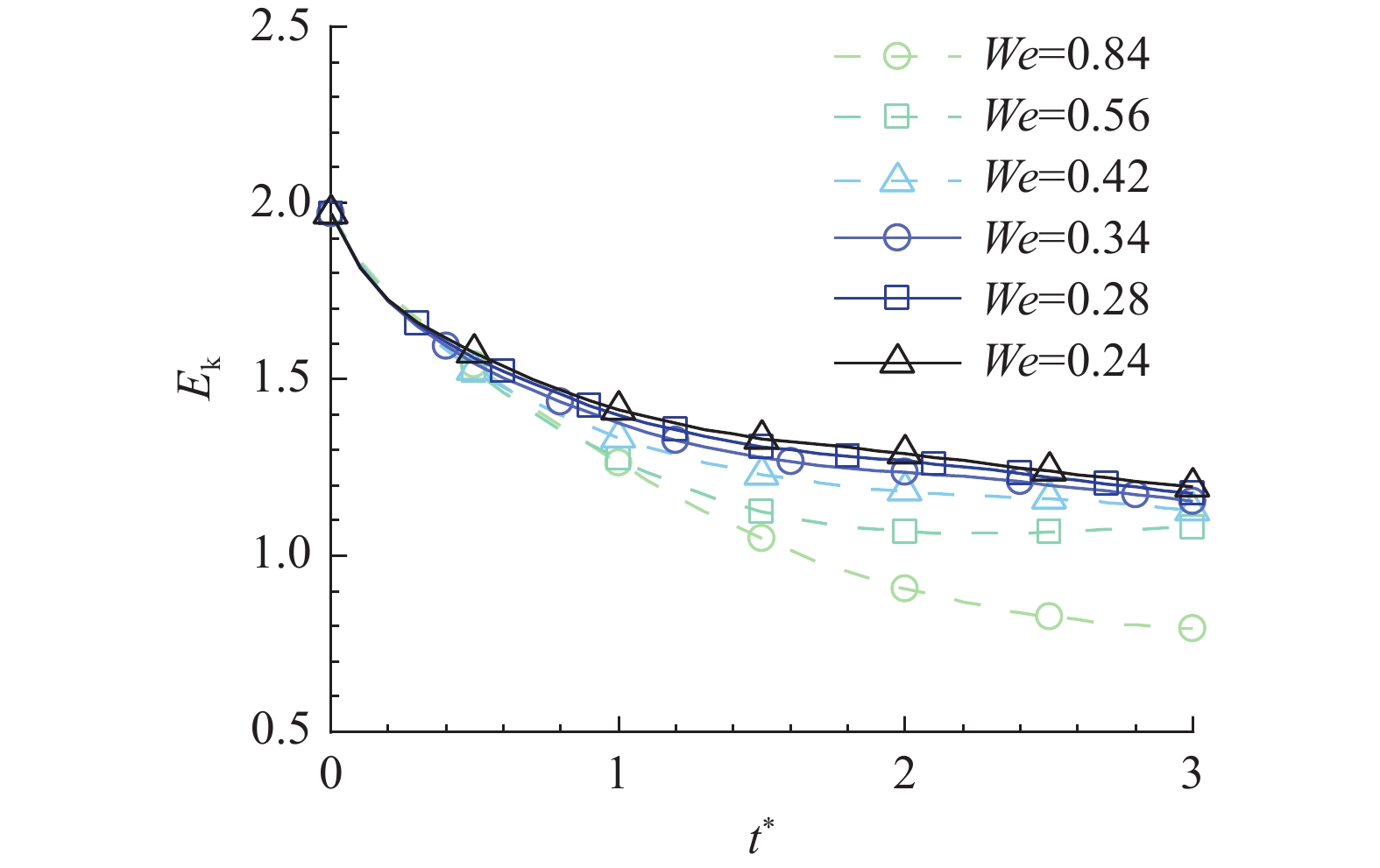
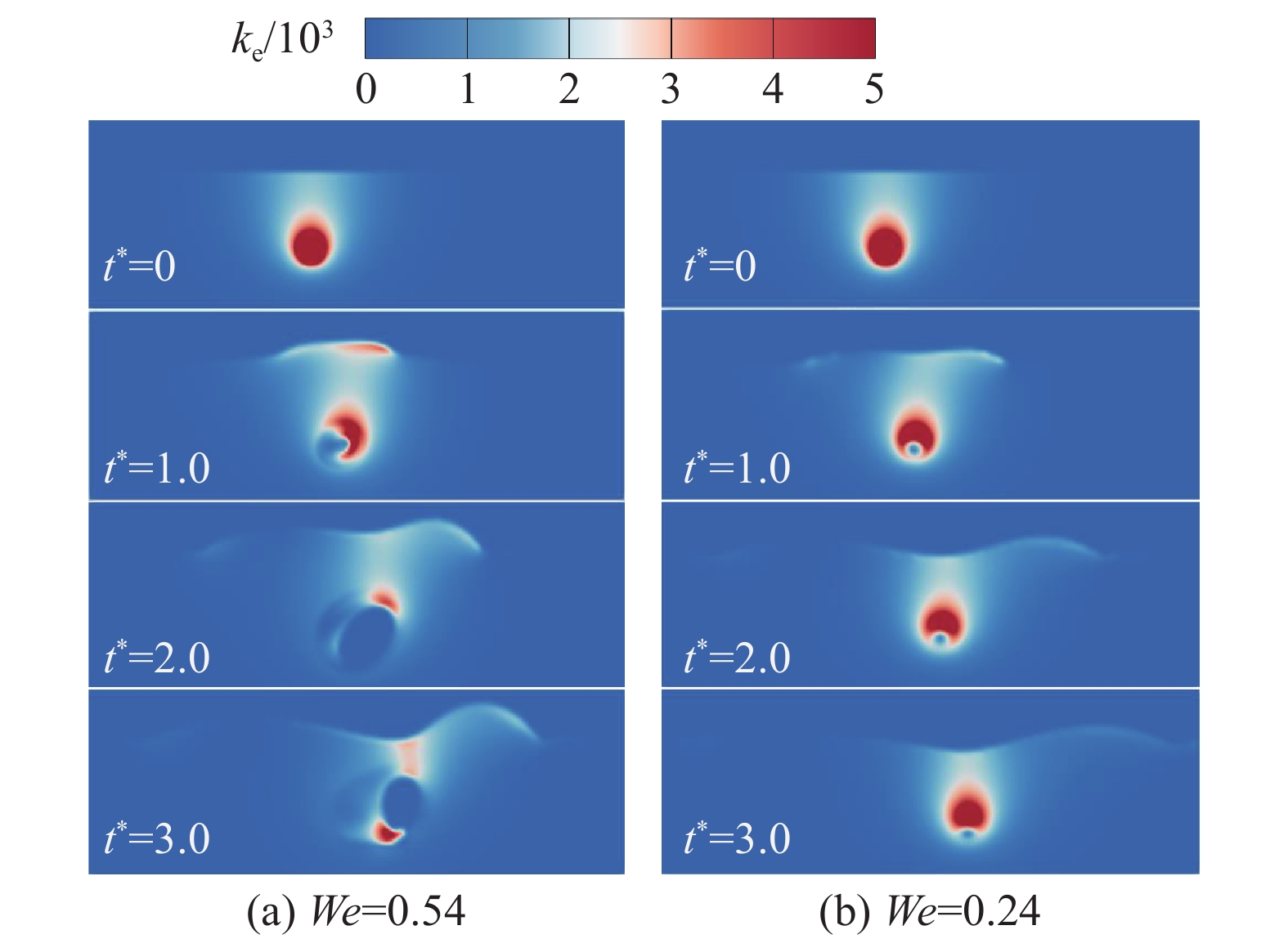
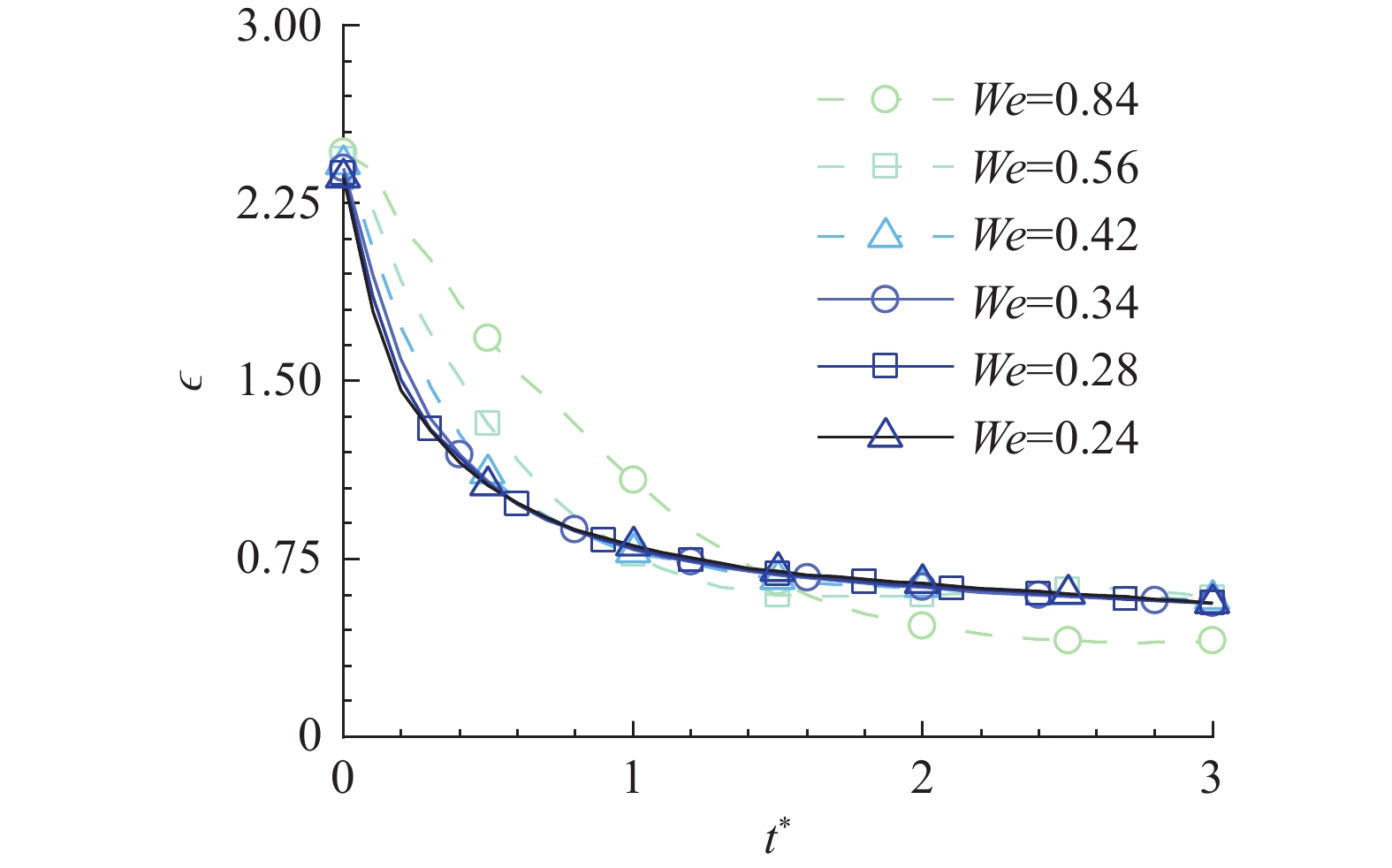
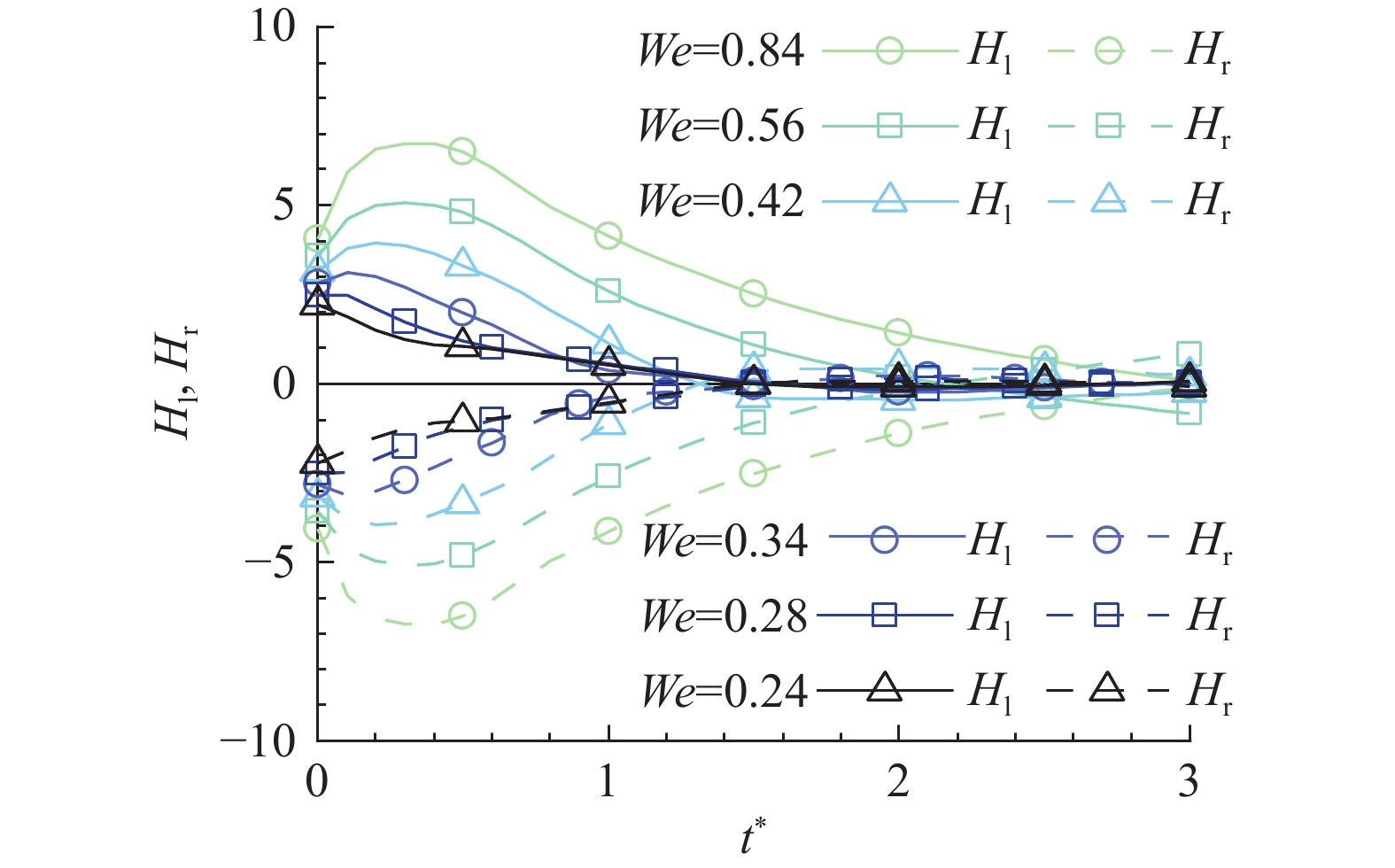
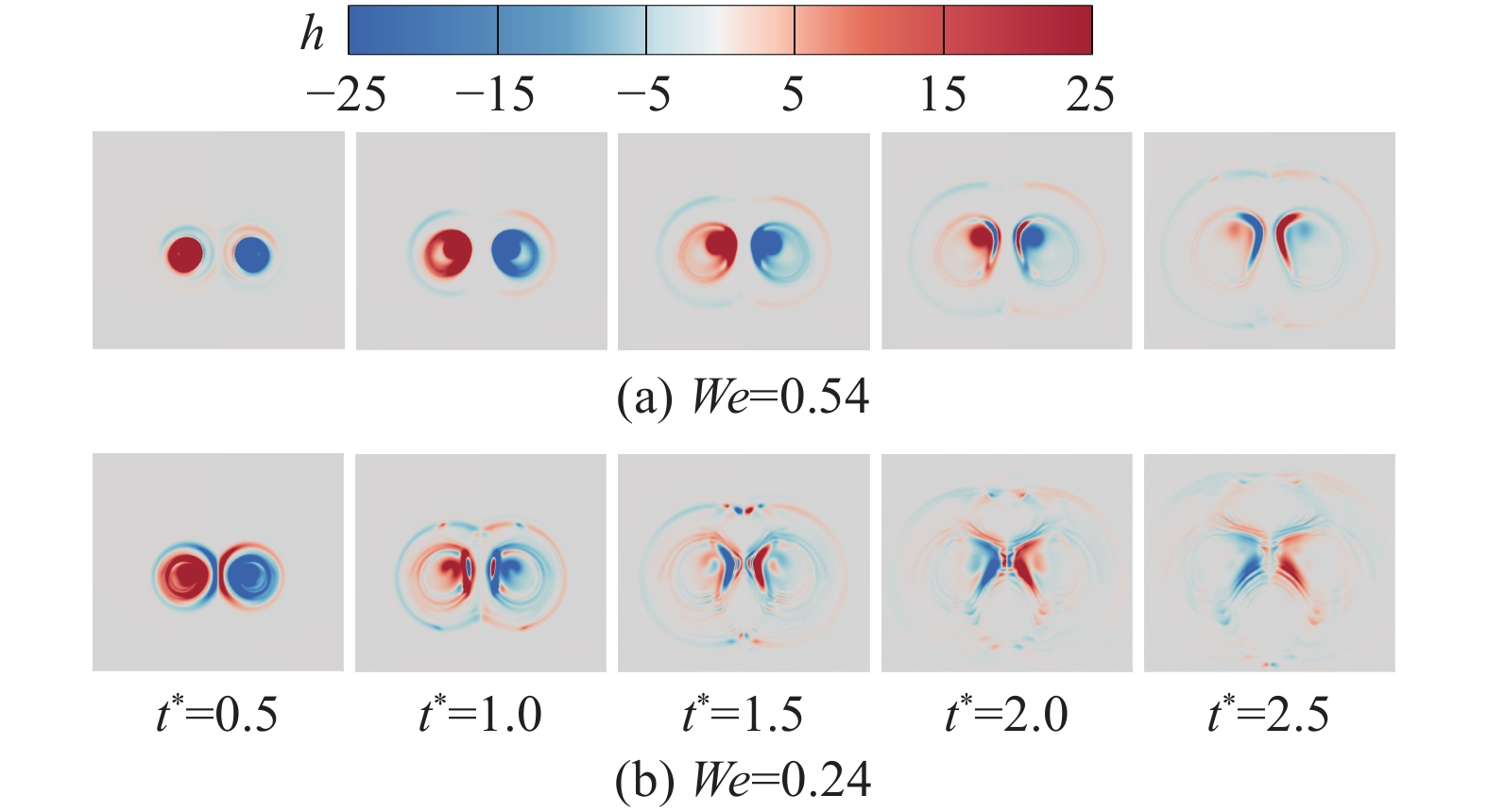
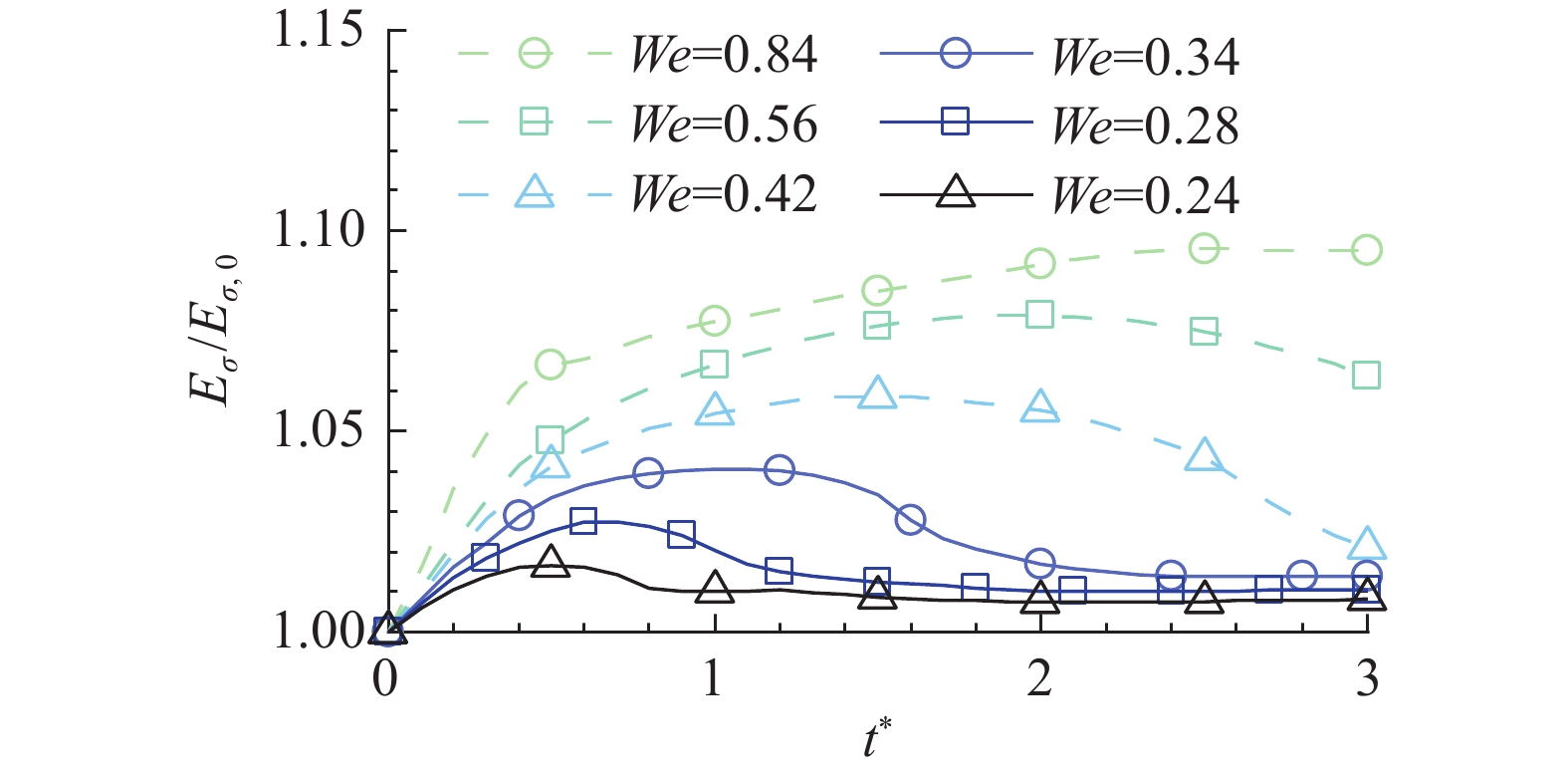
Abstract Direct numerical simulations were performed to investigate the interaction between a horseshoe vortex and a free surface at various Weber numbers. The incompressible Navier-Stokes equations were solved using the volume-of-fluid method coupled with the piecewise linear interface construction scheme. The continuum surface force model was incorporated to account for surface tension effects during interface deformation. The simulations covered a range of Weber numbers from 0.24 to 0.84. By quantitatively analyzing the evolution of total kinetic energy, dissipation rate, total helicity, and surface energy, the influence of Weber number on the vortex-interface interaction was elucidated. At low Weber numbers, surface tension dominated, maintaining the interface as a coherent ring-like structure and suppressing deformation and topological changes, while the vorticity field remained stable with negligible variations in helicity. Conversely, at high Weber numbers, inertial forces dominated over capillary effects, leading to significant interface deformation, breakup, and reconnection. This process resulted in vortex breakdown, accelerated kinetic energy decay, distinct peaks in energy dissipation, and a continuous decrease in helicity. These findings underscored the critical role of the Weber number in energy transfer and dissipation mechanisms, providing theoretical support for multiphase flow dynamics and guidelines for engineering applications such as the design of surface and trans-media vehicles.
|
|
Received: 31 December 2025
Published: 28 July 2026
|
|
|
| Fund: 国家自然科学基金资助项目(12302294, 12432010). |
|
Corresponding Authors:
Shiying XIONG
E-mail: zengweiyuan@zju.edu.cn;shiying.xiong@zju.edu.cn
|
不同韦伯数下马蹄涡与自由界面的相互作用
通过直接数值模拟研究不同韦伯数下马蹄涡与自由界面之间的相互作用. 采用分段线性界面重构方法结合体积分数法,求解不可压Navier-Stokes方程,并引入连续表面力模型,对韦伯数0.24~0.84范围内的流动过程进行模拟. 通过对流场中总动能、耗散率、总螺旋度及表面能的演化进行定量分析,揭示了韦伯数对涡环与自由界面相互作用的影响. 在低韦伯数情况下,表面张力占主导地位,相界面保持紧凑的环状结构,涡量场稳定且螺旋度几乎不变;在高韦伯数下,惯性力主导,界面经历显著的拉伸、断裂和重联过程,涡结构发生破碎,动能衰减加速,出现明显的能量耗散峰值,螺旋度持续减小. 研究结果揭示了韦伯数在涡环与界面作用的能量传递与耗散机制中具有重要作用,可为多相流界面动力学特性提供理论支撑,并为跨界面航行器设计这类工程应用提供指导.
关键词:
自由表面马蹄涡,
自由界面,
韦伯数,
涡动力学,
表面张力
|
|
| [21] |
ZHANG L, DENG J, SHAO X Modification of flow transition for a vortex ring by a bubble released at the axis[J]. Journal of Fluid Mechanics, 2023, 967: A28
doi: 10.1017/jfm.2023.517
|
|
|
| [22] |
ZHANG C, SHEN L, YUE D K P The mechanism of vortex connection at a free surface[J]. Journal of Fluid Mechanics, 1999, 384: 207- 241
doi: 10.1017/s0022112099004243
|
|
|
| [23] |
TERRINGTON S J, HOURIGAN K, THOMPSON M C Vortex ring connection to a free surface[J]. Journal of Fluid Mechanics, 2022, 944: A56
doi: 10.1017/jfm.2022.529
|
|
|
| [24] |
ZHANG T, ZHANG A M, ZHANG S, et al Free-surface jetting driven by a cavitating vortex ring[J]. Journal of Fluid Mechanics, 2025, 1003: A4
doi: 10.1017/jfm.2024.1209
|
|
|
| [25] |
YOUNGS D L. Time-dependent multi-material flow with large fluid distortion [D]. New York: Academic Press, 1982: 273–285.
|
|
|
| [26] |
BRACKBILL J U, KOTHE D B, ZEMACH C A continuum method for modeling surface tension[J]. Journal of Computational Physics, 1992, 100 (2): 335- 354
doi: 10.1016/0021-9991(92)90240-Y
|
|
|
| [27] |
CHORIN A J Numerical solution of the navier-stokes equations[J]. Mathematics of Computation, 1968, 22 (104): 745- 762
doi: 10.1090/S0025-5718-1968-0242392-2
|
|
|
| [28] |
HAIRER E, NØRSETT S P, WANNER G. Solving ordinary differential equations I: nonstiff problems [M]. 2nd ed. Berlin: Springer-Verlag, 1993.
|
|
|
| [29] |
RUDMAN M Volume-tracking methods for interfacial flow calculations[J]. International Journal for Numerical Methods in Fluids, 1997, 24 (7): 671- 691
doi: 10.1002/(SICI)1097-0363(19970415)24:7<671::AID-FLD508>3.0.CO;2-9
|
|
|
| [30] |
RUDMAN M A volume-tracking method for incompressible multifluid flows with large density variations[J]. International Journal for Numerical Methods in Fluids, 1998, 28 (2): 357- 378
doi: 10.1002/(SICI)1097-0363(19980815)28:2<357::AID-FLD750>3.0.CO;2-D
|
|
|
| [31] |
GUEYFFIER D, LI J, NADIM A, et al Volume-of-fluid interface tracking with smoothed surface stress methods for three-dimensional flows[J]. Journal of Computational Physics, 1999, 152 (2): 423- 456
doi: 10.1006/jcph.1998.6168
|
|
|
| [32] |
SPRITTLES J E, SHIKHMURZAEV Y D Coalescence of liquid drops: different models versus experiment[J]. Physics of Fluids, 2012, 24 (12): 122105
doi: 10.1063/1.4773067
|
|
|
| [1] |
HU D L, CHAN B, BUSH J W M The hydrodynamics of water strider locomotion[J]. Nature, 2003, 424 (6949): 663- 666
doi: 10.1038/nature01793
|
|
|
| [2] |
WALKER D T, CHEN C Y, WILLMARTH W W Turbulent structure in free-surface jet flows[J]. Journal of Fluid Mechanics, 1995, 291: 223- 261
doi: 10.1017/S0022112095002680
|
|
|
| [3] |
DICKINSON M How to walk on water[J]. Nature, 2003, 424 (6949): 621- 622
doi: 10.1038/424621a
|
|
|
| [4] |
DENNY M W. Air and water [M]. Chichester, Princeton: Princeton University Press, 1993.
|
|
|
| [5] |
SUTER R, ROSENBERG O, LOEB S, et al Locomotion on the water surface: propulsive mechanisms of the fisher spider[J]. The Journal of Experimental Biology, 1997, 200: 2523- 2538
doi: 10.1242/jeb.200.19.2523
|
|
|
| [6] |
HU D L, BUSH J W M The hydrodynamics of water-walking arthropods[J]. Journal of Fluid Mechanics, 2010, 644: 5- 33
doi: 10.1017/S0022112009992205
|
|
|
| [7] |
SARPKAYA T Vorticity, free surface, and surfactants[J]. Annual Review of Fluid Mechanics, 1996, 28: 83- 128
doi: 10.1146/annurev.fl.28.010196.000503
|
|
|
| [8] |
张霄月, 杨帆, 郭雪岩 自由表面涡流动现象的数值模拟[J]. 能源研究与信息, 2018, 34 (1): 43- 50
ZHANG Xiaoyue, YANG Fan, GUO Xueyan Numerical simulation of free surface vortex flow phenomenon[J]. Energy Research and Information, 2018, 34 (1): 43- 50
doi: 10.13259/j.cnki.eri.2018.01.008
|
|
|
| [9] |
HERLINA H, WISSINK J G Simulation of air-water interfacial mass transfer driven by high-intensity isotropic turbulence[J]. Journal of Fluid Mechanics, 2019, 860: 419- 440
doi: 10.1017/jfm.2018.884
|
|
|
| [10] |
XIONG S, WANG Z, WANG M, et al A Clebsch method for free-surface vortical flow simulation[J]. ACM Transactions on Graphics, 2022, 41 (4): 1- 13
doi: 10.1145/3528223.3530150
|
|
|
| [11] |
XIONG S, YANG Y Construction of knotted vortex tubes with the writhe-dependent helicity[J]. Physics of Fluids, 2019, 31 (4): 047101
doi: 10.1063/1.5088015
|
|
|
| [12] |
陈红勋, 郭加宏, 胡雷, 等 吸水口前自由表面旋涡的LBM模拟[J]. 水动力学研究与进展A辑, 2010, 25 (5): 676- 682
CHEN Hongxun, GUO Jiahong, HU Lei, et al LBM simulation of free surface vortex in front of suction inlet[J]. Journal of Hydrodynamics, 2010, 25 (5): 676- 682
doi: 10.3969/j.issn.1000-4874.2010.05.014
|
|
|
| [13] |
GHARIB M, WEIGAND A Experimental studies of vortex disconnection and connection at a free surface[J]. Journal of Fluid Mechanics, 1996, 321: 59- 86
doi: 10.1017/S0022112096007641
|
|
|
| [14] |
JI C, LIN F Y, ZOU J Experimental investigation of vortex-ring cavitation[J]. Journal of Zhejiang University: Science A, 2017, 18 (7): 545- 552
doi: 10.1631/jzus.A1600537
|
|
|
| [15] |
GU M, TANG S, WANG N Experimental study on gas entrainment caused by free surface vortices in residual heat removal systems[J]. Progress in Nuclear Energy, 2025, 185: 105773
doi: 10.1016/j.pnucene.2025.105773
|
|
|
| [16] |
MONDAL R K, ROHILLA L, KUMAR P Free surface vortex and associated air entrainment during liquid drainage using two outlets[J]. Experimental Thermal and Fluid Science, 2025, 160: 111314
doi: 10.1016/j.expthermflusci.2024.111314
|
|
|
| [17] |
POLAT C, SAYDAM D B, SOYLER M, et al Horseshoe vortex formation around a rotationally oscillating cylinder: experimental investigation with PIV[J]. Ocean Engineering, 2025, 336: 121666
doi: 10.1016/j.oceaneng.2025.121666
|
|
|
| [18] |
ZHANG B, MA L, CHENG L, et al Characterization of free-surface vortex evolution and its impact on hydraulic stability of the pump sump[J]. Experimental Thermal and Fluid Science, 2025, 166: 111466
doi: 10.1016/j.expthermflusci.2025.111466
|
|
|
| [19] |
SUERICH-GULICK F, GASKIN S J, VILLENEUVE M, et al Free surface intake vortices: scale effects due to surface tension and viscosity[J]. Journal of Hydraulic Research, 2014, 52 (4): 513- 522
doi: 10.1080/00221686.2014.905503
|
|
|
| [20] |
BANDYOPADHYAY P R Vortex bursting near a free surface[J]. Journal of Fluid Mechanics, 2020, 888: A27
doi: 10.1017/jfm.2019.1075
|
|
|
|
Viewed |
|
|
|
Full text
|
|
|
|
|
Abstract
|
|
|
|
|
Cited |
|
|
|
|
| |
Shared |
|
|
|
|
| |
Discussed |
|
|
|
|