|
|
|
| Global learning-expanded visible-infrared person re-identification |
Ziqiang GUO1( ),Xuan XIAO1,Haoran TAO1,Shaorong WANG1,2,*() ),Xuan XIAO1,Haoran TAO1,Shaorong WANG1,2,*() |
1. School of Information Science and Technology, Beijing Forest University, Beijing 100083, China
2. Engineering Research Center for Forestry-oriented Intelligent Information Processing of National Forestry and Grassland Administration, Beijing 100083, China |
|
|
|
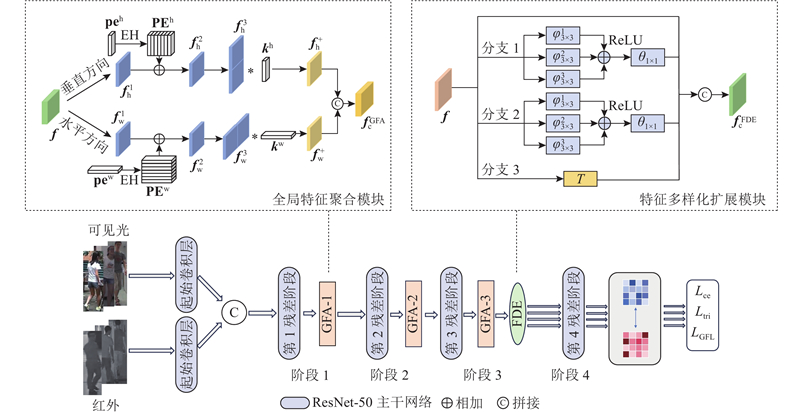
Abstract In visible-infrared person re-identification, the limited number of training samples and the significant discrepancy between visible and infrared images pose key challenges in mining diverse cross-modal information and achieving feature alignment. An embedding enhancement network based on global learning expansion was proposed to address the challenges, which effectively integrated the strengths of both vision Transformer and CNN to jointly capture local details and global structural information from images. By generating diversified embedding features and introducing the feature map structural alignment mechanism, the model’s ability to model global structures was further enhanced and the modality gap between visible and infrared images was reduced, thereby enabling more comprehensive and discriminative feature representations to be learned. Experimental results demonstrated that, compared to the baseline model DEEN, the proposed method achieved improvements of 4.2 and 9.1 percentage points in Rank-1 accuracy under the full-search mode of the SYSU-MM01 dataset and the visible-light-to-infrared retrieval mode of the LLCM dataset, respectively. By aggregating global spatial information, the proposed method generated more discriminative feature embeddings, significantly boosting the network performance.
|
|
Received: 15 July 2025
Published: 16 July 2026
|
|
|
|
Corresponding Authors:
Shaorong WANG
E-mail: ZQGuo@bjfu.edu.cn;shaorongwang@hotmail.com
|
全局学习扩展的可见光-红外行人重识别
在可见光-红外行人重识别任务中,由于训练样本有限,且可见光与红外图像之间存在较大差异,如何挖掘多样化的跨模态信息并实现特征对齐是该任务的关键挑战. 为此,提出全局学习扩展的嵌入增强网络,有效融合视觉变换器与卷积神经网络的优势,协同捕获图像的局部细节与全局结构信息. 通过生成多样化的嵌入特征,引入特征图结构对齐机制,进一步增强模型对全局结构的建模能力,减小可见光与红外图像之间的模态差异,从而学习到更加丰富且判别性强的特征表示. 实验结果表明,相较于基线模型DEEN,所提方法在SYSU-MM01数据集的全搜索模式和LLCM数据集的可见光检索红外模式下的Rank-1准确率分别提高了4.2和9.1个百分点. 该方法通过聚合全局空间信息,生成了更具判别性的特征嵌入,显著增强了网络性能.
关键词:
可见光-红外行人重识别,
跨模态检索,
全局特征,
特征对齐,
嵌入增强
|
|
| [1] |
ZHENG Y, TANG S, TENG G, et al. Online pseudo label generation by hierarchical cluster dynamics for adaptive person re-identification [C]// Proceedings of the IEEE/CVF International Conference on Computer Vision. Montreal: IEEE, 2021: 8351–8361.
|
|
|
| [2] |
PU N, CHEN W, LIU Y, et al. Lifelong person re-identification via adaptive knowledge accumulation [C]// Proceedings of the IEEE/CVF Conference on Computer Vision and Pattern Recognition. Nashville: IEEE, 2021: 7897–7906.
|
|
|
| [3] |
TAN L, DAI P, JI R, et al. Dynamic prototype mask for occluded person re-identification [C]// Proceedings of the 30th ACM International Conference on Multimedia. Lisboa: ACM, 2022: 531–540.
|
|
|
| [4] |
LIU J, SUN Y, ZHU F, et al. Learning memory-augmented unidirectional metrics for cross-modality person re-identification [C]// Proceedings of the IEEE/CVF Conference on Computer Vision and Pattern Recognition. New Orleans: IEEE, 2022: 19344–19353.
|
|
|
| [5] |
YANG B, YE M, CHEN J, et al. Augmented dual-contrastive aggregation learning for unsupervised visible-infrared person re-identification [C]// Proceedings of the 30th ACM International Conference on Multimedia. Lisboa: ACM, 2022: 2843–2851.
|
|
|
| [6] |
WEI X, LI D, HONG X, et al. Co-attentive lifting for infrared-visible person re-identification [C]// Proceedings of the 28th ACM International Conference on Multimedia. Seattle: ACM, 2020: 1028–1037.
|
|
|
| [7] |
YE M, SHEN J, LIN G, et al Deep learning for person re-identification: a survey and outlook[J]. IEEE Transactions on Pattern Analysis and Machine Intelligence, 2022, 44 (6): 2872- 2893
doi: 10.1109/TPAMI.2021.3054775
|
|
|
| [8] |
REN M, HE L, LIAO X, et al. Learning instance-level spatial-temporal patterns for person re-identification [C]// Proceedings of the IEEE/CVF International Conference on Computer Vision. Montreal: IEEE, 2021: 14910–14919.
|
|
|
| [9] |
SUN Y, ZHENG L, YANG Y, et al. Beyond part models: person retrieval with refined part pooling (and a strong convolutional baseline) [C]// Proceedings of the European Conference on Computer Vision. Munich: Springer, 2018: 501–518.
|
|
|
| [10] |
HE S, LUO H, WANG P, et al. TransReID: Transformer-based object re-identification [C]// Proceedings of the IEEE/CVF International Conference on Computer Vision. Montreal: IEEE, 2021: 14993–15002.
|
|
|
| [11] |
ZHANG L, LIU Z, ZHANG W, et al Style uncertainty based self-paced meta learning for generalizable person re-identification[J]. IEEE Transactions on Image Processing, 2023, 32: 2107- 2119
doi: 10.1109/TIP.2023.3263112
|
|
|
| [12] |
FU X, HUANG F, ZHOU Y, et al Cross-modal cross-domain dual alignment network for RGB-infrared person re-identification[J]. IEEE Transactions on Circuits and Systems for Video Technology, 2022, 32 (10): 6874- 6887
doi: 10.1109/TCSVT.2022.3173263
|
|
|
| [13] |
LIANG W, WANG G, LAI J, et al Homogeneous-to-heterogeneous: unsupervised learning for RGB-infrared person re-identification[J]. IEEE Transactions on Image Processing, 2021, 30: 6392- 6407
doi: 10.1109/TIP.2021.3092578
|
|
|
| [14] |
WU A, ZHENG W S, YU H X, et al. RGB-infrared cross-modality person re-identification [C]// Proceedings of the IEEE International Conference on Computer Vision. Venice: IEEE, 2017: 5390–5399.
|
|
|
| [15] |
YE M, SHEN J, CRANDALL D J, et al. Dynamic dual-attentive aggregation learning for visible-infrared person re-identification [C]// Proceedings of the European Conference on Computer Vision. Glasgow: Springer, 2020: 229–247.
|
|
|
| [16] |
ZHANG Y, WANG H. Diverse embedding expansion network and low-light cross-modality benchmark for visible-infrared person re-identification [C]// Proceedings of the IEEE/CVF Conference on Computer Vision and Pattern Recognition. Vancouver: IEEE, 2023: 2153–2162.
|
|
|
| [17] |
KIM M, KIM S, PARK J, et al. PartMix: regularization strategy to learn part discovery for visible-infrared person re-identification [C]// Proceedings of the IEEE/CVF Conference on Computer Vision and Pattern Recognition. Vancouver: IEEE, 2023: 18621–18632.
|
|
|
| [18] |
REN K, ZHANG L. Implicit discriminative knowledge learning for visible-infrared person re-identification [C]// Proceedings of the IEEE/CVF Conference on Computer Vision and Pattern Recognition. Seattle: IEEE, 2024: 393–402.
|
|
|
| [19] |
YANG B, CHEN J, YE M. Top-K visual tokens Transformer: selecting tokens for visible-infrared person re-identification [C]// Proceedings of the IEEE International Conference on Acoustics, Speech and Signal Processing. Rhodes Island: IEEE, 2023: 1–5.
|
|
|
| [20] |
CHEN C, YE M, QI M, et al Structure-aware positional Transformer for visible-infrared person re-identification[J]. IEEE Transactions on Image Processing, 2022, 31: 2352- 2364
doi: 10.1109/TIP.2022.3141868
|
|
|
| [21] |
JIANG K, ZHANG T, LIU X, et al. Cross-modality Transformer for visible-infrared person re-identification [C]// Proceedings of the European Conference on Computer Vision. Tel Aviv: Springer, 2022: 480–496.
|
|
|
| [22] |
ZHAO J, WANG H, ZHOU Y, et al Spatial-channel enhanced Transformer for visible-infrared person re-identification[J]. IEEE Transactions on Multimedia, 2023, 25: 3668- 3680
doi: 10.1109/TMM.2022.3163847
|
|
|
| [23] |
ZHANG H, HU W, WANG X. ParC-Net: position aware circular convolution with merits from ConvNets and Transformer [C]// Proceedings of the European Conference on Computer Vision. Tel Aviv: Springer, 2022: 613–630.
|
|
|
| [24] |
CHEN Y, DAI X, CHEN D, et al. Mobile-former: bridging MobileNet and Transformer [C]// Proceedings of the IEEE/CVF Conference on Computer Vision and Pattern Recognition. New Orleans: IEEE, 2022: 5260–5269.
|
|
|
| [25] |
HE K, ZHANG X, REN S, et al. Deep residual learning for image recognition [C]// Proceedings of the IEEE Conference on Computer Vision and Pattern Recognition. Las Vegas: IEEE, 2016: 770–778.
|
|
|
| [26] |
LI X, LU Y, LIU B, et al. Counterfactual intervention feature transfer for visible-infrared person re-identification [C]// Proceedings of the European Conference on Computer Vision. Tel Aviv: Springer, 2022: 381–398.
|
|
|
| [27] |
LUO H, GU Y, LIAO X, et al. Bag of tricks and a strong baseline for deep person re-identification [C]// Proceedings of the IEEE/CVF Conference on Computer Vision and Pattern Recognition Workshops. Long Beach: IEEE, 2019: 1487–1495.
|
|
|
| [28] |
HERMANS A, BEYER L, LEIBE B. In defense of the triplet loss for person re-identification [EB/OL]. (2017–11–21) [2024–10–25]. https://arxiv.org/abs/1703.07737.
|
|
|
| [29] |
ZHONG Z, ZHENG L, KANG G, et al Random erasing data augmentation[J]. Proceedings of the AAAI Conference on Artificial Intelligence, 2020, 34 (7): 13001- 13008
doi: 10.1609/aaai.v34i07.7000
|
|
|
| [30] |
YANG M, HUANG Z, HU P, et al. Learning with twin noisy labels for visible-infrared person re-identification [C]// Proceedings of the IEEE/CVF Conference on Computer Vision and Pattern Recognition. New Orleans: IEEE, 2022: 14288–14297.
|
|
|
| [31] |
YE M, RUAN W, DU B, et al. Channel augmented joint learning for visible-infrared recognition [C]// Proceedings of the IEEE/CVF International Conference on Computer Vision. Montreal: IEEE, 2021: 13547–13556.
|
|
|
| [32] |
WU Q, DAI P, CHEN J, et al. Discover cross-modality nuances for visible-infrared person re-identification [C]// Proceedings of the IEEE/CVF Conference on Computer Vision and Pattern Recognition. Nashville: IEEE, 2021: 4328–4337.
|
|
|
| [33] |
ZHANG Y, YAN Y, LU Y, et al. Towards a unified middle modality learning for visible-infrared person re-identification [C]// Proceedings of the 29th ACM International Conference on Multimedia. [S.l.]: ACM, 2021: 788–796.
|
|
|
| [34] |
SUN H, LIU J, ZHANG Z, et al. Not all pixels are matched: dense contrastive learning for cross-modality person re-identification [C]// Proceedings of the 30th ACM International Conference on Multimedia. Lisboa: ACM, 2022: 5333–5341.
|
|
|
| [35] |
QIU L, CHEN S, YAN Y, et al High-order structure based middle-feature learning for visible-infrared person re-identification[J]. Proceedings of the AAAI Conference on Artificial Intelligence, 2024, 38 (5): 4596- 4604
doi: 10.1609/aaai.v38i5.28259
|
|
|
| [36] |
FANG X, YANG Y, FU Y. Visible-infrared person re-identification via semantic alignment and affinity inference [C]// Proceedings of the IEEE/CVF International Conference on Computer Vision. Paris: IEEE, 2023: 11236–11245.
|
|
|
| [37] |
YU H, CHENG X, PENG W, et al. Modality unifying network for visible-infrared person re-identification [C]// Proceedings of the IEEE/CVF International Conference on Computer Vision. Paris: IEEE, 2023: 11151–11161.
|
|
|
| [38] |
ZHANG Y, ZHAO S, KANG Y, et al. Modality synergy complement learning with cascaded aggregation for visible-infrared person re-identification [C]// Proceedings of the European Conference on Computer Vision. Tel Aviv: Springer, 2022: 462–479.
|
|
|
| [39] |
PARK H, LEE S, LEE J, et al. Learning by aligning: visible-infrared person re-identification using cross-modal correspondences [C]// Proceedings of the IEEE/CVF International Conference on Computer Vision. Montreal: IEEE, 2021: 12026–12035.
|
|
|
|
Viewed |
|
|
|
Full text
|
|
|
|
|
Abstract
|
|
|
|
|
Cited |
|
|
|
|
| |
Shared |
|
|
|
|
| |
Discussed |
|
|
|
|